Opportunity to respond to jurisdictional reports is mandatory before customs settlement duty enhancement; connected applications require consistent ad...
Specific customs headings for scaffolding components prevail over general classification, invalidating misclassification proceedings and enabling with...
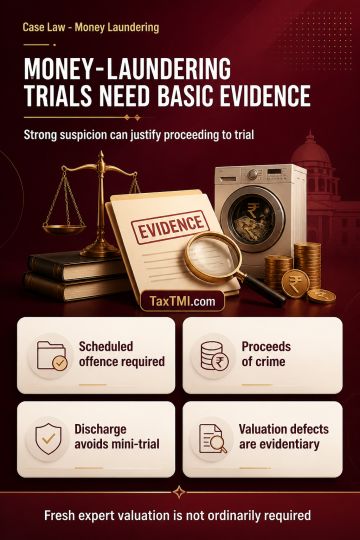
Money-laundering prosecution is described as requiring a scheduled offence, proceeds of crime generated from that offence, and their projection as untainted, including knowing assistance in related processes. Challenges to investigation or discharge grounds in predicate offences are presented as outside the scope of the money-laundering proceeding. The notes explain that discharge requires assessment of a prima facie case and that strong suspicion may justify trial without a mini-trial. They also state that alleged defects in an authorised valuation report are evidentiary matters, and fresh expert valuation is not ordinarily required; loss quantification mainly concerns the predicate offence.
Money-laundering prosecution is described as requiring a scheduled offence, proceeds of crime generated from that offence, and their projection as untainted, including knowing assistance in related processes. Challenges to investigation or discharge grounds in predicate offences are presented as outside the scope of the money-laundering proceeding. The notes explain that discharge requires assessment of a prima facie case and that strong suspicion may justify trial without a mini-trial. They also state that alleged defects in an authorised valuation report are evidentiary matters, and fresh expert valuation is not ordinarily required; loss quantification mainly concerns the predicate offence.
Note: It is a system-generated summary and is for quick reference only.
 TaxTMI
 of 4782






















 Join Channel


 TaxTMI