Business expenditure deduction requires proof of genuine commission payments and commercial allowability; turnover growth alone cannot validate the cl...
Article 8 treaty coverage excluded third-party airline support services, while documented demonetisation cash receipts remained accepted business inco...
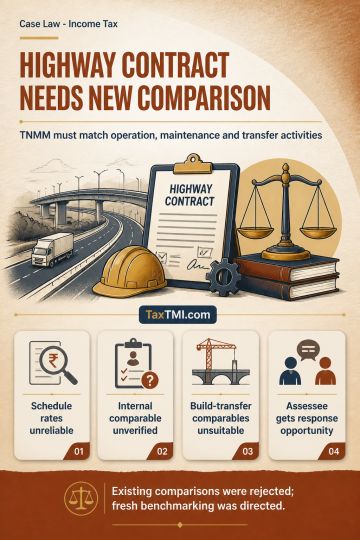
Functional comparability under TNMM requires highway contract benchmarks to reflect operation, maintenance and transfer activities, requiring fresh be...
Page of 4786
Press 'Enter' after typing page number.
241 to 260 of 95715 Results
❮
❯
❯❯
0 / 200
Expand Note
Add to Folder
No Folders have been created
+
Are you sure you want to delete "My most important" ?
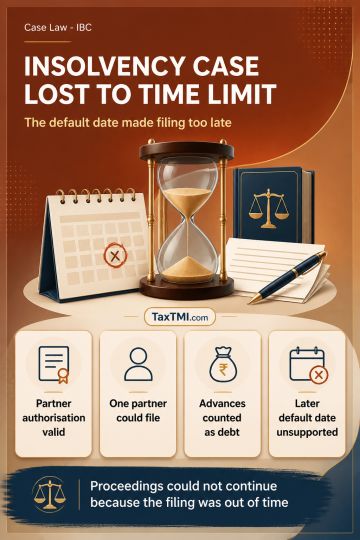
A Section 7 insolvency application was treated as time-barred because the record supported 31 March 2019 as the nearest ascertainable date of default, while a later date asserted by affidavit lacked evidentiary basis. The limitation period had therefore expired before the demand notice and filing, rendering the application not maintainable. The notes also state that a surviving-partner majority could authorise commencement of insolvency proceedings and that one partner could file in the firm's name. Advances recorded as repayable in balance sheets and ledgers constituted financial debt, even without a formal loan agreement or interest payment.
A Section 7 insolvency application was treated as time-barred because the record supported 31 March 2019 as the nearest ascertainable date of default, while a later date asserted by affidavit lacked evidentiary basis. The limitation period had therefore expired before the demand notice and filing, rendering the application not maintainable. The notes also state that a surviving-partner majority could authorise commencement of insolvency proceedings and that one partner could file in the firm's name. Advances recorded as repayable in balance sheets and ledgers constituted financial debt, even without a formal loan agreement or interest payment.
Note: It is a system-generated summary and is for quick reference only.
 TaxTMI
 of 4786










 Join Channel


 TaxTMI