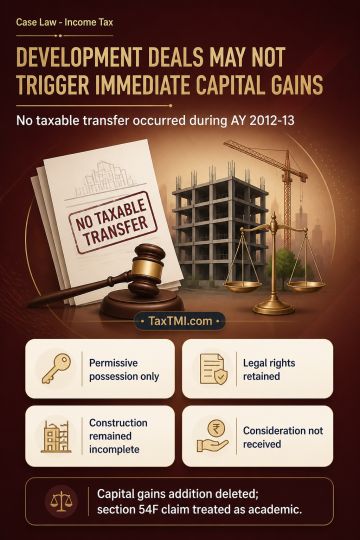
Development agreements require legal possession or effective enjoyment for capital gains transfer; permissive possession and deferred consideration de...
Prolonged sterilisation of development rights supports capital-gains treatment, while business-income disallowances cannot govern capital-gains comput...
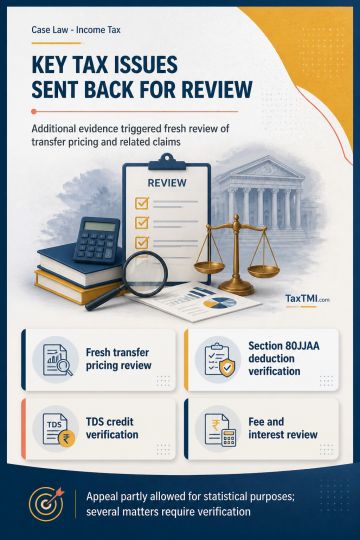
Additional evidence in transfer pricing dispute leads to fresh examination, while tax deductions, TDS credit, fee and refund interest require verifica...
Category II AIF pass-through taxation preserves non-business income character; investment receipts cannot be reclassified without applying recognised ...
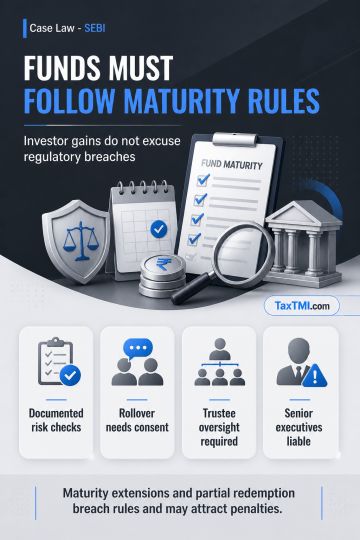
Mutual fund maturity rules require proper rollover, redemption, disclosure, and due diligence; investor gains cannot excuse regulatory breaches or pen...
Disciplinary action against an insolvency professional requires...
Disciplinary Committee jurisdiction and mandatory investigation requirements invalidated cancellation of an insolvency professional's registration and related show-cause notice.
Contents
Summary
Note
Bookmark
Share
✓ Copied successfully !
Print
Print Options
For full text, please login
Login to TaxTMI
Verification Pending
The Email Id has not been verified. Click on the link we have sent on
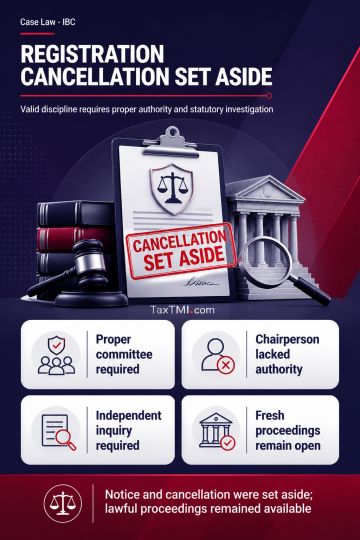
Disciplinary action against an insolvency professional requires a properly constituted Disciplinary Committee and compliance with the statutory inspection or investigation process. The text explains that the Chairperson is distinct from a whole-time Board member and cannot personally exercise powers delegated to the Disciplinary Committee; a cancellation order issued in that capacity is void for lack of jurisdiction. It further states that adverse appellate tribunal observations cannot replace an independent inspection or investigation, particularly where an earlier inspection found no irregularity. The show-cause notice and cancellation were set aside, while fresh proceedings in accordance with law remained open.
Disciplinary action against an insolvency professional requires a properly constituted Disciplinary Committee and compliance with the statutory inspection or investigation process. The text explains that the Chairperson is distinct from a whole-time Board member and cannot personally exercise powers delegated to the Disciplinary Committee; a cancellation order issued in that capacity is void for lack of jurisdiction. It further states that adverse appellate tribunal observations cannot replace an independent inspection or investigation, particularly where an earlier inspection found no irregularity. The show-cause notice and cancellation were set aside, while fresh proceedings in accordance with law remained open.
Note: It is a system-generated summary and is for quick reference only.
 TaxTMI
 of 4782














 Join Channel


 TaxTMI