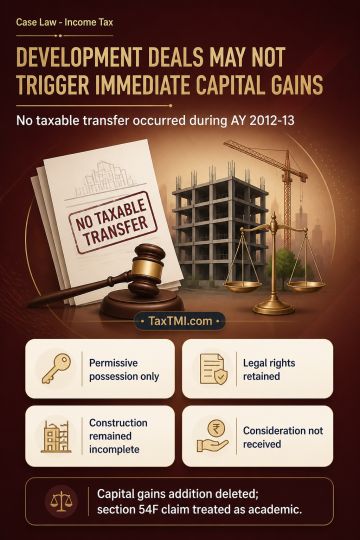
Development agreements require legal possession or effective enjoyment for capital gains transfer; permissive possession and deferred consideration de...
Prolonged sterilisation of development rights supports capital-gains treatment, while business-income disallowances cannot govern capital-gains comput...
Additional evidence in transfer pricing dispute leads to fresh examination, while tax deductions, TDS credit, fee and refund interest require verifica...
Category II AIF pass-through taxation preserves non-business income character; investment receipts cannot be reclassified without applying recognised ...
Mutual fund maturity rules require proper rollover, redemption, disclosure, and due diligence; investor gains cannot excuse regulatory breaches or pen...
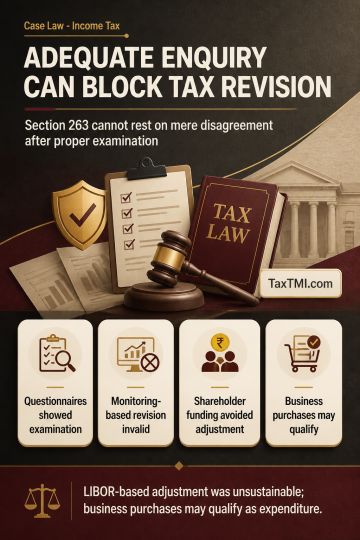
Section 263 revision requires both inadequate enquiry and an unsustainable Assessing Officer view; where questionnaires, replies, office notes and correspondence show that issues were examined, revision cannot rest on mere disagreement. The notes further state that revision initiated through monitoring, pressure or dictates of higher departmental authorities is invalid where the assessments followed adequate enquiry, while other grounds may remain open. An interest-free advance to a wholly owned overseas subsidiary may constitute quasi-equity or shareholder funding, rather than a loan intended to earn interest, where it supports expansion and returns are expected through the assessee's business; a LIBOR-based adjustment is therefore unsustainable. Purchases supported by commercial records and made for business purposes may qualify as commercially expedient expenditure despite expiry of a distributorship agreement.
Section 263 revision requires both inadequate enquiry and an unsustainable Assessing Officer view; where questionnaires, replies, office notes and correspondence show that issues were examined, revision cannot rest on mere disagreement. The notes further state that revision initiated through monitoring, pressure or dictates of higher departmental authorities is invalid where the assessments followed adequate enquiry, while other grounds may remain open. An interest-free advance to a wholly owned overseas subsidiary may constitute quasi-equity or shareholder funding, rather than a loan intended to earn interest, where it supports expansion and returns are expected through the assessee's business; a LIBOR-based adjustment is therefore unsustainable. Purchases supported by commercial records and made for business purposes may qualify as commercially expedient expenditure despite expiry of a distributorship agreement.
Note: It is a system-generated summary and is for quick reference only.
 TaxTMI
 of 4782


















 Join Channel


 TaxTMI

