Business expenditure deduction requires proof of genuine commission payments and commercial allowability; turnover growth alone cannot validate the cl...
Article 8 treaty coverage excluded third-party airline support services, while documented demonetisation cash receipts remained accepted business inco...
Functional comparability under TNMM requires highway contract benchmarks to reflect operation, maintenance and transfer activities, requiring fresh be...
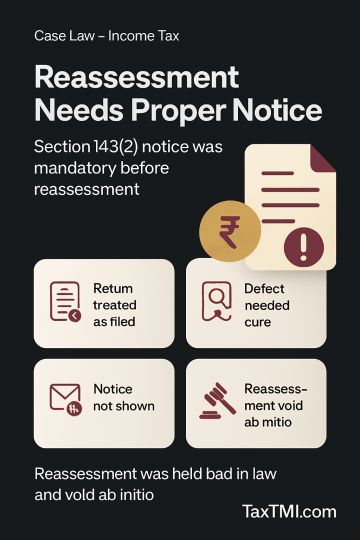
A return filed in response to notice under section 148 was treated as a return under section 139, and if it was defective for want of e-verification, the Assessing Officer had to intimate the defect and allow cure under section 139(9). Once the Assessing Officer acted on that return, issuance of notice under section 143(2) became mandatory before framing reassessment. As no such notice was shown, the Tribunal held the reassessment bad in law and void ab initio, following earlier Delhi High Court decisions.
A return filed in response to notice under section 148 was treated as a return under section 139, and if it was defective for want of e-verification, the Assessing Officer had to intimate the defect and allow cure under section 139(9). Once the Assessing Officer acted on that return, issuance of notice under section 143(2) became mandatory before framing reassessment. As no such notice was shown, the Tribunal held the reassessment bad in law and void ab initio, following earlier Delhi High Court decisions.
Note: It is a system-generated summary and is for quick reference only.
 TaxTMI
 of 4792
















 Join Channel


 TaxTMI
