Transaction value rejection requires reliable corroboration; refundable VAT is excluded and temporary registration does not defeat new-vehicle exempti...
Appellate jurisdiction remains available where a wrist-worn gold ornament cannot conclusively be characterised as imported baggage at the preliminary ...
Written complaint requirement bars cognizance on police reports for securities offences, while unsupported breach of trust and cheating allegations fa...
Risk-based postal import clearance standardises electronic assessment, document requests, duty realisation and delivery controls at Foreign Post Offic...
Page of 4794
Press 'Enter' after typing page number.
221 to 240 of 95875 Results
❮
❯
❯❯
0 / 200
Expand Note
Add to Folder
No Folders have been created
+
Are you sure you want to delete "My most important" ?
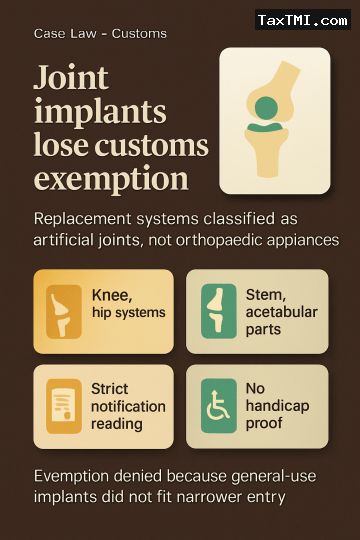
Complete knee, hip and shoulder replacement systems were classified as artificial joints, while separately imported stem and acetabular components were classified as other artificial parts of the body. The claim that they were orthopaedic appliances failed because Heading 9021 and the HSN distinguish support devices from replacement prostheses. Exemption under Sr. No. 385 of Notification No. 45/2025-Cus was denied: Entry B(1) applies only to orthopaedic appliances, and Entry E(9) requires implants for severely physically handicapped patients. The applicant did not show that these general-use implants met that narrower description, so strict construction of the exemption defeated the claim.
Complete knee, hip and shoulder replacement systems were classified as artificial joints, while separately imported stem and acetabular components were classified as other artificial parts of the body. The claim that they were orthopaedic appliances failed because Heading 9021 and the HSN distinguish support devices from replacement prostheses. Exemption under Sr. No. 385 of Notification No. 45/2025-Cus was denied: Entry B(1) applies only to orthopaedic appliances, and Entry E(9) requires implants for severely physically handicapped patients. The applicant did not show that these general-use implants met that narrower description, so strict construction of the exemption defeated the claim.
Note: It is a system-generated summary and is for quick reference only.
 TaxTMI
 of 4794











 Join Channel


 TaxTMI