Defined public benefit can retain charitable character; registration renewal requires examining genuine activities and legal compliance, not surplus a...
Capital reduction is distinct from share buy-back, preventing buy-back tax; restructuring interest and related business deductions also survive scruti...
Transfer pricing and tax deductions upheld on established principles, while employee contributions and warranty provisions returned for fresh examinat...
Captive transfer pricing relies on industrial consumer tariffs, while genuine quotations can benchmark effluent treatment transfers under the Other Me...
Specific tariff classification for ophthalmic instruments and extended limitation principles determine the treatment of duty demands, confiscation, an...
Integrated golf function determines classification, placing launch monitors and simulators under other golf equipment rather than measuring instrument...
Page of 4796
Press 'Enter' after typing page number.
1081 to 1100 of 95918 Results
❮
❯
❯❯
0 / 200
Expand Note
Add to Folder
No Folders have been created
+
Are you sure you want to delete "My most important" ?
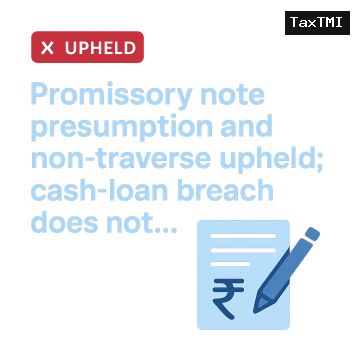
In a suit on a promissory note, the HC noted that untraversed pleadings and the absence of cross-examination meant the plaintiff's case on advance and execution stood admitted, and an adverse finding on lending capacity was perverse where the defendant filed no written statement and the court did not clarify its own doubts by questioning the witness. It further held that a promissory note need not be attested, non-examination of an attestor was not fatal, and breach of the cash-loan prohibition under section 269SS may attract tax consequences but does not make the debt void or unenforceable. The plaintiff's claim was therefore upheld.
In a suit on a promissory note, the HC noted that untraversed pleadings and the absence of cross-examination meant the plaintiff's case on advance and execution stood admitted, and an adverse finding on lending capacity was perverse where the defendant filed no written statement and the court did not clarify its own doubts by questioning the witness. It further held that a promissory note need not be attested, non-examination of an attestor was not fatal, and breach of the cash-loan prohibition under section 269SS may attract tax consequences but does not make the debt void or unenforceable. The plaintiff's claim was therefore upheld.
Note: It is a system-generated summary and is for quick reference only.
 TaxTMI
 of 4796

















 Join Channel


 TaxTMI