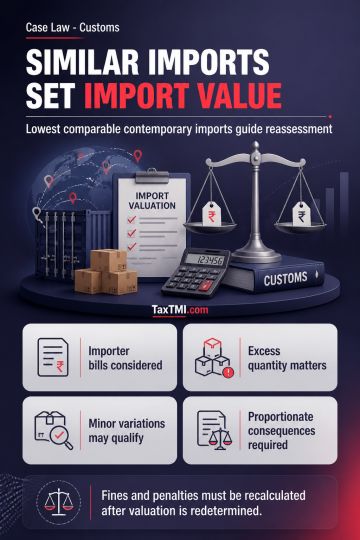
Customs valuation must use comparable contemporary imports, while confiscation fines and penalties require proportionate recalculation on reassessed v...
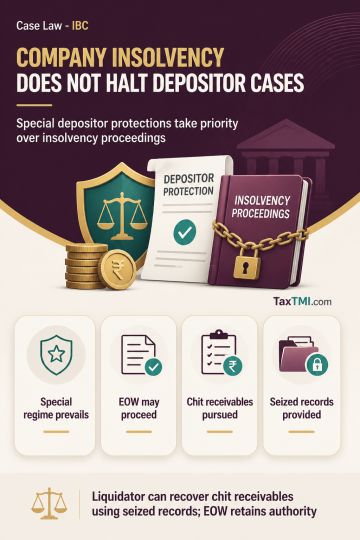
Depositor-protection proceedings prevail over corporate insolvency, while liquidators may recover chit receivables using copies of seized company reco...
Intermediary service classification fails where overseas admission facilitation is supplied independently, preserving export treatment and small-provi...
Satellite transponder bandwidth is telecommunication, not Business Support Service; foreign non-telegraph providers triggered no service tax liability...
Commitment proceedings gain extended timelines, structured defect refiling, and automatic resumption of inquiry after the adjusted completion period e...
Penalty under section 43 of the Black Money Act was treated as discretionary rather than automatic, and was deleted for a bona fide failure to disclose foreign ESOP shares in Schedule FA. The Tribunal accepted that the shares formed part of employment compensation, the related perquisite and later capital gains had already been taxed, and the only lapse was non-disclosure in the initial reporting year while the assets were held through a fiduciary structure. Applying the principles that a technical or inadvertent breach without deliberate concealment or guilty intent does not justify penalty, the Tribunal also followed prior ITAT and Supreme Court guidance. The jurisdictional challenge was left open as unnecessary.
Penalty under section 43 of the Black Money Act was treated as discretionary rather than automatic, and was deleted for a bona fide failure to disclose foreign ESOP shares in Schedule FA. The Tribunal accepted that the shares formed part of employment compensation, the related perquisite and later capital gains had already been taxed, and the only lapse was non-disclosure in the initial reporting year while the assets were held through a fiduciary structure. Applying the principles that a technical or inadvertent breach without deliberate concealment or guilty intent does not justify penalty, the Tribunal also followed prior ITAT and Supreme Court guidance. The jurisdictional challenge was left open as unnecessary.
Note: It is a system-generated summary and is for quick reference only.
 TaxTMI
  TaxTMI
 of 4809












 Join Channel