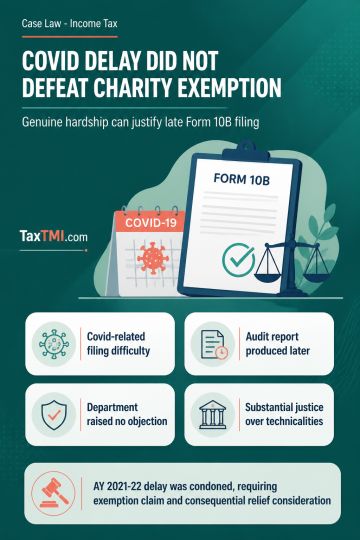
Belated Form 10B filing during Covid-19 cannot defeat charitable exemption where genuine hardship warrants condonation and substantial justice prevail...
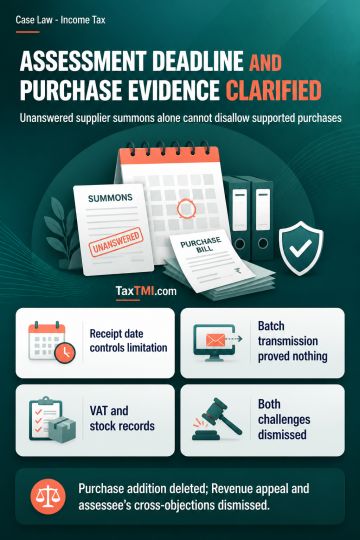
Limitation for consequential assessments runs from prescribed authority receipt, while verified purchases cannot be disallowed merely for unanswered s...
Higher depreciation for qualifying commercial vehicles, exempt-income disallowance, research deduction verification, and club-expense treatment clarif...
Charitable registration renewal cannot become an assessment of receipts, profitability or annual exemption compliance, requiring renewal and donation ...
AMP expenditure for own business is not an international transaction without an associated-enterprise arrangement, eliminating transfer pricing adjust...
Page of 4809
Press 'Enter' after typing page number.
141 to 160 of 96177 Results
❮
❯
❯❯
0 / 200
Expand Note
Add to Folder
No Folders have been created
+
Are you sure you want to delete "My most important" ?
Penalty under section 43 of the Black Money Act was treated as discretionary rather than automatic, and was deleted for a bona fide failure to disclose foreign ESOP shares in Schedule FA. The Tribunal accepted that the shares formed part of employment compensation, the related perquisite and later capital gains had already been taxed, and the only lapse was non-disclosure in the initial reporting year while the assets were held through a fiduciary structure. Applying the principles that a technical or inadvertent breach without deliberate concealment or guilty intent does not justify penalty, the Tribunal also followed prior ITAT and Supreme Court guidance. The jurisdictional challenge was left open as unnecessary.
Penalty under section 43 of the Black Money Act was treated as discretionary rather than automatic, and was deleted for a bona fide failure to disclose foreign ESOP shares in Schedule FA. The Tribunal accepted that the shares formed part of employment compensation, the related perquisite and later capital gains had already been taxed, and the only lapse was non-disclosure in the initial reporting year while the assets were held through a fiduciary structure. Applying the principles that a technical or inadvertent breach without deliberate concealment or guilty intent does not justify penalty, the Tribunal also followed prior ITAT and Supreme Court guidance. The jurisdictional challenge was left open as unnecessary.
Note: It is a system-generated summary and is for quick reference only.
 TaxTMI
  TaxTMI
 of 4809
















 Join Channel