Specified regulatory authority income receives conditional tax exemption, subject to non-commercial activity, unchanged income character, and return f...
Tax exemption for regulatory authority income applies retrospectively, subject to non-commercial activity, unchanged income sources, and return-filing...
Input tax credit conditions remain constitutionally valid, with eligible recipient claims considered under GST circulars and retrospective filing dead...
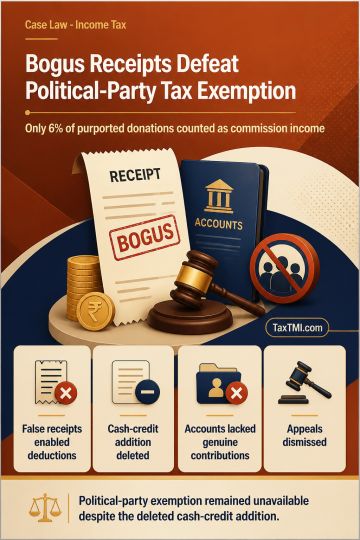
Bogus donation receipts justified commission income assessment and defeated political-party tax exemption for inaccurate accounts and reporting failur...
Pure reimbursement without income element escapes tax withholding, while delayed withholding and unsupported provisions face deferred or renewed scrut...
Public benefit requirement defeats charitable registration where residents' association services are reciprocal, member-only facilities governed by mu...
Penalty under section 43 of the Black Money Act was treated as discretionary rather than automatic, and was deleted for a bona fide failure to disclose foreign ESOP shares in Schedule FA. The Tribunal accepted that the shares formed part of employment compensation, the related perquisite and later capital gains had already been taxed, and the only lapse was non-disclosure in the initial reporting year while the assets were held through a fiduciary structure. Applying the principles that a technical or inadvertent breach without deliberate concealment or guilty intent does not justify penalty, the Tribunal also followed prior ITAT and Supreme Court guidance. The jurisdictional challenge was left open as unnecessary.
Penalty under section 43 of the Black Money Act was treated as discretionary rather than automatic, and was deleted for a bona fide failure to disclose foreign ESOP shares in Schedule FA. The Tribunal accepted that the shares formed part of employment compensation, the related perquisite and later capital gains had already been taxed, and the only lapse was non-disclosure in the initial reporting year while the assets were held through a fiduciary structure. Applying the principles that a technical or inadvertent breach without deliberate concealment or guilty intent does not justify penalty, the Tribunal also followed prior ITAT and Supreme Court guidance. The jurisdictional challenge was left open as unnecessary.
Note: It is a system-generated summary and is for quick reference only.
 TaxTMI
 of 4805





















 Join Channel


 TaxTMI