

Loading...

Top
Help
×

By creating an account you can:

Logo TaxTMI
Call Us / Help / Feedback

Contact Us At :

E-mail: [email protected]

Call / WhatsApp at: +91 99117 96707

For more information, Check Contact Us

FAQs :

To know Frequently Asked Questions, Check FAQs

Most Asked Video Tutorials :

For more tutorials, Check Video Tutorials

Submit Feedback/Suggestion :

Email :
Please provide your email address so we can follow up on your feedback.
Category :
Description :
Min 15 characters 0/2000
Make Most of Text Search
  1. Checkout this video tutorial: How to search effectively on TaxTMI.
  2. Put words in double quotes for exact word search, eg: "income tax"
  3. Avoid noise words such as : 'and, of, the, a'
  4. Sort by Relevance to get the most relevant document.
  5. Press Enter to add multiple terms/multiple phrases, and then click on Search to Search.
  6. Text Search
  7. The system will try to fetch results that contains ALL your words.
  8. Once you add keywords, you'll see a new 'Search In' filter that makes your results even more precise.
  9. Text Search
Add to...
You have not created any category. Kindly create one to bookmark this item!
Create New Category
Hide
Title :
Description :
❮❮ Hide
Default View
Expand ❯❯
Close ✕
🔎 News - Adv. Search
TEXT SEARCH:

Press 'Enter' to add multiple search terms. Rules for Better Search

Search In:
Main Text + AI Text
  • Main Text
  • Main Text + AI Text
  • AI Text
Category: ?
Categorized by AI
---- All Categories ----
  • ---- All Categories ----
  • Income Tax
  • GST
  • Customs, DGFT & SEZ
  • FEMA & RBI
  • Corp. Laws, SEBI & IBC
  • PMLA, Black Money & ED
  • Budget
  • News and Press Release
  • PTI News
Month:
---- All Months ----
  • ---- All Months ----
  • January
  • February
  • March
  • April
  • May
  • June
  • July
  • August
  • September
  • October
  • November
  • December
Year:
---- All Years ----
  • ---- All Years ----
  • 2026
  • 2025
  • 2024
  • 2023
  • 2022
  • 2021
  • 2020
  • 2019
  • 2018
  • 2017
  • 2016
  • 2015
  • 2014
  • 2013
  • 2012
  • 2011
Sort By: ?
In Sort By 'Default', exact matches for text search are shown at the top, followed by the remaining results in their regular order.
Relevance Default Date
❯❯
Maximize Maximize Maximize
0 / 200
Expand Note
Add to Folder

No Folders have been created

+

Are you sure you want to delete "My most important" ?

NOTE:

News
Showing Results for :
Reset Filters
Results Found:
Show All Summaries Hide All Summaries
April 4, 2026
Show AI Summary
Business connection in India reporting through Form 172 requires mandatory electronic filing, UDIN generation, and supporting documentation.
Form 172 is the mandatory accountant's report for an eligible investment fund to show compliance with conditions for claiming no business connection in India. It is filed once in a tax year by the appointed accountant through the Income Tax e-filing portal, after UDIN generation and digital signature. The form requires a valid PAN, cannot be edited after submission, and may need supporting documents such as fund manager details, SEBI registrations, financial statements, and contracts relating to the fund manager's activities and remuneration.
April 3, 2026
Show AI Summary
Authorised Income Tax Practitioner registration under Form 171 depends on eligibility, supporting documents, and authority verification.
Form 171 is the one-time application for registration as an authorised Income Tax Practitioner under the specified eligibility categories in section 515(3) of the Income Tax Act, 2025. Eligible applicants include accountants, persons who have passed a recognised accountancy examination, and other qualified persons recognised by the Central Board of Direct Taxes. The form requires applicant details, the claimed eligibility category, qualifications, prior tax appearances, and supporting documents, and is filed with the jurisdictional Income Tax Authority for verification and registration.
April 3, 2026
Show AI Summary
Authorised Income-tax Practitioner registration through Form 171 requires eligibility details, supporting documents, and one-time filing.
Form 171 is the prescribed application for registration as an Authorised Income-tax Practitioner under section 515 of the Income-tax Act 2025 and must be filed with the jurisdictional Chief Commissioner or Commissioner of Income-tax. The application is mandatory for recognition in that capacity, may be filed after eligibility arises, and is a one-time filing unless otherwise directed. It requires applicant particulars, eligibility details, qualifications, supporting documents, and relevant firm or association details. On approval, the applicant's name is entered in the Register of Income-tax Practitioners and a Certificate of Registration is issued.
April 3, 2026
Show AI Summary
Annual Information Statement consolidates tax credits, payments, transactions, and proceedings in a taxpayer's e-filing account.
Form 168 operates as an auto-generated Annual Information Statement linked to a taxpayer's PAN and available in the e-filing account. It consolidates TDS, TCS, tax payments, specified financial transactions, demand and refund details, and pending or completed proceedings, together with any other prescribed information. The taxpayer does not file the form manually. It is updated dynamically during the year as underlying reports and payments are processed, and it uses Tax Year instead of Financial Year.
April 3, 2026
Show AI Summary
Annual Information Statement and taxpayer summary streamline income reporting through detailed verification, feedback correction, and consolidated return filing.
Annual Information Statement (AIS) is the detailed financial statement linked to PAN, and Taxpayer Information Summary (TIS) is its consolidated version showing category-wise totals for use in return filing. AIS contains transaction-level data, while TIS provides summarized figures such as salary, rental income, interest, capital gains, dividend, business income and taxes paid. Taxpayers should verify AIS, use the feedback mechanism for incorrect or unrelated entries, and rely on the updated TIS; actual income must still be reported in the return even if missing from AIS.
April 3, 2026
Show AI Summary
GST appeal filing blocked by NIL demand entries despite unpaid dispute over liability and prior voluntary payment.
Taxpayers may face portal restrictions when an adjudication order reflects a NIL demand because payment was made at the show cause notice stage without admitting liability. Although such payment does not amount to acceptance of the demand, the GST portal may block filing of appeal application APL-01 when no liability is captured in the Demand and Collection Register. The taxpayer may seek rectification of the order so that the correct demand amount is reflected and the appeal can then be filed within the prescribed time.
April 3, 2026
Show AI Summary
Annual reporting for film production and specified activities under the income-tax framework now requires structured disclosure and TDS linkage.
Form 164 requires persons engaged in cinematograph film production or notified specified activities to furnish an annual statement for each tax year under section 507 of the Income-tax Act, 2025, read with Rule 236. The statement is due within 60 days from the end of the tax year and covers filer particulars, film or activity details, and payment and TDS information, including aggregate payments above the prescribed threshold linked to the relevant film or activity. The revised format uses three parts and standardised digital reporting.
April 3, 2026
Show AI Summary
Mandatory annual statement for film production and specified activities covers incomplete projects, threshold payments, TAN, and electronic filing status.
A mandatory annual statement is required under section 507 of the Income-tax Act, 2025 for persons engaged in cinematograph film production or specified activities such as event management, sports events, documentary production, OTT or TV programme production, performing arts, or similar notified activities. The filing obligation applies to every individual, partnership firm, LLP, company or other entity that produced a film or undertook a specified activity during the relevant tax year, including cases where the film or activity was not completed in that year. The statement must be filed within 60 days from the end of the tax year, and TAN is required where the filer is liable to deduct tax at source.
April 3, 2026
Show AI Summary
Personal loan flexibility expands as longer repayment tenure, collateral-free borrowing, and faster disbursal aim to ease EMI burden.
Bajaj Finance has revised its personal loan offering by extending the repayment tenure up to 108 months, replacing the earlier 96-month structure. The longer tenure is intended to reduce monthly EMI burden and give borrowers greater flexibility in managing repayments, while shorter tenures remain available within a range of 12 months to 108 months depending on customer preference. The personal loan product is described as collateral-free and designed for planned and urgent expenses, with loan amounts ranging from Rs. 40,000 to Rs. 55 lakh.
April 3, 2026
Show AI Summary
Indirect transfer reporting under Form 163 requires timely electronic disclosure of share transfers affecting Indian assets and control rights.
Form 163 is the reporting statement for indirect transfers of assets located in India under section 506 of the Income-tax Act, 2025 and Rule 235 of the Income-tax Rules, 2026. It is to be furnished by an Indian concern, or its representative, where a non-resident transfers shares or interests in a foreign company or entity in a manner affecting assets, rights, management or control in relation to the Indian concern. The form is filed electronically within the prescribed timelines and supports computation of income reported in Form 4.
April 3, 2026
Show AI Summary
Foreign exchange reserves decline as rupee pressure, RBI dollar sales, and lower gold and currency assets shape weekly movement.
India's foreign exchange reserves declined to USD 688.058 billion for the week ended March 27, driven by lower foreign currency assets and gold reserves. The Reserve Bank of India continued to intervene in the foreign exchange market through dollar sales and related policy measures as the rupee remained under pressure, while Special Drawing Rights rose slightly and the IMF reserve position edged down.
April 3, 2026
Show AI Summary
Indirect transfer reporting in Form No. 163 requires timely electronic filing, supporting documents, and a valid PAN.
Reporting of indirect transfers of assets located in India requires an Indian concern, or its representative, to furnish information in Form No. 163 under section 506 of the Income Tax Act, 2025. The form is mandatory and applies where a non-resident transfers shares of, or interest in, an offshore company or entity resulting in an indirect transfer of assets in India. It must be furnished within ninety days from the end of the financial year, or within ninety days of the transaction where management or control rights in relation to the Indian concern are transferred.
April 3, 2026
Show AI Summary
Annual statement filing for liaison offices in India requires RBI-linked disclosure, electronic submission, and timely compliance.
Form 162 is an annual statement required under section 505 of the Income Tax Act, 2025, for non-resident entities maintaining a liaison office in India. It must be filed once in each tax year within eight months from the end of the tax year, electronically through the income-tax e-filing portal and digitally signed by the authorised signatory. The form captures head office, liaison office, RBI approval, Annual Activity Certificate, financial, employee, and counterparty details, and may be used for verification, international taxation, and transfer pricing cross-checks.
April 3, 2026
Show AI Summary
Annual statement compliance for liaison offices requires electronic filing, certified activity records, valid PAN, and timely submission.
Form 162 is the annual statement required for non-resident entities maintaining a liaison office in India under the Income-tax Act, 2025, to be filed electronically once in each tax year within eight months from the end of the tax year. The filing requires particulars relating to the office's activities, approval details, employees, Indian counterparties, and audited financial information, along with a certified Annual Activity Certificate and valid PAN. The form cannot be submitted offline or edited after acknowledgment, and non-filing or delay may attract penalty, revocation of liaison office permission, and other assessment-related action.
April 3, 2026
Show AI Summary
Immunity from penalty and prosecution through Form 161 depends on full payment, no appeal, and timely electronic filing.
Form 161 is the prescribed application under the Income-tax Act, 2025 for immunity from penalty and prosecution where an assessee accepts an assessment or reassessment order, pays the full tax and interest demand within the prescribed time, and does not file an appeal. The application is event-based and must be filed within one month from the end of the month in which the order is received. It requires structured taxpayer identity details, order and payment particulars, and a statutory verification, and is filed electronically with supporting assessment, demand, payment, and PAN documents.
April 3, 2026
Show AI Summary
Immunity from penalty and prosecution through Form 161 requires full payment, no appeal, and online filing.
Form 161 is the prescribed application under section 440(2) of the Income-tax Act, 2025 for seeking immunity from penalty and prosecution after an assessment or reassessment order. It is optional and event-based, must be filed within one month from the end of the month of receipt of the order, and is available only where the taxpayer has paid the full tax and interest demand and has not filed any appeal. The form requires order details, demand details, proof of payment, and PAN, and can be submitted only online through the e-Filing portal.
April 3, 2026
Show AI Summary
Refund of wrongly deducted tax through Form 160 requires full transaction details, supporting documents, and timely filing.
Refund of tax deducted at source and deposited to the Central Government is available through Form 160 where tax was not required to be deducted on the relevant income or transaction. The form is filed by the deductor before the Assessing Officer having jurisdiction, within thirty days from payment of tax, and must contain transaction details, deductee details, agreement particulars, and proof of the tax deducted and deposited. Supporting documents and verification enable examination of whether the refund claim is admissible.
April 3, 2026
Show AI Summary
Refund of wrongly deducted tax through Form 160 requires proof that no tax was deductible and full TDS disclosure.
Refund of tax deducted at source and paid to the Central Government may be sought through Form 160 where the deductor contends that no tax was deductible on the relevant income or transaction. The form is the prescribed application under the Income-tax law and is to be used only in cases where tax was actually deducted and deposited, but the applicant later claims that the deduction was not required under the Act. It is filed before the TDS Assessing Officer having jurisdiction over the applicant, and the application is supported by the statutory particulars needed to test the claim of non-deductibility.
April 3, 2026
Show AI Summary
Tax Clearance Certificate Form 159 governs clearance for persons leaving India and requires Assessing Officer issuance on Form 158.
Tax Clearance Certificate in Form 159 is issued by the Assessing Officer in response to Form 158 and is prescribed under section 420(5) of the Income-tax Act, 2025 read with Rule 228 of the Income-tax Rules, 2026. The form records the departing person's identity details and travel-linked validity, is issued through ITBA functionality, and has no statutory timeline for issue. Form 158 is the supporting application, and the note states that the taxpayer cannot leave India without the requisite clearance certificate.
April 3, 2026
Show AI Summary
Tax Clearance Certificate governs departure-related compliance and is issued by the Assessing Officer on a Form 158 application.
Form 159 is the Tax Clearance Certificate issued by the Assessing Officer in response to Form 158. It is not filed by the taxpayer, but is issued to the specified taxpayer through the ITBA functionality, subject to the requirements of the Income-tax Act, 2025. No statutory time limit is prescribed for issuance, and the certificate is event-based, depending on the travel requirements of the person leaving India.

News

Back

All News

Showing Results for :
Reset Filters
No Records Found

News

Showing Results for : Reset Filters

Monetary Policy Statement, 2026-27 Resolution of the Monetary Policy Committee April 6 to 8, 2026

April 8, 2026

Contents
Summary
Note

Note

-

Bookmark

Print

Print

Monetary Policy Decisions

The Monetary Policy Committee (MPC) held its 60th meeting from April 6 to 8, 2026, under the chairmanship of Shri Sanjay Malhotra, Governor, Reserve Bank of India. The MPC members Dr. Nagesh Kumar, Shri Saugata Bhattacharya, Prof. Ram Singh, Dr. Poonam Gupta and Shri Indranil Bhattacharyya attended the meeting.

2. After a detailed assessment of the evolving macroeconomic and financial developments and the outlook, the MPC voted unanimously to keep the policy repo rate under the liquidity adjustment facility (LAF) unchanged at 5.25 per cent. Consequently, the standing deposit facility (SDF) rate remains at 5.00 per cent and the marginal standing facility (MSF) rate and the Bank Rate remains at 5.50 per cent. The MPC also decided to continue with the neutral stance.

Growth and Inflation Outlook

Global Outlook

3. The outbreak of the conflict in West Asia has led to severe disruption of global supply chains. This poses an unprecedented challenge for the global economy – higher prices and lower global growth. In this environment, monetary policy faces a difficult trade-off – anchoring inflation expectations through policy tightening while minimising its impact on growth forgone. Sovereign bond yields, already high from long-run fiscal sustainability concerns across major economies, have further hardened, driven by inflation fears. Additionally, equity valuations have corrected. As a result of the turmoil in global financial markets, the US dollar has rallied, buoyed by safe‑haven demand that has exerted pressure on currencies of major economies. Further intensification of the conflict, its prolongation and widening geographical spread remain the key downside risks to the global outlook.

Domestic Outlook

4. On the domestic front, the Indian economy remained resilient in 2025-26. Real gross domestic product (GDP) is estimated to grow by 7.6 per cent (y-o-y) during the year, as per the Second Advance Estimates (SAE) of the new GDP series (base year 2022-23). Private consumption and fixed investment contributed significantly to overall growth, while net external demand remained soft. On the supply side, estimated real GVA growth of 7.7 per cent was driven by buoyant services sector and robust manufacturing activity.

5. Looking ahead, elevated energy and other commodity prices coupled with supply shock due to disruptions in the Strait of Hormuz would act as a drag on domestic production in 2026-27. Heightened volatility in global financial markets with its spillover on domestic financial conditions would weigh on growth prospects. On the external front, merchandise exports may be adversely impacted from disruptions to key shipping routes and the concomitant rise in freight and insurance costs in case the conflict is long-drawn. On the other hand, sustained momentum in services sector, persisting impact of GST rationalisation, rising capacity utilisation in manufacturing, and healthy balance sheets of financial institutions and corporates should continue to support domestic demand. In this milieu, the Government’s focus on scaling up domestic manufacturing in several strategic and frontier sectors announced in the Union Budget 2026-27 bodes well for India’s ensuing growth trajactory. Taking all these factors into consideration and on the assumption that the adverse impact of the conflict would remain contained in the near term, real GDP growth for 2026-27 is projected at 6.9 per cent, with Q1 at 6.8 per cent; Q2 at 6.7 per cent; Q3 at 7.0 per cent; and Q4 at 7.2 per cent (Chart 1). Further escalation of the conflict, its continuation over a wider geographical spread and uncertainty regarding the damage to the energy infrastructure, apart from weather related events, pose downside risks to the domestic growth outlook.

6. As per the new CPI series (2024=100), headline inflation increased to 3.2 per cent in February 2026 from 2.7 per cent in January. The uptick was primarily driven by unfavourable base effects even as the momentum remained muted. While food inflation increased in February, core (excluding food and fuel) inflation remained unchanged. Excluding precious metals, core inflation remained moderate at 2.1 per cent in January and February, suggesting subdued underlying inflation pressures.

7. The ongoing conflict has led to large volatility in international energy and other commodity prices imparting considerable uncertainty to the near-term inflation outlook. The pass-through of higher global energy prices has resulted in price increases in select fuels such as premium petrol and LPG and diesel for industrial use. On the other hand, the near-term food supply prospects have been boosted by robust rabi crop providing some comfort. Considering all these factors, CPI inflation for 2026-27 is projected to be at 4.6 per cent with Q1 at 4.0 per cent; Q2 at 4.4 per cent; Q3 at 5.2 per cent; and Q4 at 4.7 per cent. Persistently elevated energy prices due to the West Asia conflict and possible El Niño conditions (which could have a negative impact on southwest monsoon) pose upside risks to inflation (Chart 2). Core inflation is projected at 4.4 per cent for 2026-27 and, excluding precious metals, it is even lower indicating that underlying inflation pressures are expected to remain contained.
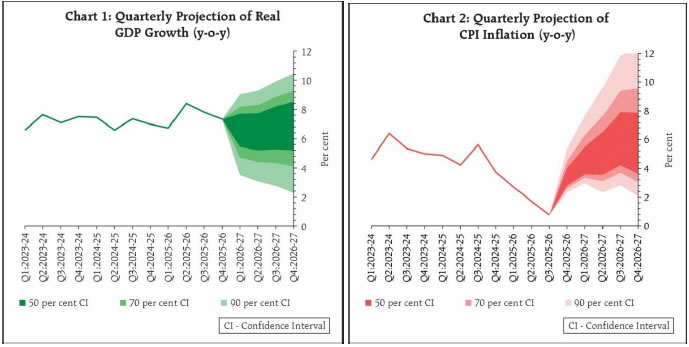
Chart 1 and 2

Rationale for Monetary Policy Decisions

8. Since the last policy meeting, geopolitical uncertainties have heightened significantly. Headline inflation remains contained and below the target, but upside risks to the inflation outlook have increased, driven by increased energy price pressures and probable weather disturbances affecting food prices. Core inflation pressures remain muted, although supply chain dislocations and the risk of second-round effects render the future inflation trajectory uncertain.

9. High frequency indicators till February 2026 suggest the continuation of strong momentum in economic activity. Growth impulses continue to be supported by robust private consumption and investment demand. However, the West Asia conflict will adversely impact growth. Higher input costs associated with increase in energy prices and international freight and insurance costs along with supply-chain disruptions could constrain availability of key inputs for downstream sectors, thus impairing growth. The Government has taken several measures targeted at supporting exports and protecting supply chains, which should mitigate the adverse impact of the conflict.

10. The MPC noted that the intensity and the duration of the conflict in West Asia and the resultant damage to the energy and other infrastructure add risk to the inflation and growth outlooks. However, the fundamentals of the Indian economy are on a stronger footing, providing it with greater resilience to withstand shocks now than in the past. The economy is confronted with a supply shock. It is prudent to wait and watch the changing circumstances and the evolving growth-inflation outlook. Accordingly, the MPC voted to keep the policy rate unchanged even as it remains vigilant, closely monitoring incoming information and assessing the balance of risks. The MPC also decided to continue with the neutral stance, retaining the flexibility to respond judiciously to incoming information.

11. The minutes of the MPC’s meeting will be published on April 22, 2026.

12. The next meeting of the MPC is scheduled for June 3 to 5, 2026.

(Brij Raj)           
Chief General Manager

Topics

Acts Income Tax
