

Loading...

Top
Help
×

By creating an account you can:

Logo TaxTMI
Call Us / Help / Feedback

Contact Us At :

E-mail: [email protected]

Call / WhatsApp at: +91 99117 96707

For more information, Check Contact Us

FAQs :

To know Frequently Asked Questions, Check FAQs

Most Asked Video Tutorials :

For more tutorials, Check Video Tutorials

Submit Feedback/Suggestion :

Email :
Please provide your email address so we can follow up on your feedback.
Category :
Description :
Min 15 characters 0/2000
Make Most of Text Search
  1. Checkout this video tutorial: How to search effectively on TaxTMI.
  2. Put words in double quotes for exact word search, eg: "income tax"
  3. Avoid noise words such as : 'and, of, the, a'
  4. Sort by Relevance to get the most relevant document.
  5. Press Enter to add multiple terms/multiple phrases, and then click on Search to Search.
  6. Text Search
  7. The system will try to fetch results that contains ALL your words.
  8. Once you add keywords, you'll see a new 'Search In' filter that makes your results even more precise.
  9. Text Search
Add to...
You have not created any category. Kindly create one to bookmark this item!
Create New Category
Hide
Title :
Description :
❮❮ Hide
Default View
Expand ❯❯
Close ✕
🔎 News - Adv. Search
TEXT SEARCH:

Press 'Enter' to add multiple search terms. Rules for Better Search

Search In:
Main Text + AI Text
  • Main Text
  • Main Text + AI Text
  • AI Text
Category: ?
Categorized by AI
---- All Categories ----
  • ---- All Categories ----
  • Income Tax
  • GST
  • Customs, DGFT & SEZ
  • FEMA & RBI
  • Corp. Laws, SEBI & IBC
  • PMLA, Black Money & ED
  • Budget
  • News and Press Release
  • PTI News
Month:
---- All Months ----
  • ---- All Months ----
  • January
  • February
  • March
  • April
  • May
  • June
  • July
  • August
  • September
  • October
  • November
  • December
Year:
---- All Years ----
  • ---- All Years ----
  • 2026
  • 2025
  • 2024
  • 2023
  • 2022
  • 2021
  • 2020
  • 2019
  • 2018
  • 2017
  • 2016
  • 2015
  • 2014
  • 2013
  • 2012
  • 2011
Sort By: ?
In Sort By 'Default', exact matches for text search are shown at the top, followed by the remaining results in their regular order.
Relevance Default Date
❯❯
Maximize Maximize Maximize
0 / 200
Expand Note
Add to Folder

No Folders have been created

+

Are you sure you want to delete "My most important" ?

NOTE:

News
Showing Results for :
Reset Filters
Results Found:
Show All Summaries Hide All Summaries
September 1, 2026
Show AI Summary
Trade facilitation and customs preparedness feature in AILBIEA's Silver Jubilee knowledge conference on liquid bulk commerce.
AILBIEA's Silver Jubilee programme focuses on trade facilitation, customs modernisation, GST dispute preparedness and maritime-risk issues affecting liquid bulk trade. The Knowledge Conference includes sessions on the Authorised Economic Operator advantage, next-generation customs technology, GST Appellate Tribunal-era dispute preparedness, and geopolitical risks to sea-borne trade. It also marks the launch of AGS 360, integrating port information, vessel tracking, port-call estimates and maritime intelligence.
September 1, 2026
Show AI Summary
Personal guarantor insolvency: repayment plan stayed pending majority determination, with restraint on direct or indirect asset alienation.
Personal-guarantee insolvency proceedings involve a stay on implementation of a repayment plan because the earlier members' views did not produce a clear majority capable of taking effect. The personal guarantor has been restrained from directly or indirectly alienating assets pending further hearing. The dispute follows split views on approval of the plan, claim admission and voting, followed by a third-member opinion that did not resolve the absence of a determinative majority. Creditors dispute the proposed recovery, claim treatment and declared net worth relevant to the guarantees.
September 1, 2026
Show AI Summary
Rupee exchange-rate movement reflects portfolio inflows, growth data and possible central-bank support, while crude oil prices constrain gains.
Foreign-exchange market conditions strengthened the rupee by 28 paise to 94.94 against the US dollar, supported by domestic growth, controlled fiscal slippage and portfolio inflows. Possible Reserve Bank of India intervention was also identified as supportive. Higher crude oil prices, weak domestic equities and hawkish US monetary-policy signals were identified as constraints on further appreciation. Foreign investment flows, stronger-than-expected domestic growth and the fiscal-deficit position remained material factors affecting currency conditions.
September 1, 2026
Show AI Summary
Money-laundering probe into public service recruitment irregularities examines alleged question-paper leaks, selection manipulation, and laundering through purported CSR donations.
Money-laundering investigation under the Prevention of Money Laundering Act concerns alleged irregularities in Public Service Commission recruitment examinations. Allegations include question-paper leaks, manipulation of candidate selection, and illegal gratification for securing appointments of relatives and favoured candidates. Recruitment rules were allegedly amended to facilitate selection of relatives. Alleged proceeds of crime were collected in cash and routed through layered banking transactions, including through a family-controlled samiti presented as receiving corporate social responsibility donations for a non-existent college.
September 1, 2026
Show AI Summary
Personal guarantor settlement scrutiny intensifies as asset alienation is restrained pending review of a disputed creditor repayment proposal.
A five-member special bench found that no clear majority view existed under section 419(5) of the Companies Act and stayed the third member's order that had permitted the proposed recovery. Notices were directed to all parties, and the guarantor was restrained from directly or indirectly alienating property pending further consideration. The dispute concerns approval of a personal guarantor's repayment proposal, treatment of guarantee claims, creditor voting support, assessment of the personal estate, and scrutiny of declared net worth.
September 1, 2026
Show AI Summary
Personal insolvency proceedings restrict property alienation while notices issue to parties in the debtor's case.
A five-member special National Company Law Tribunal bench hearing Subhash Chandra's personal insolvency matter issued notices to all parties and restrained him from alienating property directly or indirectly. The restraint applies during the continuing insolvency proceedings and concerns dealings with the relevant property. The procedural measure requires the interested parties to participate in the matter.
September 1, 2026
Show AI Summary
Aadhaar authentication alternatives enable eligible farmers with failed fingerprint verification to access loan-waiver benefits after identity verification.
Elderly farmers whose fingerprints cannot be captured for Aadhaar authentication may approach an Aaple Sarkar Seva Kendra with their Aadhaar card and bank passbook. Loan-account details are verified on the scheme portal before authentication is initiated. If authentication fails, the concerned tehsildar verifies identity using the Aadhaar card, bank passbook and 7/12 land record extract. Eligible farmers receive loan-waiver benefits directly in their bank accounts after authentication, identity verification and satisfaction of the scheme's eligibility criteria.
September 1, 2026
Show AI Summary
GST collection growth reflected higher domestic and import revenue, while increased refunds moderated net collections during August.
GST collections recorded year-on-year growth in August, with gross receipts reaching about Rs 2 lakh crore. Domestic transaction revenue increased to over Rs 1.37 lakh crore, while import-related revenue rose to Rs 62,604 crore. Refunds increased to Rs 31,795 crore, and net GST collections stood at Rs 1.68 lakh crore after refunds.
September 1, 2026
Show AI Summary
Personal insolvency repayment plan faces fresh hearing after a split bench prevents enforcement and restrains guarantor property transfers.
Personal insolvency proceedings were reopened before a five-member special bench after a split view on a repayment plan. As no majority view existed, including that of the third member, no final order was in force and the repayment-plan determination could not be acted upon. Notices were issued to all parties, including dissenting creditors, and the guarantor was restrained from directly or indirectly alienating property pending further consideration. Dissenting creditors also challenged the repayment-plan determination before the appellate tribunal.
September 1, 2026
Show AI Summary
Equity market sentiment weakens as higher crude prices, geopolitical tensions and tighter monetary policy expectations curb risk appetite.
Equity-market sentiment weakened as higher crude oil prices, renewed US-Iran tensions, and expectations of prolonged tight US monetary policy reduced emerging-market risk appetite. The Sensex and Nifty declined, while domestic GDP growth above projections offered partial support. Weakness in several Asian markets, a lower US market close, and net foreign institutional equity sales reinforced cautious trading conditions.
September 1, 2026
Show AI Summary
Money laundering investigation triggers searches linked to alleged Public Service Commission irregularities, including premises of a former chief minister's assistant.
A money-laundering investigation under the Prevention of Money Laundering Act has led to searches at seven locations in Chhattisgarh in connection with alleged irregularities at the Chhattisgarh Public Service Commission. The search operation includes the premises of K. K. Chandrakar, personal assistant to former Chief Minister Bhupesh Baghel. The investigation remains at the search and inquiry stage.
September 1, 2026
Show AI Summary
Income-tax return filing: non-audit business and professional taxpayers use applicable forms by prescribed due dates.
August 31, 2026 was the due date for taxpayers having business or professional income who were not subject to audit. Such non-audit taxpayers may use ITR-3, ITR-4, ITR-5 or ITR-7, as applicable. ITR-3 applies to individuals and Hindu Undivided Families with proprietary business or professional income, while ITR-4 is intended for small and medium taxpayers. ITR-5 applies to firms, limited liability partnerships and cooperative societies, and ITR-7 applies to trusts and charitable institutions.
September 1, 2026
Show AI Summary
Gold smuggling enforcement targets transit abuse, concealed carriage, and border routes through coordinated seizures and arrests nationwide.
Intelligence-led enforcement against organised gold smuggling resulted in the seizure of over 42 kg of foreign-origin gold and around 10 kg of foreign-origin silver, collectively valued at more than Rs. 65 crore, and the arrest of 25 persons. Operations targeted networks using airport transit routes, airport personnel, land-border corridors, coastal routes, and domestic road transport. Gold was concealed in wax, compound, paste, raw-chain and bar forms, including through body concealment, internally secreted capsules, clothing, and specially created cavities.
September 1, 2026
Show AI Summary
Predictive consumption-expenditure framework will use household survey data to support poverty estimation, consumption analysis, and economic planning.
MoSPI and Thapar Institute of Engineering & Technology have entered into a memorandum of understanding for a research study to develop a predictive and analytical framework for monthly consumption expenditure in India. The study will use Household Consumption Expenditure Survey data to estimate Monthly Per Capita Consumption Expenditure at national and state levels, analyse household consumption patterns, and generate evidence relevant to poverty estimation and broader economic planning.
August 31, 2026
Show AI Summary
Personal insolvency repayment plans: conflicting views on binding dissenting creditors prompted reconsideration through an expanded adjudicatory bench.
National Company Law Tribunal constituted a five-member bench after conflicting views on a personal insolvency repayment plan left no majority position for a formal order. The central issue is whether creditor approval of the plan binds dissenting creditors and extinguishes their claims against the personal guarantor. One view preserved dissenting creditors' independent recovery rights, while another applied the creditor-approved plan uniformly to all creditors. Disagreement also concerns the Adjudicating Authority's power to examine the resolution professional's report of the creditors' meeting.
August 31, 2026
Show AI Summary
Personal insolvency repayment plans raise unresolved questions on dissenting creditors' rights and uniform extinguishment of claims.
Personal insolvency proceedings were referred for fresh adjudication because no majority emerged on the repayment plan. The Technical Member rejected the plan; the Judicial Member confined it to consenting creditors while preserving dissentents' recovery rights; and the Third Member approved it with uniform extinguishment of all creditors' claims. The dispute concerns whether creditor approval under section 115(1) binds dissenting creditors, the effect of section 79(2)(g), and the Adjudicating Authority's power to examine the Resolution Professional's creditors' meeting report.
August 31, 2026
Show AI Summary
Rupee exchange-rate support through suspected intervention and FCNR(B) inflows offset pressure from dollar strength and higher crude prices.
Rupee exchange-rate movement reflected a recovery from early losses to close stronger against the US dollar, amid market expectations of Reserve Bank of India support at lower trading levels. Pressure arose from higher US Treasury yields, possible US rate-hike expectations and a broad dollar rally. Suspected intervention, FCNR(B)-related foreign-currency flows and the special USD-INR forex swap facility supported sentiment, while rising crude prices, geopolitical supply risks and foreign institutional equity outflows remained adverse factors.
August 31, 2026
Show AI Summary
Income-tax return filing for non-audit business and professional taxpayers closes at midnight, requiring use of applicable forms.
Income-tax return filing for Assessment Year 2026-27 reaches its due date on 31 August 2026 for taxpayers having business or professional income who are not subject to audit. Such taxpayers may file the applicable ITR-3, ITR-4, ITR-5 or ITR-7. ITR-3 applies to individuals and Hindu Undivided Families with proprietary business or professional income, ITR-4 to small and medium taxpayers, and ITR-5 to firms, limited liability partnerships and cooperative societies.
August 31, 2026
Show AI Summary
Monthly fiscal accounts track receipt composition, expenditure allocation, tax devolution, interest payments, and major subsidy outgo through July.
Union Government monthly accounts through July 2026 record total receipts comprising net tax revenue, non-tax revenue and non-debt capital receipts, with tax devolution transferred to State Governments. Total expenditure is divided between revenue and capital expenditure. Revenue expenditure includes interest payments and major subsidies.
August 31, 2026
Show AI Summary
Personal guarantor insolvency distinguishes guarantee liability from borrower debt while creditor voting challenges question repayment-plan approval.
Personal insolvency proceedings concerning personal guarantees distinguish a guarantor's liability from the underlying borrowing entities' debts. Claims against the guarantor arise from guarantees furnished for loans obtained by Essel Group-associated entities, while the borrowers' repayment obligations remain enforceable and creditors may pursue corporate assets and securities. Dissenting lenders have challenged the resolution-plan voting process, alleging that family-linked associates or related parties should have been excluded from committee of creditors voting.

News

Back

All News

Showing Results for :
Reset Filters
No Records Found

News

Showing Results for : Reset Filters
Customs, DGFT & SEZ

Directorate General of Commercial Intelligence and Statistics Revises Base Year of Merchandise Trade Indices to FY 2022–23 to Reflect Current Trade Structure and Global Patterns

February 21, 2026

Contents
Summary
Note

Note

-

Bookmark

Print

Print

Merchandise Trade Indices are compiled and published by the Directorate General of Commercial Intelligence and Statistics (DGCI&S), Ministry of Commerce & Industry, to measure changes in the unit values (prices) of India’s exports and imports over time. These indices serve as important indicators of external sector price movements and are widely used for economic analysis, including national accounts compilation and assessment of terms of trade. Over the years, the base year of the indices has been periodically revised to reflect structural changes in India’s trade composition and evolving global trade patterns. The most recent revision updates the base year to FY 2022–23 (2022–23 = 100), replacing the earlier base of FY 2012–13, thereby ensuring that the indices accurately represent the current structure of India’s merchandise trade.

Revision of Base Year of India’s Merchandise Trade Indices to FY 2022–23

The Directorate General of Commercial Intelligence and Statistics (DGCI&S), Ministry of Commerce & Industry, has revised the base year of India’s Merchandise Trade Indices from FY 2012–13 to FY 2022–23 (2022–23 = 100), in view of the structural changes in the economy, shifts in commodity composition, evolving trade patterns, and the need for improved alignment with contemporary macroeconomic indicators.

The revision has been undertaken on the recommendations of a committee constituted by DGCI&S under the Chairmanship of Prof. Nachiketa Chattopadhyay, Professor, Indian Statistical Institute, Kolkata. The Committee examined the existing methodology, data coverage, weighting structure, and compilation practices, and recommended suitable refinements in line with international best practices.

Key Features of the Revised Series (Base: FY 2022–23)

  1. Updated Base Year:
    The new base year FY 2022–23 makes the Indices reflect the current structure of India’s external trade more accurately.
  2. Revised Commodity Basket:
    The coverage and classification of commodities have been reviewed at the Principal Commodity level to better capture emerging and declining trade items.
  3. Revised Weighting Structure:
    Weights have been updated based on trade values of the new base year to reflect the latest value shares in exports and imports.
  4. Improved Methodology:
    Methodological refinements have been introduced in:
    1. Selection of common commodity basket for base year selection (procedure of selection for common commodity basket explained in detail report of the committee).
    2. Treatment of missing unit values (Imputation of missing unit values in base year selection have been explained in detail in the committee report).
  5. Indices Compiled:
    The revised series includes:
    1. Monthly, Quarterly and Annual Indices (Export Unit Value Index,Import Unit Value Index).
    2. Principal Commodity (PC) Classification wise Trade Indices (Export/Import).
    3. Standard International Trade Classification-wise (SITC) Trade Indices.
    4. Broad economic categories-wise (BEC) Trade Indices.
    5. Bilateral and Region-wise Trade Indices of Top 20 Export and Import partner nations of India.
    6. Terms of Trade (Gross terms of trade, Net terms of trade and Income terms of trade).

Rationale for Revision

Over the past decade, India’s trade basket has undergone substantial changes due to emergence of new commodities, technological advancements, Global supply chain restructuring and changes in relative price structures.

The earlier base year (FY 2012–13) no longer adequately reflected the prevailing trade structure. The revision ensures improved relevance, reliability, and analytical usefulness of the Merchandise Trade Indices for policymakers, researchers, and other stakeholders.

Use of the Revised Series

Merchandise Trade Indices compiled by the Directorate General of Commercial Intelligence and Statistics (DGCI&S) are extensively used by key government institutions for economic analysis and policy formulation. The National Accounts Division (NAD) of the Ministry of Statistics and Programme Implementation uses the Export and Import Unit Value Indices as deflators for estimating real exports and imports in GDP compilation. The Reserve Bank of India (RBI) relies on these indices for external sector assessment, balance of payments analysis, and evaluation of price competitiveness. Various Ministries and Government agencies also use them to frame and review trade-related policies and to assess movements in international prices. In addition, academic institutions, research organizations, and economic analysts utilize Merchandise Trade Indices for empirical research, modelling, and analysis of trade dynamics and terms of trade trendson and economic research.

Availability of Data

The revised Merchandise Trade Indices (Base: FY 2022–23) will be released on the official website of DGCI&S. Detailed methodological documentation is available in the Report of the Committee on Revision of Base Year for Merchandise Trade Indices.

Comparison of the new revised Indices (Base Year: 2022-23) with the already released Indices (Base Year : 2012-13) for 2022-23 and 2023-24 is given below.
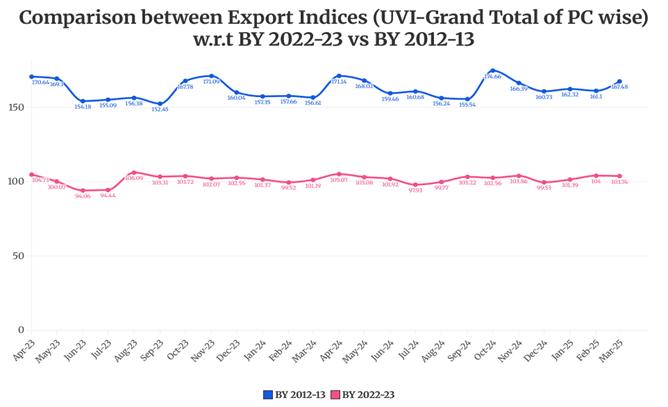
#BY means Base Year.
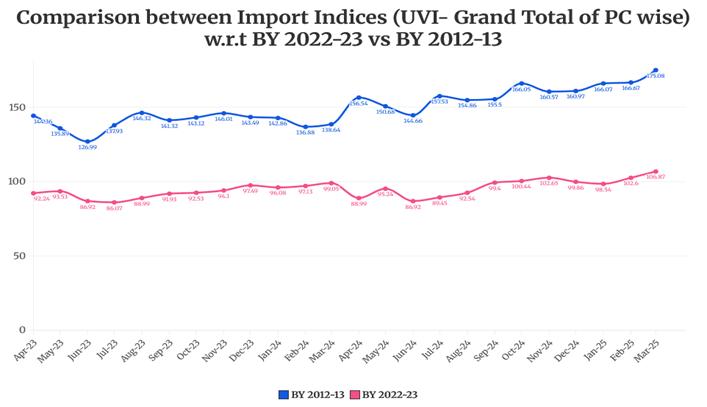
 

#BY means Base Year.

Table: Unit Value Index (UVI) and Quantity Index (QI) during FY 2025-26(Apr-Nov) using FY 2022-23 as base year


Month

Apr_25

May_25

Jun_25

1st Qtr 25-26

Jul_25

Aug_25

Sep_25

2nd Qtr 25-26

Oct_25

Nov_25

Unit Value Index

Export

105.31

99.73

96.31

100.33

99.31

100.55

104.08

101.23

103.78

105.32

Import

92.33

97.97

91.74

94.08

96.34

100.81

108.69

101.93

110.17

106.59

Quantity Index

Export

107.85

104.76

93.88

101.91

103.41

102.64

111.04

105.57

116.19

113.06

Import

138.16

126.61

112.58

125.17

122.47

124.06

126.45

124.32

137.04

121.75

Qtr  means Quarter.

Meaning and interpretation of the Indices

The Unit Value Indices and the Quantity Indices may be interpreted along the following lines.

The Unit Value Index answers the question: What is the growth in the average Unit Value of the items1 traded in the current month with respect to the same month in the Base Year?

So, an Unit Value Index of, say, 120 means that if the items that have been traded in the current month had been traded in the same month of the base year, and if the average price (or unit value) of those items had been Rs.100 in that month of the base year, then the average price (or unit value) of these items in the current month is Rs.120. Or that, there is a 20% increase in the average Unit Value, with respect to the Base Year, of the items that have been traded in the Current Month.

For example, let us suppose 30 items, 10 items each from 3 different Principal Commodities, have been traded in the current month. If these 30 items had been traded in the corresponding month of the base year at an average price of Rs.100, then the average price of these items in the current year is Rs.120.

It is to be noted that there are two successive steps of averaging done here. The first averaging is done over all the items (or ITCHS) of a PC group to arrive at the Index of that PC group. And the second averaging is done over all the PC groups to arrive at the Index at the Grand Total level for all commodities (which is the overall Index for India for a month). In both the stages, a weighted average is taken where the weights are proportional to the importance of the items and the PC groups respectively, and the Laspeyres Formula is used for averaging.

Quantity Indices, say, 200 means that if in the base year on an average 100 units were traded in India in the base year, then in the current year on an average 200 units were traded. However, it must be remembered that averaging quantities are different from averaging prices, since quantities in different units cannot be added directly.

So, the Quantity Indices are calculated by dividing the Value Indices by the Unit Value Indices. For example, if there is an increase in the Value of Export from Rs. 10,000 to Rs. 24,000, then the Value Index is 24000/10000 × 100 = 240. If the Unit Value Index is 120, then the Quantity Index comes to 240/120 × 100 = 200. So, loosely it can be said that, if the value of export has increased 2.4 times and the price of the commodities has increased 1.2 times, then the quantity must have doubled.

However, it may be noted that a very high or low Quantity Index may indicate the presence of Base Effect.

The Interpretation of the Bilateral and Regional Indices can be seen as an extension of the above.

A Unit Value Index of 120 with respect to a country, say Bangladesh, means that if all the items that have been traded with Bangladesh in the current month had been traded in the same month of the base year with the same country, and if the average price (or unit value) of those items had been Rs.100 in that month of the base year, then the average price (or unit value) of these items in the current month is Rs.120.

Similarly, a Quantity Index of 200 with respect to a country, say Bangladesh, means that if in the base year on an average 100 units were traded in India in the base year, then in the current year on an average 200 units were traded.

Comparability of the Indices across time

It is to be noted that the weights in the Index Number formula are fixed across time and there are twelve sets of weights for the twelve months. Hence, comparability of Indices is meaningful only when Indices of same month are compared across years. Different months may attach different weights to the same item, and hence comparing indices of two different months becomes vague and may have little applicability.

Further, the weights of the items that are not present in the trade basket of the current month are distributed to all the items that have been traded in the current month. This distribution is done in proportion to the weights of those items.

For example, let us suppose there are only 3 commodities for trade, say A, B and C. In month May of the Base year, let us suppose that the trade value of A was Rs. 50, B was Rs. 100 and C was Rs. 50. Then the weights assigned to A, B and C in the month of May of the following years would be in the ratio 50 :100 :50. However, in case, C is not traded in the current month, then the weight of C would be distributed proportionately among A and B, again in the ratio 1:2 (since in May the weights of A and B are in the ratio of 50 : 100, i.e., 1 : 2). So, in the current month the weights of A and B would be 3313  and 6623 .

As a result, the weights in any two given months are dependent on exactly the number of items (ITCHS codes) traded in those months. If the items traded are widely different, inference drawn from the comparison of the Indices may be done accordingly. On the other hand, more the similarity in the number of items traded more is the comparability of the two indices.

Net Terms of Trade:

Net Terms of Trade also called commodity Terms of Trade is defined as a ratio of export prices to import prices.

Let say 2022-23 be the base year and 2023-24 be the final year. We express both export and import prices in 2022-23 as 100. Now, suppose that at the end of 2023-24, it is found that the index of export prices decreased to 90 and index of import prices roses to 150. Then the Net Terms of Trade has changed to 90100150100=35 . Then terms of trade as index=35*100=60 . It implies that terms of trade of the country have decreased by about 40% in 2023-24 as compared with 2022-23. It thus shows a deterioration or a worsening of the terms of trade of the country.

If the index of export prices has risen to 150 and that of import prices had risen to 120, then the net terms of trade would have changed to 150120*100=125 . This implies an improvement in the net terms of trade of the country by 25% in 2023-24 over 2022-23.

Gross Terms of Trade:

Gross Terms of Trade is the ratio of physicalquantity of import to physical quantity of export.

Let say 2022-23 be the base year. In that year, the quantities export and import are denoted by 100. Now, suppose that in the year 2023-24, the index of quantity of import was 150 and that of quantity of export was 120. Then the gross terms of trade is given by 150100120100=54,  in terms of percentage =54*100=125 . This implies that there was an improvement of gross terms of trade by 25% in 2023-24 compared to 2022-23.

Income Terms of Trade: Income Terms of Trade is defined as- Net Terms of Trade multiplied by quantity of export.

Topics

Acts Income Tax
