

Loading...

Top
Help
×

By creating an account you can:

Logo TaxTMI
Call Us / Help / Feedback

Contact Us At :

E-mail: [email protected]

Call / WhatsApp at: +91 99117 96707

For more information, Check Contact Us

FAQs :

To know Frequently Asked Questions, Check FAQs

Most Asked Video Tutorials :

For more tutorials, Check Video Tutorials

Submit Feedback/Suggestion :

Email :
Please provide your email address so we can follow up on your feedback.
Category :
Description :
Min 15 characters 0/2000
Make Most of Text Search
  1. Checkout this video tutorial: How to search effectively on TaxTMI.
  2. Put words in double quotes for exact word search, eg: "income tax"
  3. Avoid noise words such as : 'and, of, the, a'
  4. Sort by Relevance to get the most relevant document.
  5. Press Enter to add multiple terms/multiple phrases, and then click on Search to Search.
  6. Text Search
  7. The system will try to fetch results that contains ALL your words.
  8. Once you add keywords, you'll see a new 'Search In' filter that makes your results even more precise.
  9. Text Search
Add to...
You have not created any category. Kindly create one to bookmark this item!
Create New Category
Hide
Title :
Description :
❮❮ Hide
Default View
Expand ❯❯
Close ✕
🔎 News - Adv. Search
TEXT SEARCH:

Press 'Enter' to add multiple search terms. Rules for Better Search

Search In:
Main Text + AI Text
  • Main Text
  • Main Text + AI Text
  • AI Text
Category: ?
Categorized by AI
---- All Categories ----
  • ---- All Categories ----
  • Income Tax
  • GST
  • Customs, DGFT & SEZ
  • FEMA & RBI
  • Corp. Laws, SEBI & IBC
  • PMLA, Black Money & ED
  • Budget
  • News and Press Release
  • PTI News
Month:
---- All Months ----
  • ---- All Months ----
  • January
  • February
  • March
  • April
  • May
  • June
  • July
  • August
  • September
  • October
  • November
  • December
Year:
---- All Years ----
  • ---- All Years ----
  • 2026
  • 2025
  • 2024
  • 2023
  • 2022
  • 2021
  • 2020
  • 2019
  • 2018
  • 2017
  • 2016
  • 2015
  • 2014
  • 2013
  • 2012
  • 2011
Sort By: ?
In Sort By 'Default', exact matches for text search are shown at the top, followed by the remaining results in their regular order.
Relevance Default Date
    Trump has other tariff options after Supreme Court strikes down his worldwide import taxes
    SC ruling on Trump's tariffs: Judge refers to tariffs imposed on India for buying Russian oil in dissenting note
    EU, US trade deals to boost Indian economy; growth resilient: RBI bulletin
    Supreme Court strikes down Trump's sweeping tariffs, upending central plank of economic agenda
    India’s macroeconomic fundamentals healthy, robust amid volatile financial markets: RBI guv
    Former Jaypee Infratech MD Manoj Gaur surrenders in Delhi's Tihar Jail
    Current policy rate appropriate amid buoyant eco growth, benign inflation: RBI Guv
    FTAs to play significant role in coming years by improving market access: RBI bulletin
    Sensex rebounds 316 pts, Nifty ends above 25,550; banks, metal stocks lead recovery
    India's forex kitty jumps USD 8.66 bn to record USD 725.72 bn
    India joins US-led 'Pax Silica' alliance to bolster AI and critical minerals supply chains
    Union Minister of Commerce and Industry Shri Piyush Goyal Launches Export Promotion Mission to Boost MSME Exports and Strengthen Global Competitivenes...
    Production Linked Incentive Scheme with ₹1.91 Lakh Crore Outlay Drives Strong Industry Participation Across 14 Strategic Sectors
    India-US interim trade pact likely to be operationalised in April, says commerce minister
    Officials of India and US to begin 3-day meet on Feb 23 to finalise legal text for interim trade pact
    When Investor Safety Meets Street Culture: NSDL Activation Draws Attention in Delhi
    GCCs to drive up to 50% of India office demand; US to dominate while UK & EU to gain share- says Colliers India
    Attention : Update on Advisory on Interest Collection and Related Enhancements in GSTR-3B
    Indian-origin lettings boss who wanted to run for London Mayor guilty of fraud
    Trump pushes trade, defence ties with B'desh as he congratulates new PM Rahman
❯❯
Maximize Maximize Maximize
0 / 200
Expand Note
Add to Folder

No Folders have been created

+

Are you sure you want to delete "My most important" ?

NOTE:

News
Showing Results for :
Reset Filters
Results Found:
Show All Summaries Hide All Summaries
February 20, 2026
Show AI Summary
Tariff authority options: multiple statutory pathways remain for imposing import duties despite limits on emergency powers.
After the court rejected the administration's emergency-based authority for sweeping reciprocal tariffs, the president can still impose import duties using alternative statutes: the Trade Act unfair-practices authority permitting unlimited tariffs after investigation and hearings; the Trade Act provision for addressing unbalanced trade that allows time-limited tariffs without prior investigation but is untested; the national-security tariff authority under the Trade Expansion Act which requires Commerce investigations; and a rarely used Tariff Act depression-era authorisation that allows very high, indefinite tariffs without investigation.
February 20, 2026
Show AI Summary
IEEPA authority questioned as tariffs ruled unauthorized; dissent stresses tariffs' foreign affairs leverage, including India example.
The decision holds that the International Emergency Economic Powers Act does not authorize the imposition of import duties, rejecting the use of IEEPA as a statutory basis for tariffs; a dissent argued such tariffs fall within foreign affairs practice, serve as leverage in international negotiations, and cautioned against applying a major questions constraint to executive statutory authority in national security and diplomatic contexts.
February 20, 2026
Show AI Summary
Trade deals improve market access and spur investor confidence, supporting growth and fiscal consolidation momentum.
Trade agreements with the EU and an interim US deal are expected to improve market access, boost export competitiveness, and reverse investor sentiment with renewed foreign portfolio investment into equity and debt. Fiscal consolidation alongside stepped up capital expenditure aims to crowd in private investment and support state infrastructure. Concurrently, the Reserve Bank recorded consecutive spot market dollar sales amid rupee volatility and capital flow intermittency, while inflation is expected to remain near target, sustaining a favourable near term growth-inflation balance.
February 20, 2026
Show AI Summary
Emergency powers limits curb broad presidential tariffs, invalidating sweeping reciprocal trade measures and reshaping trade policy authority.
The Supreme Court found that tariffs enacted under asserted emergency statutory powers-including widely applied reciprocal tariffs-exceeded the President's lawful authority, clarifying statutory limits on unilateral tariff measures and signaling judicial constraints on executive use of emergency powers for sweeping trade regulation.
February 20, 2026
Show AI Summary
Repo rate decision maintains neutral monetary stance as growth outlook brightens while inflation risks remain monitored.
The Monetary Policy Committee held the repo rate steady and retained a neutral stance, finding the current policy rate appropriate amid buoyant growth and broadly benign inflation. Members cited healthy medium term macroeconomic fundamentals and improving external outlook driven by trade agreements and fiscal measures, while noting persistent global volatility and risks to inflation. The MPC emphasized ongoing transmission of prior easing, awaited new GDP and inflation data series, and reaffirmed readiness to reassess policy as fresh data emerge.
February 20, 2026
Show AI Summary
Money laundering allegations prompt former MD to surrender to custody after interim bail term expires in fraud-linked probe.
Allegations of money laundering and diversion of homebuyer funds form the basis of an ED investigation and FIRs alleging that two group companies misapplied project receipts, leaving residential projects incomplete and purchasers defrauded. The promoter was arrested, obtained interim bail, and later surrendered after a court denied regular bail, the court noting allegations of widespread cheating and criminal breach of trust. A related listed company filed a regulatory update confirming the director's surrender upon expiration of interim bail.
February 20, 2026
Show AI Summary
Policy rate maintained as appropriate: neutral monetary stance justified by buoyant growth and benign inflation.
The Monetary Policy Committee voted to maintain the existing policy repo rate and retain a neutral stance, finding the current policy rate appropriate given buoyant growth and benign inflation. The Governor noted healthy medium term macroeconomic fundamentals, while the Deputy Governor cited upward revisions to near term growth projections and incomplete transmission of earlier rate cuts as reasons to defer further easing until new GDP and inflation series data are available.
February 20, 2026
Show AI Summary
Free trade agreements improving market access and export competitiveness, prompting investor confidence and supporting growth policy.
Free trade agreements with the EU and an interim pact with the US are expected to improve market access, enhance export competitiveness, and deepen Indian firms' integration into global value chains; this expectation has altered investor sentiment, prompting a return of foreign portfolio investment, while the Union Budget stresses fiscal consolidation alongside stepped up capital expenditure, and headline inflation remains benign under the revised CPI series.
February 20, 2026
Show AI Summary
Market rebound driven by banking and metal stock buying as trade deal signals and supply chain shifts lift sentiment.
Equity markets rebounded with strong buying in large-cap banking and metal stocks restoring benchmark indices to positive territory after a sharp correction. Broad sector participation favored Power, PSU Banks, Utilities, Capital Goods and Metals, while IT lagged. Sentiment was supported by trade-agreement signals and India's participation in Pax Silica, enhancing supply chain security for AI and semiconductors, even as elevated volatility and recent institutional net selling influenced near-term flow-driven moves.
February 20, 2026
Show AI Summary
Foreign exchange reserves rise to record level after gains in foreign currency assets and gold, RBI data shows
India's foreign exchange reserves rose to USD 725.727 billion in the week ended February 13, driven by increases in foreign currency assets (up USD 3.55 billion to USD 573.603 billion) and gold reserves (up USD 4.99 billion to USD 128.466 billion); SDRs increased by USD 103 million to USD 18.924 billion and the IMF reserve position rose by USD 19 million to USD 4.734 billion, with dollar reporting reflecting valuation effects of non US currency movements.
February 20, 2026
Show AI Summary
Supply chain security for critical minerals and AI strengthened as partners commit to trusted, diversified industrial cooperation.
India joined Pax Silica to build a resilient, trusted supply chain for critical minerals and AI, addressing over concentration and risks of economic coercion. The declaration commits partners to coordinated cooperation across the value chain-from raw materials and mineral processing through semiconductors and AI infrastructure-emphasising diversification, trusted industrial bases, workforce development, and a pro innovation approach that treats economic security as national security.
February 20, 2026
Show AI Summary
Export Promotion Mission expands MSME trade support with export factoring, e commerce credit and compliance facilitation.
The Export Promotion Mission deploys coordinated financial and ecosystem measures-under Niryat Protsahan and Niryat Disha-to strengthen MSME export competitiveness by reducing cost of capital, diversifying trade finance through export factoring and structured e commerce credit with interest subvention and partial guarantees, and by enhancing compliance capabilities, overseas warehousing, logistics reimbursements and trade intelligence to facilitate market entry and integration.
February 20, 2026
Show AI Summary
Production Linked Incentive scheme links incentives to incremental domestic production, deepening localisation and strengthening manufacturing competitiveness.
The Production Linked Incentive (PLI) Scheme links financial incentives to incremental domestic production over a defined base year, incentivising scale, technology adoption and domestic value addition across 14 strategic sectors. Operative approvals and performance metrics channel payments to approved applicants to deepen localisation, expand manufacturing capacity and integrate with global value chains; reported outcomes as of 31 December 2025 include 836 approved applications, cumulative rises in investment, production, exports, employment and disbursed incentives.
February 20, 2026
Show AI Summary
Interim India-US trade agreement likely operationalised in April after legal-text finalisation meeting, with related FTAs scheduled for implementation.
An interim trade agreement between India and the United States is expected to be signed in March and made operational in April after officials finalise the legal text; FTAs with the United Kingdom and Oman are likely to be implemented in April and a pact with New Zealand in September.
February 20, 2026
Show AI Summary
Interim trade agreement legal text to be finalised, codifying reciprocal tariff concessions and paving way for signature.
A three-day bilateral meeting will finalise the legal text converting the previously agreed framework into an interim trade agreement to be signed by the two governments; the agreement will codify reciprocal duty concessions and specific tariff adjustments, with the Indian negotiating team led by the chief negotiator.
February 20, 2026
Show AI Summary
Investor verification: public SEBI Check awareness activation promotes verification-first behaviour to reduce fraud and strengthen investor protection.
SEBI Check is a verification mechanism to confirm whether market entities are registered with the regulator, aimed at reducing impersonation and unregistered advisory fraud by promoting verification before investing. NSDL has advanced this objective through behavioural investor education-digital content, transit-led campaigns, and on-ground activations-culminating in a flash mob at Priya High Street that reinforced the green triangle thumbs-up symbol as a trust marker and used public-space storytelling to drive symbol recall and verification-first behaviour.
February 20, 2026
Show AI Summary
Trade agreements to reduce market barriers, spurring GCC expansion and materially boosting Grade A office demand in India.
Bilateral trade agreements with major partners are expected to reduce market barriers and tariffs, incentivizing multinational firms to expand India-based GCCs into higher value functions and thereby materially increase Grade A office demand across the top seven Indian markets; Colliers projects GCCs could account for a substantial share of future leasing while noting that benefits depend on finalisation and implementation of agreement details.
February 20, 2026
Show AI Summary
Interest computation in GSTR-3B updated; portal auto-populates minimum interest and permits CGST/SGST ITC for IGST liabilities.
From January-2026 the portal revises interest computation in GSTR-3B table 5.1 to deduct the minimum cash balance in the Electronic Cash Ledger from net tax liability for interest calculation; the computed interest is auto-populated as a non-editable minimum and taxpayers must self-assess upward if necessary. The portal will auto-populate the Tax Liability Breakup from GSTR-1/GSTR-1A/IFF document dates for prior-period supplies discharged in the current period, and once IGST ITC is exhausted allows use of CGST and SGST ITC in any sequence in Table 6.1. Interest on late final returns for cancelled taxpayers will be collected via GSTR-10.
February 19, 2026
Show AI Summary
Fraud in anticipation of winding-up: director diverted company funds after loss of control, now facing criminal and confiscation proceedings.
A director was convicted of fraud in anticipation of winding-up after transferring the company's bank funds to his personal account following appointment of a Law of Property Act receiver and the transfer of the company's assets and sole share to that Receiver. The jury rejected his claimed belief in entitlement to the funds. The Insolvency Service is pursuing confiscation under proceeds legislation, and the director remains disqualified with an indefinite suspension of bankruptcy discharge for noncooperation with the Official Receiver.
February 19, 2026
Show AI Summary
Trade agreement obligations require tariff cuts, import and defence commitments, triggering transparency and sovereignty concerns.
The bilateral package imposes binding commercial and defence commitments requiring tariff reductions, duty-free access for specified exports, mandated imports of US agricultural and energy commodities, and increased purchases of US military hardware while limiting procurement from certain other countries. The deals were negotiated under a Non-Disclosure Agreement, and commentators question whether an unelected interim government had authority to conclude secretive, long-term obligations without parliamentary oversight, raising transparency, fiscal stability, and sovereignty concerns.

News

Back

All News

Showing Results for :
Reset Filters
No Records Found

News

Showing Results for : Reset Filters
Customs, DGFT & SEZ

Directorate General of Commercial Intelligence and Statistics Revises Base Year of Merchandise Trade Indices to FY 2022–23 to Reflect Current Trade Structure and Global Patterns

February 21, 2026

Contents
Summary
Note

Note

-

Bookmark

Print

Print

Merchandise Trade Indices are compiled and published by the Directorate General of Commercial Intelligence and Statistics (DGCI&S), Ministry of Commerce & Industry, to measure changes in the unit values (prices) of India’s exports and imports over time. These indices serve as important indicators of external sector price movements and are widely used for economic analysis, including national accounts compilation and assessment of terms of trade. Over the years, the base year of the indices has been periodically revised to reflect structural changes in India’s trade composition and evolving global trade patterns. The most recent revision updates the base year to FY 2022–23 (2022–23 = 100), replacing the earlier base of FY 2012–13, thereby ensuring that the indices accurately represent the current structure of India’s merchandise trade.

Revision of Base Year of India’s Merchandise Trade Indices to FY 2022–23

The Directorate General of Commercial Intelligence and Statistics (DGCI&S), Ministry of Commerce & Industry, has revised the base year of India’s Merchandise Trade Indices from FY 2012–13 to FY 2022–23 (2022–23 = 100), in view of the structural changes in the economy, shifts in commodity composition, evolving trade patterns, and the need for improved alignment with contemporary macroeconomic indicators.

The revision has been undertaken on the recommendations of a committee constituted by DGCI&S under the Chairmanship of Prof. Nachiketa Chattopadhyay, Professor, Indian Statistical Institute, Kolkata. The Committee examined the existing methodology, data coverage, weighting structure, and compilation practices, and recommended suitable refinements in line with international best practices.

Key Features of the Revised Series (Base: FY 2022–23)

  1. Updated Base Year:
    The new base year FY 2022–23 makes the Indices reflect the current structure of India’s external trade more accurately.
  2. Revised Commodity Basket:
    The coverage and classification of commodities have been reviewed at the Principal Commodity level to better capture emerging and declining trade items.
  3. Revised Weighting Structure:
    Weights have been updated based on trade values of the new base year to reflect the latest value shares in exports and imports.
  4. Improved Methodology:
    Methodological refinements have been introduced in:
    1. Selection of common commodity basket for base year selection (procedure of selection for common commodity basket explained in detail report of the committee).
    2. Treatment of missing unit values (Imputation of missing unit values in base year selection have been explained in detail in the committee report).
  5. Indices Compiled:
    The revised series includes:
    1. Monthly, Quarterly and Annual Indices (Export Unit Value Index,Import Unit Value Index).
    2. Principal Commodity (PC) Classification wise Trade Indices (Export/Import).
    3. Standard International Trade Classification-wise (SITC) Trade Indices.
    4. Broad economic categories-wise (BEC) Trade Indices.
    5. Bilateral and Region-wise Trade Indices of Top 20 Export and Import partner nations of India.
    6. Terms of Trade (Gross terms of trade, Net terms of trade and Income terms of trade).

Rationale for Revision

Over the past decade, India’s trade basket has undergone substantial changes due to emergence of new commodities, technological advancements, Global supply chain restructuring and changes in relative price structures.

The earlier base year (FY 2012–13) no longer adequately reflected the prevailing trade structure. The revision ensures improved relevance, reliability, and analytical usefulness of the Merchandise Trade Indices for policymakers, researchers, and other stakeholders.

Use of the Revised Series

Merchandise Trade Indices compiled by the Directorate General of Commercial Intelligence and Statistics (DGCI&S) are extensively used by key government institutions for economic analysis and policy formulation. The National Accounts Division (NAD) of the Ministry of Statistics and Programme Implementation uses the Export and Import Unit Value Indices as deflators for estimating real exports and imports in GDP compilation. The Reserve Bank of India (RBI) relies on these indices for external sector assessment, balance of payments analysis, and evaluation of price competitiveness. Various Ministries and Government agencies also use them to frame and review trade-related policies and to assess movements in international prices. In addition, academic institutions, research organizations, and economic analysts utilize Merchandise Trade Indices for empirical research, modelling, and analysis of trade dynamics and terms of trade trendson and economic research.

Availability of Data

The revised Merchandise Trade Indices (Base: FY 2022–23) will be released on the official website of DGCI&S. Detailed methodological documentation is available in the Report of the Committee on Revision of Base Year for Merchandise Trade Indices.

Comparison of the new revised Indices (Base Year: 2022-23) with the already released Indices (Base Year : 2012-13) for 2022-23 and 2023-24 is given below.
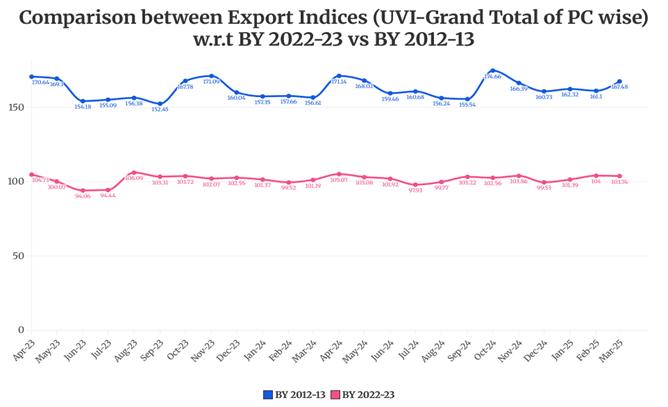
#BY means Base Year.
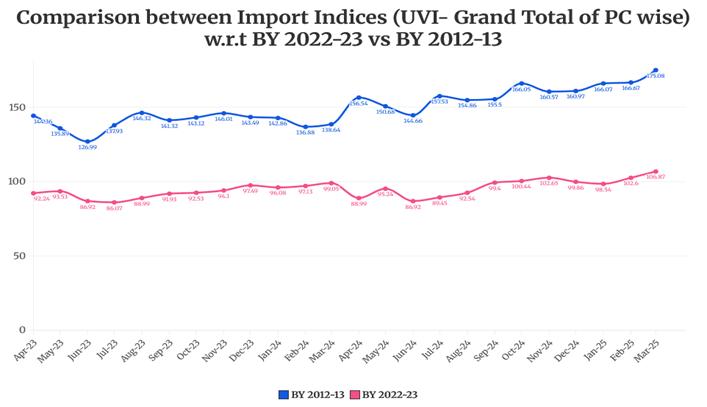
 

#BY means Base Year.

Table: Unit Value Index (UVI) and Quantity Index (QI) during FY 2025-26(Apr-Nov) using FY 2022-23 as base year


Month

Apr_25

May_25

Jun_25

1st Qtr 25-26

Jul_25

Aug_25

Sep_25

2nd Qtr 25-26

Oct_25

Nov_25

Unit Value Index

Export

105.31

99.73

96.31

100.33

99.31

100.55

104.08

101.23

103.78

105.32

Import

92.33

97.97

91.74

94.08

96.34

100.81

108.69

101.93

110.17

106.59

Quantity Index

Export

107.85

104.76

93.88

101.91

103.41

102.64

111.04

105.57

116.19

113.06

Import

138.16

126.61

112.58

125.17

122.47

124.06

126.45

124.32

137.04

121.75

Qtr  means Quarter.

Meaning and interpretation of the Indices

The Unit Value Indices and the Quantity Indices may be interpreted along the following lines.

The Unit Value Index answers the question: What is the growth in the average Unit Value of the items1 traded in the current month with respect to the same month in the Base Year?

So, an Unit Value Index of, say, 120 means that if the items that have been traded in the current month had been traded in the same month of the base year, and if the average price (or unit value) of those items had been Rs.100 in that month of the base year, then the average price (or unit value) of these items in the current month is Rs.120. Or that, there is a 20% increase in the average Unit Value, with respect to the Base Year, of the items that have been traded in the Current Month.

For example, let us suppose 30 items, 10 items each from 3 different Principal Commodities, have been traded in the current month. If these 30 items had been traded in the corresponding month of the base year at an average price of Rs.100, then the average price of these items in the current year is Rs.120.

It is to be noted that there are two successive steps of averaging done here. The first averaging is done over all the items (or ITCHS) of a PC group to arrive at the Index of that PC group. And the second averaging is done over all the PC groups to arrive at the Index at the Grand Total level for all commodities (which is the overall Index for India for a month). In both the stages, a weighted average is taken where the weights are proportional to the importance of the items and the PC groups respectively, and the Laspeyres Formula is used for averaging.

Quantity Indices, say, 200 means that if in the base year on an average 100 units were traded in India in the base year, then in the current year on an average 200 units were traded. However, it must be remembered that averaging quantities are different from averaging prices, since quantities in different units cannot be added directly.

So, the Quantity Indices are calculated by dividing the Value Indices by the Unit Value Indices. For example, if there is an increase in the Value of Export from Rs. 10,000 to Rs. 24,000, then the Value Index is 24000/10000 × 100 = 240. If the Unit Value Index is 120, then the Quantity Index comes to 240/120 × 100 = 200. So, loosely it can be said that, if the value of export has increased 2.4 times and the price of the commodities has increased 1.2 times, then the quantity must have doubled.

However, it may be noted that a very high or low Quantity Index may indicate the presence of Base Effect.

The Interpretation of the Bilateral and Regional Indices can be seen as an extension of the above.

A Unit Value Index of 120 with respect to a country, say Bangladesh, means that if all the items that have been traded with Bangladesh in the current month had been traded in the same month of the base year with the same country, and if the average price (or unit value) of those items had been Rs.100 in that month of the base year, then the average price (or unit value) of these items in the current month is Rs.120.

Similarly, a Quantity Index of 200 with respect to a country, say Bangladesh, means that if in the base year on an average 100 units were traded in India in the base year, then in the current year on an average 200 units were traded.

Comparability of the Indices across time

It is to be noted that the weights in the Index Number formula are fixed across time and there are twelve sets of weights for the twelve months. Hence, comparability of Indices is meaningful only when Indices of same month are compared across years. Different months may attach different weights to the same item, and hence comparing indices of two different months becomes vague and may have little applicability.

Further, the weights of the items that are not present in the trade basket of the current month are distributed to all the items that have been traded in the current month. This distribution is done in proportion to the weights of those items.

For example, let us suppose there are only 3 commodities for trade, say A, B and C. In month May of the Base year, let us suppose that the trade value of A was Rs. 50, B was Rs. 100 and C was Rs. 50. Then the weights assigned to A, B and C in the month of May of the following years would be in the ratio 50 :100 :50. However, in case, C is not traded in the current month, then the weight of C would be distributed proportionately among A and B, again in the ratio 1:2 (since in May the weights of A and B are in the ratio of 50 : 100, i.e., 1 : 2). So, in the current month the weights of A and B would be 3313  and 6623 .

As a result, the weights in any two given months are dependent on exactly the number of items (ITCHS codes) traded in those months. If the items traded are widely different, inference drawn from the comparison of the Indices may be done accordingly. On the other hand, more the similarity in the number of items traded more is the comparability of the two indices.

Net Terms of Trade:

Net Terms of Trade also called commodity Terms of Trade is defined as a ratio of export prices to import prices.

Let say 2022-23 be the base year and 2023-24 be the final year. We express both export and import prices in 2022-23 as 100. Now, suppose that at the end of 2023-24, it is found that the index of export prices decreased to 90 and index of import prices roses to 150. Then the Net Terms of Trade has changed to 90100150100=35 . Then terms of trade as index=35*100=60 . It implies that terms of trade of the country have decreased by about 40% in 2023-24 as compared with 2022-23. It thus shows a deterioration or a worsening of the terms of trade of the country.

If the index of export prices has risen to 150 and that of import prices had risen to 120, then the net terms of trade would have changed to 150120*100=125 . This implies an improvement in the net terms of trade of the country by 25% in 2023-24 over 2022-23.

Gross Terms of Trade:

Gross Terms of Trade is the ratio of physicalquantity of import to physical quantity of export.

Let say 2022-23 be the base year. In that year, the quantities export and import are denoted by 100. Now, suppose that in the year 2023-24, the index of quantity of import was 150 and that of quantity of export was 120. Then the gross terms of trade is given by 150100120100=54,  in terms of percentage =54*100=125 . This implies that there was an improvement of gross terms of trade by 25% in 2023-24 compared to 2022-23.

Income Terms of Trade: Income Terms of Trade is defined as- Net Terms of Trade multiplied by quantity of export.

Topics

Acts Income Tax
