

Loading...

Top
Help
×

By creating an account you can:

Logo TaxTMI
Call Us / Help / Feedback

Contact Us At :

E-mail: [email protected]

Call / WhatsApp at: +91 99117 96707

For more information, Check Contact Us

FAQs :

To know Frequently Asked Questions, Check FAQs

Most Asked Video Tutorials :

For more tutorials, Check Video Tutorials

Submit Feedback/Suggestion :

Email :
Please provide your email address so we can follow up on your feedback.
Category :
Description :
Min 15 characters 0/2000
Make Most of Text Search
  1. Checkout this video tutorial: How to search effectively on TaxTMI.
  2. Put words in double quotes for exact word search, eg: "income tax"
  3. Avoid noise words such as : 'and, of, the, a'
  4. Sort by Relevance to get the most relevant document.
  5. Press Enter to add multiple terms/multiple phrases, and then click on Search to Search.
  6. Text Search
  7. The system will try to fetch results that contains ALL your words.
  8. Once you add keywords, you'll see a new 'Search In' filter that makes your results even more precise.
  9. Text Search
Add to...
You have not created any category. Kindly create one to bookmark this item!
Create New Category
Hide
Title :
Description :
❮❮ Hide
Default View
Expand ❯❯
Close ✕
🔎 News - Adv. Search
TEXT SEARCH:

Press 'Enter' to add multiple search terms. Rules for Better Search

Search In:
Main Text + AI Text
  • Main Text
  • Main Text + AI Text
  • AI Text
Category: ?
Categorized by AI
---- All Categories ----
  • ---- All Categories ----
  • Income Tax
  • GST
  • Customs, DGFT & SEZ
  • FEMA & RBI
  • Corp. Laws, SEBI & IBC
  • PMLA, Black Money & ED
  • Budget
  • News and Press Release
  • PTI News
Month:
---- All Months ----
  • ---- All Months ----
  • January
  • February
  • March
  • April
  • May
  • June
  • July
  • August
  • September
  • October
  • November
  • December
Year:
---- All Years ----
  • ---- All Years ----
  • 2026
  • 2025
  • 2024
  • 2023
  • 2022
  • 2021
  • 2020
  • 2019
  • 2018
  • 2017
  • 2016
  • 2015
  • 2014
  • 2013
  • 2012
  • 2011
Sort By: ?
In Sort By 'Default', exact matches for text search are shown at the top, followed by the remaining results in their regular order.
Relevance Default Date
    Minutes of the Monetary Policy Committee Meeting, February 4 to 6, 2026 [Under Section 45ZL of the Reserve Bank of India Act, 1934]
    US trade deal has become an ordeal: Congress slams PM Modi
    Nothing changes, India will be paying tariffs; we will not be paying tariffs: Trump after SC ruling
    Trump seethes over Supreme Court justices who opposed him on tariffs, especially those he appointed
    The Latest: Trump says he'll sign executive order to enact 10 per cent global tariff
    Which Trump tariffs did Supreme Court strike down? Here's what to know
    The Latest: Trump addresses press after Supreme Court strikes down his sweeping tariffs
    No change in trade deal with India; it is on: Trump after SC verdict
    Trump says he used tariffs to end war between India, Pakistan as he lashes out at US Supreme Court verdict
    Trump says he'll sign executive order to enact 10 per cent global tariff after US Supreme Court defeat,
    Trump says he's 'absolutely ashamed' of US Supreme Court justices who issued 'deeply disappointing'  tariff decision
    Congress slams govt for agreeing to trade deal after US Supreme Court strikes down Trump's tariffs
    Refunds may be available on some tariffs applied to goods from India: US Chamber of Commerce after SC ruling
    What to know about the Supreme Court ruling on tariffs
    Trump's made tariffs central to his presidency, chaos may come next
    The Supreme Court struck down some of Trump's most sweeping tariffs; Which levies are impacted?
    'Walking away' from recent deals does not seem to be in cards for America's partners: Ex-trade official
    Exporters hail US Supreme Court's decision on Trump tariff
    Trump has other tariff options after Supreme Court strikes down his worldwide import taxes
    SC ruling on Trump's tariffs: Judge refers to tariffs imposed on India for buying Russian oil in dissenting note
❯❯
Maximize Maximize Maximize
0 / 200
Expand Note
Add to Folder

No Folders have been created

+

Are you sure you want to delete "My most important" ?

NOTE:

News
Showing Results for :
Reset Filters
Results Found:
Show All Summaries Hide All Summaries
February 21, 2026
Show AI Summary
Policy repo rate unchanged; MPC retains neutral stance as inflation stays benign while growth outlook strengthens.
Under Section 45ZL the MPC's minutes record a unanimous decision to keep the policy repo rate unchanged and to retain the neutral stance after reviewing staff projections, surveys and alternative risk scenarios. The committee judged growth prospects to have strengthened while headline inflation remains benign though modestly revised upward for near quarters due mainly to precious metals; risks to the outlook are broadly balanced and policy will be guided by incoming data and the progress of transmission.
February 21, 2026
Show AI Summary
Constitutional limits on presidential tariff power overturned global tariffs, reshaping the interim India-US trade deal consequences.
The US Supreme Court invalidated the President's global tariffs imposed under emergency powers, finding tariff authority lies with Congress; the decision undercuts executive unilateral tariff measures. The India-US interim agreement saw an Executive Order lifting prior punitive tariffs in return for India's energy purchasing commitments, and a reduced reciprocal tariff rate was agreed. Indian political opposition alleges the deal's timing reflected executive haste that risked sovereign bargaining leverage and domestic agricultural interests.
February 21, 2026
Show AI Summary
Presidential tariff authority curtailed; temporary global import duty imposed to rebalance trade while India trade framework remains intact.
The Supreme Court held that the President exceeded authority in imposing sweeping tariffs; in response the President signed a Proclamation imposing a temporary import duty to address international payments problems and rebalance trade relationships, effective on a specified date for a limited period. The President stated that an interim trade framework with India remains in place, removing certain punitive tariffs on India under an Executive Order while asserting India will assume tariff obligations under the bilateral arrangement.
February 21, 2026
Show AI Summary
Emergency powers tariffs invalidation prompts presidential denunciation of justices and raises separation of powers and institutional independence debate.
Six justices invalidated presidential global tariffs imposed under an asserted emergency powers statute, framing the central legal question as the permissible scope of executive authority to impose trade restrictions without clear congressional authorization, and the litigation tested statutory delegation, administrative action in the trade context, and judicial review of national-security framed economic measures.
February 21, 2026
Show AI Summary
Emergency power limits prompt alternative executive tariff action, raising concerns about agriculture costs and trade uncertainty.
The Supreme Court invalidated a presidential tariff framework as an unlawful exercise of emergency power, leading the president to announce use of alternative executive authority to impose a temporary global tariff. Stakeholders warned that further tariff actions or use of other authorities would increase agricultural input costs and create trade uncertainty, while business groups said ties with trade partners remain intact despite the disruption.
February 21, 2026
Show AI Summary
Presidential emergency powers curtailed as court invalidates broad tariffs imposed under IEEPA, overturning central global levies.
The Supreme Court found the President exceeded authority under the International Emergency Economic Powers Act by using IEEPA to impose broad tariffs, invalidating core IEEPA-based measures including the Liberation Day global tariff framework and subsequent trafficking and country-specific levies on Canada, Mexico, China, Brazil and India; sectoral and non-IEEPA tariffs remain in place while the executive considers alternative measures.
February 21, 2026
Show AI Summary
Executive emergency tariff authority limited, prompting administration to pursue alternative statutory bases for imposing tariffs.
The Supreme Court concluded that the Constitution vests the taxing power in Congress and that the emergency statute invoked by the Executive does not authorize imposition of tariffs as revenue measures, constraining executive emergency tariff authority; the administration plans to rely on alternative statutory bases to replace the invalidated tariffs.
February 21, 2026
Show AI Summary
Tariff policy remains central as the India trade arrangement continues despite judicial limits on tariff authority.
President Trump stated the bilateral trade arrangement with India remains in effect after the Supreme Court invalidated his broad tariffs, noting an Executive Order rescinded punitive tariffs on Indian oil imports from Russia and an Interim Agreement framework reduces reciprocal U.S. tariff treatment toward India while maintaining tariffs on Indian imports under the new terms; he framed tariffs as leverage for energy-sourcing commitments and de-escalation between India and Pakistan.
February 21, 2026
Show AI Summary
IEEPA authority rejected, limiting tariff powers while administration decries the decision and cites geopolitical effects.
The Supreme Court held that the International Emergency Economic Powers Act does not authorize imposition of duties, constraining executive authority to impose tariffs under national emergencies; the President criticized the ruling and reiterated that tariffs were used as a foreign policy tool to end hostilities between India and Pakistan, a claim denied by India which attributes cessation to direct military talks.
February 21, 2026
Show AI Summary
Global tariff authority challenged after court invalidated emergency-use tariffs; president plans executive-order, time-limited alternative.
A judicial body invalidated a broad presidential program of global tariffs as an unlawful exercise of emergency power, eliminating the administration's primary emergency-based mechanism for imposing unilateral worldwide duties. The president announced intent to use an alternative statutory authority via executive order that would impose time-limited tariffs restricted to 150 days, signaling a shift to a different administrative vehicle for trade measures.
February 21, 2026
Show AI Summary
Emergency powers invalidation limits executive authority to impose unilateral tariffs, nullifying sweeping reciprocal import duties.
The executive's imposition of sweeping "reciprocal" import duties under a claimed emergency powers statute was found unlawful; the tariffs were invalidated because setting import duties required clear congressional authorization rather than unilateral emergency proclamations, signaling a legal limit on executive authority to alter statutory tariff schemes by emergency declaration.
February 21, 2026
Show AI Summary
Judicial review of emergency tariff powers restores congressional tariff authority, affecting recently announced India-US trade concessions.
The US Supreme Court struck down President Trump's global tariffs imposed under emergency powers, finding tariff authority lies with Congress, thereby removing the legal basis for those sweeping reciprocal tariffs. Indian opposition leaders contend that a recently announced India-US trade framework contained concessions extracted while the tariffs were assumed valid, and they seek clarity on whether those commitments-covering tariff eliminations, import targets, energy sourcing, and non tariff barrier commitments-will persist or be revisited following the judgment.
February 20, 2026
Show AI Summary
IEEPA authority invalidated - certain IEEPA based tariffs now refundable to importers who directly paid them.
IEEPA based tariffs were deemed impermissible, allowing refunds only to US importers of record or consignees who directly paid tariffs. Eligible tariffs include IEEPA imposed levies commonly termed fentanyl, trafficking, reciprocal or baseline tariffs, including certain tariffs on goods from Brazil and India. Refunds exclude duties imposed under other statutory authorities such as anti dumping, countervailing, trade remedy or national security provisions. The administrative procedure and timing for claims remain uncertain pending further court and executive guidance.
February 20, 2026
Show AI Summary
Presidential emergency powers limited: IEEPA cannot be used to impose broad import tariffs, leaving refund questions open.
The Supreme Court concluded that the International Emergency Economic Powers Act does not authorize the president to impose broad import tariffs, stressing that authority to levy taxes and tariffs rests with Congress and that longstanding practice shows such power has not been exercised under IEEPA. The opinion invalidates tariffs enacted under emergency proclamations while leaving untouched tariffs based on other statutory grounds, and it leaves unresolved whether and how refunds should be returned to importers who paid the challenged levies.
February 20, 2026
Show AI Summary
Presidential emergency tariff power invalidated, forcing alternative legal routes and prolonging trade and political uncertainty.
The Court held the president lacked authority to declare an economic emergency and impose sweeping import tariffs, removing an executive legal basis for those tariffs and forcing the administration to pursue alternative statutory mechanisms, which will prolong legal and political debate over trade policy.
February 20, 2026
Show AI Summary
IEEPA authority curtailed: major emergency based tariffs invalidated, leaving sectoral trade measures and exemptions intact.
The President exceeded statutory authority by invoking IEEPA to impose broad import tariffs, nullifying core emergency based levies. Affected measures include the wide ranging "Liberation Day" tariffs, trafficking justified duties on Canada, Mexico and China, Brazil linked duties, and India related levies tied to Russian oil purchases. The decision removes the IEEPA route for economy wide tariffs but leaves intact sectoral and statute specific tools that continue to impose tariffs on selected industries and products.
February 20, 2026
Show AI Summary
IEEPA authority struck down; partners unlikely to abandon recent tariff deals, administration to rely on other statutes.
The Supreme Court invalidated reliance on the International Emergency Economic Powers Act (IEEPA) to impose broad tariffs, finding IEEPA does not authorize such duties. Observers anticipate the Administration will instead invoke clear congressional tariff statutes and that trading partners who made recent deals are unlikely to withdraw them, having expected alternative statutory mechanisms to keep tariffs in place.
February 20, 2026
Show AI Summary
Emergency-powers tariff invalidation restores trade predictability for exporters, but sectoral steel and aluminium duties remain in force.
The US Supreme Court invalidated country-specific reciprocal tariffs imposed under emergency powers, restoring predictability for exporters and enabling importers to seek refunds for duties paid under the invalidated regime, while separate sector-specific duties on steel, aluminium and certain auto components remain in force.
February 20, 2026
Show AI Summary
Tariff authority options: multiple statutory pathways remain for imposing import duties despite limits on emergency powers.
After the court rejected the administration's emergency-based authority for sweeping reciprocal tariffs, the president can still impose import duties using alternative statutes: the Trade Act unfair-practices authority permitting unlimited tariffs after investigation and hearings; the Trade Act provision for addressing unbalanced trade that allows time-limited tariffs without prior investigation but is untested; the national-security tariff authority under the Trade Expansion Act which requires Commerce investigations; and a rarely used Tariff Act depression-era authorisation that allows very high, indefinite tariffs without investigation.
February 20, 2026
Show AI Summary
IEEPA authority questioned as tariffs ruled unauthorized; dissent stresses tariffs' foreign affairs leverage, including India example.
The decision holds that the International Emergency Economic Powers Act does not authorize the imposition of import duties, rejecting the use of IEEPA as a statutory basis for tariffs; a dissent argued such tariffs fall within foreign affairs practice, serve as leverage in international negotiations, and cautioned against applying a major questions constraint to executive statutory authority in national security and diplomatic contexts.

News

Back

All News

Showing Results for :
Reset Filters
No Records Found

News

Showing Results for : Reset Filters
Customs, DGFT & SEZ

Directorate General of Commercial Intelligence and Statistics Revises Base Year of Merchandise Trade Indices to FY 2022–23 to Reflect Current Trade Structure and Global Patterns

February 21, 2026

Contents
Summary
Note

Note

-

Bookmark

Print

Print

Merchandise Trade Indices are compiled and published by the Directorate General of Commercial Intelligence and Statistics (DGCI&S), Ministry of Commerce & Industry, to measure changes in the unit values (prices) of India’s exports and imports over time. These indices serve as important indicators of external sector price movements and are widely used for economic analysis, including national accounts compilation and assessment of terms of trade. Over the years, the base year of the indices has been periodically revised to reflect structural changes in India’s trade composition and evolving global trade patterns. The most recent revision updates the base year to FY 2022–23 (2022–23 = 100), replacing the earlier base of FY 2012–13, thereby ensuring that the indices accurately represent the current structure of India’s merchandise trade.

Revision of Base Year of India’s Merchandise Trade Indices to FY 2022–23

The Directorate General of Commercial Intelligence and Statistics (DGCI&S), Ministry of Commerce & Industry, has revised the base year of India’s Merchandise Trade Indices from FY 2012–13 to FY 2022–23 (2022–23 = 100), in view of the structural changes in the economy, shifts in commodity composition, evolving trade patterns, and the need for improved alignment with contemporary macroeconomic indicators.

The revision has been undertaken on the recommendations of a committee constituted by DGCI&S under the Chairmanship of Prof. Nachiketa Chattopadhyay, Professor, Indian Statistical Institute, Kolkata. The Committee examined the existing methodology, data coverage, weighting structure, and compilation practices, and recommended suitable refinements in line with international best practices.

Key Features of the Revised Series (Base: FY 2022–23)

  1. Updated Base Year:
    The new base year FY 2022–23 makes the Indices reflect the current structure of India’s external trade more accurately.
  2. Revised Commodity Basket:
    The coverage and classification of commodities have been reviewed at the Principal Commodity level to better capture emerging and declining trade items.
  3. Revised Weighting Structure:
    Weights have been updated based on trade values of the new base year to reflect the latest value shares in exports and imports.
  4. Improved Methodology:
    Methodological refinements have been introduced in:
    1. Selection of common commodity basket for base year selection (procedure of selection for common commodity basket explained in detail report of the committee).
    2. Treatment of missing unit values (Imputation of missing unit values in base year selection have been explained in detail in the committee report).
  5. Indices Compiled:
    The revised series includes:
    1. Monthly, Quarterly and Annual Indices (Export Unit Value Index,Import Unit Value Index).
    2. Principal Commodity (PC) Classification wise Trade Indices (Export/Import).
    3. Standard International Trade Classification-wise (SITC) Trade Indices.
    4. Broad economic categories-wise (BEC) Trade Indices.
    5. Bilateral and Region-wise Trade Indices of Top 20 Export and Import partner nations of India.
    6. Terms of Trade (Gross terms of trade, Net terms of trade and Income terms of trade).

Rationale for Revision

Over the past decade, India’s trade basket has undergone substantial changes due to emergence of new commodities, technological advancements, Global supply chain restructuring and changes in relative price structures.

The earlier base year (FY 2012–13) no longer adequately reflected the prevailing trade structure. The revision ensures improved relevance, reliability, and analytical usefulness of the Merchandise Trade Indices for policymakers, researchers, and other stakeholders.

Use of the Revised Series

Merchandise Trade Indices compiled by the Directorate General of Commercial Intelligence and Statistics (DGCI&S) are extensively used by key government institutions for economic analysis and policy formulation. The National Accounts Division (NAD) of the Ministry of Statistics and Programme Implementation uses the Export and Import Unit Value Indices as deflators for estimating real exports and imports in GDP compilation. The Reserve Bank of India (RBI) relies on these indices for external sector assessment, balance of payments analysis, and evaluation of price competitiveness. Various Ministries and Government agencies also use them to frame and review trade-related policies and to assess movements in international prices. In addition, academic institutions, research organizations, and economic analysts utilize Merchandise Trade Indices for empirical research, modelling, and analysis of trade dynamics and terms of trade trendson and economic research.

Availability of Data

The revised Merchandise Trade Indices (Base: FY 2022–23) will be released on the official website of DGCI&S. Detailed methodological documentation is available in the Report of the Committee on Revision of Base Year for Merchandise Trade Indices.

Comparison of the new revised Indices (Base Year: 2022-23) with the already released Indices (Base Year : 2012-13) for 2022-23 and 2023-24 is given below.
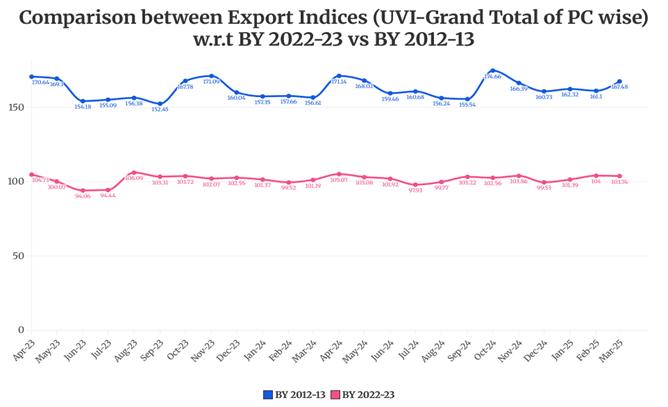
#BY means Base Year.
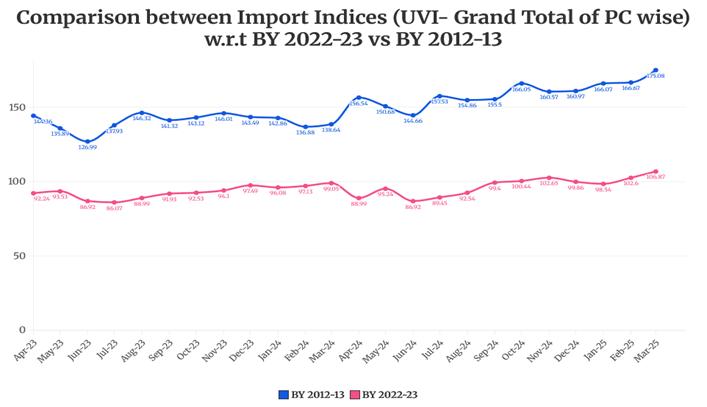
 

#BY means Base Year.

Table: Unit Value Index (UVI) and Quantity Index (QI) during FY 2025-26(Apr-Nov) using FY 2022-23 as base year


Month

Apr_25

May_25

Jun_25

1st Qtr 25-26

Jul_25

Aug_25

Sep_25

2nd Qtr 25-26

Oct_25

Nov_25

Unit Value Index

Export

105.31

99.73

96.31

100.33

99.31

100.55

104.08

101.23

103.78

105.32

Import

92.33

97.97

91.74

94.08

96.34

100.81

108.69

101.93

110.17

106.59

Quantity Index

Export

107.85

104.76

93.88

101.91

103.41

102.64

111.04

105.57

116.19

113.06

Import

138.16

126.61

112.58

125.17

122.47

124.06

126.45

124.32

137.04

121.75

Qtr  means Quarter.

Meaning and interpretation of the Indices

The Unit Value Indices and the Quantity Indices may be interpreted along the following lines.

The Unit Value Index answers the question: What is the growth in the average Unit Value of the items1 traded in the current month with respect to the same month in the Base Year?

So, an Unit Value Index of, say, 120 means that if the items that have been traded in the current month had been traded in the same month of the base year, and if the average price (or unit value) of those items had been Rs.100 in that month of the base year, then the average price (or unit value) of these items in the current month is Rs.120. Or that, there is a 20% increase in the average Unit Value, with respect to the Base Year, of the items that have been traded in the Current Month.

For example, let us suppose 30 items, 10 items each from 3 different Principal Commodities, have been traded in the current month. If these 30 items had been traded in the corresponding month of the base year at an average price of Rs.100, then the average price of these items in the current year is Rs.120.

It is to be noted that there are two successive steps of averaging done here. The first averaging is done over all the items (or ITCHS) of a PC group to arrive at the Index of that PC group. And the second averaging is done over all the PC groups to arrive at the Index at the Grand Total level for all commodities (which is the overall Index for India for a month). In both the stages, a weighted average is taken where the weights are proportional to the importance of the items and the PC groups respectively, and the Laspeyres Formula is used for averaging.

Quantity Indices, say, 200 means that if in the base year on an average 100 units were traded in India in the base year, then in the current year on an average 200 units were traded. However, it must be remembered that averaging quantities are different from averaging prices, since quantities in different units cannot be added directly.

So, the Quantity Indices are calculated by dividing the Value Indices by the Unit Value Indices. For example, if there is an increase in the Value of Export from Rs. 10,000 to Rs. 24,000, then the Value Index is 24000/10000 × 100 = 240. If the Unit Value Index is 120, then the Quantity Index comes to 240/120 × 100 = 200. So, loosely it can be said that, if the value of export has increased 2.4 times and the price of the commodities has increased 1.2 times, then the quantity must have doubled.

However, it may be noted that a very high or low Quantity Index may indicate the presence of Base Effect.

The Interpretation of the Bilateral and Regional Indices can be seen as an extension of the above.

A Unit Value Index of 120 with respect to a country, say Bangladesh, means that if all the items that have been traded with Bangladesh in the current month had been traded in the same month of the base year with the same country, and if the average price (or unit value) of those items had been Rs.100 in that month of the base year, then the average price (or unit value) of these items in the current month is Rs.120.

Similarly, a Quantity Index of 200 with respect to a country, say Bangladesh, means that if in the base year on an average 100 units were traded in India in the base year, then in the current year on an average 200 units were traded.

Comparability of the Indices across time

It is to be noted that the weights in the Index Number formula are fixed across time and there are twelve sets of weights for the twelve months. Hence, comparability of Indices is meaningful only when Indices of same month are compared across years. Different months may attach different weights to the same item, and hence comparing indices of two different months becomes vague and may have little applicability.

Further, the weights of the items that are not present in the trade basket of the current month are distributed to all the items that have been traded in the current month. This distribution is done in proportion to the weights of those items.

For example, let us suppose there are only 3 commodities for trade, say A, B and C. In month May of the Base year, let us suppose that the trade value of A was Rs. 50, B was Rs. 100 and C was Rs. 50. Then the weights assigned to A, B and C in the month of May of the following years would be in the ratio 50 :100 :50. However, in case, C is not traded in the current month, then the weight of C would be distributed proportionately among A and B, again in the ratio 1:2 (since in May the weights of A and B are in the ratio of 50 : 100, i.e., 1 : 2). So, in the current month the weights of A and B would be 3313  and 6623 .

As a result, the weights in any two given months are dependent on exactly the number of items (ITCHS codes) traded in those months. If the items traded are widely different, inference drawn from the comparison of the Indices may be done accordingly. On the other hand, more the similarity in the number of items traded more is the comparability of the two indices.

Net Terms of Trade:

Net Terms of Trade also called commodity Terms of Trade is defined as a ratio of export prices to import prices.

Let say 2022-23 be the base year and 2023-24 be the final year. We express both export and import prices in 2022-23 as 100. Now, suppose that at the end of 2023-24, it is found that the index of export prices decreased to 90 and index of import prices roses to 150. Then the Net Terms of Trade has changed to 90100150100=35 . Then terms of trade as index=35*100=60 . It implies that terms of trade of the country have decreased by about 40% in 2023-24 as compared with 2022-23. It thus shows a deterioration or a worsening of the terms of trade of the country.

If the index of export prices has risen to 150 and that of import prices had risen to 120, then the net terms of trade would have changed to 150120*100=125 . This implies an improvement in the net terms of trade of the country by 25% in 2023-24 over 2022-23.

Gross Terms of Trade:

Gross Terms of Trade is the ratio of physicalquantity of import to physical quantity of export.

Let say 2022-23 be the base year. In that year, the quantities export and import are denoted by 100. Now, suppose that in the year 2023-24, the index of quantity of import was 150 and that of quantity of export was 120. Then the gross terms of trade is given by 150100120100=54,  in terms of percentage =54*100=125 . This implies that there was an improvement of gross terms of trade by 25% in 2023-24 compared to 2022-23.

Income Terms of Trade: Income Terms of Trade is defined as- Net Terms of Trade multiplied by quantity of export.

Topics

Acts Income Tax
