

Loading...

Top
Help
×

By creating an account you can:

Logo TaxTMI
Call Us / Help / Feedback

Contact Us At :

E-mail: [email protected]

Call / WhatsApp at: +91 99117 96707

For more information, Check Contact Us

FAQs :

To know Frequently Asked Questions, Check FAQs

Most Asked Video Tutorials :

For more tutorials, Check Video Tutorials

Submit Feedback/Suggestion :

Email :
Please provide your email address so we can follow up on your feedback.
Category :
Description :
Min 15 characters 0/2000
Make Most of Text Search
  1. Checkout this video tutorial: How to search effectively on TaxTMI.
  2. Put words in double quotes for exact word search, eg: "income tax"
  3. Avoid noise words such as : 'and, of, the, a'
  4. Sort by Relevance to get the most relevant document.
  5. Press Enter to add multiple terms/multiple phrases, and then click on Search to Search.
  6. Text Search
  7. The system will try to fetch results that contains ALL your words.
  8. Once you add keywords, you'll see a new 'Search In' filter that makes your results even more precise.
  9. Text Search
Add to...
You have not created any category. Kindly create one to bookmark this item!
Create New Category
Hide
Title :
Description :
❮❮ Hide
Default View
Expand ❯❯
Close ✕
🔎 News - Adv. Search
TEXT SEARCH:

Press 'Enter' to add multiple search terms. Rules for Better Search

Search In:
Main Text + AI Text
  • Main Text
  • Main Text + AI Text
  • AI Text
Category: ?
Categorized by AI
---- All Categories ----
  • ---- All Categories ----
  • Income Tax
  • GST
  • Customs, DGFT & SEZ
  • FEMA & RBI
  • Corp. Laws, SEBI & IBC
  • PMLA, Black Money & ED
  • Budget
  • News and Press Release
  • PTI News
Month:
---- All Months ----
  • ---- All Months ----
  • January
  • February
  • March
  • April
  • May
  • June
  • July
  • August
  • September
  • October
  • November
  • December
Year:
---- All Years ----
  • ---- All Years ----
  • 2026
  • 2025
  • 2024
  • 2023
  • 2022
  • 2021
  • 2020
  • 2019
  • 2018
  • 2017
  • 2016
  • 2015
  • 2014
  • 2013
  • 2012
  • 2011
Sort By: ?
In Sort By 'Default', exact matches for text search are shown at the top, followed by the remaining results in their regular order.
Relevance Default Date
    US futures, bitcoin fall, Asian markets mixed after Supreme Court nixes Trump's tariffs
    Stock markets trade higher in early session tracking rally in Asian peers
    INDEX OF EIGHT CORE INDUSTRIES (BASE YEAR: 2011-12=100) FOR JANUARY, 2026.
    Rupee rises 21 paise to 90.73 against the US dollar in early trade
    US futures fall while Asian markets are mostly higher after the Supreme Court nixes Trump's tariffs
    Indo-US deal against country’s honour, sovereignty: Congress’ Shrinate
    EU says US must honour a trade deal after court blocks Trump tariffs
    EU-India FTA opens doors to trade, AI, resilient supply chains: Austrian official
    'Don't share OTP, Aadhaar, bank details': PM Modi's tips on combating digital fraud
    ED sets target of filing 500 chargesheets this fiscal; completing probe in 1-2 years
    India, US reschedule chief negotiators meeting on interim trade deal: Sources
    SC to hear Meta-WhatsApp privacy policy case on Monday
    Supreme Court ruling offers little relief for Republicans divided on Trump's tariffs
    Trump says he'll raise tariffs to 15 per cent after Supreme Court ruling
    Trump announces hike in tariffs to 15 pc on all countries
    Cheating case: Delhi court refuses bail to businessman Satya Prakash Bagla
    Trump now hikes global tariffs 15 pc, up from 10 pc; US to announce new levies soon
    President Trump wants to impose 15% tariff, up from 10% he announced after Supreme Court decision
    President Trump wants to impose 15 pc tariff, up from 10 pc he announced after Supreme Court decision
    Modi, Lula discuss US supreme court striking down reciprocal tariffs; set USD 30 bn annual trade target
❯❯
Maximize Maximize Maximize
0 / 200
Expand Note
Add to Folder

No Folders have been created

+

Are you sure you want to delete "My most important" ?

NOTE:

News
Showing Results for :
Reset Filters
Results Found:
Show All Summaries Hide All Summaries
February 23, 2026
Show AI Summary
Tariff authority curtailed, prompting mixed market moves and heightened regulatory uncertainty across trade, crypto, and commodities.
The cancellation of broad presidential import levies removed a central trade policy instrument and prompted immediate market adjustments: equity futures fell, Asian indices were mixed, bitcoin dropped sharply, and precious metals rose. The incumbent plans alternative measures, including a global tariff via executive order and Commerce Department investigations, leaving trade policy and market expectations uncertain while growth, inflation, and corporate guidance continue to influence volatility.
February 23, 2026
Show AI Summary
Illegality of presidential tariffs undermines executive tariff authority, prompting legal challenges and reshaping trade negotiation dynamics.
The judicial invalidation of the presidential tariff program undercuts executive unilateral tariff authority and invites legal challenges to successor emergency tariff measures, prompting reassessment of trade negotiations and reliance on discretionary tariffs without concrete balance of payments predicates.
February 23, 2026
Show AI Summary
Index of Eight Core Industries shows overall growth, with cement and steel leading while oil and gas sectors decline.
The combined Index of Eight Core Industries rose provisionally by 4.0 per cent year on year in January 2026, with Cement, Steel, Electricity, Fertilizers and Coal recording positive monthly growth while Crude Oil and Natural Gas declined and Refinery Products remained unchanged. The cumulative April-January 2025-26 growth is reported as 2.8 per cent (provisional). The release provides industry weights, monthly and annual indices, notes that January data are provisional and December data final, and explains methodological inclusions and revision practice.
February 23, 2026
Show AI Summary
Foreign exchange volatility: rupee strengthened after oil-led dollar weakness, while reserve gains and capital flows shape market risk.
The rupee strengthened in early trade due to lower global crude prices and a softer dollar amid tariff-related uncertainty, aided by a strong equity opening; persistent dollar-buying sentiment and foreign institutional outflows could reintroduce selling pressure. The Reserve Bank of India's rise in foreign exchange reserves to a record level is a material macroprudential indicator affecting market liquidity and perceived intervention capacity under FEMA and central bank reserve management frameworks.
February 23, 2026
Show AI Summary
Supreme Court rejection of sweeping tariffs reshapes import-tax authority and prompts pursuit of alternative tariff mechanisms.
The Supreme Court struck down the majority of the President's broad import tariffs, prompting varied market reactions as investors repriced winners and losers; the administration announced alternative measures including an executive-order global tariff and use of Commerce Department trade-investigation authorities, preserving the prospect of import taxation while altering statutory mechanism and temporal limits.
February 22, 2026
Show AI Summary
Sovereignty concerns over Indo US trade agreement; alleged tariff and procurement conditions threaten national, energy and data autonomy.
Allegations that an interim trade arrangement with the United States compromises national sovereignty and domestic interests by conceding tariff advantages and large import commitments, harming agriculture and industry. The pact is criticized for limiting energy procurement choices and creating dependency by discouraging purchases from alternative suppliers, thereby threatening energy security and raising inflationary pressure. Concerns also focus on obligations affecting data sovereignty, which are said to risk exposing sensitive data to foreign access.
February 22, 2026
Show AI Summary
Trade commitments: EU urges US to honour agreed tariff ceiling and warns of anti-coercion countermeasures and uncertainty.
EU urges the United States to adhere to the trans Atlantic trade agreement and not exceed the agreed tariff ceiling, warning that unpredictable tariff changes harm trade stability and supply chains. The EU noted it may pause ratification and could deploy its Anti Coercion Instrument-permitting trade and investment restrictions, exclusions from public tenders, and limits on foreign direct investment-to defend its interests if commitments are not honoured.
February 22, 2026
Show AI Summary
EU-India free trade agreement expands trade and AI cooperation and strengthens supply chain resilience pending final ratification.
The EU India Free Trade Agreement substantially liberalises tariffs across the majority of bilateral trade to expand market access, while prioritising cooperation on human centred artificial intelligence and promoting interdependent, resilient supply chains; the agreement is subject to final legal vetting and ratification before implementation.
February 22, 2026
Show AI Summary
Digital fraud prevention: protect accounts by not sharing OTP or Aadhaar and using authorised re KYC channels.
Individuals must not share OTP, Aadhaar numbers, or bank account details and should change passwords regularly. KYC and re KYC are security measures that must be undertaken only via bank branches, official apps, or authorised platforms because criminals use fake calls, SMS and links to compromise accounts.
February 22, 2026
Show AI Summary
PMLA enforcement targets accelerate investigations and timely prosecution filings, urging probes to finish within a short defined timeframe.
The Enforcement Directorate directed acceleration of PMLA prosecutions by increasing prosecution filings and concluding most investigations within one to two years, except in complex cases. Officers must exercise PMLA powers with caution, ensure legally sustainable attachments and penalties, and issue notices judiciously. Operational priorities include tracing illicit assets abroad, targeting misuse of trade channels and insolvency processes for laundering, prioritising digital arrest and cyber fraud work, checking illegal online gaming and share market manipulation, leveraging MLATs, Interpol and extradition, and completing pending FERA adjudications while addressing manpower, cooperation and valuation challenges.
February 22, 2026
Show AI Summary
Trade tariffs altered by recent court ruling disrupt interim trade agreement negotiations and prompt rescheduling of chief negotiators' meeting.
The meeting of chief negotiators was postponed to permit assessment of a court ruling limiting executive tariff authority and subsequent US tariff adjustments, which have introduced uncertainty into agreed concessions under the interim trade framework. The framework must be converted into a legal instrument, but finalisation of the legal text and implementation timelines are deferred pending clarification of how additional US tariff layers will interact with existing Most Favoured Nation duties and the ultimate tariff treatment for the partner country.
February 22, 2026
Show AI Summary
Data privacy: Appeals on platform data sharing penalty and consent safeguards to be heard, with government party added.
Appeals challenge a CCI penalty and limits on platform data sharing under privacy and competition law; an appellate tribunal removed a ban on advertising related data sharing but retained the penalty. The dispute centers on consent standards, protection of dependent or unaware users, and whether platform data aggregation creates market dominance. Procedural issues include interim directions, inclusion of the technology ministry as a party, and a cross appeal by the regulator against the tribunal's narrowing of remedies.
February 22, 2026
Show AI Summary
Congressional authority over tariffs affirmed, but executive invoked temporary trade statute to impose new global import tax.
A majority of justices held that the power to levy tariffs is vested in Congress, voiding a major part of the presidential global tariff program; the President then invoked the Trade Act's temporary emergency authority to impose a new short-term global import tax, a provision never previously used this way, raising questions about the statute's reach and prompting political fallout, calls for consumer refunds, and intensified partisan divisions over trade policy.
February 21, 2026
Show AI Summary
Tariff authority: President seeks to impose a higher global tariff using alternate legal powers after court rebuke.
The President seeks to impose a higher global tariff relying on alternative executive authority and statutory avenues requiring Commerce Department investigations, while a separate executive order established a temporary import tax limited in duration and contingent on legislative extension; this raises constitutional questions about the allocation of tariff-setting and taxation powers and uncertainty over funds already collected.
February 21, 2026
Show AI Summary
Presidential tariff authority raised a temporary global import surcharge, altering trade deal dynamics and exemptions for critical goods.
The executive invoked trade act authority to impose a temporary global import surcharge, increasing a recently announced ad valorem levy and reserving the right to issue further legally permissible tariffs within a 150 day period; the proclamation excludes specified critical minerals, energy products, select agricultural goods, pharmaceuticals, certain electronics, passenger vehicles and aerospace products, and the surcharge is applied in addition to existing Most Favoured Nation import duties, affecting ongoing bilateral trade negotiations.
February 21, 2026
Show AI Summary
Criminal breach of trust: bail denied due to complex fund diversion, risk of evidence tampering and undisclosed antecedents.
Refusal of bail rested on prima facie findings that the NBFC owner-director engaged in calculated, layered diversion of investor funds amounting to criminal breach of trust; investigation remained at a nascent stage with a complex money trail requiring forensic analysis and a real risk of evidence tampering, compounded by the applicant's non-disclosure of prior criminal antecedents and insufficient medical justification.
February 21, 2026
Show AI Summary
Presidential authority on emergency economic powers challenged; administration announces higher worldwide import levies pending new tariff rules.
President announced an immediate increase in the worldwide import surcharge to a higher legally framed rate and stated the administration will determine new legally permissible tariffs; this follows a Supreme Court decision holding that reliance on IEEPA to impose sweeping duties exceeded presidential authority and has affected bilateral tariff arrangements under an interim trade framework with India.
February 21, 2026
Show AI Summary
Presidential tariff authority to impose global import taxes expanded via executive order, with temporary duration and statutory investigations.
The President announced an increase in a global import tariff implemented by an executive order designed to bypass ordinary congressional action and operate for a limited temporary period unless extended by legislation; concurrently, the administration is pursuing additional tariff measures under federal statutes that require Commerce Department investigations and administrative determinations.
February 21, 2026
Show AI Summary
Presidential tariff authority contested; executive order raises global import tariff after review of recent legal limitation.
After a judicial ruling that his emergency powers did not authorize sweeping tariffs, the President signed an executive order bypassing Congress to impose a temporary global import tax limited to 150 days unless extended by legislation; following review of the court decision he announced an upward adjustment to the proposed global tariff rate.
February 21, 2026
Show AI Summary
Reciprocal tariffs: leaders agree to study implications and adopt a wait-and-watch approach while boosting strategic trade ties.
Discussion focused on the trade-policy implications of a major US decision affecting reciprocal tariffs, with both leaders adopting a "wait-and-watch" posture to study potential US administrative responses. Parallel measures included a pact on critical minerals to build resilient supply chains, a joint digital partnership declaration, and multiple MoUs covering mining, MSMEs, healthcare, defence maintenance cooperation, and technology and energy collaboration.

News

Back

All News

Showing Results for :
Reset Filters
No Records Found

News

Showing Results for : Reset Filters
Customs, DGFT & SEZ

Directorate General of Commercial Intelligence and Statistics Revises Base Year of Merchandise Trade Indices to FY 2022–23 to Reflect Current Trade Structure and Global Patterns

February 21, 2026

Contents
Summary
Note

Note

-

Bookmark

Print

Print

Merchandise Trade Indices are compiled and published by the Directorate General of Commercial Intelligence and Statistics (DGCI&S), Ministry of Commerce & Industry, to measure changes in the unit values (prices) of India’s exports and imports over time. These indices serve as important indicators of external sector price movements and are widely used for economic analysis, including national accounts compilation and assessment of terms of trade. Over the years, the base year of the indices has been periodically revised to reflect structural changes in India’s trade composition and evolving global trade patterns. The most recent revision updates the base year to FY 2022–23 (2022–23 = 100), replacing the earlier base of FY 2012–13, thereby ensuring that the indices accurately represent the current structure of India’s merchandise trade.

Revision of Base Year of India’s Merchandise Trade Indices to FY 2022–23

The Directorate General of Commercial Intelligence and Statistics (DGCI&S), Ministry of Commerce & Industry, has revised the base year of India’s Merchandise Trade Indices from FY 2012–13 to FY 2022–23 (2022–23 = 100), in view of the structural changes in the economy, shifts in commodity composition, evolving trade patterns, and the need for improved alignment with contemporary macroeconomic indicators.

The revision has been undertaken on the recommendations of a committee constituted by DGCI&S under the Chairmanship of Prof. Nachiketa Chattopadhyay, Professor, Indian Statistical Institute, Kolkata. The Committee examined the existing methodology, data coverage, weighting structure, and compilation practices, and recommended suitable refinements in line with international best practices.

Key Features of the Revised Series (Base: FY 2022–23)

  1. Updated Base Year:
    The new base year FY 2022–23 makes the Indices reflect the current structure of India’s external trade more accurately.
  2. Revised Commodity Basket:
    The coverage and classification of commodities have been reviewed at the Principal Commodity level to better capture emerging and declining trade items.
  3. Revised Weighting Structure:
    Weights have been updated based on trade values of the new base year to reflect the latest value shares in exports and imports.
  4. Improved Methodology:
    Methodological refinements have been introduced in:
    1. Selection of common commodity basket for base year selection (procedure of selection for common commodity basket explained in detail report of the committee).
    2. Treatment of missing unit values (Imputation of missing unit values in base year selection have been explained in detail in the committee report).
  5. Indices Compiled:
    The revised series includes:
    1. Monthly, Quarterly and Annual Indices (Export Unit Value Index,Import Unit Value Index).
    2. Principal Commodity (PC) Classification wise Trade Indices (Export/Import).
    3. Standard International Trade Classification-wise (SITC) Trade Indices.
    4. Broad economic categories-wise (BEC) Trade Indices.
    5. Bilateral and Region-wise Trade Indices of Top 20 Export and Import partner nations of India.
    6. Terms of Trade (Gross terms of trade, Net terms of trade and Income terms of trade).

Rationale for Revision

Over the past decade, India’s trade basket has undergone substantial changes due to emergence of new commodities, technological advancements, Global supply chain restructuring and changes in relative price structures.

The earlier base year (FY 2012–13) no longer adequately reflected the prevailing trade structure. The revision ensures improved relevance, reliability, and analytical usefulness of the Merchandise Trade Indices for policymakers, researchers, and other stakeholders.

Use of the Revised Series

Merchandise Trade Indices compiled by the Directorate General of Commercial Intelligence and Statistics (DGCI&S) are extensively used by key government institutions for economic analysis and policy formulation. The National Accounts Division (NAD) of the Ministry of Statistics and Programme Implementation uses the Export and Import Unit Value Indices as deflators for estimating real exports and imports in GDP compilation. The Reserve Bank of India (RBI) relies on these indices for external sector assessment, balance of payments analysis, and evaluation of price competitiveness. Various Ministries and Government agencies also use them to frame and review trade-related policies and to assess movements in international prices. In addition, academic institutions, research organizations, and economic analysts utilize Merchandise Trade Indices for empirical research, modelling, and analysis of trade dynamics and terms of trade trendson and economic research.

Availability of Data

The revised Merchandise Trade Indices (Base: FY 2022–23) will be released on the official website of DGCI&S. Detailed methodological documentation is available in the Report of the Committee on Revision of Base Year for Merchandise Trade Indices.

Comparison of the new revised Indices (Base Year: 2022-23) with the already released Indices (Base Year : 2012-13) for 2022-23 and 2023-24 is given below.
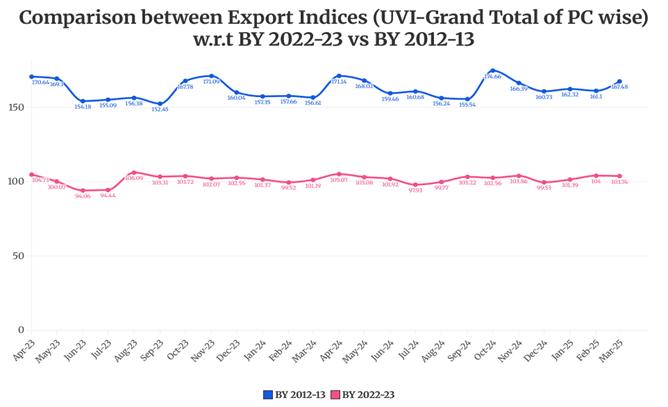
#BY means Base Year.
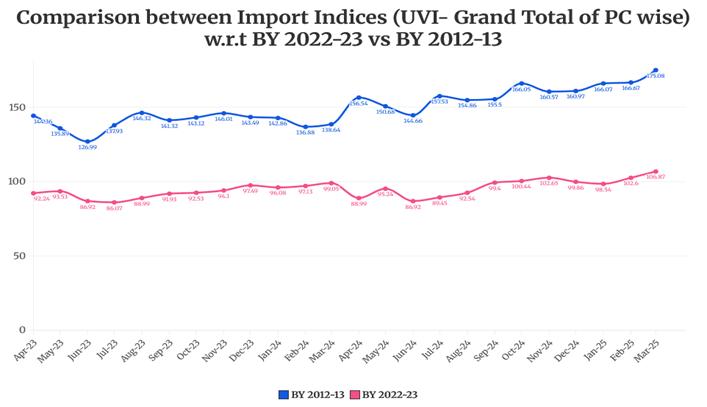
 

#BY means Base Year.

Table: Unit Value Index (UVI) and Quantity Index (QI) during FY 2025-26(Apr-Nov) using FY 2022-23 as base year


Month

Apr_25

May_25

Jun_25

1st Qtr 25-26

Jul_25

Aug_25

Sep_25

2nd Qtr 25-26

Oct_25

Nov_25

Unit Value Index

Export

105.31

99.73

96.31

100.33

99.31

100.55

104.08

101.23

103.78

105.32

Import

92.33

97.97

91.74

94.08

96.34

100.81

108.69

101.93

110.17

106.59

Quantity Index

Export

107.85

104.76

93.88

101.91

103.41

102.64

111.04

105.57

116.19

113.06

Import

138.16

126.61

112.58

125.17

122.47

124.06

126.45

124.32

137.04

121.75

Qtr  means Quarter.

Meaning and interpretation of the Indices

The Unit Value Indices and the Quantity Indices may be interpreted along the following lines.

The Unit Value Index answers the question: What is the growth in the average Unit Value of the items1 traded in the current month with respect to the same month in the Base Year?

So, an Unit Value Index of, say, 120 means that if the items that have been traded in the current month had been traded in the same month of the base year, and if the average price (or unit value) of those items had been Rs.100 in that month of the base year, then the average price (or unit value) of these items in the current month is Rs.120. Or that, there is a 20% increase in the average Unit Value, with respect to the Base Year, of the items that have been traded in the Current Month.

For example, let us suppose 30 items, 10 items each from 3 different Principal Commodities, have been traded in the current month. If these 30 items had been traded in the corresponding month of the base year at an average price of Rs.100, then the average price of these items in the current year is Rs.120.

It is to be noted that there are two successive steps of averaging done here. The first averaging is done over all the items (or ITCHS) of a PC group to arrive at the Index of that PC group. And the second averaging is done over all the PC groups to arrive at the Index at the Grand Total level for all commodities (which is the overall Index for India for a month). In both the stages, a weighted average is taken where the weights are proportional to the importance of the items and the PC groups respectively, and the Laspeyres Formula is used for averaging.

Quantity Indices, say, 200 means that if in the base year on an average 100 units were traded in India in the base year, then in the current year on an average 200 units were traded. However, it must be remembered that averaging quantities are different from averaging prices, since quantities in different units cannot be added directly.

So, the Quantity Indices are calculated by dividing the Value Indices by the Unit Value Indices. For example, if there is an increase in the Value of Export from Rs. 10,000 to Rs. 24,000, then the Value Index is 24000/10000 × 100 = 240. If the Unit Value Index is 120, then the Quantity Index comes to 240/120 × 100 = 200. So, loosely it can be said that, if the value of export has increased 2.4 times and the price of the commodities has increased 1.2 times, then the quantity must have doubled.

However, it may be noted that a very high or low Quantity Index may indicate the presence of Base Effect.

The Interpretation of the Bilateral and Regional Indices can be seen as an extension of the above.

A Unit Value Index of 120 with respect to a country, say Bangladesh, means that if all the items that have been traded with Bangladesh in the current month had been traded in the same month of the base year with the same country, and if the average price (or unit value) of those items had been Rs.100 in that month of the base year, then the average price (or unit value) of these items in the current month is Rs.120.

Similarly, a Quantity Index of 200 with respect to a country, say Bangladesh, means that if in the base year on an average 100 units were traded in India in the base year, then in the current year on an average 200 units were traded.

Comparability of the Indices across time

It is to be noted that the weights in the Index Number formula are fixed across time and there are twelve sets of weights for the twelve months. Hence, comparability of Indices is meaningful only when Indices of same month are compared across years. Different months may attach different weights to the same item, and hence comparing indices of two different months becomes vague and may have little applicability.

Further, the weights of the items that are not present in the trade basket of the current month are distributed to all the items that have been traded in the current month. This distribution is done in proportion to the weights of those items.

For example, let us suppose there are only 3 commodities for trade, say A, B and C. In month May of the Base year, let us suppose that the trade value of A was Rs. 50, B was Rs. 100 and C was Rs. 50. Then the weights assigned to A, B and C in the month of May of the following years would be in the ratio 50 :100 :50. However, in case, C is not traded in the current month, then the weight of C would be distributed proportionately among A and B, again in the ratio 1:2 (since in May the weights of A and B are in the ratio of 50 : 100, i.e., 1 : 2). So, in the current month the weights of A and B would be 3313  and 6623 .

As a result, the weights in any two given months are dependent on exactly the number of items (ITCHS codes) traded in those months. If the items traded are widely different, inference drawn from the comparison of the Indices may be done accordingly. On the other hand, more the similarity in the number of items traded more is the comparability of the two indices.

Net Terms of Trade:

Net Terms of Trade also called commodity Terms of Trade is defined as a ratio of export prices to import prices.

Let say 2022-23 be the base year and 2023-24 be the final year. We express both export and import prices in 2022-23 as 100. Now, suppose that at the end of 2023-24, it is found that the index of export prices decreased to 90 and index of import prices roses to 150. Then the Net Terms of Trade has changed to 90100150100=35 . Then terms of trade as index=35*100=60 . It implies that terms of trade of the country have decreased by about 40% in 2023-24 as compared with 2022-23. It thus shows a deterioration or a worsening of the terms of trade of the country.

If the index of export prices has risen to 150 and that of import prices had risen to 120, then the net terms of trade would have changed to 150120*100=125 . This implies an improvement in the net terms of trade of the country by 25% in 2023-24 over 2022-23.

Gross Terms of Trade:

Gross Terms of Trade is the ratio of physicalquantity of import to physical quantity of export.

Let say 2022-23 be the base year. In that year, the quantities export and import are denoted by 100. Now, suppose that in the year 2023-24, the index of quantity of import was 150 and that of quantity of export was 120. Then the gross terms of trade is given by 150100120100=54,  in terms of percentage =54*100=125 . This implies that there was an improvement of gross terms of trade by 25% in 2023-24 compared to 2022-23.

Income Terms of Trade: Income Terms of Trade is defined as- Net Terms of Trade multiplied by quantity of export.

Topics

Acts Income Tax
