

Loading...

Top
Help
×

By creating an account you can:

Logo TaxTMI
Call Us / Help / Feedback

Contact Us At :

E-mail: [email protected]

Call / WhatsApp at: +91 99117 96707

For more information, Check Contact Us

FAQs :

To know Frequently Asked Questions, Check FAQs

Most Asked Video Tutorials :

For more tutorials, Check Video Tutorials

Submit Feedback/Suggestion :

Email :
Please provide your email address so we can follow up on your feedback.
Category :
Description :
Min 15 characters 0/2000
Make Most of Text Search
  1. Checkout this video tutorial: How to search effectively on TaxTMI.
  2. Put words in double quotes for exact word search, eg: "income tax"
  3. Avoid noise words such as : 'and, of, the, a'
  4. Sort by Relevance to get the most relevant document.
  5. Press Enter to add multiple terms/multiple phrases, and then click on Search to Search.
  6. Text Search
  7. The system will try to fetch results that contains ALL your words.
  8. Once you add keywords, you'll see a new 'Search In' filter that makes your results even more precise.
  9. Text Search
Add to...
You have not created any category. Kindly create one to bookmark this item!
Create New Category
Hide
Title :
Description :
❮❮ Hide
Default View
Expand ❯❯
Close ✕
🔎 News - Adv. Search
TEXT SEARCH:

Press 'Enter' to add multiple search terms. Rules for Better Search

Search In:
Main Text + AI Text
  • Main Text
  • Main Text + AI Text
  • AI Text
Category: ?
Categorized by AI
---- All Categories ----
  • ---- All Categories ----
  • Income Tax
  • GST
  • Customs, DGFT & SEZ
  • FEMA & RBI
  • Corp. Laws, SEBI & IBC
  • PMLA, Black Money & ED
  • Budget
  • News and Press Release
  • PTI News
Month:
---- All Months ----
  • ---- All Months ----
  • January
  • February
  • March
  • April
  • May
  • June
  • July
  • August
  • September
  • October
  • November
  • December
Year:
---- All Years ----
  • ---- All Years ----
  • 2026
  • 2025
  • 2024
  • 2023
  • 2022
  • 2021
  • 2020
  • 2019
  • 2018
  • 2017
  • 2016
  • 2015
  • 2014
  • 2013
  • 2012
  • 2011
Sort By: ?
In Sort By 'Default', exact matches for text search are shown at the top, followed by the remaining results in their regular order.
Relevance Default Date
    India emerges as key diesel supplier to Europe as Russian, US flows falter
    Trump keeps heralding an economic boom, but even a solid jobs report is causing problems for him
    Telangana CM urges TCS'' HyperVault to launch its Hyderabad AI data centre by June 2028
    CBI FIR against Subhash Chandra for 'inflating' net worth to secure Rs 980 Cr in loans
    TCS subsidiary HyperVault to invest Rs 70,000 cr to develop Hyderabad AI data centre
    CBI FIR against Subhash Chandra for 'inflation' of net worth to secure nearly Rs 1,000-cr in loans
    Union Minister of Commerce & Industry Shri Piyush Goyal Calls for Nationwide FTA Utilisation Drive to Expand India’s Global Trade Footprint
    Union Minister of Commerce & Industry Shri Piyush Goyal Calls Upon Automotive Industry to Deepen Localisation, Expand Exports and Prepare to Serve Glo...
    GeM and Textiles Committee Sign MoU to Boost Procurement of Recycled and Upcycled Textiles
    India–EU FTA Opens Huge Opportunities for Farmers, MSMEs, Innovators, Startups and Businesses in India and Europe: Commerce and Industry Minister Sh...
    First Batch of Corporate Mitra Course Commences with 2879 Learners registered
    NFRA Constitutes Advisory Committee on Audit Quality, Assurance and Technology
    ED arrests ex-panchayat CEO who allotted govt funds for fake marriages during COVID lockdown
    Goyal blames market conditions for Jet Airways' downfall; ED says he 'bled airline to death'
    Rupee rises 8 paise to close at 94.43 against US dollar
    NSE gets regulatory nod for Rs 30,000 cr IPO, the biggest so far
    Sensex rebounds 362 pts, snaps 4-day losses on strong rally in metal, oil shares
    Forex kitty jumps USD 11.47 bn to fresh all-time high of USD 740.8 bn
    NSE gets Sebi nod for Rs 30,000-cr IPO, one of India's largest public issues
    'Policing the Republic': Book traces history of personal security, from Pharaohs to presidents
❯❯
Maximize Maximize Maximize
0 / 200
Expand Note
Add to Folder

No Folders have been created

+

Are you sure you want to delete "My most important" ?

NOTE:

News
Showing Results for :
Reset Filters
Results Found:
Show All Summaries Hide All Summaries
September 6, 2026
Show AI Summary
European diesel supply dependence on alternative refiners grows amid constrained exports, weakening transatlantic flows, and restricted shipping routes.
European diesel supply is becoming increasingly dependent on Indian refining capacity as Russian diesel and gasoil exports remain constrained by export restrictions, refinery disruptions and port outages, while US shipments to Europe have weakened. Alternative supply routes offer limited additional clean-product volumes because reduced tanker crossings and lower ship-to-ship transfers offshore Oman constrain flows through the Strait of Hormuz. Low diesel inventories, seasonal demand and planned refinery maintenance increase exposure to supply disruptions.
September 5, 2026
Show AI Summary
Tariff-driven inflation and elevated borrowing costs constrain growth, while durable deficit reduction may require spending restraint and tax increases.
Persistent inflation, elevated interest rates and rising public debt constrain economic growth policy. Tariffs and oil shortages are identified as contributing to inflationary pressures, while lower interest rates could increase money flows and worsen inflation. Tariffs, tax cuts, artificial intelligence productivity gains and anti-fraud measures are advanced as mechanisms to support growth, investment and domestic employment. Fiscal sustainability, however, cannot be achieved through growth alone where social security and healthcare costs exceed revenue growth; deficit reduction may require slower spending, spending reductions and tax increases.
September 5, 2026
Show AI Summary
AI data centre development receives state support for a high-capacity campus and accelerated commissioning timetable.
HyperVault's proposed artificial-intelligence data-centre campus in Hyderabad is planned on 264 acres, with investment projected at up to Rs 70,000 crore and capacity of up to 1 GW. The campus is intended to provide high-density, liquid-cooled computing infrastructure for frontier AI companies and hyperscalers. Telangana's Chief Minister sought inauguration by June 2, 2028, while assuring required governmental sanctions and support. The project is estimated to create 7,000 jobs.
September 5, 2026
Show AI Summary
Inflated net-worth certificates allegedly enabled secured lending, triggering fraud, breach-of-trust and asset-stripping allegations after default.
Alleged inflation of net-worth certificates is said to have induced approval and disbursal of two corporate loan facilities aggregating Rs 980 crore, each secured by continuing personal guarantees. The facilities subsequently defaulted. The FIR alleges that materially higher net-worth representations made in 2018 were later contradicted during insolvency proceedings, and attributes the lending to collusion among the guarantor, borrower entities and their officers. Allegations include cheating, creation of false documents, misappropriation and misapplication of loan funds, breach of trust, and asset stripping intended to frustrate recovery.
September 5, 2026
Show AI Summary
AI data centre infrastructure investment enables phased deployment of high-density, liquid-cooled computing capacity using green and water-neutral design.
HyperVault plans to develop an artificial intelligence data-centre campus on 264 acres in Hyderabad, with capacity of up to 1 GW and investment by HyperVault and its partners of up to Rs 70,000 crore. The facility is intended to provide high-density, liquid-cooled computing infrastructure for frontier AI companies and hyperscalers. Development will proceed in phases according to customer demand and technology requirements, incorporating green-energy use and water-neutral design principles.
September 5, 2026
Show AI Summary
Alleged inflation of personal net worth underpins fraud and breach-of-trust accusations over secured corporate lending.
CBI registration of an FIR concerns allegations that inflated personal net-worth certificates were used to secure corporate loan facilities from Life Insurance Corporation Housing Finance Ltd. The lender alleges that the certificates influenced lending decisions, the facilities subsequently defaulted, and later insolvency proceedings disclosed inconsistency between the represented and asserted net-worth figures. Allegations include collusion with borrower entities, false documentation, cheating, misappropriation of loan funds, and breach of lender trust.
September 5, 2026
Show AI Summary
Free trade agreement utilisation requires district-level exporter support, rules-of-origin assistance, standards compliance, and coordinated market-access outreach nationwide.
Free Trade Agreement utilisation is to be advanced through coordinated action by central and state governments, sectoral ministries, Export Promotion Councils, industry associations and local export-support institutions. Preferential treatment is assessed against tariff rates faced by competing countries, while export competitiveness depends on scale, quality, customer trust and timely delivery. The Export Promotion Mission supports export credit, digitised compliance and FTA documentation, including rules-of-origin certification. District-level identification of products, clusters, new exporters and practical constraints, supported by workshops and rapid online facilitation, is intended to deepen market access.
September 5, 2026
Show AI Summary
Automotive localisation and export competitiveness are prioritised through global-standard manufacturing, technology partnerships, sustainable mobility, and government infrastructure support.
Automotive-sector localisation, export expansion and global-standard manufacturing are prioritised to strengthen India's role in global production and trade. Companies are urged to invest in technology, innovation, research and development, use domestic scale for overseas markets, and avoid supplying inferior products domestically. Trade agreements are positioned as channels for market access, technology absorption and exports. Greater indigenisation is encouraged through component localisation, technology collaborations and expanded exports, supported by critical minerals, batteries, indigenous energy sources, research funding, plug-and-play infrastructure and industrial ecosystems.
September 5, 2026
Show AI Summary
Circular textile procurement integrates certification, product categories and seller support to expand government markets for recycled materials.
Memorandum of Understanding for circular textile procurement links certification, standardisation and public-market access for recycled and upcycled products made from textile waste, scrap and second-hand clothes. The Textiles Committee will identify, verify, certify and recognise eligible producers and support specifications, catalogues and capacity building. Government e Marketplace will create dedicated product categories, onboard sellers, facilitate online market linkages, promote products to government buyers, and provide training and handholding to recyclers and upcyclers.
September 5, 2026
Show AI Summary
India-EU Free Trade Agreement promotes tariff reduction, market access, investment resilience, and India-Belgium industrial and skills cooperation.
India-EU Free Trade Agreement is presented as reducing or removing tariffs on more than 95 per cent of Indian and European goods exports while protecting sensitive sectors on both sides. It is intended to expand trade, investment and economic resilience, with the Port of Antwerp-Bruges serving as a major gateway for Indian exports into European markets. India-Belgium cooperation is identified in gems and jewellery, semiconductors, green hydrogen, advanced manufacturing, agriculture and food processing, supported by mutual recognition, workforce mobility, skills development and technology collaboration.
September 5, 2026
Show AI Summary
MSME compliance capacity-building programme launches structured learning and workplace training to develop certified paraprofessional support.
Corporate Mitra Course has commenced to develop trained and certified paraprofessionals capable of providing affordable business and regulatory compliance support to Micro, Small and Medium Enterprises. The 12-month programme includes six months of structured academic learning and six months of on-the-job training in professional firms. Its digital learning system offers recorded lectures, reference materials, assessments and learner-support facilities. The programme aims to strengthen MSME formalisation, ease of doing business, trust, transparency, accountability and orderly growth.
September 5, 2026
Show AI Summary
Audit quality advisory committee broadens expert input on assurance, technology, and stakeholder perspectives in oversight.
NFRA has constituted an Advisory Committee on Audit Quality, Assurance and Technology under Rules 15 and 16 of the National Financial Reporting Authority Rules, 2018. The Committee will provide expert inputs and suggestions on matters significantly affecting audit quality, while supporting functions relating to awareness of auditing and accounting standards. Its members represent professionals, chief financial officers, audit committees, independent directors, technology experts, regulators and industry.
September 4, 2026
Show AI Summary
Money laundering allegations over fraudulent marriage-assistance disbursements prompted investigation into false credentials and ineligible beneficiary payments.
Alleged money laundering arose from fraudulent disbursement of marriage-assistance funds intended for daughters of registered construction workers. The allegations include approvals and releases for suspicious marriage cases, use of bank accounts opened or misused on false credentials, multiple cash withdrawals, and extension of benefits to ineligible persons. Investigation under the Prevention of Money Laundering Act followed an economic-offences FIR concerning suspected misuse of the welfare scheme.
September 4, 2026
Show AI Summary
Money-laundering allegations: discharge plea attributes airline's financial collapse to macroeconomic conditions and denies loan siphoning through sales agents.
Money-laundering proceedings arising from alleged bank fraud concern claims that loans advanced to an airline were siphoned off. The discharge application attributes the airline's financial collapse to adverse macroeconomic conditions rather than fraudulent conduct or laundering, denies diversion through General Sales Agents, and maintains that related payments were board-approved and disclosed. It also contests the treatment of the bank's outstanding claim as funds received by the founder, while the investigating agency alleges systemic fraud, loan diversion and laundering.
September 4, 2026
Show AI Summary
Foreign exchange market conditions supported rupee appreciation, while oil prices and geopolitical tensions limited potential gains.
Foreign exchange market conditions supported the rupee's appreciation by 8 paise to 94.43 against the US dollar, aided by positive domestic equity markets, improved risk appetite, foreign capital inflows and foreign institutional buying. Reserve Bank of India intervention was also cited as support. Elevated crude oil prices, safe-haven dollar demand and United States-Iran tensions were identified as factors limiting further gains. India's foreign exchange reserves increased to a new all-time high during the relevant reporting week.
September 4, 2026
Show AI Summary
Offer-for-sale IPO clearance enables existing exchange shareholders to monetise holdings, while sale proceeds remain outside the exchange.
Regulatory clearance permits the National Stock Exchange to proceed with an initial public offering structured wholly as an offer for sale by existing shareholders. The proposed issue does not raise fresh capital, and sale proceeds will accrue to the selling shareholders rather than the exchange. Revised offer documents were required after addition of a selling shareholder, triggering a fresh public-feedback period. The offering follows settlement of co-location and dark-fibre matters and governance and compliance measures addressing regulatory concerns.
September 4, 2026
Show AI Summary
Equity market resilience was tempered by profit booking, geopolitical tensions, global rate expectations and domestic liquidity.
Equity markets registered a recovery after four consecutive losing sessions, led by buying in metal, private banking, oil and gas, housing finance, telecommunication, insurance, commodities and financial services shares. The benchmark equity index closed higher, while the broader index recorded a modest gain after retreating from an intraday level above the psychological threshold during the newly introduced Closing Auction Session. Investor sentiment was supported by easing interest-rate concerns, strong earnings momentum, resilient economic growth and domestic demand, but was constrained by profit booking, geopolitical tensions and crude-oil price risks.
September 4, 2026
Show AI Summary
Forex reserve management reflects rising foreign currency assets and gold holdings, alongside marginal declines in SDRs and IMF reserve position.
India's foreign exchange reserves increased to a fresh all-time high, supported principally by higher foreign currency assets and gold reserves. Reserve accumulation has continued after concessional foreign-exchange swap initiatives introduced amid local-currency depreciation. Foreign currency assets, expressed in United States dollar terms, also reflect valuation effects from movements in currencies such as the euro, pound and yen. Special drawing rights and the reserve position with the International Monetary Fund declined marginally.
September 4, 2026
Show AI Summary
IPO regulatory clearance enables further public issue preparations, with existing shareholders proposing a complete offer for sale.
SEBI's final observations on the proposed initial public offering enable the National Stock Exchange to undertake further public-issue preparations, subject to applicable regulatory requirements. The proposed issue is structured entirely as an offer for sale, under which existing shareholders would divest a portion of their holdings rather than the exchange issuing new shares. The draft red herring prospectus contemplates sale of 14.89 crore shares, representing nearly 6 per cent of the exchange's stake.
September 4, 2026
Show AI Summary
Personal security frameworks evolved from elite guards into intelligence-led protection systems, while VIP culture can distort their necessity.
Personal security evolved from elite guards into structured systems combining physical protection, intelligence, technology and specialised protocols. Prime Ministerial security in India was reorganised after the 1984 assassination of Prime Minister Indira Gandhi by her bodyguards. A commission recommended a single protective agency, leading to the formation of the Special Protection Group in 1985. Statutory parameters introduced in 1988 sought to rationalise and scientifically streamline protection arrangements. Advanced technology, training, intelligence and protocols do not eliminate personal-protection vulnerabilities, and security is characterised as a necessity rather than a status symbol.

News

Back

All News

Showing Results for :
Reset Filters
No Records Found

News

Showing Results for : Reset Filters

EDUCATION THE CORE PILLAR OF HUMAN CAPITAL AND CENTRAL TO SHAPING THE NATION’S GROWTH PATH TOWARDS VIKSIT BHARAT @2047 : ECONOMIC SURVEY 2025-2026

January 29, 2026

Contents
Summary
Note

Note

-

Bookmark

Print

Print

ACHIEVEMENTS IN EDUCATION MARKED BY ENHANCED LITERACY RATES, INCREASING ENROLMENT IN SCHOOLS AND HIGHER EDUCATION INSTITUTIONS, PROVISION OF VOCATIONAL EDUCATION AVENUES, SAYS THE SURVEY

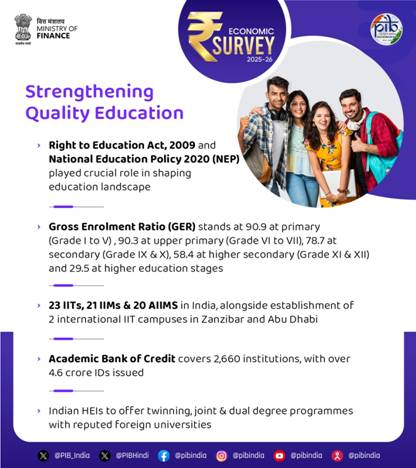
GROSS ENROLMENT RATIO (GER) REACHES AT 90.9 FOR PRIMARY STAGE AND 90.3 FOR UPPER PRIMARY STAGE

INDIA NOW HAS 23 IITS, 21 IIMS, AND 20 AIIMS, ALONGSIDE TWO INTERNATIONAL IIT CAMPUSES IN ZANZIBAR AND ABU DHABI

ACADEMIC BANK OF CREDIT COVERS 2660 INSTITUTIONS, WITH OVER 4.6 CRORE IDs ISSUED

FLEXIBLE ENTRY-EXIT PATHWAYS AND BIANNUAL ADMISSIONS INTRODUCED BY 153 UNIVERSITIES TO ACHIEVE THE NEP TARGET OF 50 % GER BY 2035

INDIAN HEIs TO OFFER TWINNING, JOINT, AND DUAL DEGREE PROGRAMMES WITH REPUTED FOREIGN UNIVERSITIES, WHILE 15 FOREIGN HEIs ARE EXPECTED TO SET UP CAMPUSES IN INDIA

STRUCTURED SKILLING PATHWAYS IN SECONDARY SCHOOLS TO PROVIDE EARLY EXPOSURE TO EMPLOYABLE COMPETENCIES, SAYS ECONOMIC SURVEY 2025-2026

In the education space, progress in school and higher education has been at the back of enhanced quality and access through community engagement, effective assessments, improved accountability, and stronger alignment between education and skill requirements states the Economic Survey 2025-2026 tabled in Parliament today by Union Minister of Finance and Corporate Affairs, Smt. Nirmala Sitharaman .

According to the Survey, the achievements in the education space have been marked by enhanced literacy rates, increasing enrolment in schools and higher education institutions, provision of vocational education avenues, etc. The Right to Education Act 2009 and the National Education Policy 2020 (NEP) have played a crucial role in shaping the education landscape by expanding access to quality education universally, promoting equity, and driving innovation in teaching and learning.

India has made notable gains in school enrolment by strengthening infrastructure and teacher capacity, with schemes like Poshan Shakti Nirman and Samagra Shiksha Abhiyan promoting access and equity. Gross Enrolment Ratio (GER) are 90.9 at the primary stage (Grade I to V), 90.3 at the upper primary (Grade VI to VIII), 78.7 at the secondary stage (Grade IX and X) and 58.4 at the higher secondary stage (Grade XI and XII).

Progress in school education

School education forms the foundation of human capital and is central to shaping the nation’s growth path towards Viksit Bharat @2047. Experiences from fast-growing Asian economies clearly demonstrate that consistent investments in education, skills development, and technology can significantly enhance productivity, foster innovation, and accelerate economic transformation.

To fully convert its vast human resource base into high-quality human capital, India needs to raise its Expected Years of Schooling (EYS) to 15-year set by NEP’s 5+3+3+4 schooling structure for ages 3-18. This requires a holistic, lifecycle approach that encompasses early childhood education, foundational literacy and numeracy (FLN), universal secondary schooling, and the seamless integration of vocational and digital skills.

To achieve the goals of NEP, the government launched school-level schemes such as the Sarv Shiksha Abhiyan, ULLAS, PM-SHRI(PM-Schools for Rising India), PM POSHAN (PM Poshan Shakti Nirman) and initiatives, such as PARAKH, Vidya Pravesh, DIKSHA (Digital Infrastructure for Knowledge Sharing), NIPUN Bharat Mission and Atal Tinkering Labs.In school education, the policy emphasises Early Childhood Care and Education (ECCE), FLN, reducing dropouts, ensuring universal access, revamping curriculum and pedagogy, strengthening teacher capacity, promoting equity, and improving quality.

School infrastructure

India operates one of the world’s largest school systems, serving 24.69 crore students across 14.71 lakh schools, supported by over 1.01 crore teachers (UDISE+ 2024-25). Aligned with the NEP goal of achieving a 100 per cent gross enrolment ratio (GER) from pre-primary to secondary education by 2030, steady progress has been observed across all school levels.

GER scores, as per NEP academic structure, are 95.4 at the preparatory stage (Grade III to Grade V), 90.3 at the middle stage (Grade VI to Grade VIII), and 68.5 at the secondary stage (Grade IX to Grade XII).  Various Government of India schemes have been instrumental in improving the GER . These include setting up of 13,076 PM shri Schools in 33 states / UTs, Co-location of Anganwadi Centres in 2,99,544 Schools to create a unified and strengthened Early childhood Care and Education (ECCE)  system for universal access to high quality learning. Schemes like Jaadui Pitara, e Jaaduai pitara, Kitab Ek Padhe Anek and Bhartiya Bhasha Pustak Scheme has made teaching material available to children in local languages 

India has made notable gains in school enrolment by strengthening infrastructure and teacher capacity, with schemes like Poshan Shakti Nirman and Samagra Shiksha Abhiyan promoting access and equity. Improving infrastructure, teacher skills through strengthened DIETs (District Institute of Education & Training), and SCERTs (State Council of Educational Research and Training), and involving parents and communities in governance can create an inclusive, learner focused environment. Combining these strategies with curriculum and assessment reforms aligned with NEP and the use of digital platforms such as PM e-Vidya can provide high-quality, equitable education, even in remote areas.
Improvement in learning outcomes

Since 2001, National Achievement Surveys (NAS) conducted by the National Council of Educational Research and Training (NCERT) have provided valuable insights into the school education system. Building on this and with a focus on competency-based learning, PARAKH (Performance Assessment, Review, and Analysis of Knowledge for Holistic Development) Rashtriya Sarvekshan 2024 was launched. The PARAKH 2024 findings inform that Grade III results show promising recovery post-COVID. Compared to NAS 2021 and 2017, Grade III proficiency levels have rebounded significantly, with 65 per cent of students proficient in Mathematics (up from 42 per cent in 2021) and 57 per cent in Language (up from 39 per cent).

School-to-skill pathways

Embedding structured skilling pathways in secondary schools can make education more relevant, provide early exposure to employable competencies, and transform schools into hubs of lifelong learning. The PLFS 2023-24 highlights the limited coverage of training, with only 0.97 per cent of 14-18-year-olds having received institutional skilling while nearly 92 per cent have none. Addressing this gap is crucial for leveraging India’s demographic dividend. Skill education in schools would equip young people with market-aligned skills, particularly in the service sector, which absorbs over half of the formally trained youth, while reducing dropouts by linking education to economic opportunities.

Higher education

The number of higher education institutions (HEIs) has increased from 51,534 in 2014-15 to 70,018 as of June 2025.  This increase is marked by substantial growth in universities and colleges. The number of premier higher education institutions (HEIs) has expanded significantly between 2014-15 and 2024-25. It now stands at 23 IITs, 21 IIMs, and 20 AIIMS, alongside the establishment of two international IIT campuses in Zanzibar and Abu Dhabi.

The All-India Survey on Higher Education (AISHE), 2022-23 (Provisional), reports an increase in student enrolment from 4.33 crore in 2021-22 to 4.46 crore in 2022-23.

Under the NEP, the higher education system has undergone several reforms. The National Credit Framework (NCrF), which aims to blend academic and skills-based learning, has been adopted by 170 universities. The Academic Bank of Credit covers 2,660 HEIs, with over 4.6 crore IDs issued, including 2.2 crore APAAR IDs with credits.

 Flexible entry-exit pathways and biannual admissions have been introduced by 153 universities to achieve the NEP target of 50 per cent GER by 2035.

 Aligned with the NEP  to build robust R&D capacity, Anusandhan National Research Foundation have been established to nurture a research-driven culture across universities, colleges, and research institutions nationwide.

To improve the quality of technical education, the Multidisciplinary Education and Research Improvement in Technical Education (MERITE) Scheme has been approved recently for 275 technical institutions, including 175 engineering colleges and 100 polytechnics.

Industry-academia integration in STEM education

The NEP aims to integrate vocational training with general education and to encourage collaboration between industry and academia within HEIs. Industry-academia linkages in the higher education sphere have traditionally emphasised research collaborations, such as joint research, consulting, and technology transfer. One such measure is the introduction of the ‘Professor of Practice’ (PoP) category at HEIs by the UGC and the AICTE. The PoP concept allows industry professionals to bring real world practices and experiences into the classroom and also augment faculty resources in HEIs. Complementing this, the AICTE-Industry Fellowship Programme aims to bridge the gap between academia and industry through active faculty engagement.

Internationalisation of Higher Education

NEP aims at ‘Internationalisation’ of higher education by making the Indian education system self-reliant and comparable to global standards and norms, enabling it to attract more students from abroad and reduce outbound student migration.

UGC issued the Regulations on Academic Collaboration between Indian and Foreign Higher Educational Institutions, 2022, enabling Indian HEIs to offer twinning, joint, and dual degree programmes with reputed foreign universities. Further, 100 per cent foreign direct investment (FDI) is allowed in higher education. These efforts are reinforced by the UGC (Setting Up and Operation of Campuses of Foreign Higher Educational Institutions in India) Regulations, 2023, under which 15 foreign HEIs are expected to set up campuses in India.

India’s policy ecosystem for internationalisation has become more enabling, with the introduction of the NEP, updated UGC guidelines, regulations for academic collaboration and mutual recognition of qualifications, and permissions for foreign branch campuses, including those in GIFT City.

India's education sectors require unwavering focus to unlock the nation's true potential through integrated, accountable, and adaptive policy frameworks to build a future ready workforce.

Topics

Acts Income Tax
