Loading...

Top
Help
×

By creating an account you can:

Logo TaxTMI
Call Us / Help / Feedback

Contact Us At :

E-mail: [email protected]

Call / WhatsApp at: +91 99117 96707

For more information, Check Contact Us

FAQs :

To know Frequently Asked Questions, Check FAQs

Most Asked Video Tutorials :

For more tutorials, Check Video Tutorials

Submit Feedback/Suggestion :

Email :
Please provide your email address so we can follow up on your feedback.
Category :
Description :
Min 15 characters 0/2000
Make Most of Text Search
  1. Checkout this video tutorial: How to search effectively on TaxTMI.
  2. Put words in double quotes for exact word search, eg: "income tax"
  3. Avoid noise words such as : 'and, of, the, a'
  4. Sort by Relevance to get the most relevant document.
  5. Press Enter to add multiple terms/multiple phrases, and then click on Search to Search.
  6. Text Search
  7. The system will try to fetch results that contains ALL your words.
  8. Once you add keywords, you'll see a new 'Search In' filter that makes your results even more precise.
  9. Text Search
Add to...
You have not created any category. Kindly create one to bookmark this item!
Create New Category
Hide
Title :
Description :
❮❮ Hide
Default View
Expand ❯❯
Close ✕
🔎 News - Adv. Search
TEXT SEARCH:

Press 'Enter' to add multiple search terms. Rules for Better Search

Search In:
Main Text + AI Text
  • Main Text
  • Main Text + AI Text
  • AI Text
Category: ?
Categorized by AI
---- All Categories ----
  • ---- All Categories ----
  • Income Tax
  • GST
  • Customs, DGFT & SEZ
  • FEMA & RBI
  • Corp. Laws, SEBI & IBC
  • PMLA, Black Money & ED
  • Budget
  • News and Press Release
  • PTI News
Month:
---- All Months ----
  • ---- All Months ----
  • January
  • February
  • March
  • April
  • May
  • June
  • July
  • August
  • September
  • October
  • November
  • December
Year:
---- All Years ----
  • ---- All Years ----
  • 2026
  • 2025
  • 2024
  • 2023
  • 2022
  • 2021
  • 2020
  • 2019
  • 2018
  • 2017
  • 2016
  • 2015
  • 2014
  • 2013
  • 2012
  • 2011
Sort By: ?
In Sort By 'Default', exact matches for text search are shown at the top, followed by the remaining results in their regular order.
Relevance Default Date
    Axis Bank sees religious tourism, defence, MSMEs as key growth areas in UP
    Rupee falls 13 paise to close at 94.56 against US dollar
    Vimal Elaichi makers move Delhi HC against Maharashtra FDA notice to 3 actors
    As world faced turmoil, India forged partnerships to maintain its economic growth: Shah
    Haryana govt, RBI review measures to tackle financial frauds
    Union law minister Meghwal inaugurates ITAT's new premises in Kolkata
    Enabling Filing of Appeals in Cases Involving NIL or Zero Demand Amount
    DGFT Introduces Open API Facility for Certificate of Origin on the Trade Connect e-Platform
    Amid global turmoil, India maintained momentum of its economic growth, says Amit Shah
    Zaggle Brings Cricket and Business Together in Hyderabad; Hosts Padma Bhushan Dr. Sunil Gavaskar
    AI may accelerate anti-competitive practices in digital markets: CCI chief
    Union Minister of Commerce and Industry Shri Piyush Goyal Calls for India to Emerge as a Global Medical and Healthcare Destination
    Union Minister of Commerce and Industry Shri Piyush Goyal Calls for Trained Caregivers and Wider Hospital Participation in Heal in India Gateway
    Rupee falls 7 paise to close at 94.50 against US dollar
    India Must Build Resilient, Globally Integrated Healthcare Supply Chains: Commerce and Industry Minister Shri Piyush Goyal at Bharat Health Global Exp...
    Rupee rises 4 paise to 94.39 against US dollar in early trade
    Jantar Mantar student stir, mass struggles could impact Assembly polls: MA Baby
    FDA awaiting response from restaurants at Mumbai Cricket Association premises: Mundhe
    India emerges as key diesel supplier to Europe as Russian, US flows falter
    Trump keeps heralding an economic boom, but even a solid jobs report is causing problems for him
❯❯
Maximize Maximize Maximize
0 / 200
Expand Note
Add to Folder

No Folders have been created

+

Are you sure you want to delete "My most important" ?

NOTE:

News
Showing Results for :
Reset Filters
Results Found:
Show All Summaries Hide All Summaries
September 7, 2026
Show AI Summary
Rupee exchange-rate movement reflected crude oil pressures, domestic equity weakness, foreign inflows, and a softer dollar.
Foreign-exchange market conditions resulted in the rupee closing weaker against the US dollar after initial support from foreign currency deposit inflows. Rising crude oil prices and weakness in domestic equity markets weighed on sentiment and offset support from a softer dollar and foreign investor equity purchases. Future movement may remain influenced by foreign inflows, crude oil prices, domestic market conditions, geopolitical tensions and inflation data.
September 7, 2026
Show AI Summary
Surrogate advertising allegations challenge notices targeting brand ambassadors and raise jurisdiction and hearing concerns for product promoters.
Challenge to surrogate advertising allegations concerns notices requiring brand ambassadors promoting Vimal Elaichi to prove that it differs from prohibited pan masala, halt promotions, and remove digital materials. The product promoter contests the notices because they were addressed only to the actors, it was not heard, and the regulator allegedly lacked jurisdiction to stop the advertisements. Territorial jurisdiction to entertain the challenge is also contested.
September 7, 2026
Show AI Summary
Free trade agreements and cyber-fraud prevention feature in India's stated strategy for economic growth, security, and digital protection.
India's external economic strategy relies on diplomatic engagement, strategic partnerships and free trade agreements to sustain growth amid geopolitical uncertainty. Cooperation extends to defence, technology, energy, investment and trade, as well as digital public infrastructure, disaster relief and capacity building. Internal and border security are treated as conditions for national development, while police responsibilities include community safety, maritime protection and tourist safety. Growing cyber-fraud risks linked to the digital economy are addressed through coordination with states and the national cybercrime helpline.
September 7, 2026
Show AI Summary
Financial fraud prevention advances through accessible complaints, cyber awareness, intelligence-sharing, and AI-based detection of mule accounts.
Financial-fraud prevention measures rely on coordinated review of alleged fraud, unauthorised deposit collection, complaints, market intelligence, investor protection and cyber threats. The SACHET portal supports market intelligence and complaints concerning unregulated financial activities through multilingual and accessibility features. MuleHunter.ai uses artificial intelligence and machine learning to identify mule accounts used in fraudulent fund flows. Financial-literacy programmes and accessible educational initiatives promote safe banking, fraud awareness and coordinated responses to cyber-enabled financial crime.
September 7, 2026
Show AI Summary
Technology-driven tax dispute resolution supports faster tribunal processes, reduced litigation, and improved taxpayer services through digital filing and assessments.
The Kolkata Bench of the Income Tax Appellate Tribunal is intended to expedite tax-dispute resolution across 12 states, including seven northeastern states, while advancing impartial, accessible and swift justice. Its administrative role includes improving justice delivery, reducing pendency and pursuing AI-driven digital transformation. The Income Tax Department and the Tribunal seek reduced litigation and improved taxpayer services through technology-driven measures, including faceless assessment and electronic filing.
September 7, 2026
Show AI Summary
Appeals against NIL or Zero GST demand orders are enabled where taxpayers paid liabilities before issuance of the order.
GST Portal validation restricting appeals against demand orders showing NIL or Zero demand has been removed where a liability dispute exists and the taxpayer made payment before issuance of the demand order. Taxpayers may challenge such orders by filing an appeal in Form GST APL-01, and may raise a ticket with the GST Helpdesk if filing difficulties arise.
September 7, 2026
Show AI Summary
Certificate of origin API integration enables exporters to submit applications, receive certificates, verify issuance, and reduce repetitive data entry.
Open API integration for Certificates of Origin enables eligible exporters to connect ERP, accounting and other business software with the Trade Connect e-Platform for electronic application submission. The facility covers preferential and non-preferential certificates, provides authentication, file-submission and certificate-verification APIs, and maintains a transaction ledger for application tracking. Security measures include digital signatures, password hashing, IP whitelisting and time-limited access tokens. Relevant origin criteria, fields and validation rules are automatically applied according to the selected trade agreement or certification scheme.
September 7, 2026
Show AI Summary
Free trade agreements and strategic partnerships were identified as supporting India's trade engagement and economic growth amid geopolitical disruption.
India's international economic engagement through free trade agreements and strategic partnerships was identified as a means of sustaining economic growth amid geopolitical disruption. Economic cooperation was described as extending across defence, technology, energy, investment and trade. Nine free trade agreements were stated to have been concluded by 2026, with further trade arrangements proposed with other countries. Pursuit of free trade agreements was linked to increasing trade and to reported first-quarter GDP growth in the financial year 2026-27.
September 7, 2026
Show AI Summary
Leadership, talent recognition and legacy framed a discussion linking cricketing performance with entrepreneurship and organisational responsibility.
No FEMA or RBI regulatory measure, compliance obligation, legal interpretation, or adjudicatory determination is identified. The subject matter concerns leadership, performance and entrepreneurship, with emphasis on preparation, decision-making under pressure, teamwork, recognising potential and supporting talent. Corporate success is linked with creating opportunities, contributing to society and building a lasting legacy. Zaggle is described as providing enterprise spend management, card-based financial products through banking partnerships and software offerings for corporate customers.
September 7, 2026
Show AI Summary
AI-driven digital markets require competition scrutiny of autonomous pricing, self-preferencing, discriminatory pricing, tying, and market manipulation.
Artificial intelligence may accelerate anti-competitive conduct in digital markets through self-preferencing, discriminatory pricing, tying and market manipulation. Agentic AI may create particular concerns where it monitors competitors' prices and autonomously responds without direct human intervention. Competition law aims to prevent anti-competitive practices, promote competition, protect consumers and preserve freedom of trade, while allowing legitimate growth and innovation. Market dominance is not objectionable in itself; concern arises from abuse of dominance through exclusionary or exploitative practices.
September 7, 2026
Show AI Summary
Healthcare innovation and supply-chain self-reliance are prioritised through trade access, investment, research collaboration, testing infrastructure, and quality standards.
Healthcare-sector development priorities seek to expand medical devices, diagnostics, digital health, research, and pharmaceutical machinery through exports, import substitution, and services growth. Free trade agreements are presented as supporting preferential market access, services opportunities, and mobility. Sectoral growth is linked to startup incubation, intellectual-property capability, international research collaboration, technology transfer, and joint ventures. Healthcare self-reliance requires indigenous equipment, critical components, resilient supply chains, shared testing and certification infrastructure, and uncompromising quality standards.
September 7, 2026
Show AI Summary
Medical value tourism quality standards prioritise verified hospitals, ethical treatment, transparent pricing, and seamless international patient care.
Medical value tourism is proposed to expand through trained caregivers, transparent treatment packages, ethical hospital practices, seamless reimbursement and cashless-payment systems, telemedicine, and verified hospital participation. International patients are intended to receive care through accredited quality systems, supported by interpreters, global outreach, and coordinated healthcare networks. Expansion beyond metropolitan areas must maintain equivalent high-quality care for domestic and foreign patients without discrimination. Certification systems are expected to remain professionally independent and free from unethical influence.
September 7, 2026
Show AI Summary
Foreign exchange market pressures from rising crude oil and weak domestic equities constrained rupee support from foreign inflows.
Foreign exchange market conditions caused the rupee to depreciate against the US dollar despite support from FCNR dollar inflows and a softer dollar. Rising crude oil prices, weak domestic equities and global headwinds constrained gains. The outlook remained dependent on foreign inflows, dollar movements, crude prices, market sentiment and inflation data, with geopolitical tensions capable of increasing pressure on the currency.
September 7, 2026
Show AI Summary
Healthcare supply-chain resilience requires diversified sourcing, global investment, domestic innovation, and stronger medical-device production supported by enabling infrastructure.
Healthcare supply-chain resilience requires diversified sourcing, restoration of domestic capacity in Active Pharmaceutical Ingredients and Key Starting Materials, and continued imports where necessary through multiple suppliers and geographies. Pharmaceutical industry growth should move beyond generics towards research, development, patented products, new molecules, biosimilars and biotechnology. Regulatory convergence should support clinical trials, patenting and new-product introduction. Government support is contemplated for medical value travel, healthcare infrastructure, bulk drug parks, plug-and-play facilities, medical-device component production and scientific validation of Ayush products.
September 7, 2026
Show AI Summary
Foreign exchange market pressures offset rupee support from FCNR inflows amid higher crude oil and dollar demand.
The rupee gained marginally against the US dollar, supported by FCNR-related dollar inflows and robust liquidity. Elevated Brent crude prices, safe-haven dollar demand and geopolitical tensions constrained this support. Higher oil prices may enlarge India's import bill, increase dollar demand and pressure the rupee, although rising foreign-exchange reserves indicated external-sector strength.
September 6, 2026
Show AI Summary
Census data privacy and electoral integrity concerns emerge alongside calls to repeal insolvency law and protect political dissent.
CPI(M) called for repeal of the Insolvency and Bankruptcy Code, alleging that insolvency processes enabled diversion of public resources. It questioned economic growth figures against agricultural weakness, mining contraction, higher input costs, inflation, unemployment and malnutrition. The party also raised Census data privacy concerns over caste-data collection, potential linkage with government databases, and possible implications for citizenship, electoral rolls and future delimitation.
September 6, 2026
Show AI Summary
Food business licensing: Third-party restaurant operators require their own licences and cannot operate under another entity's registration.
Food Business Operator licensing requires the entity holding a food licence or registration to itself conduct the licensed food business at the specified premises. A third-party operator cannot operate under another entity's licence or registration and must obtain its own licence or registration. Regulatory notices concerning such arrangements may also address hygiene lapses and structural violations, followed by consideration of the operators' responses.
September 6, 2026
Show AI Summary
European diesel supply dependence on alternative refiners grows amid constrained exports, weakening transatlantic flows, and restricted shipping routes.
European diesel supply is becoming increasingly dependent on Indian refining capacity as Russian diesel and gasoil exports remain constrained by export restrictions, refinery disruptions and port outages, while US shipments to Europe have weakened. Alternative supply routes offer limited additional clean-product volumes because reduced tanker crossings and lower ship-to-ship transfers offshore Oman constrain flows through the Strait of Hormuz. Low diesel inventories, seasonal demand and planned refinery maintenance increase exposure to supply disruptions.
September 5, 2026
Show AI Summary
Tariff-driven inflation and elevated borrowing costs constrain growth, while durable deficit reduction may require spending restraint and tax increases.
Persistent inflation, elevated interest rates and rising public debt constrain economic growth policy. Tariffs and oil shortages are identified as contributing to inflationary pressures, while lower interest rates could increase money flows and worsen inflation. Tariffs, tax cuts, artificial intelligence productivity gains and anti-fraud measures are advanced as mechanisms to support growth, investment and domestic employment. Fiscal sustainability, however, cannot be achieved through growth alone where social security and healthcare costs exceed revenue growth; deficit reduction may require slower spending, spending reductions and tax increases.

News

Back

All News

Showing Results for :
Reset Filters
No Records Found

News

Showing Results for : Reset Filters

India-European Free Trade Association Trade and Economic Partnership Agreement (TEPA) to come into effect on 01 October 2025

September 30, 2025

Contents
Summary
Note

Note

-

Bookmark

Print

Print

TEPA offers binding commitment of $100 bn investment and 1 million direct jobs in the next 15 years

TEPA to stimulate services exports in sectors such as IT, business services, education, audio-visual etc

TEPA provides Mutual Recognition Agreements in Professional Services like nursing, chartered accountants, architects etc

India-European Free Trade Association(EFTA) Trade and Economic Partnership Agreement (TEPA) will come into effect on 01 October 2025. The agreement was signed on 10th March 2024 at New Delhi.TEPA is a modern and ambitious agreement that incorporates, for the first time in any Free Trade Agreement (FTA) signed by India, a commitment linked to investment and job creation. 

The agreement comprises of 14 chapters with main focus on market access related to goods, rules of origin, trade facilitation, trade remedies, sanitary and phytosanitary measures, technical barriers to trade, investment promotion, market access on services, intellectual property rights, trade and sustainable development and other legal and horizontal provisions.

The EFTA’s market access offer under TEPA covers 100% of non-agri products and tariff concession on Processed Agricultural Products (PAP)Sensitivity related to PLI in sectors such as pharma, medical devices & processed food etc. have been taken while extending offers.

The agreement goes beyond goods and services and committed to promote investments with the aim to increase the stock of foreign direct investments by USD 100 billion in India in the next 15 years, and to facilitate the generation of 1 million direct employment in India, through such investments.

Key features of the agreement

EFTA is an important regional group, with several growing opportunities for enhancing international trade in goods and services. EFTA is one important economic block out of the three (other two - EU &UK) in Europe. Among EFTA countries, Switzerland is the largest trading partner of India followed by Norway.

The TEPA will empower India’s exporters by providing access to specialized inputs and create conducive trade and investment environment. This would boost exports of Indian made goods as well as provide opportunities for services sector to access more markets.

Investment and Employment Commitments

As per Article 7.1 of TEPA, the EFTA States shall aim to increase foreign direct investment (FDI) from their investors into India by USD 50 billion within 10 years from the entry into force of the Agreement, and an additional USD 50 billion in the succeeding 5 years, amounting to a total of USD 100 billion over 15 years. Concurrently, the EFTA States shall aim to facilitate the generation of 1 million direct jobs in India resulting from these investment inflows.

This investment commitment explicitly excludes foreign portfolio investment (FPI), focusing on long-term capital for productive capacity building. 

Market Access for Goods

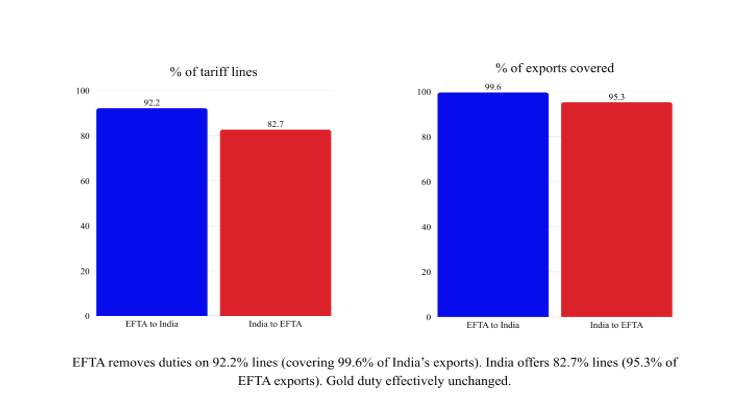
Under TEPA, EFTA has offered 92.2% of tariff lines encompassing 99.6% of India’s exports. Includes 100% of non-agricultural products and tariff concessions on Processed Agricultural Products (PAP).

India’s offer to EFTA covers 82.7% of tariff lines, accounting for 95.3% of EFTA exports. Over 80% of these imports are Gold, with no change in effective duty on Gold. Sensitive sectors protected, including pharma, medical devices, processed food, dairy, soya, coal, and sensitive agricultural products.
Boost for Services and Mobility

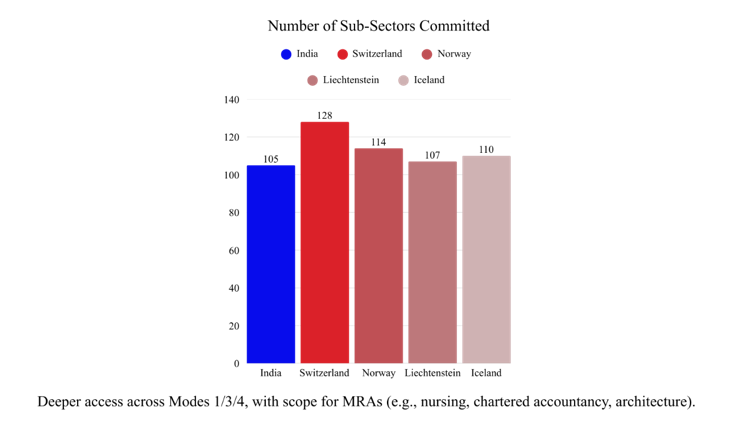
India has offered commitments in 105 sub-sectors. EFTA commitments: 128 (Switzerland), 114 (Norway), 107 (Liechtenstein), 110 (Iceland). TEPA enables Mutual Recognition Agreements (MRAs) in professional services such as nursing, chartered accountancy, and architecture

TEPA presents stronger opportunities in IT, business services, cultural and recreational services, education, and audio-visual services.

Improved access via: Mode 1: Digital delivery of services, Mode 3: Commercial presence and Mode 4: Greater certainty for entry and temporary stay of key personnel.

Intellectual Property Rights
TEPA ensures IPR commitments at TRIPS level. The IPR chapter with Switzerland has high standard for IPR, shows the robust IPR regime. India’s interests in generic medicines and concerns related to evergreening of patents have been fully addressed.

Sustainable and Inclusive Development
TEPA emphasizes sustainable development, inclusive growth, social progress, and environmental protection. It will foster transparency, efficiency, simplification, harmonization, and consistency in trade procedures.

Employment, Skills and Technology Collaboration
TEPA would accelerate creation of large number of direct jobs for India’s young aspirational workforce in next 15 years in India, including better facilities for vocational and technical training. TEPA also facilitates technology collaboration and access to world leading technologies in precision engineering, health sciences, renewable energy, Innovation and Research & Development.

Sector wise gains under TEPA
The India-EFTA Trade and economic Partnership Agreement unlock opportunities across wide range of industries. With EFTA’s offer covering 92% of tariff lines, Indian exporters in sectors like machinery, organic chemicals, textiles, and processed foods will enjoy significantly improved access to EFTA markets though TEPA. This will enhance competitiveness, reduce compliance costs and accelerate access to EFTA market.

Agriculture and Allied Goods

  • India’s exports to EFTA are concentrated, with Guar Gum accounting for over 70% of the export basket in 2024-25. Other exports include processed vegetables, basmati rice, pulses, fresh fruits, cereal preparations, and grapes.
  • Norway and Switzerland together account for over 99% of India’s agri-exports to EFTA.
  • India’s exports to EFTA stood at USD 72.37 million in 2024, contributing 0.41% of EFTA’s total imports. This agreement is expected to reduce tariff barriers and expand India’s share in key commodities.
  • Expected Gains: Based on trade patterns and FTA tariff concessions, the following categories are high-opportunity sectors for India:
  • Processed Food Products – biscuits, confectionery, chocolate, malt extracts, sauces, and miscellaneous food preparations.
  •  Rice (Basmati & Non-Basmati) – tariff elimination enhances competitiveness against Italy, Thailand, and Pakistan.
  • Guar Gum & Pulses – where India already has strong presence, FTA will secure larger market share.
  • Fresh Grapes, Mangoes, Vegetables, and Millets – tariff concessions improve market entry and positioning.
  • Cashew Kernels and Other Nuts – demand in EFTA is large, and India can scale exports.
  • Country Specific Gains: -

EFTA Nations

Products / HS Codes

Tariff Concessions / Opportunities

Switzerland

Food Preparations

Tariffs up to 127.5 CHF/100 kg eliminated; scope for Indian exports

Confectionery, Biscuits

Duty cuts create opportunities in processed foods

Fresh Grapes

Tariffs up to 272 CHF/100 kg eliminated

Nuts & Seeds, Fresh Vegetables

Zero tariffs post FTA, boosting competitiveness

Norway

Food Preparations, Condiments

Duty-free access on several tariff lines

Rice

Tariff reductions (non-feed purposes) open new markets

Processed Vegetables & Fruits

Duty-free access on selected lines

Biscuits, Malt Extracts, Beverages

Tariff relief improves access for Indian brands

Iceland

Processed Foods

High MFN tariffs (up to 97 ISK/kg) cut to zero

Chocolate & Confectionery

Duties eliminated; strong potential for processed food exports

Fresh/Chilled Vegetables

Tariff elimination

Coffee

  • EFTA member countries viz., Switzerland (USD 145 million), Norway (USD 27 million) and Iceland (USD 3 million) together import coffee valued at USD 175 million, which is about 3% of the global coffee imports.
  • EFTA has offered Import Duty of 0% on all the HS lines pertaining to Coffee.
  • Switzerland and Norway are high-value markets with strong demand for high quality coffee.
  • TEPA provide most favorable market access to Indian Coffees in EFTA market.
  • TEPA may help the coffee exporters to access the premium markets in Switzerland, Norway and Iceland with the opportunity for positioning India’s high-quality shade grown, handpicked and sun-dried coffees in EFTA market.

Tea

  • EFTA has a combined tea market size of around 3.0 million kg.
  • In the post-TEPA period, the average unit export price realization has risen appreciably ($6.77/kg in 2024-25 vis-à-vis $5.93/kg in 2023-24).

Marine Products

  • Norway: Exemption of duty of upto 13.16% from fish/shrimp feed. This will make Indian products competitive and enhance the export of fish feed and raw materials for fish/shrimp feed from India to Norway
  • Iceland: Tariff Elimination of upto 10% on Frozen, Prepared and preserved shrimps and prawns, squid and Cuttlefish and upto 55% on fish feed.
  • Switzerland: Zero Duty on Fats and oils of fish (other than liver oil)
  • TEPA will provide an opportunity to increase the export of the Marine products in addition to frozen shrimps from India to EFTA countries.
  • This is expected to increase the exports to USD 3.50 million in coming years.

Textiles and Clothing

  • India’s textiles and apparel exports to the EFTA stood at USD 0.13 billion in 2024.
  • Given India’s total global textiles exports were USD 36.71 billion in 2024, TEPA offers opportunity to capture the untapped market by leveraging tariff concessions.

Leather and Footwear

  • The MFN is 0% in EFTA countries for leathers and footwear, an advantage to continue Post TEPA implementation.
  • TEPA consolidates and guarantees this preferential treatment, providing long-term certainty and stability for exporters.

Sports Goods and Toys

  • TEPA would bring zero-duty access for a large share of tariff lines, enhancing competitiveness for Indian exporters.
  • Streamlined conformity assessment, mutual recognition of standards (MRAs), and simplified CE marking compliance under TEPA to lower compliance costs for exporters.

Engineering Goods

  • India’s engineering exports to the EFTA reached US$ 315.2 million in FY 2024–25, marking an 18% growth over the previous fiscal year.
  • Norway and Switzerland remain the largest destinations, accounting for almost 99% of total exports.
  • TEPA will provide enhanced market access and tariff concessions to boost competitiveness and open new opportunities for Indian engineering exporters across high-value sectors.
  • Significant Market Potential exists in electric machinery, aluminum products, AC/refrigeration machinery, bicycle and copper products highlighting diversification and potential for growth in sustainable, precision engineering, energy-efficient and infrastructure-related goods.

Gems and Jewellery

  • Gems & Jewellery exports enjoy duty-free access in EFTA markets- a preferential treatment that will continue under TEPA.
  • Country wise Market potential for Gems & Jewellery Sector include:
  • Iceland: Gold jewellery, silver jewellery, and imitation jewellery.
  • Norway: Cut and polished natural diamonds, gold jewellery, silver jewellery, and imitation jewellery.
  • Switzerland: Cut and polished natural diamonds, gold jewellery, and polished rubies, sapphires, and emeralds.

Electronics and Software

  • With a $100 billion investment commitment and preferential access to high-income European markets, TEPA offers a strategic springboard for India’s electronics sector—especially MSMEs and OEMs seeking global scale.
  • Country-wise Electronics Export Potential
  • Switzerland: Medical electronics (diagnostic devices, wearables), Smart sensors and embedded systems, Secure communication modules (for fintech and banking)

Strategic Edge: Leverage TEPA’s IPR chapter to protect proprietary tech

  • Norway: EV components and battery management systems, Marine electronics (navigation, sonar, IoT buoys), Smart grid and energy monitoring devices

        Strategic Edge: Align with Norway’s climate tech goals and public procurement Channels

  • Iceland: Compact medical devices and diagnostics, Smart home and energy-efficient electronics, educational tech hardware (tablets, sensors)

        Strategic Edge: Target niche distributors and public health initiatives

  • Liechtenstein: Industrial control systems, Secure embedded electronics for banking, High-precision components for OEMs

       Strategic Edge: Position India as a reliable EMS partner for European OEMs.

Chemicals and Allied Products

  • On the market access front, EFTA has offered zero or reduced tariffs on more than 95% of India’s exports, including a wide range of chemical products. India, in turn, has granted market access to nearly 80% of its tariff lines covering 95% of EFTA’s exports.
  • TEPA also incorporates product-specific rules of origin, certificates of origin, and movement certificates (EUR.1), ensuring greater transparency and simplifying compliance for exporters, especially in the chemical and pharmaceutical sectors.
  • Pre-FTA, certain chemical sector products faced tariffs of up to 54% (Source: Trademap), but post-FTA, these tariffs will be eliminated, increasing the reach of Indian chemical products in the EFTA bloc.
  • Exports of CAPEXIL products to EFTA are expected to expand gradually from USD 49.41 million to around USD 65–70 million in the post-FTA period, with notable gains anticipated in pet food, rubber products, paper, stone/ceramic items, and glassware.

Plastics and Shellac based products

  • TEPA offers Indian plastic exporters significant opportunities to diversify away from high-tariff markets such as the USA and strengthen their presence in high-value EFTA markets. With zero tariffs and improved trade facilitation, India’s exports across diverse panels are expected to achieve steady growth, supported by vast untapped potential in Switzerland and Norway.
  • TEPA can significantly strengthen India’s position in high-value botanical and forest product markets, while also attracting investments and supporting small exporters.

    Gains in the Services sector
  • The services sector, contributing nearly 55% of India’s Gross Value Added (GVA), stands to gain significantly from TEPA. India has offered commitments in 105 sub-sectors to the EFTA while securing enhanced access in 128 sub-sectors from Switzerland, 114 from Norway, 107 from Liechtenstein, and 110 from Iceland.  
  • TEPA is expected to boost India’s services exports in areas of core strength such as IT and business services, cultural and recreational services, education, and audio-visual services.
  •  EFTA’s Services offers better access through digital delivery of Services (Mode 1), commercial presence (Mode 3) and improved commitments and certainty for entry and temporary stay of key personnel (Mode 4).
  •  Additionally, TEPA includes provisions for Mutual Recognition Agreements (MRAs) in professional services such as nursing, chartered accountancy, and architecture, creating new avenues for Indian professionals in EFTA markets.

INVESTMENT PROMOTION

  • EFTA has committed to promote investments with the aim to increase the foreign direct investments by USD 100 billion ((equivalent to Rs 8 Lakh crore as per present exchange rate) in India in the next 15 years -a major boost to “Make in India”.
  • Dedicated EFTA Desk has been operational since Feb 2025, as a single-window mechanism for investment facilitation to support EFTA businesses in investing, expanding, and establishing operations in India.
  • The India-EFTA Desk to drive investment in renewable energy, life sciences, engineering, and digital transformation, while streamlining regulatory processes for EFTA businesses.
  • TEPA will facilitate joint ventures, SME collaborations, and technology partnerships, with the Desk streamlining regulatory navigation for EFTA businesses.
  • The Desk will also act as the primary channel for fostering continuous business-government dialogue, ensuring continuous engagement between India and EFTA partners.

    India Protects what Matters
  • India has safeguarded its sensitive sectors such as dairy, soya, coal and sensitive agricultural products.
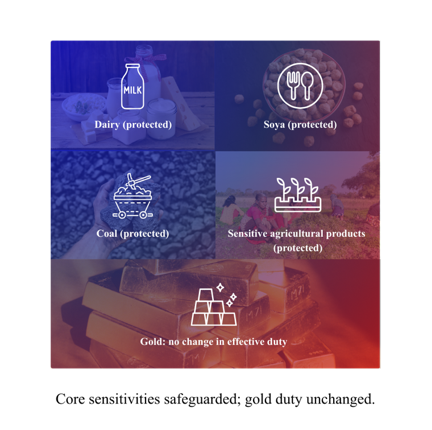
  • India has opened 82.7% tariff 82.7% of its tariff lines which covers 95.3% of EFTA exports of which more than 80% import is Gold.
  • Strategically important products- particularly that where domestic capacity is being built under flagship initiatives like Make in India and PLI – Concessions provided over period of 5,7 or even 10 years with gradual tariff reduction.

Conclusion

The India–EFTA Trade and Economic Partnership Agreement (TEPA) marks a historic milestone, establishing India’s first FTA with four developed European nations and committing USD 100 billion in investments and 1 million direct jobs over 15 years. TEPA enhances market access for goods and services, strengthens intellectual property rights, and fosters sustainable, inclusive development, while supporting Make in India and Atmanirbhar Bharat initiatives.

Complementing this, the India–EFTA Desk has been inaugurated as a single-window platform to facilitate EFTA investments in renewable energy, life sciences, engineering, and digital transformation, while fostering joint ventures, SME collaborations, and technology partnerships.

TEPA is a “model agreement” and reaffirms India’s readiness to build a robust future with EFTA.

References:

Ministry of Commerce and Industry

Topics

Acts Income Tax

