
Just a moment...

Top
Help
×

By creating an account you can:

Logo TaxTMI
Call Us / Help / Feedback

Contact Us At :

E-mail: [email protected]

Call / WhatsApp at: +91 99117 96707

For more information, Check Contact Us

FAQs :

To know Frequently Asked Questions, Check FAQs

Most Asked Video Tutorials :

For more tutorials, Check Video Tutorials

Submit Feedback/Suggestion :

Email :
Please provide your email address so we can follow up on your feedback.
Category :
Description :
Min 15 characters0/2000
Make Most of Text Search
  1. Checkout this video tutorial: How to search effectively on TaxTMI.
  2. Put words in double quotes for exact word search, eg: "income tax"
  3. Avoid noise words such as : 'and, of, the, a'
  4. Sort by Relevance to get the most relevant document.
  5. Press Enter to add multiple terms/multiple phrases, and then click on Search to Search.
  6. Text Search
  7. The system will try to fetch results that contains ALL your words.
  8. Once you add keywords, you'll see a new 'Search In' filter that makes your results even more precise.
  9. Text Search
Add to...
You have not created any category. Kindly create one to bookmark this item!
Create New Category
Hide
Title :
Description :
❮❮ Hide
Default View
Expand ❯❯
Close ✕
🔎 News - Adv. Search
TEXT SEARCH:

Press 'Enter' to add multiple search terms. Rules for Better Search

Search In:
Main Text + AI Text
  • Main Text
  • Main Text + AI Text
  • AI Text
Category: ?
Categorized by AI
---- All Categories ----
  • ---- All Categories ----
  • Income Tax
  • GST
  • Customs, DGFT & SEZ
  • FEMA & RBI
  • Corp. Laws, SEBI & IBC
  • PMLA, Black Money & ED
  • Budget
  • News and Press Release
  • PTI News
Month:
---- All Months ----
  • ---- All Months ----
  • January
  • February
  • March
  • April
  • May
  • June
  • July
  • August
  • September
  • October
  • November
  • December
Year:
---- All Years ----
  • ---- All Years ----
  • 2026
  • 2025
  • 2024
  • 2023
  • 2022
  • 2021
  • 2020
  • 2019
  • 2018
  • 2017
  • 2016
  • 2015
  • 2014
  • 2013
  • 2012
  • 2011
Sort By: ?
In Sort By 'Default', exact matches for text search are shown at the top, followed by the remaining results in their regular order.
RelevanceDefaultDate
    Gross GST mop-up grows 15.4 pc to over Rs 2.11 lakh cr in July on higher imports, sales
    Gross and Net GST revenue collections for the month of July, 2026
    India and Rwanda Hold First Joint Trade Committee Meeting to Deepen Bilateral Trade and Investment Cooperation
    West Bengal GST collection rises 2 pc in July to Rs 5,564 crore
    Gross GST collection kitty swells 15.4 pc to over Rs 2.11 lakh cr in July
    RBI says USD 40.82 bn mobilised under forex swap facility till Jul 31
    Sebi bars ZEEL for 2 months, Subhash Chandra, Punit Goenka for 1 year in Hyderabad land pledge case
    Department of Commerce Holds Workshop on Trade and Sustainable Development Policy Landscape
    GeM Launches 10-Day Celebrations Ahead of 10th Foundation Day, Unveils Commemorative Logo
    All Indian exports of dual-use items comply with international obligations: MEA
    PM Modi to inaugurate Bhogapuram Airport in Andhra on Aug 1
    HIGHLIGHTS
    Closely monitoring: India on US bill seeking up to 100 % tariffs on purchasers of Russian oil
    Delhi HC seeks ED stand on Nayan Raheja's plea against money laundering case
    Rupee appreciates 7 paise to close at 95.43 against US dollar
    PM Modi, UK PM Burnham commit to harnessing full potential of mega trade deal
    ITC Q1 profit declines 15.6 pc to Rs 4,508.79 cr; non-cigarette FMCG posts robust growth
    Punjab extends deadline of one-time scheme for settling tax dues of pre-GST period till Sept 30
    PM Modi speaks to UK counterpart Burnham
    Bank credit to industry records robust growth of 19.2 pc in June: RBI data
❯❯
MaximizeMaximizeMaximize
0 / 200
Expand Note
Add to Folder

No Folders have been created

    +

    Are you sure you want to delete "My most important" ?

    NOTE:

    News
    Showing Results for :
    Reset Filters
    Results Found:
    Show All SummariesHide All Summaries
    August 1, 2026
    Show AI Summary
    Goods and Services Tax collections rise on domestic consumption and imports, while elevated import revenue prompts assessment of underlying drivers.
    Goods and Services Tax collections for July increased over the corresponding prior-year period, supported by domestic sales and imports. Gross receipts included Central GST, State GST and Integrated GST, with net GST revenue calculated after adjusting refunds. For the April-July period, gross and net collections also increased. Commentary linked domestic GST growth to consumption, formalisation and industrial activity, while identifying elevated import GST collections as an area requiring assessment of import composition, currency effects and volumes.
    August 1, 2026
    Show AI Summary
    GST revenue collections show provisional gross, refund and net revenue trends, with State-wise settlement and domestic collection data.
    GST revenue collections for July 2026 are reported provisionally through gross domestic and import revenue, domestic and export-related refunds, and net GST revenue after refunds. The data also sets out SGST collections and the SGST share of IGST settled to States and Union Territories, both monthly and cumulatively. State-wise domestic GST growth excludes GST on imported goods, while jurisdiction-wise data allocates collections between central and State formations and identifies CGST, SGST and IGST components.
    August 1, 2026
    Show AI Summary
    Bilateral trade cooperation expands through a Joint Trade Committee covering investment, critical minerals, healthcare, digital technologies and market access.
    Bilateral trade and investment cooperation between India and Rwanda is to be advanced through a structured Joint Trade Committee mechanism for reviewing commerce, diversifying trade, promoting investment, facilitating business engagement and addressing market-access and logistical issues. Priority cooperation includes critical minerals, pharmaceuticals and healthcare, agriculture and agro-processing, standards harmonisation, digital public infrastructure, fintech, cybersecurity, green mobility and renewable energy. Investment focal points will support engagement, while capacity-building assistance and close monitoring of the Agreed Minutes are intended to support time-bound implementation.
    August 1, 2026
    Show AI Summary
    GST collection growth in West Bengal continued year-on-year in July but remained below the national growth trend.
    West Bengal's July GST collection increased year-on-year and over the preceding month, marking a second consecutive month of annual growth. Official data also indicated that the State's annual growth rate was below the national trend, while gross domestic GST revenue excluding imports and overall gross GST collections including import-related taxes rose nationally during July.
    August 1, 2026
    Show AI Summary
    GST collection growth reflects higher revenue mobilisation from domestic transactions and imports, with refunds adjusted in net revenue.
    Goods and Services Tax collections increased in July, driven by higher revenue from domestic transactions and imports. The gross collection comprised Central GST, State GST and Integrated GST components. Refunds also increased during the month, and net GST revenue was determined after adjustment of refund outflows from gross tax receipts.
    August 1, 2026
    Show AI Summary
    Concessional foreign-exchange swaps encourage bank deposits and foreign borrowings to strengthen balance-of-payments resilience and foreign-exchange liquidity.
    The Reserve Bank of India introduced a concessional foreign-exchange swap facility to encourage foreign-currency inflows, strengthen the balance of payments and support foreign-exchange liquidity. The facility applies to fresh Foreign Currency Non-Resident (Bank) deposits, Overseas Foreign Currency Borrowings and External Commercial Borrowings. Foreign Currency Non-Resident (Bank) deposits constitute the principal source of inflows mobilised under the arrangement. The facility is available for specified time-bound periods, with a later availability period for Overseas Foreign Currency Borrowings and External Commercial Borrowings.
    August 1, 2026
    Show AI Summary
    Unauthorised pledge of listed-company land triggered securities-market bars for disclosure failures and misuse of management authority.
    Unauthorised pledge of ZEEL's Hyderabad land as security for loans obtained by promoter-linked entities was treated as a related-party transaction lacking prior audit committee approval. ZEEL failed to disclose the land's deployment in its financial statements. Its Chairman Emeritus was stated to have transferred title deeds by falsely representing management approval and to have concealed the transaction's nature. Securities-market prohibitions and monetary penalties were imposed with immediate effect.
    August 1, 2026
    Show AI Summary
    Trade and sustainable development policy integrates carbon regulation, sustainability standards and domestic frameworks to strengthen trade competitiveness and preparedness.
    Trade and Sustainable Development policy was examined in relation to international trade disciplines, sustainability regulation and India's trade strategy. Discussions considered carbon markets, carbon pricing, carbon border adjustment measures, sustainability standards and regulatory cooperation, and their implications for trade and industrial competitiveness. Domestic mechanisms, including the Carbon Credit Trading Scheme, Indian Carbon Market, Extended Producer Responsibility framework, and accreditation and conformity assessment systems, were considered for strengthening preparedness for emerging sustainability-related trade disciplines.
    August 1, 2026
    Show AI Summary
    Digital public procurement engagement begins with stakeholder events promoting transparent, efficient and inclusive marketplace governance.
    Government e-Marketplace launched ten-day celebrations preceding its tenth Foundation Day, including a commemorative logo, stakeholder events and recognition of employees, buyers and sellers. The programme begins a year-long nationwide outreach initiative bringing together buyers, sellers, policymakers, industry representatives and ecosystem partners through events, dialogues and collaborative platforms. Its stated focus is technology-enabled, transparent, efficient and inclusive public procurement.
    July 31, 2026
    Show AI Summary
    Strategic trade controls require dual-use exports to comply with national law and international obligations amid arms-transfer allegations.
    Strategic trade controls governing dual-use exports require Indian exports of dual-use items and technologies to comply with national law and India's international obligations. The stated framework applies to exports to various countries. In response to allegations concerning supplies to Israel, the position notes calls for an arms embargo covering direct or indirect transfers of arms and military material, including weapons, ammunition, parts and components, without determining the underlying allegations.
    July 31, 2026
    Show AI Summary
    Greenfield airport development under a public-private partnership advances licensed international passenger, cargo, logistics, and sustainable infrastructure.
    A greenfield international airport is being developed under a Public-Private Partnership and Design, Build, Finance, Operate and Transfer framework, with airport, aviation-hub, education and supporting infrastructure components. The airport has obtained an aerodrome licence and required safety, fire and environmental clearances. Passenger, airfield and terminal systems are designed for domestic and international operations. A cargo terminal with cold-chain facilities and integration with port, industrial-corridor and logistics networks are intended to strengthen exports and air-cargo logistics. Recycled-water use and LEED Platinum development standards form part of its environmental measures.
    July 31, 2026
    Show AI Summary
    Regulatory and legal developments cover trade measures, legislative action, offshore exploration support, court directions and platform algorithm scrutiny.
    The compilation reports proposed United States tariff measures concerning purchasers of Russian oil and gas, India-United Kingdom trade engagement, extension of farmer-support measures, and approval of offshore exploration support. It also covers passage of the Registration of Births and Deaths (Amendment) Bill, 2026, a privilege-motion notice, a criminal sentencing, and directions to appoint a nodal officer for families affected by the Russia-Ukraine war. Regulatory items include industrial credit data and examination of social-media algorithms, bias and public-order implications.
    July 31, 2026
    Show AI Summary
    Russian oil purchases may trigger proposed targeted tariffs, with periodic reassessment based on countries' purchasing behaviour.
    Proposed United States measures would authorise sanctions against Russia and persons supporting its war in Ukraine, while permitting targeted tariffs on imports from countries purchasing substantial volumes of Russian oil or gas or facilitating sanctions evasion. The framework identifies major purchasers and shadow-fleet facilitators for possible additional tariffs and provides for periodic reassessment and tariff adjustments based on purchasing behaviour. India stated that its energy-security policy rests on national priorities and diversified energy sources.
    July 31, 2026
    Show AI Summary
    Money-laundering proceedings face challenge over absent predicate offence, alleged lack of criminal intent, and treatment of related FIRs.
    Money-laundering proceedings linked to alleged diversion of homebuyer funds are challenged on the ground that no scheduled offence or criminal intent is attributable to the petitioner. The petitioner relies on his asserted exoneration in two predicate FIRs, where charge sheets did not name him, and settlement of the remaining FIR. Notice was issued for a response and status report, and the petitioner undertook to cooperate with the investigation.
    July 31, 2026
    Show AI Summary
    Rupee appreciation reflected foreign capital inflows and central bank support, tempered by crude prices and geopolitical tensions.
    Rupee appreciation against the US dollar was linked to sustained foreign capital inflows and Reserve Bank support through dollar selling. Higher crude oil prices, a stronger US dollar and geopolitical tensions in West Asia constrained further gains. A slightly positive near-term rupee bias was associated with softer dollar conditions, dovish US monetary expectations, favourable global markets and improved foreign inflows, while geopolitical risks remained relevant. Domestic equity indices rose, foreign-exchange reserves increased, and fiscal-deficit data showed the central government's position against its full-year target.
    July 31, 2026
    Show AI Summary
    India-UK trade agreement enables duty-free access and bilateral cooperation on investment, technology, and strategic partnership.
    The India-UK Comprehensive Economic and Trade Agreement provides zero-duty market access in the UK for nearly 99 per cent of India's exports and is intended to expand bilateral trade and investment opportunities. The governments committed to maximise its benefits through the Comprehensive Strategic Partnership, including cooperation on technology, innovation, security, clean energy, education and people-to-people links. Advanced technology collaboration, including artificial intelligence, is also contemplated.
    July 31, 2026
    Show AI Summary
    Excise duty increases on cigarettes pressured profitability, while calibrated pricing and FMCG growth supported market resilience.
    Excise duty increases on cigarettes affected consolidated profitability, prompting calibrated pricing and portfolio measures to protect market share and limit migration to illicit trade. The cigarette portfolio was re-architected across price points through value-accretive offerings and staggered pricing actions. Non-cigarette FMCG growth was supported by demand for packaged foods, dairy and personal-care products. Input-cost inflation was mitigated through inventory cover, commodity hedging and price-volume rebalancing amid crude-price volatility, supply-chain disruption and imported inflation concerns.
    July 31, 2026
    Show AI Summary
    One-Time Settlement Scheme offers final pre-GST tax dispute resolution relief before stricter recovery action against defaulters begins.
    The One-Time Settlement Scheme 2025 for pre-GST tax dues has been extended until September 30. Eligible taxpayers may resolve pending legacy tax disputes with full waiver of interest and penalties and slab-wise relief in principal tax. After the deadline, recovery action may be intensified under applicable tax laws and the Punjab Land Revenue Act, including property attachment, auction and freezing of bank accounts. The department also supports amicable settlement of tax disputes through the SAMADHAN initiative.
    July 31, 2026
    Show AI Summary
    Bilateral trade agreement implementation supports expanded trade, investment and strategic cooperation through technology, security, clean energy and community links.
    The India-UK Comprehensive Economic and Trade Agreement was identified as a framework for expanding bilateral trade and investment opportunities following its operationalisation. The two governments proposed closer cooperation to use the agreement for shared prosperity, while advancing their comprehensive strategic partnership through technology, innovation, defence, security, clean energy, education and people-to-people links.
    July 31, 2026
    Show AI Summary
    Sectoral bank credit growth reflects broad-based expansion across industry, services, agriculture and personal loans, with slower credit-card growth.
    Sectoral bank credit growth accelerated across non-food lending, agriculture, industry, services and personal loans. Industrial credit expanded across micro and small, medium and large enterprises, with strong lending to infrastructure, engineering, food processing, textiles, construction, metals, petroleum-related products and chemical products. Services lending was supported by non-banking financial companies, commercial real estate and trade. Vehicle and housing loans maintained double-digit growth, while credit-card outstanding growth decelerated.

    News

    Back

    All News

    Showing Results for :
    Reset Filters
      No Records Found

      News

      Back

      All News

      whatsappJoin Channel
      Showing Results for : Reset Filters

      Union Minister of Finance and Corporate Affairs Smt. Nirmala Sitharaman launches Goods and Services Tax Appellate Tribunal (GSTAT) in New Delhi

      September 25, 2025

      Contents
      Plus +
      Summary
      Note

      Note

      -

      Bookmark

      Print

      Print

      GSTAT is result of our determination to continue improving, reforming, and adapting for the future: Union Finance Minister

      GSTAT must focus on jargon-free decisions in plain language; simplified formats and checklists; digital-by-default filings and virtual hearings; and time standards for listing, hearing and pronouncement, says FM Smt. Sitharaman.

      Outcome of GSTAT must be straightforward with reduced legal frictions, greater simplicity, and proactively addressing delays in litigation to ensure cash flows move faster and MSMEs and exporters invest with confidence and citizens feel benefits of the system: FM Smt. Nirmala Sitharaman

      Inspired by the Prime Minister's 'Minimum Government, Maximum Governance,' India had moved towards clarity with targeted initiatives, and technology is at centre of India's reforms journey: MoS Finance

      Strong appellate mechanism instils this trust that justice will be swift and fair: MoS Shri Chaudhary

      GSTAT to ensure that every taxpayer's appeal will be heard, rights will be protected, with no delay in justice: Shri Pankaj Chaudhary

      GST not just good and simple tax, but also a fair and trustworthy tax system: MoS Finance

      Cooperation of Central and State Governments has been instrumental in enabling timely establishment of the GST Appellate Tribunal: Justice Sanjaya Kumar Mishra

      GSTAT to provide a specialised, nationwide forum for consistency in interpretation, predictability in outcomes, and credibility to the appellate process: Revenue Secretary

      GSTAT e-Courts Portal unveiled to enable taxpayers and practitioners to file appeals online, track the progress of cases, and participate in hearings through digital mode

      The Union Minister for Finance and Corporate Affairs Smt. Nirmala Sitharaman formally launched the Goods and Services Tax Appellate Tribunal (GSTAT) in New Delhi.
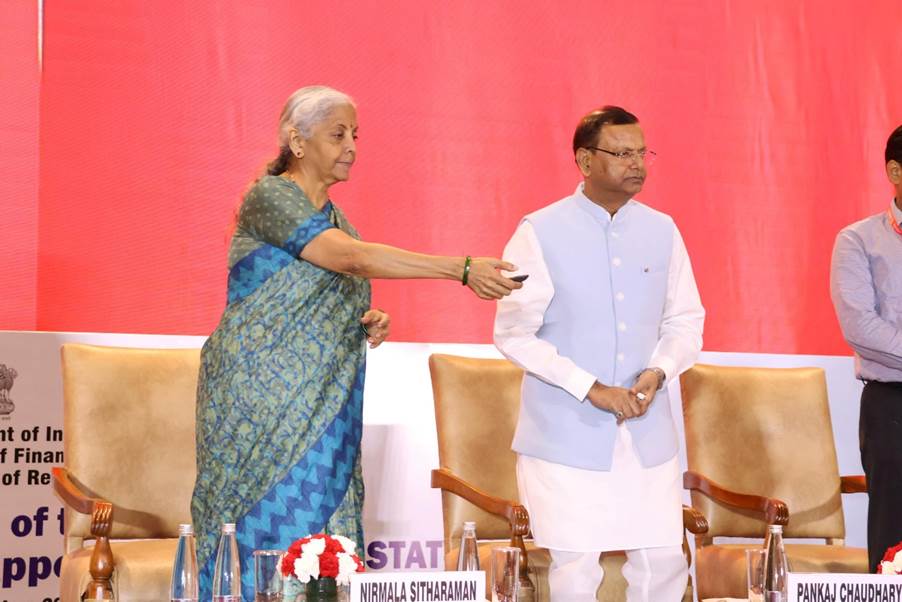
      The launch of GSTAT marks a major milestone in the evolution of the Goods and Services Tax regime and strengthens the institutional framework for indirect tax dispute resolution in the country.

      The launch was also attended by Union Minister of State for Finance Shri Pankaj Chaudhary; President of GSTAT, Justice Shri Sanjaya Kumar Mishra: Minister from the State of Haryana Shri Rao Narbir Singh, senior officers from the Department of Revenue, officers from State and Central GST formations, eminent members of the legal fraternity, and representatives from trade and industry.

      In her address, the Union Finance Minister called the launch of Goods and Services Tax Appellate Tribunal (GSTAT) not just an institutional milestone — it is a symbol of how far GST has come in the last eight years, and it is also a powerful reminder of our determination to continue improving, reforming, and adapting it for the future.

      The guiding idea behind introducing GST was unity - 'unity in policy’, ‘unity in compliance’, and ‘unity in economic purpose’, She added.

      Since its launch, the GST Council, working with States and Union Territories, has refined and strengthened the system. GST has grown as a reliable revenue source, widened the tax base, encouraged formalisation and become a foundation of India’s growth story, the Union Finance Minister said.

      Smt. Sitharaman underlined that reform is a continuous process and GST must evolve and it is evolving around the principle of simplicity and ease of living.

      The Union Finance Minister stated that from the ramparts of the Red Fort, the Prime Minister, Shri Narendra Modi, had announced the Next Generation of GST Reforms.  Guided by 'Nagarik Devo Bhava', we are moving with a citizen-first lens that values time, clarity and savings.  Next-Gen GST is delivering exactly that and the outcome this festive season, is a nationwide GST Bachat Utsav across sectors and everyday life, She added.

      In the spirit of 'Nagarik Devo Bhava', Smt. Sitharaman said that our focus for GSTAT must be clear:

      • Jargon-free decisions in plain language, simplified formats and checklists, digital-by-default filings and virtual hearings, and time standards for listing, hearing and pronouncement.
      • The outcome we seek is straightforward: reduced legal frictions, greater simplicity, and delays in litigation addressed proactively, so cash flows move faster, MSMEs and exporters invest with confidence and citizens feel the benefits of the system.

      The Union Finance Minister said that ease of living for taxpayers extends beyond filing and refunds — it includes fair, efficient dispute resolution.

      Smt. Sitharaman stated that GSTAT is a natural extension of the reform arc — an important advance for ease of doing business and a vital forum for justice; and in simple terms: when a taxpayer has a dispute, the first appeal lies within the tax administration. At the second level, whether the original order is from the Centre or a State, the appeal will now converge at a single, independent forum - the GSTAT.

      Marking the operationalisation of GSTAT is an important milestone, the Union Finance Minister said that what began in 2017 as 'One Nation, One Tax, One Market' now evolves into 'One Nation, One Forum for Fairness and Certainty'.

      In his address on the occasion, Shri Pankaj Chaudhary stated that this is not merely a capitalization of a new system, but it aims to deepen those reforms that have received continuous support from the honourable Prime Minister, Shri Narendra Modi. The purpose of these reforms is to make governance more transparent, empower citizens, and strengthen businesses.

      The Union Minister of State said that over the past several years, the government has made efforts to enhance the system, making it simpler, fairer, and more technology-driven. Inspired by the Prime Minister's 'Minimum Government, Maximum Governance,' we have moved towards clarity with targeted initiatives. Technology has been at the centre of this journey. Digital systems like return filing, e-invoicing, and online refunds have not only reduced the burden on taxpayers but have also strengthened trust between the government and the public.

      The launch of the GST Appellate Tribunal is a significant step in this journey so that the resolution of disputes can be simple and accessible. It will provide a uniform, transparent, and reliable platform for the resolution of disputes. It will reduce ambiguity, bring uniformity across the country, and ensure that both large and small taxpayers do not have to wait long for justice. More importantly, this improvement is not just related to numbers or processes. It concerns the public. For the common citizen, GST means easy taxation and reasonable prices. For small businesses, it means less paperwork and more time to focus on growth. For startups and entrepreneurs, it signifies the freedom to dream big without being hindered by complex tax structures. And for our economy as a whole, its impact is significant, Shri Chaudhary said.

      The Union Minister of state underlined that a strong appellate mechanism instils this trust that justice will be swift and fair. It assures both large and small businesses that they will not be caught in endless litigations. It makes it clear to investors that India is not only a large market but also a reliable and fair market. The most important thing is that it strengthens the trust between citizens and the government. Today, India is seen as an emerging economic power in the entire world. This confidence has been built on the reforms we have undertaken in recent years.

      With the introduction of the GST Appellate Mechanism, Shri Chaudhary said, we assure every taxpayer that your appeal will be heard, your rights will be protected, and there will be no delay in justice. In this way, we make GST not just a good and simple tax, but also a fair and trustworthy tax system for the new India. The role of the GST Council and its honourable members have been extremely important in shaping these reforms and providing guidance for them. The Council has worked with the spirit of cooperative federalism so that GST can emerge as a system that balances national priorities and the needs of states and citizens, the Union Minister of State said.

      The operation of the GST Appellate Tribunal is another step in this direction, and Shri Chaudhary wished all stakeholders his best wishes and commended everyone working hard to realise this institution. On reaching this milestone, it is necessary that the team continues this institution in the spirit of cooperation, Shri Chaudhary added.

      In his address on the occasion, Justice Sanjaya Kumar Mishra underlined the pivotal role the Tribunal will play in clearing the significant backlog of appeals under GST while also laying down jurisprudence for future disputes. He also underscored that the cooperation of both Central and State Governments has been instrumental in enabling the timely establishment of the Tribunal and expressed confidence that such support will continue in the future.

      In his address on the occasion, Shri Arvind Shrivastava said that GSTAT comes at a critical juncture in the journey of GST. Shri Shrivastava said that a formal appellate body will allow equal opportunity to all sides to present their standpoint and hopefully enable settlement of such issues in a fair and stable manner.

      The Tribunal will provide a specialised, nationwide forum that can bring consistency in interpretation, predictability in outcomes, and credibility to the appellate process. This is vital for strengthening trust between taxpayers and tax administration, the Revenue Secretary underlined.

      Highlighting the three core dimensions in the design of the GSTAT, the Revenue Secretary emphasised on the 3 S’s: structure, scale, and synergy. Its structure combines judicial and technical expertise to deliver balanced decisions. Its scale, with state benches and the possibility of single-member benches for simpler matters, ensures reach and efficiency. And its synergy — between technology, process, and human expertise — will allow it to deliver justice with both speed and depth.

      Concluding his remarks, Shri Shrivastava said that the Department of Revenue, in partnership with GSTN and NIC, has developed a digital platform that will anchor the work of GSTAT from the very start. e-Filing, case management tools, and electronic court modules will make proceedings smoother and more transparent, setting new benchmarks for the functioning of a Tribunal in our country.

      A vote of thanks on the occasion was given by Shri Balasubramanian Krishnamurthy, Joint Secretary, Department of Revenue, Ministry of Finance.

      A key feature unveiled during the launch was the GSTAT e-Courts Portal, developed by Goods and Services Tax Network (GSTN) in collaboration with National Informatics Centre (NIC). This digital platform will enable taxpayers and practitioners to file appeals online, track the progress of cases, and participate in hearings through digital mode. The portal is expected to enhance the efficiency and productivity of GSTAT, building on the success of NIC’s e-courts modules already operational in other tribunals under the Department of Revenue. To enable a smooth and convenient filing experience for taxpayers, GSTAT has allowed staggered filing of appeals up to 30th June 2026. This measure ensures that taxpayers, trade bodies, and advisors have adequate time to prepare and submit their appeals in an orderly manner, without procedural bottlenecks. Comprehensive guidance has also been provided to support users including FAQs, explanatory notes, and instructional videos available on the GSTAT Portal (https://efiling.gstat.gov.in). This covers aspects of registration, filing of appeals, digital hearings, and case tracking. These resources are aimed at ensuring that all stakeholders, including MSMEs and individual taxpayers, can easily access and benefit from the Tribunal’s services.

      The launch of GSTAT is a significant step in the continuing evolution of India’s indirect tax system. It will provide taxpayers with a specialized forum to seek justice and will bring greater orderliness, predictability, and credibility to the GST regime. The Tribunal is envisaged as a cornerstone institution in ensuring that India’s tax administration remains responsive, transparent, and aligned with the principles of ease of doing business.

      About GSTAT

      The Goods and Services Tax Appellate Tribunal (GSTAT) is a statutory appellate body established under the Goods and Services Tax laws. It has been constituted to hear appeals against orders passed by the GST Appellate Authorities and to provide taxpayers with an independent forum for justice. The Tribunal will function through a Principal Bench in New Delhi and 31 State Benches across 45 locations in India, thereby ensuring accessibility and nationwide reach.

      Each Bench of the GSTAT will comprise two Judicial Members, one Technical Member (Centre), and one Technical Member (State), ensuring a balanced composition of judicial expertise and technical knowledge from both Central and State administrations. This structure reflects the spirit of cooperative federalism and is designed to deliver impartial and consistent decisions.

      Topics

      ActsIncome Tax
