

Loading...

Top
Help
×

By creating an account you can:

Logo TaxTMI
Call Us / Help / Feedback

Contact Us At :

E-mail: [email protected]

Call / WhatsApp at: +91 99117 96707

For more information, Check Contact Us

FAQs :

To know Frequently Asked Questions, Check FAQs

Most Asked Video Tutorials :

For more tutorials, Check Video Tutorials

Submit Feedback/Suggestion :

Email :
Please provide your email address so we can follow up on your feedback.
Category :
Description :
Min 15 characters 0/2000
Make Most of Text Search
  1. Checkout this video tutorial: How to search effectively on TaxTMI.
  2. Put words in double quotes for exact word search, eg: "income tax"
  3. Avoid noise words such as : 'and, of, the, a'
  4. Sort by Relevance to get the most relevant document.
  5. Press Enter to add multiple terms/multiple phrases, and then click on Search to Search.
  6. Text Search
  7. The system will try to fetch results that contains ALL your words.
  8. Once you add keywords, you'll see a new 'Search In' filter that makes your results even more precise.
  9. Text Search
Add to...
You have not created any category. Kindly create one to bookmark this item!
Create New Category
Hide
Title :
Description :
❮❮ Hide
Default View
Expand ❯❯
Close ✕
🔎 News - Adv. Search
TEXT SEARCH:

Press 'Enter' to add multiple search terms. Rules for Better Search

Search In:
Main Text + AI Text
  • Main Text
  • Main Text + AI Text
  • AI Text
Category: ?
Categorized by AI
---- All Categories ----
  • ---- All Categories ----
  • Income Tax
  • GST
  • Customs, DGFT & SEZ
  • FEMA & RBI
  • Corp. Laws, SEBI & IBC
  • PMLA, Black Money & ED
  • Budget
  • News and Press Release
  • PTI News
Month:
---- All Months ----
  • ---- All Months ----
  • January
  • February
  • March
  • April
  • May
  • June
  • July
  • August
  • September
  • October
  • November
  • December
Year:
---- All Years ----
  • ---- All Years ----
  • 2026
  • 2025
  • 2024
  • 2023
  • 2022
  • 2021
  • 2020
  • 2019
  • 2018
  • 2017
  • 2016
  • 2015
  • 2014
  • 2013
  • 2012
  • 2011
Sort By: ?
In Sort By 'Default', exact matches for text search are shown at the top, followed by the remaining results in their regular order.
Relevance Default Date
    About 100 highway plazas used illegal apps to collect toll from vehicles not bearing FASTag stickers: ED
    CBI conducts course on financial crimes for officers from ITEC-member countries
    Delhi workers welfare board blacklists firm for over 20,000 'unauthorised' Aadhaar transactions
    Rupee rises 22 paise to close at 94.51 against US dollar
    Electrifying India's vehicles can cut its import bill by USD 125 billion by 2050: Study
    Loans to go beyond SHGs, women to get access to credit to expand livelihoods: Union minister Chouhan
    MIDC's role not just selling plots, but creation of conducive environment for development: CEO
    Decentro Wins Three Industry Honours for Fintech Infrastructure Innovation and Leadership in 2026
    Marching ahead with Responsibility and Growth - Keynote Address[Contributions by RBI colleague Shri Mohammed Majidullah, General Manager] delivered by...
    CCI directs Trustees’ Association of India, IDBI Trusteeship Services Ltd, Axis Trustee Services and SBI CAP Trustee Company to cease and desist fro...
    The Digital Textile Printer Revolution: How Konica Minolta NASSENGER is Preparing India for the Next Global Textile Opportunity
    Union minister Goyal hails 7.8 pc GDP growth; lauds Modi, takes dig at Oppn
    SC disposes of SEBI's pleas against NSE after Rs 1500-crore settlement
    India-US trade pact to be finalised once US offers preferential rate: Goyal
    Business Nextgen Finance Raises Rs 215 Crore in Equity to Accelerate MSME Lending
    Drugs: ED raids in 4 states; over 2 dozen offenders, foreign links under scanner
    Razorpay Launches a Conversational AI Account Manager 'RAY' on WhatsApp For Businesses, in Partnership with IndusInd Bank
    AssetPlus Launches Portfolio Management Services to Help MFD Partners Grow and Retain High-Net-Worth Clients
    APEDA Facilitates Flag-Off of 18 MT of NPOP-Certified Ethnic Rice from Tripura for Export to Austria and the Netherlands
    VR LIVIN’s ‘THE FIRST’ Records Sale of 20 Villas Within Two Days of Launch
❯❯
Maximize Maximize Maximize
0 / 200
Expand Note
Add to Folder

No Folders have been created

+

Are you sure you want to delete "My most important" ?

NOTE:

News
Showing Results for :
Reset Filters
Results Found:
Show All Summaries Hide All Summaries
September 3, 2026
Show AI Summary
Unauthorised toll collection apps allegedly generated fake receipts, concealed non-FASTag collections, and triggered a money-laundering investigation.
Unauthorised digital applications allegedly enabled toll collection from vehicles without FASTag stickers outside the official reporting system. Mobdata and Any were allegedly used to generate unauthorised or fake toll receipts, conceal collections from NHAI, and monitor such collections through dedicated portals. A PMLA investigation followed an FIR alleging fraudulent toll collection, with digital forensic material indicating use of the mechanism across around 100 toll plazas. Searches resulted in seizure of financial and digital records and freezing of bank accounts.
September 3, 2026
Show AI Summary
Economic offence investigations: cross-border training strengthens officers' practical skills in investigation, prosecution, procedures, and handling complex financial crimes.
Capacity-building training under the Indian Technical and Economic Cooperation programme equipped officers from member countries with practical skills for investigating economic offences. It covered varied forms of financial and economic crime, cross-border impact, challenges in investigation and prosecution, standard operating procedures, and investigative best practices. The specialised law-enforcement engagement aims to strengthen international cooperation and investigative capacity in economic-offence matters.
September 3, 2026
Show AI Summary
Unauthorised Aadhaar credential use triggers blacklisting and procurement debarment following alleged post-termination enrolment and update transactions.
Alleged unauthorised use of Aadhaar Registrar/EA Code credentials after termination of an operational engagement led the Delhi Construction and Other Workers Welfare Board to blacklist MDS Solution Pvt Ltd. UIDAI communication indicated that Aadhaar-related activity allegedly continued after cancellation through the Board's credentials. The Board lodged a police complaint, barred the firm from its tenders, procurement processes, empanelment and contract awards, and recommended consideration of action under applicable rules and policies.
September 3, 2026
Show AI Summary
FCNR(B) deposits strengthen foreign-exchange liquidity and support rupee appreciation alongside foreign portfolio inflows into government securities.
Foreign-currency inflows through FCNR(B) deposits, overseas foreign-currency borrowings and external commercial borrowings strengthened foreign-exchange liquidity and supported appreciation of the rupee against the US dollar. Foreign portfolio investment in government securities was linked to the abolition of withholding tax and long-term capital gains tax on such investment. Currency-market conditions were also influenced by foreign institutional equity purchases, global risk appetite, crude-oil prices and geopolitical tensions.
September 3, 2026
Show AI Summary
Electric vehicle adoption can reduce transport import dependence while domestic battery manufacturing increases projected long-term savings.
Electric-vehicle adoption across road-transport segments is projected to reduce dependence on imported petrol and diesel, notwithstanding continuing battery imports. Accelerated electrification could reduce vehicle-related import expenditure substantially by 2050 because reduced oil imports are expected to exceed battery-import costs. Domestic cell-manufacturing capacity may further increase savings by combining rapid vehicle electrification with battery localisation.
September 3, 2026
Show AI Summary
Women's livelihood credit access will extend beyond self-help groups through standardised loan formalities and coordinated banking support.
Women's access to credit for livelihood expansion is to extend beyond Self-Help Groups to individual women members. Loan accessibility concerns include distance from bank branches, repeated visits to complete formalities, and inconsistent banking procedures. Regular State Rural Livelihood Mission meetings, bank participation, training, helplines, process improvements and coordination with bankers are intended to reduce barriers. Loan formalities are to be standardised across banks through a uniform process involving RBI and NABARD.
September 3, 2026
Show AI Summary
Industrial development facilitation prioritises infrastructure, services, policy utilisation, and dry-port trade connectivity for businesses and agro-based farmers.
Industrial development facilitation extends beyond allocation of industrial plots to infrastructure development, services, and a favourable business environment. Industry-support policies seek to encourage participation by entrepreneurs, promote growth across sectors, and improve investment conditions without distinction between small and large enterprises. Dry-port infrastructure strengthens national and international trade connectivity, supporting import and export expansion for industrial and agro-based businesses.
September 3, 2026
Show AI Summary
Regulated fintech infrastructure recognition highlights integrated payment, identity and collections capabilities across embedded financial product delivery.
Decentro operates an integrated fintech infrastructure platform combining payment acceptance, identity verification, banking and AI-led collections through a unified integration layer. It holds Payment Aggregator authorisations for online and physical payments, a Payment Service Provider licence through its GIFT City entity, and certification for offline identity-verification workflows. These capabilities support embedded financial products, payment acceptance, lending collections and related financial workflows for enterprise users.
September 3, 2026
Show AI Summary
Responsible NBFC and HFC growth requires technology-enabled inclusion, proportionate regulation, sound governance, liquidity discipline, customer protection and cyber resilience.
NBFCs and HFCs can complement bank-led credit delivery through last-mile reach, sector-specific expertise, digital infrastructure, consent-based data sharing and cash-flow-based underwriting. Sustainable growth requires strong liquidity risk management, governance, compliance culture, diversified funding, stress testing, early-warning systems, dynamic provisioning and sound underwriting standards. Proportionate scale-based regulation, digital lending standards and a substance-over-form approach seek to support innovation while preserving financial stability. Customer protection, responsible lending, grievance redressal, fair recovery conduct, cyber resilience and protection of customer data remain essential.
September 3, 2026
Show AI Summary
Debenture trusteeship fee fixing constitutes cartelisation by constraining independent pricing and restricting service availability in the market.
Collective minimum-fee fixing for debenture trusteeship services prevented trustees from making independent commercial pricing decisions and constituted cartelisation. Prescription of a benchmark fee limited and controlled the supply or market for such services by directing association members and non-members not to serve debenture issuers below that fee. The conduct contravened Section 3(3)(a) and Section 3(3)(b) read with Section 3(1) of the Competition Act, 2002.
September 3, 2026
Show AI Summary
Digital textile printing enables flexible industrial production, shorter lead times, reduced screen dependency and sustainability-focused manufacturing for export markets.
Digital textile printing is presented as an industrial alternative to conventional screen printing, allowing direct production from digital design files with faster design changes, shorter lead times and flexibility across varying order quantities. Single-pass systems support high-volume production through fixed printing units and continuous fabric movement, while multipass platforms provide flexible production across natural, synthetic and specialised textiles. Digital production is associated with printing closer to demand, eliminating physical screens, reducing unnecessary production, and addressing wastewater reduction, chemical compliance, traceability and responsible manufacturing expectations.
September 3, 2026
Show AI Summary
Economic growth and infrastructure investment were presented as supporting exports, skilled employment, connectivity, and long-term development.
Economic growth, export expansion and infrastructure investment are presented as interconnected drivers of India's development, global standing and employment opportunities. Infrastructure expenditure, railway expansion and improved transport connectivity are identified as measures intended to facilitate movement, simplify transportation, support trade and exports, and strengthen industrial and commercial activity. These measures are associated with the objective of a developed India by 2047 and enhanced employment, business and growth opportunities.
September 3, 2026
Show AI Summary
Co-location and dark fibre settlement addressed allegations of preferential market-data access and speed advantages in trading.
SEBI's co-location and dark fibre matters involving NSE concerned allegations that certain stockbrokers obtained unfair preferential speed advantages to access market data and execute trades ahead of other investors. NSE pursued settlement applications covering both matters, and revised settlement terms increased the cumulative amount. Payments made by NSE together completed the agreed settlement amount.
September 3, 2026
Show AI Summary
Preferential tariff treatment remains the condition for finalising the bilateral trade agreement and improving Indian export competitiveness.
Finalisation of the India-US Bilateral Trade Agreement is contingent on the United States extending preferential tariff treatment to India relative to competing supplier countries. Further negotiations are required following changes in the United States tariff environment. A comparative tariff advantage is intended to improve the price competitiveness of Indian goods in the United States market, particularly against competitors benefiting from lower duties under least-developed-country preferences or trade agreements.
September 3, 2026
Show AI Summary
MSME secured lending equity capital, subject to regulatory approval, supports expansion without management-control change in operations.
Business Nextgen Finance Private Limited, a non-deposit taking non-banking financial company registered with the Reserve Bank of India, has raised Rs 215 crore in equity capital to expand secured credit for micro, small and medium enterprises. The transaction received prior Reserve Bank of India approval. The capital base will support secured lending scale-up, geographic expansion, technology investment and wider access to formal credit in underserved markets. The investment does not involve a change in management or day-to-day control.
September 3, 2026
Show AI Summary
Money-laundering probes into narcotics trafficking rely on predicate police and narcotics cases and examine cross-border linkages.
Money-laundering investigation under the Prevention of Money Laundering Act involves coordinated searches in connection with multiple narcotics-trafficking matters. The investigation is founded on police and Narcotics Control Bureau FIRs and linked chargesheets concerning separate drug-trafficking allegations, including alleged trafficking in methamphetamine, marijuana and MDMA with suspected cross-border linkages.
September 3, 2026
Show AI Summary
Conversational AI account management enables businesses to access payment information, settlement support, refunds, and payment links through WhatsApp.
RAY is a conversational AI account manager on WhatsApp that enables businesses to access payment information, support, and operational actions through messages or voice notes. It can provide payment summaries, analyse payment activity, monitor settlement status, generate payment links, and issue refunds. The AI assistant is designed to proactively identify payment-health issues, flag settlement events, recommend actions, and use merchant-specific context to support payment management without dashboard navigation.
September 3, 2026
Show AI Summary
Portfolio management services distribution enables certified mutual fund distributors to digitally onboard and report for eligible high-net-worth clients through AssetPlus.
AssetPlus has launched Portfolio Management Services for certified Mutual Fund Distributor partners to digitally onboard, track, manage and report PMS investments for eligible high-net-worth clients. PMS distribution requires NISM Series-XXI-A certification and operates within the APRN distributor-registration framework. PMS comprises individually managed portfolios run by SEBI-registered Portfolio Managers and held in clients' demat accounts. The minimum investment is Rs. 50 lakh, and offerings are governed by the SEBI (Portfolio Managers) Regulations, 2020. The platform provides daily reconciliation of holdings, performance and valuations.
September 3, 2026
Show AI Summary
NPOP-certified ethnic rice exports strengthen organic producer access to international markets through certification, traceability, and organised export production.
NPOP-certified ethnic rice exports from Tripura to Austria and the Netherlands connect local farmers and Farmer Producer Companies with international markets through organised, export-oriented production. The initiative emphasises certification, traceability, food safety and quality as requirements for access to markets for certified organic products. Buyer-seller linkages support export opportunities, while coordinated organic value-chain engagement strengthens certification and quality systems and supports producers in meeting international standards.
September 3, 2026
Show AI Summary
Gated residential community launch combines smart-home villas, extensive lifestyle amenities and planned expansion into future residential developments.
VR LIVIN Ventures LLP launched 'THE FIRST', an 83-villa gated residential community in Madhavaram, North Chennai, which recorded sales of 20 villas during its first two launch days. The development includes smart-home villas and more than 50 lifestyle amenities, with access to nearby metro connectivity and social infrastructure. It forms part of the company's intended expansion of residential projects in Chennai and other South Indian locations.

News

Back

All News

Showing Results for :
Reset Filters
No Records Found

News

Showing Results for : Reset Filters
Corp. Laws, SEBI & IBC

Pilot Study on Annual Survey of Services Sector Enterprises (ASSSE) to capture insights into the Incorporated Service Sector

April 30, 2025

Contents
Summary
Note

Note

-

Bookmark

Print

Print

The pilot study was carried out in two phases using a GSTN frame primarily with an objective to test the suitability of the GSTN database as sampling frame, verify and update selected frame information (in Phase-I) and to test the operational modalities such as, response of the enterprises, adequacy of the instruction, structure of the questionnaire, collectability of information, etc. (in Phase-II).

The pilot study covered those service sector enterprises from the GSTN database which are registered under Companies Act, 1956 or, Companies Act, 2013 or Limited Liability Partnership (LLP) Act, 2008.

The pilot provides valuable operational insights and a foundation for launching a robust, full-scale annual survey of incorporated service sector enterprises from January 2026.

Objective of the Pilot Survey on ASSSE

  1. The service sector is a key driver of India's economy, contributing more than 50% to the country's GDP and providing millions of jobs. Accurate and comprehensive data on this sector is crucial for informed policymaking, strategic planning, and investment decisions. While the unincorporated part of the service sector is covered in Annual Survey of Unincorporated Sector Enterprises (ASUSE) conducted by National Statistics Office, there is a lack of granular data on the economic and operational characteristics, employment, and other related aspects of the incorporated service sector. This gap in data is primarily due to the absence of a regular national-level survey covering the various sub-sectors of the incorporated non-agricultural non-manufacturing sectors.
  2. The main objective was to test operational processes - enterprise response, clarity of survey instructions, efficacy of the questionnaire and the availability of key data from official records such as books of accounts, profit and loss statements, and labour registers.

Requirement of Pilot Study before launching full-fledged ASSSE

To firm up the methodology, survey instruments and other operational aspects of conducting a full-fledged pan-India survey (ASSSE), there was a felt need to undertake a pilot. Accordingly, the Ministry of Statistics and Programme Implementation (MoSPI) has conducted the Pilot Study on ASSSE and releases its findings as a Technical Report in this press note.

This pilot marks a pioneering effort in the Indian official survey ecosystem, utilizing a GSTN-based enterprise frame for the first time comprising of incorporated enterprises across the Construction, Trade, and Other Services categories including transport, accommodation and food services, information and communication, health, education, real estate, etc. Technical Report available in the website of the MoSPI viz. https://www.mospi.gov.in.

Modalities of conducting the Pilot Study

The Pilot Study on ASSSE has been conducted using an ‘enterprise approach’ where the term ‘enterprise’ is referred to as a GSTN unit conducting operations in a particular state. As per GSTN nomenclature, the term enterprise is analogous to ‘principal place of business’ which may have one or more ‘additional place of business’ (establishments) in the state. Combined data of all the additional places of businesses have been collected from the principal place of business in this pilot study.

The two-phase pilot study, conducted through CAPI (Computer-Assisted Personal Interviewing) on tablets, aimed to test the suitability of GSTN database as sampling frame, validate and update selected frame information, test operational processes, and assess data availability from business records including balance sheets, books of accounts and labour registers maintained by the enterprises for the financial year 2022–2023.

Phase I of the pilot was conducted during May 2024–August 2024 covering 10,005 enterprises primarily to verify and update address and activity information along with collecting some quantitative information such as gross sale value, employment, etc.

Phase-II of the Pilot Study on 5020 enterprises selected from the list of eligible enterprises of Phase-I took place during November 2024 to January 2025. Data for this phase were collected under the Collection of Statistics Act, 2008 (as amended in 2017), with notices issued in October 2024.

Major takeaway from the pilot study

  • Majority of the enterprises were found to be existent and operational.
  • Units with headquarters in other states required significant effort to collect the relevant data. Also, challenges were faced in bifurcating the GSTIN level information pertaining to the selected enterprises from Pan-India centralized records (often CIN based) maintained at headquarter level.
  • Majority of the responding units were found to be cooperative in furnishing information/data.
  • Barring a few blocks, the questionnaire was found to be reasonably easy to fill in.
  • The instructions were found to be mostly clear and unambiguous and easy to understand.

Key finding of the pilot study (based on unweighted i.e without applying any multiplier on sample observations):

  1. Distribution of Enterprises by type of organization

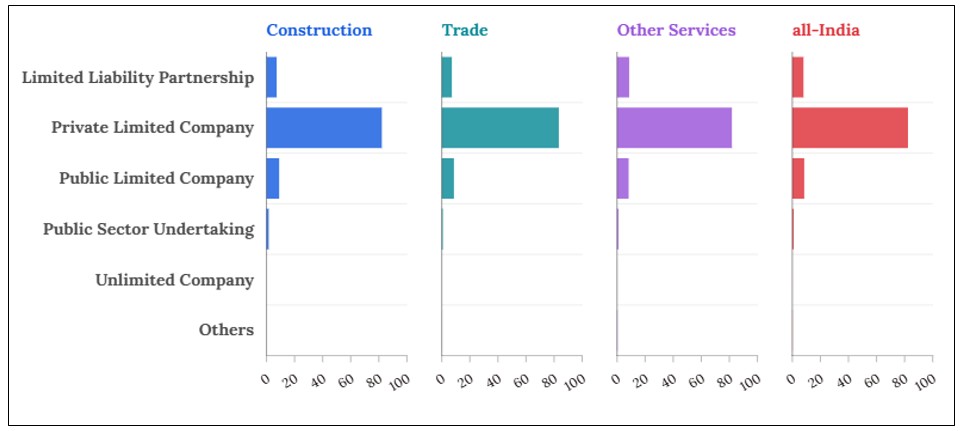
In Figure 1, distribution of enterprises by type of organization is presented. It can be seen that majority of the corporate entities in the pilot study on ASSSE are Private Limited Companies (82.40% at overall level) during FY 2022-23 followed by Public Limited Company and Limited Liability Partnership (each having nearly 8% share). The same trend is noticeable for all the Broad Activity Categories (BAC) i.e., Construction, Trade and Other Services.

Figure 1: Distribution of enterprises by type of organization for each BAC
  1. Percentage share of economic indicators by different size classes of output (FY 2022-23)

Size Class of Output (Rs.)

No. of enterprises surveyed

Indicator*

Fixed Assets

Net Fixed Capital Formation

Gross Fixed Capital Formation

Gross Value Added

Net Value Added

Total persons engaged

Total compensation

all-India

Less than 10 cr.

2720

2.64

2.19

2.44

1.19

1.07

9.28

3.17

10 cr. or more, but less than  100 cr.

927

9.58

6.00

8.32

9.45

9.38

20.03

11.43

100 cr. or more, but less than 500 cr.

326

25.00

29.08

26.96

19.90

19.33

33.73

22.24

500 cr. or more

113

62.77

62.73

62.28

69.47

70.21

36.96

63.17

All

4086

100.00

100.00

100.00

100.00

100.00

100.00

100.00


The following Table presents the percentage share of different important indicators over different size-classes of output.

* generated based on sample data without using weights

The data reveals that larger enterprises with output Rupees 500 crores and above dominate in terms of asset ownership (62.77%), net fixed capital formation (62.73%), gross value added (69.47%) and total compensation (63.17%). Further, data also reveals that enterprises (having output below Rupees 500 crores) make up almost  account for 63.03% of total employment and 36.84% of total compensation.

Fig. 2: Enterprises with additional places of businesses in the state for each Broad Activity Categories.
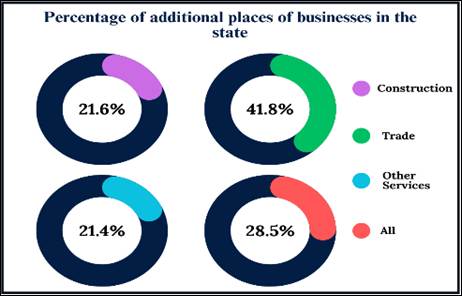
The above Figure (Figure 2) shows that overall, 28.5% of enterprises reported having additional places of business within the state. This percentage was observed to be the highest in the Trade sector with around 41.8% of enterprises belonging to this sector reported additional places of business in the state. As per GSTN nomenclature, the term enterprise is analogous to ‘principal place of business’ which may have one or more ‘additional place of business’ (establishments) in the state.

Way Forward

  1. The pilot study on ASSSE represents a significant milestone in strengthening India’s statistical infrastructure for the service sector, a key contributor to both GDP and employment.
  2. The findings from the pilot study provide a strong foundation for launching the full-scale annual survey starting in January 2026.
  3. The pilot study confirmed the suitability of the GSTN database as a sampling frame for the survey.
  4. It highlighted the importance of proper verification and validation of survey instruments, the collectability of data from records maintained by selected enterprises and the challenges encountered during data collection.
  5. The pilot study offers valuable insights for planning and finalizing the sampling design, determining the sample size and refining the questionnaire for the full-fledged survey in consultation with major stakeholders.
  6. The major indicators of the survey include percentage share of Fixed Assets, Net fixed Capital Formation, Gross Fixed Capital Formation, GVA, NVA, number of persons engaged and compensation etc. over different size-classes of output.

Important Caveat

The basic purpose of the pilot study was experience gathering on various aspects of the survey (as mentioned in previous paras) rather than generating estimates. Considering the small sample size of only 5020 units and the fact that a number of selected units were found to be non-existing and/or non-responding for various reasons, no design-based estimate (using sampling weights) has been attempted in this pilot study. Hence the estimates of any sector or Broad Activity Category (BAC) obtained by summing the estimates of all enterprises belonging to that sector/BAC tend to be skewed towards the estimates of large units present in that sector/BAC. Thus, the estimates are not indicative of or comparable to the overall actual aggregates of the sector/BAC.

Topics

Acts Income Tax
