Ministry of Statistics and Programme Implementation (MoSPI), Government of India, released the 26th edition of its publication titled “Women and Men in India 2024: Selected Indicators and Data”.
The publication offers a comprehensive overview of the gender landscape in India, presenting selected indicators and data across key areas like population, education, health, economic participation, and decision-making, all sourced from various Ministries/ Departments/Organizations. Utilizing official statistics, it presents gender-disaggregated data across urban-rural divides and geographic regions, facilitating a nuanced understanding of the challenges and opportunities faced by women and men.
"Women and Men in India 2024: Selected Indicators and Data" serves as a crucial resource, highlighting both progress in gender equality and persistent disparities. By analyzing socio-economic indicators and highlighting trends, it empowers policymakers, researchers, and other stakeholders to develop gender-sensitive policies fostering sustainable and inclusive development.
“Women and Men in India 2024: Selected Indicators and Data” is available at the website of the Ministry (https://mospi.gov.in/).
Some of the highlights of the publication are as follows:
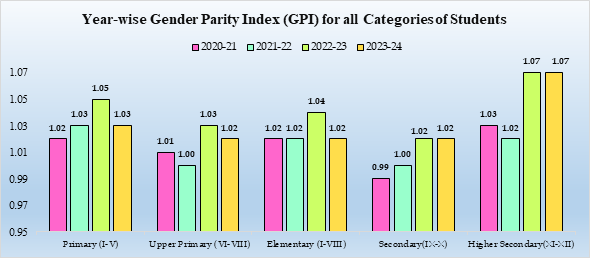
- The primary and higher Secondary levels have consistently high GPI, indicating strong female enrolment. Upper primary and elementary levels saw fluctuations but remained close to parity.

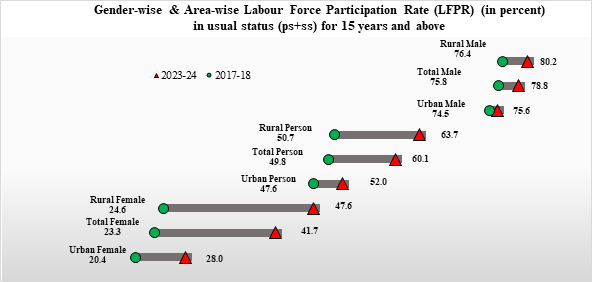
- The LPFR in usual status for ages 15 years and above has improved from 49.8% (2017-18) to 60.1% (2023-24).

- Women own 39.2% of all bank accounts and contribute to 39.7% of total deposits. Their participation is highest in rural areas, where they make up 42.2% of account holders.
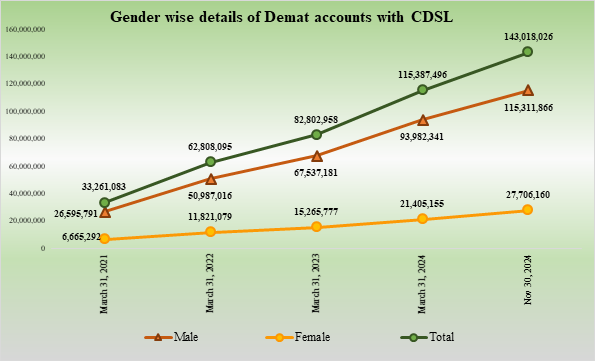
- There is rise in DEMAT account over the years, indicating growing participation in the stock market. From March 31, 2021, to November 30, 2024, the total number of DEMAT accounts increased from 33.26 million to 143.02 million, marking more than a fourfold rise. Male account holders have consistently outnumbered female account holders, but female participation has also shown a growing trend. The number of male accounts rose from 26.59 million in 2021 to 115.31 million in 2024, while female accounts increased from 6.67 million to 27.71 million during the same period.

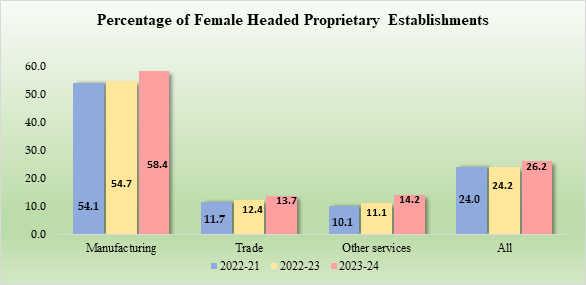
- Rising percentage of female-headed proprietary establishments across manufacturing, trade, and other services sectors over the years 2021-22, 2022-23 and 2023-24 has been observed.
- The total number of electors increased from 173.2 million in 1952 to 978 million in 2024, with a notable rise in female voter registration. Female voter turnout varied over the years, reaching 67.2% in 2019 but slightly declining to 65.8% in 2024. The gender gap in voting has narrowed, with female turnout surpassing male turnout in 2024.
- Over the years, there has been an increase in the number of startups recognized by DPIIT with at least one-woman director, reflecting a positive trend in female entrepreneurship. The total number of such startups rose from 1,943 in 2017 to 17,405 in 2024.
Gender-disaggregated indicators reveal trends in education, labour participation, financial inclusion, entrepreneurship and electoral engagement. Publication provides gender-disaggregated official indicators across education, labour participation, financial inclusion, entrepreneurship and electoral engagement to support gender-sensitive policymaking. It notes high Gender Parity Index at primary and higher secondary levels, rising labour force participation for ages 15 and above, increased female bank account ownership and deposit share with strong rural representation, rapid growth in DEMAT accounts with growing female participation, rising female-headed proprietary establishments, narrowed gender gaps in elector registration and turnout, and an increase in startups with at least one-woman director.