
Just a moment...

Top
Help
×

By creating an account you can:

Logo TaxTMI
Call Us / Help / Feedback

Contact Us At :

E-mail: [email protected]

Call / WhatsApp at: +91 99117 96707

For more information, Check Contact Us

FAQs :

To know Frequently Asked Questions, Check FAQs

Most Asked Video Tutorials :

For more tutorials, Check Video Tutorials

Submit Feedback/Suggestion :

Email :
Please provide your email address so we can follow up on your feedback.
Category :
Description :
Min 15 characters0/2000
Make Most of Text Search
  1. Checkout this video tutorial: How to search effectively on TaxTMI.
  2. Put words in double quotes for exact word search, eg: "income tax"
  3. Avoid noise words such as : 'and, of, the, a'
  4. Sort by Relevance to get the most relevant document.
  5. Press Enter to add multiple terms/multiple phrases, and then click on Search to Search.
  6. Text Search
  7. The system will try to fetch results that contains ALL your words.
  8. Once you add keywords, you'll see a new 'Search In' filter that makes your results even more precise.
  9. Text Search
Add to...
You have not created any category. Kindly create one to bookmark this item!
Create New Category
Hide
Title :
Description :
❮❮ Hide
Default View
Expand ❯❯
Close ✕
🔎 News - Adv. Search
TEXT SEARCH:

Press 'Enter' to add multiple search terms. Rules for Better Search

Search In:
Main Text + AI Text
  • Main Text
  • Main Text + AI Text
  • AI Text
Category: ?
Categorized by AI
---- All Categories ----
  • ---- All Categories ----
  • Income Tax
  • GST
  • Customs, DGFT & SEZ
  • FEMA & RBI
  • Corp. Laws, SEBI & IBC
  • PMLA, Black Money & ED
  • Budget
  • News and Press Release
  • PTI News
Month:
---- All Months ----
  • ---- All Months ----
  • January
  • February
  • March
  • April
  • May
  • June
  • July
  • August
  • September
  • October
  • November
  • December
Year:
---- All Years ----
  • ---- All Years ----
  • 2026
  • 2025
  • 2024
  • 2023
  • 2022
  • 2021
  • 2020
  • 2019
  • 2018
  • 2017
  • 2016
  • 2015
  • 2014
  • 2013
  • 2012
  • 2011
Sort By: ?
In Sort By 'Default', exact matches for text search are shown at the top, followed by the remaining results in their regular order.
RelevanceDefaultDate
    Modernization of National Sample Surveys through adoption of digital platforms such as Computer Assisted Personal Interview (CAPI) integrated with e- ...
    Govt hikes windfall gains tax on petrol, diesel, ATF exports
    No guidelines to regulate online astrology platforms: Consumer affairs department to CIC
    Yellow.ai, a Global Leader in Enterprise Agentic AI, to Go Public via $550 Million Merger with Bluerock Acquisition Corp.
    Shri Piyush Goyal Invites Indian and Uzbek Businesses to Co-invest and Co-manufacture; Calls for Doubling Bilateral Trade at India-Uzbekistan Business...
    Every ₹1 invested under Kisan Credit Card– Modified Interest Subvention Scheme (KCC-MISS) contributes ₹2.30 to net value addition in the...
    India achieves near-universal banking coverage, with 99.92% of inhabited villages now served by a banking outlet
    Rupee rises for 6th day, gains 12 paise to 95.31 against US dollar as crude drops
    ACE Software Posts Earnings Turnaround; Standalone Profit Before Tax Up 43% YoY
    Rajya Sabha passes bill to tackle payment delays faced by MSMEs amid Opposition protests
    MPC's 3-day meeting begins amid expectations of status quo on interest rates
    Trane Technologies Reports Strong Second Quarter Results; Raises Full-Year Revenue and EPS Guidance
    CBN dismantles inter-state counterfeit drug network in Bihar under Operation Vajra; mastermind arrested
    DRI seizes quantities of gold; drugs, e-cigarettes and other contraband in pan-India Ops; 20 persons, including 5 foreign nationals, arrested
    Union Government releases tax devolution of ₹1,09,019 crore to State Governments, as one advance instalment to accelerate their capital and deve...
    Raymond Lifestyle Limited Delivered a stable Q1 FY27 Performance
    Rupee rises 31 paise to 95.12 against US dollar in early trade
    Customs seizes 8 kg gold worth over Rs 11 cr at Kerala airports in one week
    Drill, Baby, Drill: India to fund Rs 650 cr per well for 60 deepsea wells to break its oil import habit
    Punjab GST revenue rises 20 pc to Rs 10,447 crore in April-July: Cheema
❯❯
MaximizeMaximizeMaximize
0 / 200
Expand Note
Add to Folder

No Folders have been created

    +

    Are you sure you want to delete "My most important" ?

    NOTE:

    News
    Showing Results for :
    Reset Filters
    Results Found:
    Show All SummariesHide All Summaries
    August 4, 2026
    Show AI Summary
    Digital statistical modernisation strengthens survey quality, macroeconomic indicators, international standards alignment and infrastructure performance monitoring through standardised data systems.
    National statistical modernisation uses digital survey platforms with validation checks, AI-enabled support and multilingual interfaces, alongside short-duration surveys and administrative data to improve sampling and timely official statistics. Reforms include base revisions for Gross Domestic Product, Consumer Price Index and Index of Industrial Production; adoption of metadata, quality-assessment and classification standards; and alignment with international statistical principles and methodologies. Sustainable development indicators and infrastructure monitoring are supported through a national indicator framework, PAIMANA and a standardised performance dashboard.
    August 3, 2026
    Show AI Summary
    Windfall gains tax on petroleum exports increases to discourage exports and preserve domestic fuel availability during regional supply disruptions.
    Special additional excise duty on exports of petrol, diesel and aviation turbine fuel has been increased for the relevant fortnightly period, while existing duty rates for petrol and diesel cleared for domestic consumption remain unchanged. The windfall gains tax is intended to preserve domestic availability of petroleum products during the West Asia crisis and prevent exporters from benefiting unduly from price differences linked to elevated global crude oil prices.
    August 3, 2026
    Show AI Summary
    Online Astrology Platform Regulation: consumer department reported no guidelines, while information requests required revised factual disclosures.
    Online astrology platforms were reported as lacking specific regulatory guidelines within the consumer affairs department. The RTI application sought information on alleged unfair trade practices, investigations, complaints, licences, approvals, and applicable rules. The National Consumer Helpline stated that it had not investigated because it functions as a grievance-resolution platform. A revised factual response was required on investigations and complaint data, while queries concerning regulation, licences, approvals, and related investigations were to be transferred to the public authorities likely to hold that information.
    August 3, 2026
    Show AI Summary
    Business combination disclosure outlines shareholder approval, registration requirements, financing conditions, and forward-looking risks for the proposed public listing.
    The proposed business combination would take Yellow.ai public through a definitive agreement with Bluerock Acquisition Corp., subject to customary closing conditions and shareholder approval. Bluerock intends to file a Form S-4 registration statement containing a proxy statement/prospectus for proxy solicitation and securities issuance in connection with the transaction. The communication is not an offer or solicitation and states that no securities offering may occur without compliance with applicable registration, qualification or exemption requirements. Transaction projections and anticipated benefits are forward-looking statements subject to material risks and uncertainties.
    August 3, 2026
    Show AI Summary
    Bilateral investment and trade facilitation drive proposed co-investment, digital cooperation and advanced manufacturing partnerships between Indian and Uzbek businesses.
    India-Uzbekistan cooperation is proposed through co-investment, co-manufacturing and co-innovation, supported by the Bilateral Investment Treaty to promote investor confidence and reciprocal investment. Priority sectors include mining, textiles, healthcare, agriculture, food processing, digital technologies and advanced manufacturing. Trade facilitation measures include reducing trade barriers, mutual recognition of standards, approvals, testing and certification, customs digitalisation and improved trade routes. Regulators and standard-setting bodies are expected to cooperate under a structured, time-bound economic partnership.
    August 3, 2026
    Show AI Summary
    Concessional agricultural credit supports working capital, crop diversification, allied activities, and digital expansion under the Kisan Credit Card scheme.
    The Kisan Credit Card-Modified Interest Subvention Scheme provides concessional institutional credit to reduce farmers' interest burdens and improve timely working-capital access. The scheme is reported to support cropping intensity, multi-season cultivation, diversified crop portfolios, timely input use, and credit discipline through the Prompt Repayment Incentive. It also supports dairy, livestock, and fisheries-based income diversification. Credit-delivery measures include collateral-free lending, digital platforms, simplified applications, coverage expansion, and awareness campaigns. State-wise data tracks operative accounts, outstanding credit, and non-performing Kisan Credit Card accounts.
    August 3, 2026
    Show AI Summary
    Banking inclusion expands rural access while digital credit systems and payment security controls address service delivery and cyber fraud.
    Banking inclusion is pursued by providing banking outlets within a five-kilometre radius of inhabited villages, with branch expansion permitted subject to rural-coverage requirements and continuing assessment of uncovered areas. Agricultural credit delivery uses digital loan, beneficiary-verification, processing and claim-settlement systems. Digital payment security measures require minimum controls for payment channels and include fraud-intelligence sharing, artificial-intelligence-based identification of money-mule activity, digital lending-app analysis, cyber-incident reporting, public awareness campaigns and electronic-banking training.
    August 3, 2026
    Show AI Summary
    Foreign exchange market movement strengthened the rupee as lower crude prices, investment inflows and improved risk sentiment provided support.
    Foreign exchange market movement saw the rupee strengthen for a sixth consecutive trading session against the US dollar, supported by declining global crude oil prices, a softer dollar, foreign institutional investment inflows and gains in domestic equity markets. Improved global risk sentiment followed the decision to defer planned US military strikes against Iran and allow diplomatic engagement. Renewed geopolitical tensions were identified as a factor that could limit further appreciation.
    August 3, 2026
    Show AI Summary
    Quarterly financial performance reflects revenue growth, improved standalone profitability, and continued investment in AI-led digital technology platforms.
    Quarterly financial performance reported revenue growth in standalone and consolidated operations, higher standalone profit before tax, and a return to consolidated profitability. The company continues to invest in an AI-led, intellectual-property-driven digital technology strategy through enterprise software, SaaS platforms, digital commerce, cloud, data and AI solutions. Its priorities include scalable platforms, proprietary technology assets, recurring-revenue offerings, partnerships and selective acquisitions. Complete financial results, notes to accounts and regulatory disclosures are available through exchange filings and the company website.
    August 3, 2026
    Show AI Summary
    MSME delayed-payment reforms strengthen award recovery, faster dispute adjudication, invoice discounting, and interim supplier payment protection.
    MSME delayed-payment reforms seek faster adjudication, strengthened recovery and improved liquidity for enterprise suppliers. Courts may direct payment of at least half of an awarded amount where a setting-aside application remains pending beyond six months. Mediated settlements and arbitral awards may be recovered as arrears of land revenue and recognised as legally enforceable debts under the insolvency framework. The measures also provide graded penalties, voluntary digital registration, invoice settlement through the Trade Receivables Discounting System, and additional Facilitation Councils.
    August 3, 2026
    Show AI Summary
    Monetary policy rate setting remains cautious as inflation, liquidity, growth and global uncertainty shape the policy stance.
    Monetary policy rate setting is expected to remain cautious amid global uncertainty, rising inflation risks and steady domestic growth. The inflation outlook is affected by energy-price pass-through, higher input costs, and seasonal and monsoon-related food-price pressures. Policy decisions are expected to remain data-dependent, guided primarily by domestic inflation, liquidity conditions and economic growth. A cautious or neutral stance is identified as preferable while external risks and inflation developments persist.
    August 3, 2026
    Show AI Summary
    Forward-looking financial disclosure raises revenue and earnings guidance while describing non-GAAP measures, capital allocation, and material business risks.
    Financial performance reporting identifies increased bookings, revenue growth, continuing earnings, and backlog, with segment-level operating and margin measures. The release addresses cash flow, capital allocation through dividends, acquisitions and share repurchases, and increased full-year revenue and earnings guidance. Forward-looking statements concerning financial performance, operations, demand, liquidity and capital deployment are subject to identified risks and uncertainties. Non-GAAP measures are presented as supplemental to GAAP measures, with definitions and reconciliations stated to be available in accompanying materials.
    August 3, 2026
    Show AI Summary
    Counterfeit drug enforcement targets illicit manufacture, storage and trafficking networks, with coordinated seizures and referral of non-narcotic stock.
    Counterfeit-drug enforcement under Operation Vajra addressed an inter-state network involved in the illicit manufacture, storage and distribution of narcotic drugs, psychotropic substances and spurious pharmaceutical products. Searches of unregistered godowns recovered narcotic products, unauthorisedly manufactured Buprenorphine injection ampoules, and counterfeit non-NDPS medicines. A farmhouse-based illicit manufacturing facility was dismantled, with machinery, chemicals and related materials seized under the NDPS Act, 1985.
    August 3, 2026
    Show AI Summary
    Anti-smuggling enforcement targets concealed gold, narcotics, protected products, prohibited e-cigarettes and restricted imports through coordinated intelligence operations.
    Intelligence-led anti-smuggling operations resulted in seizures of foreign-origin gold, narcotic drugs, hydroponic weed, protected wildlife and forest products, prohibited electronic cigarettes, and restricted poppy seeds and areca nuts. The operations identified concealment through fabricated baggage cavities, false cargo declarations, misdeclaration of origin, forged documentation, and concealment in transport vehicles. Poppy seeds are restricted under the Foreign Trade Policy and may be imported only subject to conditions concerning legally cultivated produce from designated countries and registration of import contracts with the Narcotics Commissioner.
    August 3, 2026
    Show AI Summary
    Tax devolution advance instalment strengthens State finances for accelerated capital and developmental expenditure through distribution of Union tax proceeds.
    Tax devolution was released to State Governments as an additional advance instalment alongside the normal monthly devolution schedule. The fiscal transfer shares net proceeds of Union taxes and duties with States, with the stated purpose of strengthening State finances and supporting accelerated capital and developmental expenditure. The release includes a State-wise distribution of tax-devolution proceeds.
    August 3, 2026
    Show AI Summary
    Financial performance reporting highlights revenue and EBITDA growth, garmenting recovery, retail optimisation, ESG commitments, and forward-looking risk disclosures.
    Financial performance reflects growth in total income and EBITDA, with improved margin, reduced net working-capital days, and a net-cash position. Branded textiles and high-value cotton shirting reported lower revenue due to the prior-year base effect, while branded apparel grew but faced lower margin from channel mix. Garmenting improved through order-book execution, tariff rationalisation, and new global clients. ESG priorities include female representation, waste-management initiatives, renewable energy, emissions reduction, and workplace safety. Forward-looking statements remain subject to regulatory, political, economic, and technological risks.
    August 3, 2026
    Show AI Summary
    Foreign exchange market support strengthens the rupee as lower crude prices, portfolio inflows and reserve growth improve sentiment.
    Foreign exchange market conditions supported an early appreciation of the rupee against the US dollar, attributed to lower global crude oil prices, a weaker dollar, sustained foreign portfolio inflows, higher foreign exchange reserves, and Reserve Bank of India presence in the foreign exchange market. Domestic equity market gains and net foreign institutional equity purchases were also identified as supporting factors.
    August 2, 2026
    Show AI Summary
    Gold smuggling detection targets sophisticated concealment methods through strengthened passenger profiling, intelligence gathering and coordinated investigations into organised networks.
    Gold smuggling detection at Kerala airports led to multiple seizures, registration of cases and arrests in alleged smuggling attempts. Organised networks reportedly use gold in paste or compound forms concealed in clothing, body cavities, aircraft seats and other unconventional locations. Enforcement measures include strengthened passenger profiling, intelligence gathering and inter-agency coordination, while investigations continue to identify associated syndicates and financiers.
    August 2, 2026
    Show AI Summary
    Offshore exploration funding supports deepwater drilling, shared infrastructure and seismic data to strengthen domestic hydrocarbon production potential.
    The Samudra Manthan National Offshore Exploration Scheme provides direct budgetary support for high-risk deepwater and ultra-deepwater exploratory drilling, subject to cost-sharing and per-well limits. Support is available to eligible operators holding or securing exploration acreage. The scheme also funds offshore data acquisition and shared subsea, receipt and processing infrastructure through a Common Hub Infrastructure model. It is intended to promote risk exploration, improve commercialisation of offshore discoveries and strengthen domestic hydrocarbon production potential within the existing exploration and licensing framework.
    August 1, 2026
    Show AI Summary
    GST compliance enforcement combines taxpayer refunds, analytics-based fraud detection, cancellation of fake registrations, and recovery of outstanding VAT arrears.
    Punjab attributed increased GST collections to voluntary compliance, intelligence-based enforcement and technology-driven tax administration, while facilitating compliant taxpayers through timely GST refunds. Data analytics, risk profiling and field verification were used to identify tax evasion, bogus billing, fake input tax credit networks and misuse of the GST registration framework. Measures included penalties, cancellation of fraudulent registrations and recovery of long-pending VAT arrears through attachment and auction of defaulters' properties.

    News

    Back

    All News

    Showing Results for :
    Reset Filters
      No Records Found

      News

      Back

      All News

      whatsappJoin Channel
      Showing Results for : Reset Filters

      INDIAN ECONOMY RECORDS STEADY CREDIT GROWTH; BANKS POST HIGHER PROFITABILITY, LOWER NPAs: ECONOMIC SURVEY 2024-25

      January 31, 2025

      Contents
      Plus +
      Summary
      Note

      Note

      -

      Bookmark

      Print

      Print

      ASSET QUALITY OF RURAL FINANCIAL INSTITUTIONS IMPROVE, NET NPAs DECLINE FROM 3.2 PERCENT IN FY23 TO 2.4 PERCENT IN FY24

      CREDIT TO DEPOSIT RATIO OF REGIONAL RURAL BANKS GROW FROM 67.5 PERCENT IN MARCH 2023 TO 71.2 PERCENT IN MARCH 2024

      MONITORY POLICY MAINTAINS PRICE STABILITY WHILE ENSURING SUSTAINABLE GROWTH AND LIQUIDITY

      NUMBER OF INVESTORS IN INDIAN CAPITAL MARKETS MORE THAN DOUBLES IN FOUR YEARS, FROM 4.9 CRORE IN FY20 TO 13.2 CRORE AT THE END OF 2024

      TOTAL RESOURCE MOBILIZATION FROM PRIMARY MARKETS (EQUITY AND DEBT) GROWS 5 PERCENT OVER PREVIOUS YEAR, STANDS AT ₹11.1 LAKH CRORE FROM APRIL TO DECEMBER 2024

      INDIAN INSURANCE MARKET RECORDS HEALTHY GROWTH, TOTAL INSURANCE PREMIUMS GROW BY 7.7 PER CENT IN FY24 TO REACH ₹11.2 LAKH CRORE

      PENSION MARKET POSTS ROBUST GROWTH, TOTAL NUMBER OF SUBSCRIBERS REACHED 783.4 LAKH IN SEPTEMBER 2024

      FINANCIAL INCLUSION INDEX INCREASES FROM 53.9 IN MARCH 2021 TO 64.2 IN MARCH 2024

      INSTITUTIONALISING REGULATORY IMPACT ASSESSMENTS IN INDEPENDENT REGULATORY BODIES (IRBS) KEY TO ROBUST FINANCIAL SECTOR : ECONOMIC SURVEY

      India’s monetary and financial sectors have performed well in the first nine months of Financial Year 2024-25, states the Economic Survey 2024-25, tabled by Union Minister of Finance and Corporate Affairs, Smt. Nirmala Sitaraman in the Parliament today.

       According to Economic Survey, bank credit has grown at a steady rate in the current financial year. There has been a consistent improvement in the profitability of Scheduled Commercial Banks (SCBs) as reflected in a fall in gross non-performing assets (GNPAs) accompanied by a rise in the capital-to-risk weighted asset ratio (CRAR). GNPAs of SCBs are now down to a 12- year low of 2.6 per cent at the end of September 2024. The profitability of SCBs improved during H1 of FY25, with profit after tax (PAT) surging by 22.2 per cent (YoY).
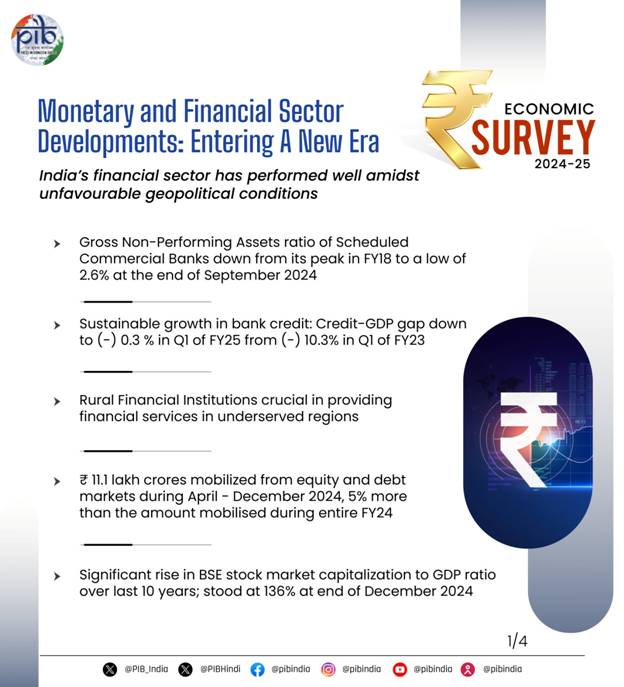
      The Survey points out that bank deposits continue to exhibit double-digit growth. As of the end of November 2024, the YoY growth in aggregate deposits of SCBs stood at 11.1 per cent. Sector-wise, the growth in agriculture credit as of 29 November 2024 in the current financial year was 5.1 per cent. The growth in industrial credit picked up and stood at 4.4 per cent as of the end of November 2024, higher than 3.2 per cent recorded a year ago. Across industries, bank credit to micro, small, and medium enterprises (MSMEs) has been growing faster than credit disbursal to large enterprises. As of the end of November 2024, credit to MSMEs registered a YoY growth of 13 per cent, whereas it stood at 6.1 per cent for large enterprises.

      Rural Financial Institutions also show lower NPAs and better credit off-take. The consolidated net profit of RRBs increased from ₹4,974 crore in FY23 to ₹7,571 crore in FY24. The consolidated CRAR rose from 13.4 per cent as of March 2023 to an all-time high of 14.2 per cent by March 31, 2024. Credit to deposit ratio of Regional Rural Banks (RRBs) grew from 67.5 percent in March 2023 to 71.2 percent in March 2024.

      During the first nine months of FY25 (April 2024-December 2024), the Monetary Policy Committee (MPC) of the RBI, in its various meetings, decided to keep the policy repo rate unchanged at 6.5 per cent to balance the twin requirements of maintaining growth and keeping inflation within acceptable limits. The Survey points out that system liquidity, represented by the net position under the Liquidity Adjustment Facility, remained in surplus during October-November 2024.

      The Survey notes that the government also achieved significant progress in financial inclusion, with the Financial Inclusion Index of the Reserve Bank of India (RBI) increasing from 53.9 in March 2021 to 64.2 at the end of March 2024. Rural Financial Institutions (RFIs) have been an important player in facilitating India’s financial inclusion journey. Development Financial Institutions (DFIs) have contributed significantly to the country’s economic progress by financing infrastructure development projects.

      Capital markets

      The capital markets have demonstrated strong performance, driving capital formation in the real economy, increasing the financialisation of domestic savings, and supporting wealth creation, says Economic Survey 2024-25. Strong macroeconomic fundamentals, healthy corporate earnings, supportive institutional investment, robust inflows from SIPs, and increased formalisation, digitisation, and accessibility have all fuelled the market's continued growth.

      The survey highlights that the primary markets continued to witness heightened listing activities and investor enthusiasm in FY25, notwithstanding the market volatility and geopolitical uncertainties. India's share in global IPO listings surged to 30 per cent in 2024, up from 17 per cent in 2023, making it the leading contributor of primary resource mobilisation globallyThe total resource mobilisation from primary markets (equity and debt) stands at ₹11.1 lakh crore from April to December 2024, which is 5 per cent more than the amount mobilised during entire FY24.
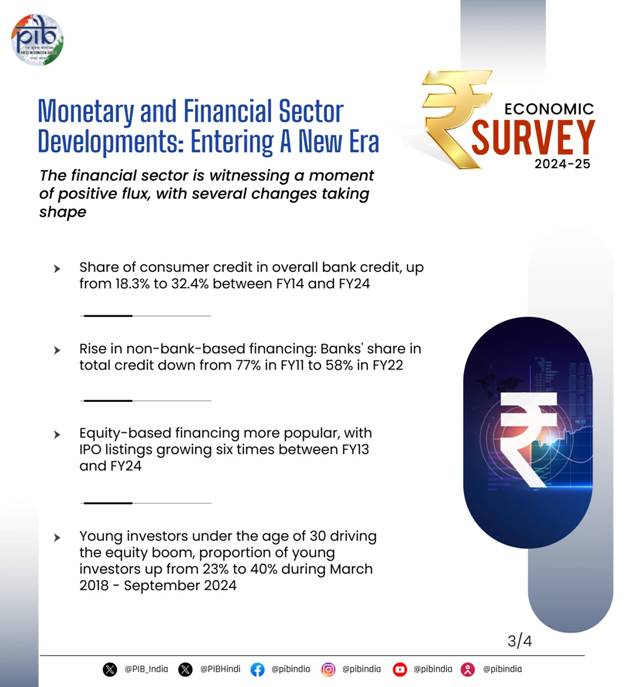
      BSE market capitalization to GDP ratio stood at 136 percent at the end of December 2024, rising significantly over the last 10 years. The positive performance of the Indian stock was driven by strong profitability growth, rapid traction of digital financial infrastructure, expanding investor base and substantial reforms in products and processes.

      Investor participation in capital markets has been on rise, with number of investors growing from 4.9 crore in FY20 to 13.2 crore as of 31 December 2024. This growth, combined with active listing activity and recent measures by the regulator, viz. Securities and Exchange Board of India (SEBI), to temper excesses, is expected to foster sustainable market expansion.

      Insurance and Pension Sector

      According to the Survey, India's insurance sector is performing well and is projected to become the fastest-growing market among G20 nations over the next five years (2024-2028). It has continued its upward trajectory, with total insurance premiums growing by 7.7 percent in FY-24, reaching ₹ 11.2 lakh crore. With an overall insurance penetration rate of 3.7 per cent, below the global average of 7 per cent, there is a notable gap in coverage that presents opportunities for insurers to expand their reach. By targeting tier 2 and 3 cities and rural areas where awareness and accessibility are limited, insurers can tap into new customer segments and stimulate growth.
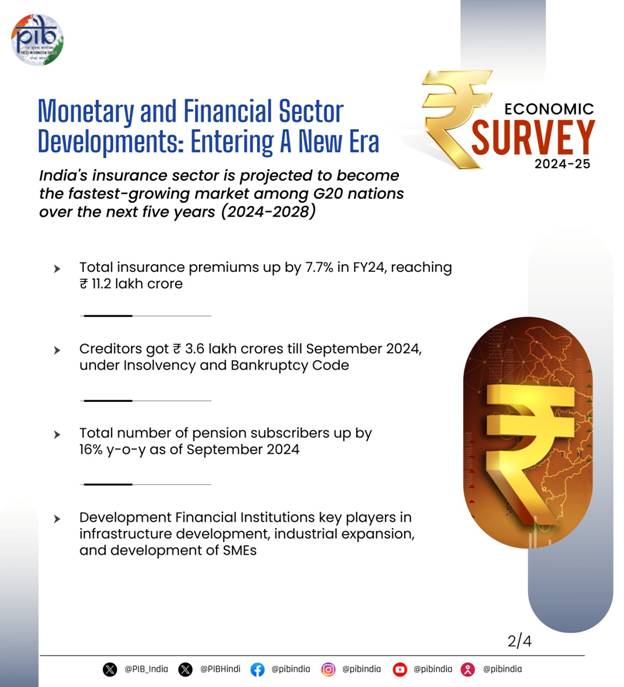
      The Survey also highlights that India's pension sector has a grown significantly since the introduction of the National Pension System (NPS) and Atal Pension Yojana (APY). As of September 2024, the total number of subscribers reached 783.4 lakh, showing a YoY growth of 16 per cent from 675.2 lakh in September 2023. Despite this growth, India's pension system has considerable potential for further expansionThe pension sector is expected to grow as the economy transitions from a lower middle-income to an upper middle- income countryThe insurance and pension sectors continue to perform with the vision of achieving universal coverage and strengthening the financial ecosystem further.

      Insolvency Law

      The Insolvency and Bankruptcy Code, 2016 has ushered in a modern and comprehensive insolvency resolution framework for distressed entities. By addressing financial distress and NPAs, the Code has had an indelible impact on the health of the country’s banking sector and redefined the debtor-creditor relationship. Out of the 12 large accounts referred by the RBI for resolution under the Code, 10 have been successfully resolved. Till March 2024, 28,818 applications for initiation of Corporate Insolvency Resolution Process of Corporate Debtors having underlying default of ₹10.2 lakh crore were withdrawn before their admission. The code has other far-reaching impacts through its interaction with the higher-level systems like the legal, economic and financial systems.

      Financial Sector

      The financial sector is primarily governed through Independent Regulatory Bodies (IRBs)   – Reserve Bank of India (RBI), Securities and Exchange Board of India (SEBI), Insurance Regulatory Development Authority of India (IRDAI), Pension Funds Regulatory Development Authority (PFRDA) and Insolvency and Bankruptcy Board of India (IBBI).  Financial Stability and Development Council (FSDC) has a broader financial stability mandate, enabling inter-regulatory coordination and promoting financial sector development. Each IRB varies in design, the nature of delegated functions, and the degree of autonomy, which are unique to the socio-political context of its evolution and the regulated domain. However, certain basic structure elements are common to all regulatory bodies: they are backed by a statute, are accountable to the legislature, enjoy a certain degree of autonomy from the government, have legislative, executive and quasi-judicial functions, and engage in specialised and technocratic decision-making processes.
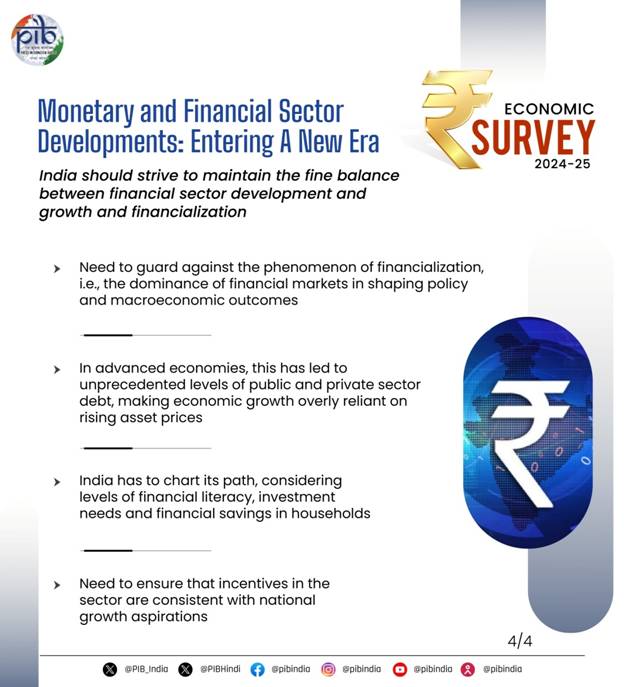
      Regulations are the basic instruments of law through which the IRBs conduct their functions and deliver on their objectiveness. The efficiency and effectiveness of regulatory action are directly dependent on the quality of regulations. The primary responsibility of these IRBs is the making of regulations, the power for which is delegated to the IRBs by statute and is an essential component of the autonomy of IRBs.

      Economic Survey notes that the quality of regulations are broadly assessed based on five criteria: democratic legitimacy, accountability of the regulator, fair, accessible and open procedures, expertise and efficiency. 

      Cybersecurity of India's financial sector

      With technological advancements, the Indian financial sector is witnessing a digital transformation that has enhanced efficiency and accessibility and increased exposure to diverse cyber threats. These threats, ranging from phishing and ransomware to Distributed Denial of Service (DDoS) attacks, SMSing, and fake/malicious mobile applications, pose serious challenges to the financial system's stability. In view of the increasing digitalisation of the financial sector, FSDC has been focusing on cyber security issues as strengthening the cyber resilience of the financial sector is key to maintaining financial stability.

      India's Tier 1 ranking in the Global Cybersecurity Index (GCI) 2024, with a commendable score of 98.49 out of 100, signifies a significant milestone in its cybersecurity journey. This recognition places India among the world's 'role-model' nations in cybersecurity. The GCI evaluates national efforts across five pillars—legal, technical, organisational, capacity building, and cooperation, highlighting India's holistic approach. India has strengthened its cybersecurity ecosystem through robust legal frameworks, targeted education programs, and international collaborations. By promoting awareness, skill development, and research, the country effectively addresses current cyber threats while preparing for emerging challenges, reaffirming its leadership in securing digital infrastructure.

      The Indian financial sector is witnessing various financial innovations such as UPI, Open Credit Enablement Network (OCEN) and T+1 settlement. These have significantly eased access to credit in India. The Economic survey concludes that these emerging trends mark the dawn of a new era for India's financial sector.

      Topics

      ActsIncome Tax
