 TaxTMI
 Login
 TaxTMI
Login
Loading...
Press 'Enter' to add multiple search terms. Rules for Better Search

Press 'Enter' after typing page number.
Press 'Enter' after typing page number.


No Folders have been created
Are you sure you want to delete "My most important" ?
NOTE:
Press 'Enter' after typing page number.
Press 'Enter' after typing page number.

All News
Press 'Enter' after typing page number.
All News

Note

Bookmark

Share


ASSET QUALITY OF RURAL FINANCIAL INSTITUTIONS IMPROVE, NET NPAs DECLINE FROM 3.2 PERCENT IN FY23 TO 2.4 PERCENT IN FY24
CREDIT TO DEPOSIT RATIO OF REGIONAL RURAL BANKS GROW FROM 67.5 PERCENT IN MARCH 2023 TO 71.2 PERCENT IN MARCH 2024
MONITORY POLICY MAINTAINS PRICE STABILITY WHILE ENSURING SUSTAINABLE GROWTH AND LIQUIDITY
NUMBER OF INVESTORS IN INDIAN CAPITAL MARKETS MORE THAN DOUBLES IN FOUR YEARS, FROM 4.9 CRORE IN FY20 TO 13.2 CRORE AT THE END OF 2024
TOTAL RESOURCE MOBILIZATION FROM PRIMARY MARKETS (EQUITY AND DEBT) GROWS 5 PERCENT OVER PREVIOUS YEAR, STANDS AT ₹11.1 LAKH CRORE FROM APRIL TO DECEMBER 2024
INDIAN INSURANCE MARKET RECORDS HEALTHY GROWTH, TOTAL INSURANCE PREMIUMS GROW BY 7.7 PER CENT IN FY24 TO REACH ₹11.2 LAKH CRORE
PENSION MARKET POSTS ROBUST GROWTH, TOTAL NUMBER OF SUBSCRIBERS REACHED 783.4 LAKH IN SEPTEMBER 2024
FINANCIAL INCLUSION INDEX INCREASES FROM 53.9 IN MARCH 2021 TO 64.2 IN MARCH 2024
INSTITUTIONALISING REGULATORY IMPACT ASSESSMENTS IN INDEPENDENT REGULATORY BODIES (IRBS) KEY TO ROBUST FINANCIAL SECTOR : ECONOMIC SURVEY
India’s monetary and financial sectors have performed well in the first nine months of Financial Year 2024-25, states the Economic Survey 2024-25, tabled by Union Minister of Finance and Corporate Affairs, Smt. Nirmala Sitaraman in the Parliament today.
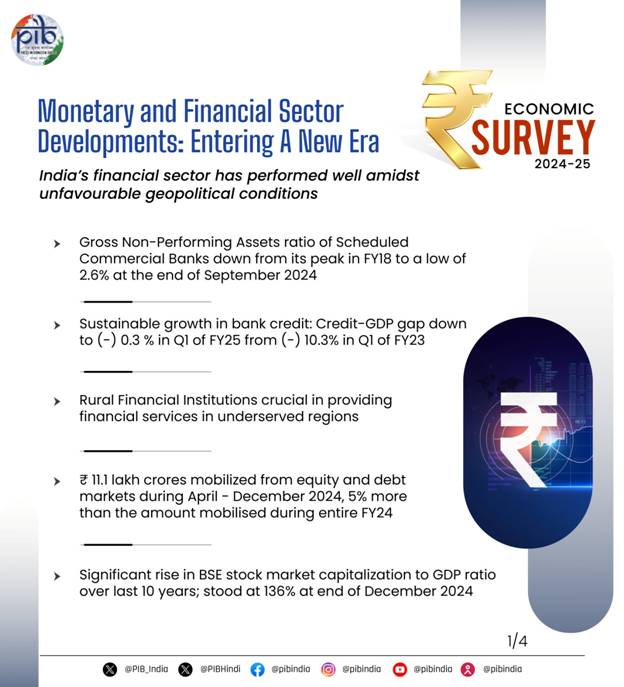
According to Economic Survey, bank credit has grown at a steady rate in the current financial year. There has been a consistent improvement in the profitability of Scheduled Commercial Banks (SCBs) as reflected in a fall in gross non-performing assets (GNPAs) accompanied by a rise in the capital-to-risk weighted asset ratio (CRAR). GNPAs of SCBs are now down to a 12- year low of 2.6 per cent at the end of September 2024. The profitability of SCBs improved during H1 of FY25, with profit after tax (PAT) surging by 22.2 per cent (YoY).
The Survey points out that bank deposits continue to exhibit double-digit growth. As of the end of November 2024, the YoY growth in aggregate deposits of SCBs stood at 11.1 per cent. Sector-wise, the growth in agriculture credit as of 29 November 2024 in the current financial year was 5.1 per cent. The growth in industrial credit picked up and stood at 4.4 per cent as of the end of November 2024, higher than 3.2 per cent recorded a year ago. Across industries, bank credit to micro, small, and medium enterprises (MSMEs) has been growing faster than credit disbursal to large enterprises. As of the end of November 2024, credit to MSMEs registered a YoY growth of 13 per cent, whereas it stood at 6.1 per cent for large enterprises.
Rural Financial Institutions also show lower NPAs and better credit off-take. The consolidated net profit of RRBs increased from ₹4,974 crore in FY23 to ₹7,571 crore in FY24. The consolidated CRAR rose from 13.4 per cent as of March 2023 to an all-time high of 14.2 per cent by March 31, 2024. Credit to deposit ratio of Regional Rural Banks (RRBs) grew from 67.5 percent in March 2023 to 71.2 percent in March 2024.
During the first nine months of FY25 (April 2024-December 2024), the Monetary Policy Committee (MPC) of the RBI, in its various meetings, decided to keep the policy repo rate unchanged at 6.5 per cent to balance the twin requirements of maintaining growth and keeping inflation within acceptable limits. The Survey points out that system liquidity, represented by the net position under the Liquidity Adjustment Facility, remained in surplus during October-November 2024.
The Survey notes that the government also achieved significant progress in financial inclusion, with the Financial Inclusion Index of the Reserve Bank of India (RBI) increasing from 53.9 in March 2021 to 64.2 at the end of March 2024. Rural Financial Institutions (RFIs) have been an important player in facilitating India’s financial inclusion journey. Development Financial Institutions (DFIs) have contributed significantly to the country’s economic progress by financing infrastructure development projects.
Capital markets
The capital markets have demonstrated strong performance, driving capital formation in the real economy, increasing the financialisation of domestic savings, and supporting wealth creation, says Economic Survey 2024-25. Strong macroeconomic fundamentals, healthy corporate earnings, supportive institutional investment, robust inflows from SIPs, and increased formalisation, digitisation, and accessibility have all fuelled the market's continued growth.
The survey highlights that the primary markets continued to witness heightened listing activities and investor enthusiasm in FY25, notwithstanding the market volatility and geopolitical uncertainties. India's share in global IPO listings surged to 30 per cent in 2024, up from 17 per cent in 2023, making it the leading contributor of primary resource mobilisation globally. The total resource mobilisation from primary markets (equity and debt) stands at ₹11.1 lakh crore from April to December 2024, which is 5 per cent more than the amount mobilised during entire FY24.
BSE market capitalization to GDP ratio stood at 136 percent at the end of December 2024, rising significantly over the last 10 years. The positive performance of the Indian stock was driven by strong profitability growth, rapid traction of digital financial infrastructure, expanding investor base and substantial reforms in products and processes.
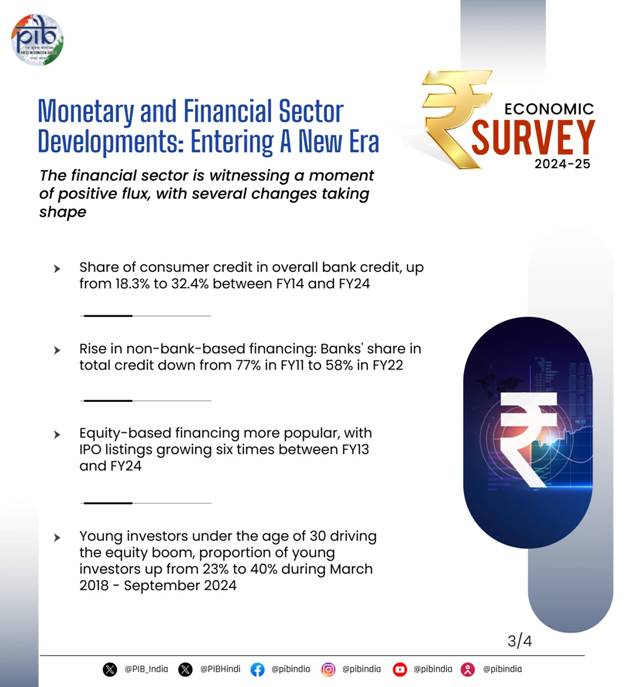
Investor participation in capital markets has been on rise, with number of investors growing from 4.9 crore in FY20 to 13.2 crore as of 31 December 2024. This growth, combined with active listing activity and recent measures by the regulator, viz. Securities and Exchange Board of India (SEBI), to temper excesses, is expected to foster sustainable market expansion.
Insurance and Pension Sector
According to the Survey, India's insurance sector is performing well and is projected to become the fastest-growing market among G20 nations over the next five years (2024-2028). It has continued its upward trajectory, with total insurance premiums growing by 7.7 percent in FY-24, reaching ₹ 11.2 lakh crore. With an overall insurance penetration rate of 3.7 per cent, below the global average of 7 per cent, there is a notable gap in coverage that presents opportunities for insurers to expand their reach. By targeting tier 2 and 3 cities and rural areas where awareness and accessibility are limited, insurers can tap into new customer segments and stimulate growth.
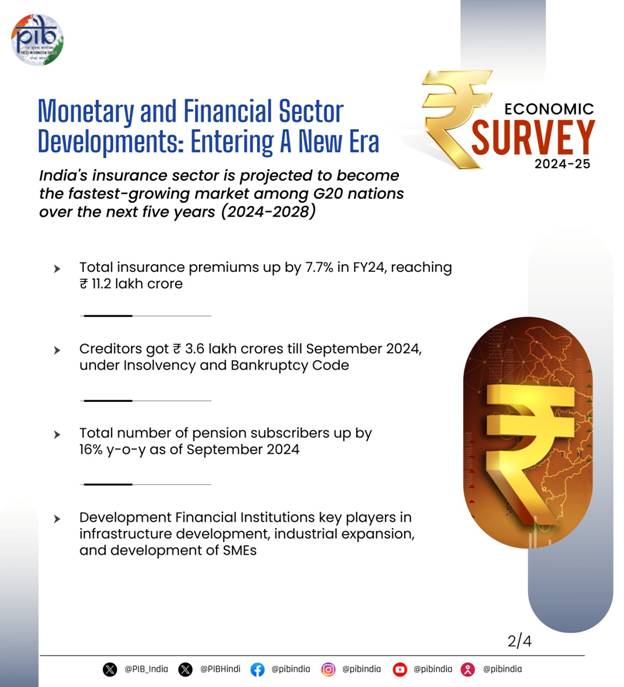
The Survey also highlights that India's pension sector has a grown significantly since the introduction of the National Pension System (NPS) and Atal Pension Yojana (APY). As of September 2024, the total number of subscribers reached 783.4 lakh, showing a YoY growth of 16 per cent from 675.2 lakh in September 2023. Despite this growth, India's pension system has considerable potential for further expansion. The pension sector is expected to grow as the economy transitions from a lower middle-income to an upper middle- income country. The insurance and pension sectors continue to perform with the vision of achieving universal coverage and strengthening the financial ecosystem further.
Insolvency Law
The Insolvency and Bankruptcy Code, 2016 has ushered in a modern and comprehensive insolvency resolution framework for distressed entities. By addressing financial distress and NPAs, the Code has had an indelible impact on the health of the country’s banking sector and redefined the debtor-creditor relationship. Out of the 12 large accounts referred by the RBI for resolution under the Code, 10 have been successfully resolved. Till March 2024, 28,818 applications for initiation of Corporate Insolvency Resolution Process of Corporate Debtors having underlying default of ₹10.2 lakh crore were withdrawn before their admission. The code has other far-reaching impacts through its interaction with the higher-level systems like the legal, economic and financial systems.
Financial Sector
The financial sector is primarily governed through Independent Regulatory Bodies (IRBs) – Reserve Bank of India (RBI), Securities and Exchange Board of India (SEBI), Insurance Regulatory Development Authority of India (IRDAI), Pension Funds Regulatory Development Authority (PFRDA) and Insolvency and Bankruptcy Board of India (IBBI). Financial Stability and Development Council (FSDC) has a broader financial stability mandate, enabling inter-regulatory coordination and promoting financial sector development. Each IRB varies in design, the nature of delegated functions, and the degree of autonomy, which are unique to the socio-political context of its evolution and the regulated domain. However, certain basic structure elements are common to all regulatory bodies: they are backed by a statute, are accountable to the legislature, enjoy a certain degree of autonomy from the government, have legislative, executive and quasi-judicial functions, and engage in specialised and technocratic decision-making processes.
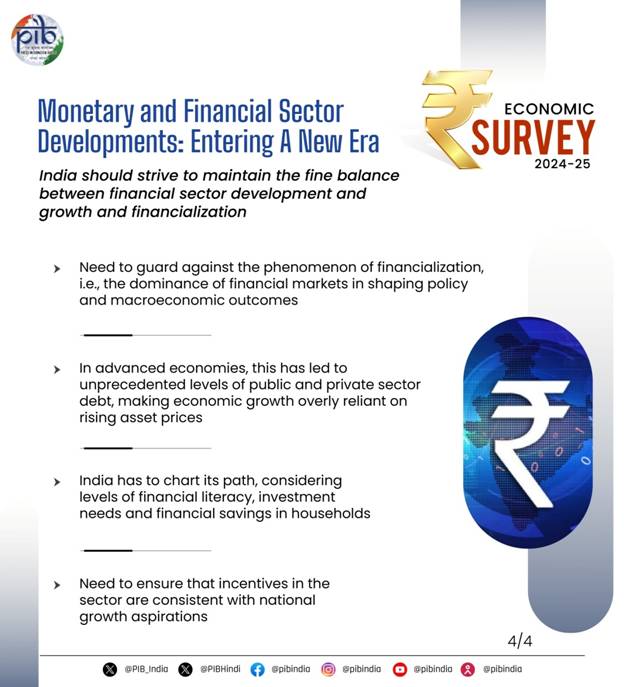
Regulations are the basic instruments of law through which the IRBs conduct their functions and deliver on their objectiveness. The efficiency and effectiveness of regulatory action are directly dependent on the quality of regulations. The primary responsibility of these IRBs is the making of regulations, the power for which is delegated to the IRBs by statute and is an essential component of the autonomy of IRBs.
Economic Survey notes that the quality of regulations are broadly assessed based on five criteria: democratic legitimacy, accountability of the regulator, fair, accessible and open procedures, expertise and efficiency.
Cybersecurity of India's financial sector
With technological advancements, the Indian financial sector is witnessing a digital transformation that has enhanced efficiency and accessibility and increased exposure to diverse cyber threats. These threats, ranging from phishing and ransomware to Distributed Denial of Service (DDoS) attacks, SMSing, and fake/malicious mobile applications, pose serious challenges to the financial system's stability. In view of the increasing digitalisation of the financial sector, FSDC has been focusing on cyber security issues as strengthening the cyber resilience of the financial sector is key to maintaining financial stability.
India's Tier 1 ranking in the Global Cybersecurity Index (GCI) 2024, with a commendable score of 98.49 out of 100, signifies a significant milestone in its cybersecurity journey. This recognition places India among the world's 'role-model' nations in cybersecurity. The GCI evaluates national efforts across five pillars—legal, technical, organisational, capacity building, and cooperation, highlighting India's holistic approach. India has strengthened its cybersecurity ecosystem through robust legal frameworks, targeted education programs, and international collaborations. By promoting awareness, skill development, and research, the country effectively addresses current cyber threats while preparing for emerging challenges, reaffirming its leadership in securing digital infrastructure.
The Indian financial sector is witnessing various financial innovations such as UPI, Open Credit Enablement Network (OCEN) and T+1 settlement. These have significantly eased access to credit in India. The Economic survey concludes that these emerging trends mark the dawn of a new era for India's financial sector.

