
Just a moment...

Top
Help
×

By creating an account you can:

Logo TaxTMI
>
Call Us / Help / Feedback

Contact Us At :

E-mail: [email protected]

Call / WhatsApp at: +91 99117 96707

For more information, Check Contact Us

FAQs :

To know Frequently Asked Questions, Check FAQs

Most Asked Video Tutorials :

For more tutorials, Check Video Tutorials

Submit Feedback/Suggestion :

Email :
Please provide your email address so we can follow up on your feedback.
Category :
Description :
Min 15 characters0/2000
Add to...
You have not created any category. Kindly create one to bookmark this item!
Create New Category
Hide
Title :
Description :
❮❮ Hide
Default View
Expand ❯❯
Close ✕
🔎 News - Adv. Search
TEXT SEARCH:

Press 'Enter' to add multiple search terms. Rules for Better Search

Search In:
Main Text + AI Text
  • Main Text
  • Main Text + AI Text
  • AI Text
Category: ?
Categorized by AI
---- All Categories ----
  • ---- All Categories ----
  • Income Tax
  • GST
  • Customs, DGFT & SEZ
  • FEMA & RBI
  • Corp. Laws, SEBI & IBC
  • PMLA, Black Money & ED
  • Budget
  • News and Press Release
  • PTI News
Month:
---- All Months ----
  • ---- All Months ----
  • January
  • February
  • March
  • April
  • May
  • June
  • July
  • August
  • September
  • October
  • November
  • December
Year:
---- All Years ----
  • ---- All Years ----
  • 2026
  • 2025
  • 2024
  • 2023
  • 2022
  • 2021
  • 2020
  • 2019
  • 2018
  • 2017
  • 2016
  • 2015
  • 2014
  • 2013
  • 2012
  • 2011
Sort By: ?
In Sort By 'Default', exact matches for text search are shown at the top, followed by the remaining results in their regular order.
RelevanceDefaultDate
    India's forex kitty swells by USD 10.5 bn to USD 692.87 bn
    Rs 5,000 cr credited to 6.22 lakh Maharashtra farmers so far under loan waiver scheme: Fadnavis
    SBI Life and J&K Bank partner to bring comprehensive life insurance solutions closer to families across India
    DRI intensifies vigil along India's North-Eastern Frontier
    Vijayan slams Kerala govt's move to end doorstep pension delivery through cooperative banks
    Kerala to stop welfare pension delivery through cooperative banks, shifts to DBT
    China's exports slow slightly in July despite robust demand for high-tech products
    India successfully concludes the Tenth BRICS Industry Ministers' Meeting in Jaipur under its BRICS Chairship 2026
    APEDA Organises BIOFACH INDIA 2026 to Promote India's Certified Organic Products and Expand Global Market Access
    RBI bars banks from disabling mobile devices of defaulting borrowers
    Par panel for early conclusion of India-US trade pact, tariff exemptions on key goods
    No commitments relating to ethanol import from US for fuel blending under FTA talks: Govt
    No concession or commitment on import of Ethanol for fuel blending from the United States
    Office of the Controller General of Patents, Designs and Trade Marks Announces Tentative Schedule for Patent and Trade Marks Agent Examinations 2027 a...
    RBI invites comments on the draft “Reserve Bank of India (Non-Banking Financial Companies – Credit Facilities) Amendment Directions, 2026”
    West Bengal seeks 100pc foodgrain, 40pc sugar jute packaging quota at SAC meeting
    RBI clasifies Tata Sons, 16 others as large NBFCs
    Sensex climbs 374 points on buying in Reliance, ICICI Bank; Nifty ends flat
    Insurance Division, DFS Secures 3rd Rank in Group A Category of Grievance Redressal Assessment & Index (GRAI) for June 2026
    VKDL Group’s NPA Bazaar Strengthens India’s Distressed Asset Resolution Ecosystem Under the Leadership of V K Dubey
❯❯
MaximizeMaximizeMaximize
0 / 200
Expand Note
Add to Folder

No Folders have been created

    +

    Are you sure you want to delete "My most important" ?

    NOTE:

    News
    Showing Results for :
    Reset Filters
    Results Found:
    Show All SummariesHide All Summaries
    August 7, 2026
    Show AI Summary
    Foreign exchange reserves rose as foreign currency assets, gold holdings, Special Drawing Rights and IMF reserve position increased.
    India's foreign exchange reserves increased during the week ended July 31, principally because of higher foreign currency assets and gold reserves. Foreign currency assets include US dollar valuation effects arising from movements in currencies such as the euro, pound and yen. Special Drawing Rights and India's reserve position with the International Monetary Fund also increased. The movement followed measures to attract foreign exchange inflows, including an FCNR(B) measure, after earlier reserve declines associated with rupee pressure and dollar sales for foreign exchange market intervention.
    August 7, 2026
    Show AI Summary
    Farm loan waiver eligibility depends on verified beneficiary status and Aadhaar authentication for direct credit of eligible crop-loan relief.
    The farm loan waiver scheme covers eligible short-term crop loans within the prescribed ceiling and eligibility period. Waiver amounts are credited to verified bank accounts after field verification and completion of Aadhaar authentication. Aadhaar authentication is the operative condition for automatic processing of benefits, while eligibility rules and technical conditions have raised concerns about exclusion of distressed farmers.
    August 7, 2026
    Show AI Summary
    Corporate agency distribution expands access to life insurance products, supporting insurance awareness, financial inclusion and long-term household financial protection.
    A corporate agency arrangement enables J&K Bank to distribute SBI Life Insurance protection, savings, retirement and child-oriented life insurance plans through its branch network. The partnership aims to improve insurance access, awareness, financial literacy and long-term financial planning for households, particularly in Jammu & Kashmir and Ladakh. It is intended to expand insurance penetration, strengthen household financial protection and support financial inclusion in line with the IRDAI vision of "Insurance for All by 2047".
    August 7, 2026
    Show AI Summary
    Cross-border smuggling controls target narcotics, poppy seeds and areca nuts entering through the Indo-Myanmar border region.
    Cross-border smuggling enforcement targeted methamphetamine, foreign-origin poppy seeds and areca nuts allegedly brought from Myanmar. Methamphetamine concealed in an ambulance was seized under the NDPS Act, 1985. Poppy seeds and areca nuts recovered in separate operations were seized under the Customs Act, 1962. Poppy-seed imports are restricted to designated countries and require registration to ensure traceability and prevent illicit produce entering legitimate supply chains. The enforcement action addresses circumvention of customs controls and regulated import requirements.
    August 7, 2026
    Show AI Summary
    Direct benefit transfer for welfare pensions replaces cooperative-bank doorstep delivery, while retaining limited home service for excluded beneficiaries.
    Direct Benefit Transfer for social security and welfare pensions is to be made through Aadhaar-linked bank accounts, replacing cooperative-bank doorstep delivery. Home delivery remains available for bedridden persons and others who cannot be excluded. The change is associated with delays in remitting undistributed amounts, record-update failures, reconciliation issues, duplicate payments, and incomplete Aadhaar-based payment implementation. Concerns have been raised that mandatory bank-account credit may disadvantage beneficiaries dependent on doorstep delivery.
    August 7, 2026
    Show AI Summary
    Direct Benefit Transfer for welfare pensions replaces doorstep cooperative-bank delivery, while home delivery remains for bedridden beneficiaries.
    Direct Benefit Transfer of social security and welfare pensions is to be made mandatory through Aadhaar-linked bank accounts, replacing cooperative-bank doorstep distribution. Home delivery continues for completely bedridden beneficiaries and others who cannot be excluded. The change addresses delays in remitting undistributed amounts, record-update and reconciliation deficiencies, duplicate payments linked to incomplete Aadhaar-based payments, delivery incentive costs, and the need to comply with Direct Benefit Transfer norms to avoid loss of central financial assistance.
    August 7, 2026
    Show AI Summary
    Customs trade data show moderating July growth while high-technology exports, vehicles and advanced manufacturing supplies remain strongly supported.
    Customs and trade data showed that China's July export and import growth moderated and its trade surplus narrowed from the preceding month. Typhoon-related port disruptions affected trade flows, but demand for electronics and green technology products supported elevated values. High-technology items, vehicles, electronics and machinery recorded strong January-July export growth, while trade performance varied among the United States, the European Union and Southeast Asia.
    August 7, 2026
    Show AI Summary
    BRICS industrial cooperation advances MSME, photovoltaic, startup and logistics frameworks alongside resilient trade and digital services collaboration.
    BRICS industrial cooperation under PartNIR was strengthened through a Joint Declaration and institutional measures addressing MSMEs, photovoltaics, startup-led innovation, and resilient transport and logistics. The measures include an SME cooperation framework, Terms of Reference and an Action Plan for photovoltaic industry cooperation, and a startup innovation action plan. Trade discussions focused on the multilateral trading system, MSME participation in international trade, resilient global value chains, and cross-border digitally delivered services within a rules-based trading framework.
    August 7, 2026
    Show AI Summary
    Certified organic export promotion: BIOFACH INDIA facilitates buyer-seller engagement, certification awareness, traceability discussions and international market access.
    BIOFACH INDIA 2026 promotes certified organic exports by providing a platform for Indian organic enterprises to showcase diverse certified products and engage with overseas buyers through structured Buyer-Seller Meets. Technical sessions address organic certification, traceability, sustainability, quality standards, international regulatory requirements and export-market expectations. The initiative supports quality assurance, international market access, export linkages and sustainable agricultural practices across the organic value chain.
    August 6, 2026
    Show AI Summary
    Device-based loan recovery restrictions protect essential mobile functions while permitting gradual locking only for lender-financed devices.
    Technology-based recovery mechanisms cannot restrict or disable a borrower's mobile device unless the bank financed acquisition of that device. Where permitted, banks must adopt a gradual approach and preserve essential functions, including incoming calls, SMS access, and emergency SOS features. Regulated entities and service providers must obtain manufacturer or operating-system certification for device-locking technology. Disclosure of borrower or guarantor information to recovery personnel must be limited to what is necessary for loan-recovery duties.
    August 6, 2026
    Show AI Summary
    Bilateral trade agreement negotiations should secure tariff certainty, protect key exports, strengthen supply chains, and support vulnerable small industries.
    An early Bilateral Trade Agreement is proposed to protect Indian interests, secure tariff exemptions for key exports, reduce barriers affecting industrial products, and create predictable trade conditions. Recommended measures include financial and export-credit support for small industries, real-time monitoring of customs requirements, documentation assistance, and timely policy support against tariff and non-tariff barriers. Export strategy should develop knowledge services and critical supply-chain integration, while a National Fund should assist suppliers with redesign, tooling, certification and entry into new global supply chains.
    August 6, 2026
    Show AI Summary
    Ethanol imports for fuel blending remain excluded from trade commitments, with domestic producers continuing to supply the blending programme.
    Ethanol imports for fuel blending remain outside concessions or commitments in India-US trade discussions. Under the Ethanol Blended with Petrol Programme, ethanol procurement is governed solely by domestic policy requirements and is sourced entirely from domestic producers. Claims of existing or intended large-scale ethanol imports from the United States for fuel blending, or of a policy change permitting them, are stated to be baseless.
    August 6, 2026
    Show AI Summary
    Domestic ethanol sourcing for fuel blending continues unchanged, with no import commitments or concessions involving United States ethanol.
    Ethanol used for fuel blending under the Ethanol Blended with Petrol Programme is sourced entirely from domestic producers, with no imports from the United States for that purpose. No concessions or commitments on importing United States ethanol for fuel blending have been made in trade discussions. Fuel blending and ethanol procurement continue to be governed solely by domestic policy requirements, and claims of a policy change allowing large-scale imports are incorrect.
    August 6, 2026
    Show AI Summary
    Patent and trade marks agent qualification examinations require written-paper minimums, aggregate passing scores, and viva voce assessment for registration.
    Patent and trade marks agent examinations comprise an objective Paper I, a descriptive Paper II and a viva voce assessing suitability to practise before the Intellectual Property Office. Candidates must secure the stipulated minimum marks in each written paper and the required aggregate score to pass. Registration in the relevant Register of Patent Agents or Register of Trade Marks Agents is available only to candidates who satisfy all prescribed eligibility conditions and qualify the examination.
    August 6, 2026
    Show AI Summary
    Draft NBFC credit-facilities amendments open for stakeholder consultation through designated online and email feedback channels.
    Draft amendments to the Non-Banking Financial Companies credit-facilities framework have been released for public consultation. Regulated entities and other interested stakeholders may submit comments or feedback through the 'Connect 2 Regulate' platform or by email using the specified subject line.
    August 6, 2026
    Show AI Summary
    Mandatory jute packaging reservations were urged to protect cultivators, mill workers, crop absorption, and environmentally sustainable packaging.
    Mandatory jute packaging reservations were sought to be retained at full coverage for foodgrains and increased for sugar packaging for the forthcoming Jute Year. The submission before the Standing Advisory Committee emphasised absorption of bumper jute output, remunerative prices for cultivators, uninterrupted mill operations, and protection of farm and worker livelihoods. It also stressed that biodegradable jute bags offer an environmentally friendly alternative to HDPE and polypropylene woven sacks, and that dilution of compulsory packaging could undermine plastic-pollution reduction efforts.
    August 6, 2026
    Show AI Summary
    NBFC Upper Layer classification imposes enhanced regulation and listing obligations, while de-registration applications remain under examination.
    NBFC Upper Layer classification subjects identified large non-banking financial companies to enhanced regulatory requirements for at least five years and requires stock-exchange listing within three years of identification. The framework divides NBFCs into Base, Middle, Upper and Top Layers. Seventeen large NBFCs were included in the Upper Layer list, while Tata Sons' classification remains subject to the pending examination of its de-registration application.
    August 6, 2026
    Show AI Summary
    Closing auction price discovery may affect benchmark levels differently based on constituent liquidity and concentrated institutional order flow.
    The Closing Auction Session in the equity cash segment uses an auction-based method to determine closing prices of eligible shares with futures and options contracts, aiming to strengthen transparent and robust price discovery. Its effect on benchmark closing levels may differ according to constituent liquidity and institutional order flow. The Reserve Bank of India retained the policy repo rate and neutral stance, indicating that future policy decisions will be data-dependent and influenced by assessment of energy-cost effects on inflation.
    August 6, 2026
    Show AI Summary
    Public grievance redressal strengthens through monitoring, senior review, workshops, stakeholder coordination, and customer-centric service delivery improvements.
    Public grievance redressal is assessed through the Grievance Redressal Assessment and Index, which analyses grievance categories and disposal. The Department of Financial Services' Insurance and Banking Divisions received third and sixth ranks respectively in the June 2026 assessment. Its framework includes disposal of grievances, random reviews by senior officials, and workshops on effective grievance redressal, supporting best practices, stakeholder coordination, technology use, customer-centric service, and accountable public service delivery.
    August 6, 2026
    Show AI Summary
    Distressed asset resolution integrates restructuring, insolvency advisory, funding facilitation and digital marketplaces for transparent financial recovery transactions.
    The platform provides integrated advisory, management and transaction-facilitation services for Non-Performing Assets, stressed assets and distressed assets. Its services include NPA resolution, debt restructuring, One-Time Settlements, funding assistance, insolvency and bankruptcy advisory, asset reconstruction, financial restructuring and capital raising. Digital and offline marketplaces facilitate transactions involving distressed assets, receivables and related movable or immovable properties, supported by collaborations with banks, Non-Banking Financial Companies, Asset Reconstruction Companies, corporates and investors.

    News

    Back

    All News

    Showing Results for :
    Reset Filters
      No Records Found

      News

      Back

      All News

      whatsappJoin Channel
      Showing Results for : Reset Filters

      INDIAN ECONOMY RECORDS STEADY CREDIT GROWTH; BANKS POST HIGHER PROFITABILITY, LOWER NPAs: ECONOMIC SURVEY 2024-25

      January 31, 2025

      Contents
      Plus +
      Summary
      Note

      Note

      -

      Bookmark

      Print

      Print

      ASSET QUALITY OF RURAL FINANCIAL INSTITUTIONS IMPROVE, NET NPAs DECLINE FROM 3.2 PERCENT IN FY23 TO 2.4 PERCENT IN FY24

      CREDIT TO DEPOSIT RATIO OF REGIONAL RURAL BANKS GROW FROM 67.5 PERCENT IN MARCH 2023 TO 71.2 PERCENT IN MARCH 2024

      MONITORY POLICY MAINTAINS PRICE STABILITY WHILE ENSURING SUSTAINABLE GROWTH AND LIQUIDITY

      NUMBER OF INVESTORS IN INDIAN CAPITAL MARKETS MORE THAN DOUBLES IN FOUR YEARS, FROM 4.9 CRORE IN FY20 TO 13.2 CRORE AT THE END OF 2024

      TOTAL RESOURCE MOBILIZATION FROM PRIMARY MARKETS (EQUITY AND DEBT) GROWS 5 PERCENT OVER PREVIOUS YEAR, STANDS AT ₹11.1 LAKH CRORE FROM APRIL TO DECEMBER 2024

      INDIAN INSURANCE MARKET RECORDS HEALTHY GROWTH, TOTAL INSURANCE PREMIUMS GROW BY 7.7 PER CENT IN FY24 TO REACH ₹11.2 LAKH CRORE

      PENSION MARKET POSTS ROBUST GROWTH, TOTAL NUMBER OF SUBSCRIBERS REACHED 783.4 LAKH IN SEPTEMBER 2024

      FINANCIAL INCLUSION INDEX INCREASES FROM 53.9 IN MARCH 2021 TO 64.2 IN MARCH 2024

      INSTITUTIONALISING REGULATORY IMPACT ASSESSMENTS IN INDEPENDENT REGULATORY BODIES (IRBS) KEY TO ROBUST FINANCIAL SECTOR : ECONOMIC SURVEY

      India’s monetary and financial sectors have performed well in the first nine months of Financial Year 2024-25, states the Economic Survey 2024-25, tabled by Union Minister of Finance and Corporate Affairs, Smt. Nirmala Sitaraman in the Parliament today.

       According to Economic Survey, bank credit has grown at a steady rate in the current financial year. There has been a consistent improvement in the profitability of Scheduled Commercial Banks (SCBs) as reflected in a fall in gross non-performing assets (GNPAs) accompanied by a rise in the capital-to-risk weighted asset ratio (CRAR). GNPAs of SCBs are now down to a 12- year low of 2.6 per cent at the end of September 2024. The profitability of SCBs improved during H1 of FY25, with profit after tax (PAT) surging by 22.2 per cent (YoY).
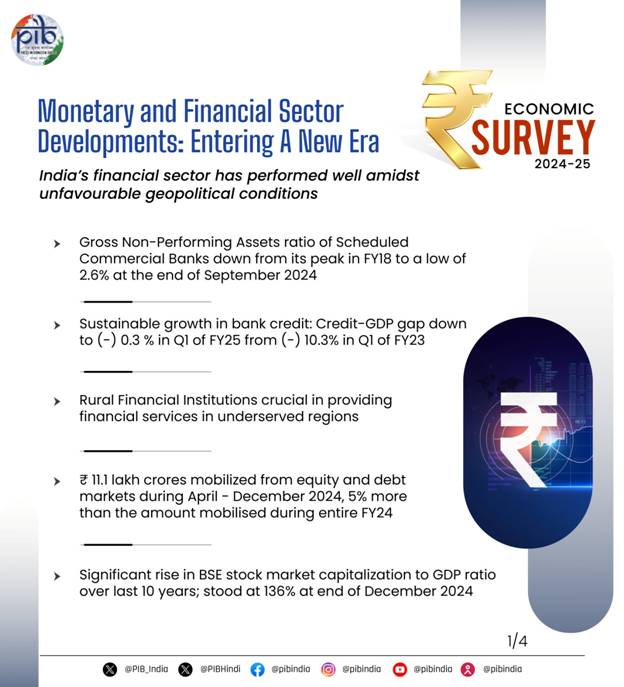
      The Survey points out that bank deposits continue to exhibit double-digit growth. As of the end of November 2024, the YoY growth in aggregate deposits of SCBs stood at 11.1 per cent. Sector-wise, the growth in agriculture credit as of 29 November 2024 in the current financial year was 5.1 per cent. The growth in industrial credit picked up and stood at 4.4 per cent as of the end of November 2024, higher than 3.2 per cent recorded a year ago. Across industries, bank credit to micro, small, and medium enterprises (MSMEs) has been growing faster than credit disbursal to large enterprises. As of the end of November 2024, credit to MSMEs registered a YoY growth of 13 per cent, whereas it stood at 6.1 per cent for large enterprises.

      Rural Financial Institutions also show lower NPAs and better credit off-take. The consolidated net profit of RRBs increased from ₹4,974 crore in FY23 to ₹7,571 crore in FY24. The consolidated CRAR rose from 13.4 per cent as of March 2023 to an all-time high of 14.2 per cent by March 31, 2024. Credit to deposit ratio of Regional Rural Banks (RRBs) grew from 67.5 percent in March 2023 to 71.2 percent in March 2024.

      During the first nine months of FY25 (April 2024-December 2024), the Monetary Policy Committee (MPC) of the RBI, in its various meetings, decided to keep the policy repo rate unchanged at 6.5 per cent to balance the twin requirements of maintaining growth and keeping inflation within acceptable limits. The Survey points out that system liquidity, represented by the net position under the Liquidity Adjustment Facility, remained in surplus during October-November 2024.

      The Survey notes that the government also achieved significant progress in financial inclusion, with the Financial Inclusion Index of the Reserve Bank of India (RBI) increasing from 53.9 in March 2021 to 64.2 at the end of March 2024. Rural Financial Institutions (RFIs) have been an important player in facilitating India’s financial inclusion journey. Development Financial Institutions (DFIs) have contributed significantly to the country’s economic progress by financing infrastructure development projects.

      Capital markets

      The capital markets have demonstrated strong performance, driving capital formation in the real economy, increasing the financialisation of domestic savings, and supporting wealth creation, says Economic Survey 2024-25. Strong macroeconomic fundamentals, healthy corporate earnings, supportive institutional investment, robust inflows from SIPs, and increased formalisation, digitisation, and accessibility have all fuelled the market's continued growth.

      The survey highlights that the primary markets continued to witness heightened listing activities and investor enthusiasm in FY25, notwithstanding the market volatility and geopolitical uncertainties. India's share in global IPO listings surged to 30 per cent in 2024, up from 17 per cent in 2023, making it the leading contributor of primary resource mobilisation globallyThe total resource mobilisation from primary markets (equity and debt) stands at ₹11.1 lakh crore from April to December 2024, which is 5 per cent more than the amount mobilised during entire FY24.
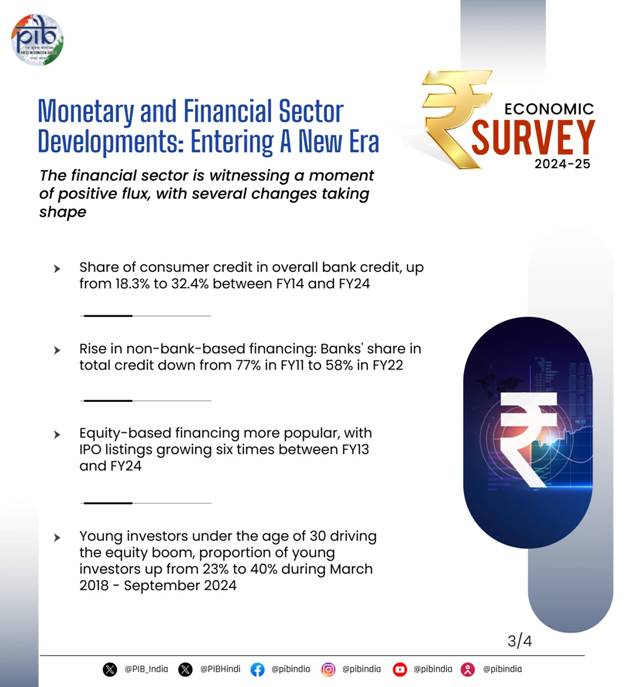
      BSE market capitalization to GDP ratio stood at 136 percent at the end of December 2024, rising significantly over the last 10 years. The positive performance of the Indian stock was driven by strong profitability growth, rapid traction of digital financial infrastructure, expanding investor base and substantial reforms in products and processes.

      Investor participation in capital markets has been on rise, with number of investors growing from 4.9 crore in FY20 to 13.2 crore as of 31 December 2024. This growth, combined with active listing activity and recent measures by the regulator, viz. Securities and Exchange Board of India (SEBI), to temper excesses, is expected to foster sustainable market expansion.

      Insurance and Pension Sector

      According to the Survey, India's insurance sector is performing well and is projected to become the fastest-growing market among G20 nations over the next five years (2024-2028). It has continued its upward trajectory, with total insurance premiums growing by 7.7 percent in FY-24, reaching ₹ 11.2 lakh crore. With an overall insurance penetration rate of 3.7 per cent, below the global average of 7 per cent, there is a notable gap in coverage that presents opportunities for insurers to expand their reach. By targeting tier 2 and 3 cities and rural areas where awareness and accessibility are limited, insurers can tap into new customer segments and stimulate growth.
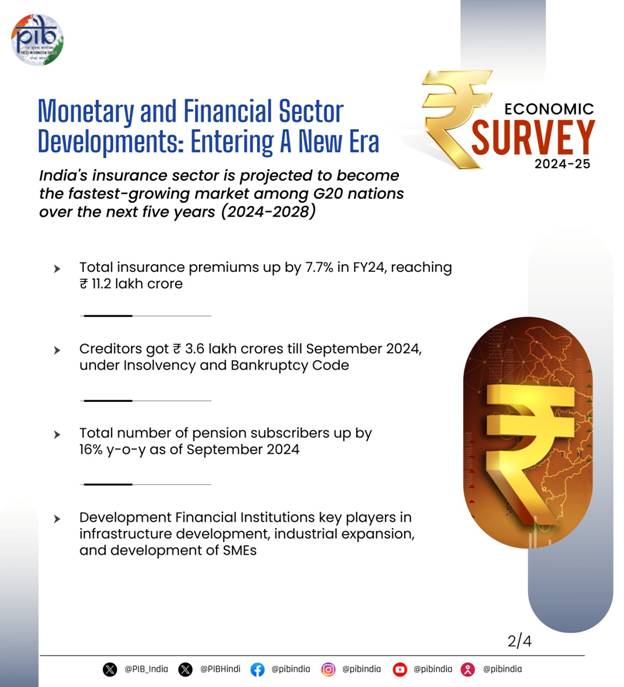
      The Survey also highlights that India's pension sector has a grown significantly since the introduction of the National Pension System (NPS) and Atal Pension Yojana (APY). As of September 2024, the total number of subscribers reached 783.4 lakh, showing a YoY growth of 16 per cent from 675.2 lakh in September 2023. Despite this growth, India's pension system has considerable potential for further expansionThe pension sector is expected to grow as the economy transitions from a lower middle-income to an upper middle- income countryThe insurance and pension sectors continue to perform with the vision of achieving universal coverage and strengthening the financial ecosystem further.

      Insolvency Law

      The Insolvency and Bankruptcy Code, 2016 has ushered in a modern and comprehensive insolvency resolution framework for distressed entities. By addressing financial distress and NPAs, the Code has had an indelible impact on the health of the country’s banking sector and redefined the debtor-creditor relationship. Out of the 12 large accounts referred by the RBI for resolution under the Code, 10 have been successfully resolved. Till March 2024, 28,818 applications for initiation of Corporate Insolvency Resolution Process of Corporate Debtors having underlying default of ₹10.2 lakh crore were withdrawn before their admission. The code has other far-reaching impacts through its interaction with the higher-level systems like the legal, economic and financial systems.

      Financial Sector

      The financial sector is primarily governed through Independent Regulatory Bodies (IRBs)   – Reserve Bank of India (RBI), Securities and Exchange Board of India (SEBI), Insurance Regulatory Development Authority of India (IRDAI), Pension Funds Regulatory Development Authority (PFRDA) and Insolvency and Bankruptcy Board of India (IBBI).  Financial Stability and Development Council (FSDC) has a broader financial stability mandate, enabling inter-regulatory coordination and promoting financial sector development. Each IRB varies in design, the nature of delegated functions, and the degree of autonomy, which are unique to the socio-political context of its evolution and the regulated domain. However, certain basic structure elements are common to all regulatory bodies: they are backed by a statute, are accountable to the legislature, enjoy a certain degree of autonomy from the government, have legislative, executive and quasi-judicial functions, and engage in specialised and technocratic decision-making processes.
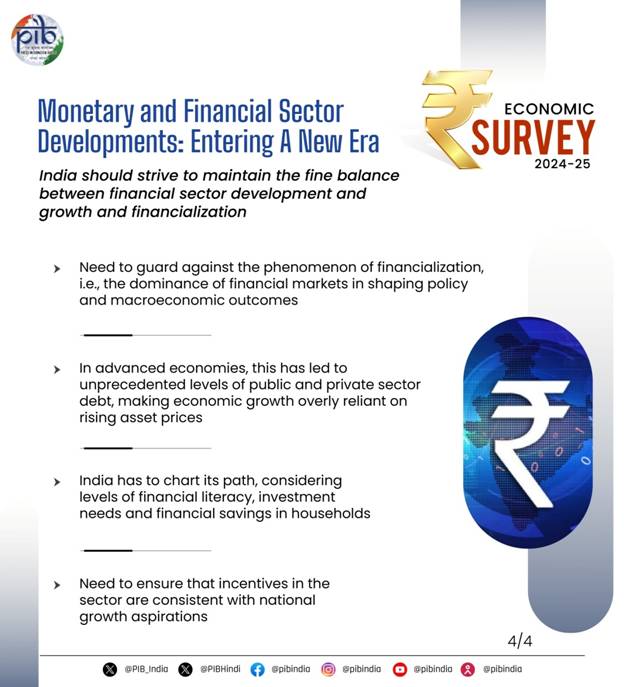
      Regulations are the basic instruments of law through which the IRBs conduct their functions and deliver on their objectiveness. The efficiency and effectiveness of regulatory action are directly dependent on the quality of regulations. The primary responsibility of these IRBs is the making of regulations, the power for which is delegated to the IRBs by statute and is an essential component of the autonomy of IRBs.

      Economic Survey notes that the quality of regulations are broadly assessed based on five criteria: democratic legitimacy, accountability of the regulator, fair, accessible and open procedures, expertise and efficiency. 

      Cybersecurity of India's financial sector

      With technological advancements, the Indian financial sector is witnessing a digital transformation that has enhanced efficiency and accessibility and increased exposure to diverse cyber threats. These threats, ranging from phishing and ransomware to Distributed Denial of Service (DDoS) attacks, SMSing, and fake/malicious mobile applications, pose serious challenges to the financial system's stability. In view of the increasing digitalisation of the financial sector, FSDC has been focusing on cyber security issues as strengthening the cyber resilience of the financial sector is key to maintaining financial stability.

      India's Tier 1 ranking in the Global Cybersecurity Index (GCI) 2024, with a commendable score of 98.49 out of 100, signifies a significant milestone in its cybersecurity journey. This recognition places India among the world's 'role-model' nations in cybersecurity. The GCI evaluates national efforts across five pillars—legal, technical, organisational, capacity building, and cooperation, highlighting India's holistic approach. India has strengthened its cybersecurity ecosystem through robust legal frameworks, targeted education programs, and international collaborations. By promoting awareness, skill development, and research, the country effectively addresses current cyber threats while preparing for emerging challenges, reaffirming its leadership in securing digital infrastructure.

      The Indian financial sector is witnessing various financial innovations such as UPI, Open Credit Enablement Network (OCEN) and T+1 settlement. These have significantly eased access to credit in India. The Economic survey concludes that these emerging trends mark the dawn of a new era for India's financial sector.

      Topics

      ActsIncome Tax
