 TaxTMI
 Login
 TaxTMI
Login
Loading...
Press 'Enter' to add multiple search terms. Rules for Better Search

Press 'Enter' after typing page number.
Press 'Enter' after typing page number.


No Folders have been created
Are you sure you want to delete "My most important" ?
NOTE:
Press 'Enter' after typing page number.
Press 'Enter' after typing page number.

All News
Press 'Enter' after typing page number.
All News

Note

Bookmark

Share


169 NEW TRADE-RESTRICTIVE MEASURES AFFECT TRADE WORTH $887.7 BILLION IN OCTOBER 2024, AN INCREASE FROM $337.1 BILLION IN OCTOBER 2023
OVER 24000 NEW RESTRICTIONS ON TRADE AND INVESTMENT IMPOSED GLOBALLY BETWEEN 2020 AND 2024
INDIA SHOULD REINVIGORATE INTERNAL ENGINES AND DOMESTIC LEVERS OF GROWTH AMIDST NEW AND EMERGING GLOBAL REALITY:ECONOMIC SURVEY
“Worldwide, we see a backsliding of economic integration with geo-economic fragmentation (GEF) replacing globalisation. Economic realignments and readjustments are imminent”, states the Economic Survey 2024-25, tabled by Union Minister of Finance and Corporate Affairs, Smt. Nirmala Sitharaman in the Parliament today. The Survey defines ‘geo-economic fragmentation' as a policy-driven reversal of global economic integration often guided by strategic considerations. This process encompasses different channels, including trade, capital, and migration flows.
In a re-enactment of the cold war era, countries are once again getting grouped into two blocs and phrases like ‘friend-shoring’ have come to play centre-stage in global policymaking. Tensions over trade, technology standards, and security have been growing for many years, undermining growth and trust in the current global economic system. Therefore, fragmentation - economic, social and cultural - is a direct consequence of the imposition of a 'one-size-fits-all' emission, as well as social and labour standards by western nations. These developments have growth implications
As per figures released by the World Trade Organization (WTO) as part of the WTO Director-General's annual overview of global trade developments, there is a sharp rise in the coverage of trade-restrictive measures by WTO members between mid-October 2023 and mid-October 2024, compared to the last Trade Monitoring Report in November 2023. As per estimates, the value of trade covered by the 169 new trade-restrictive measures introduced between October 2023 and October 2024 is USD 887.7 billion, which is half a trillion dollars more than the value of trade covered by restrictions introduced in the preceding year, which stood at USD 337.1 billion.
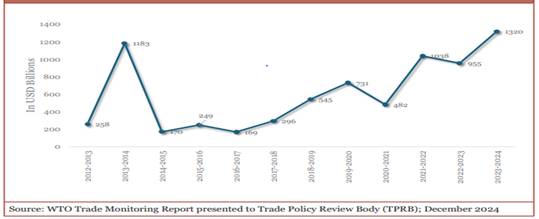
Fig 1: Trade coverage of new import-restrictive measures (USD Billion, not cumulative)
Fundamental shifts in global economic engagement are underway with the proliferation of trade and investment restrictions. Between 2020 and 2024, over 24000 new restrictions related to trade and investments have gone into place globally .The impact of this shift in global structural forces is reflected in global trade growth, which has slowed down significantly, and signs of secular stagnation in the global economy are beginning to emerge.
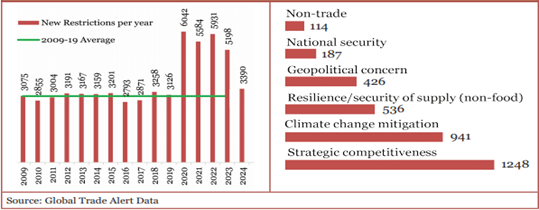
Fig 2: Proliferation of trade and investment restrictions
IMF observes that trade fragmentation is much more costly because, unlike the start of the cold war when goods trade to GDP was 16 per cent, the ratio stands at 45 per cent today. Less trade implies less knowledge diffusion, which could also be reduced by fragmentation of cross-border direct investment.
The impact of GEF is seen in global FDI flows, which are increasingly concentrated among geopolitically aligned countries, particularly in strategic sectors. This relocation of FDI increases the vulnerability of several emerging markets and developing economies. The output losses associated with this FDI relocation emerging from friend-shoring and re-shoring are especially severe for emerging markets and developing economies. They face heightened restrictions from advanced economies, which are their major sources of FDI.
The Economic Survey points out the emergence of China as a dominant force in the global manufacturing and energy transition ecosystems. It has gained a strategic advantage leveraging its competitiveness and economic policy to access and control key resources recognised today as critical for global supply chains. UNIDO projects that China will account for 45 per cent of all global manufacturing, singlehandedly matching or outmatching the US and its allies. Economic Survey also points out the current dominance of China in energy transition technologies. China’s share of solar panels (polysilicon, ingots, wafers, cells, and modules) exceeds 80 per cent in all the manufacturing stages. China also houses nearly 80 per cent of the world's battery manufacturing capacity, pivotal to the energy transition. About 60 per cent of the world's wind installed capacity is sourced from China.
The global economy is at a significant juncture where long-held principles and practices are being re-evaluated and, in some cases, losing their relevance. As a result, many countries now operate in an environment markedly different from what they were accustomed to, with traditional rules being reconsidered and uncertainty surrounding what might replace them.
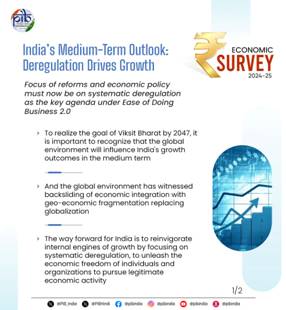
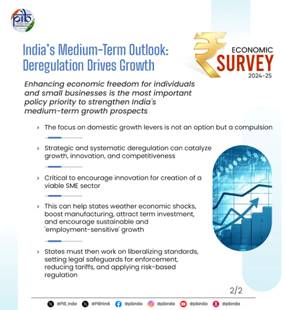
The way forward for India amidst this new and emerging global reality is to reinvigorate the internal engines and domestic levers of growth and focusing on a central element – the economic freedom of individuals and organisations to pursue legitimate economic activity through systematic deregulation.

