 TaxTMI
 Login
 TaxTMI
Login
Loading...
Press 'Enter' to add multiple search terms. Rules for Better Search

Press 'Enter' after typing page number.
Press 'Enter' after typing page number.


No Folders have been created
Are you sure you want to delete "My most important" ?
NOTE:
Press 'Enter' after typing page number.
Press 'Enter' after typing page number.

All News
Press 'Enter' after typing page number.
All News

Note

Bookmark

Share


PERCENTAGE OF SCHOOLS HAVING COMPUTERS INCREASED FROM 38.5 % IN 2019-20 TO 57.2 % IN 2023-2024: ECONOMIC SURVEY
PERCENTAGE OF SCHOOLS HAVING INTERNET FACILITY INCREASED FROM 22.3 % IN 2019-20 TO 53.9 % IN 2023-2024
SCHOOL DROPOUT RATES HAVE STEADILY DECLINED IN RECENT YEARS, STANDING AT 1.9 % FOR PRIMARY, 5.2 % FOR UPPER PRIMARY AND 14.1 % FOR SECONDARY LEVELS
INTEGRATION OF TECHNOLOGY (ARTIFICIAL INTELLIGENCE) ESSENTIAL IN ADDRESSING RAPIDLY EVOLVING DYNAMICS OF EDUCATION SYSTEM
TOTAL HIGHER EDUCATION INSTITUTIONS (HEIS) INCREASED BY 13.8 PER CENT FROM 51,534 IN 2014- 15 TO 58,643 IN 2022-23
ECONOMIC SURVEY HIGHLGHTS INNOVATION LIKE PEER TEACHING TO ATTAIN FINANCIAL LITERACY AND NUMERACY TARGETS
Union Minister for Finance and Corporate Affairs Smt. Nirmala Sitharaman tabled the Economic Survey 2024-25 in the Parliament today. The Survey stated that education and human capital development are among the foundational pillars of development and the National Education Policy 2020 (NEP) is built upon this principle.
SCHOOL EDUCATION
The Survey highlights that India's school education system serves 24.8 crore students across 14.72 lakh schools with 98 lakh teachers (UDISE+ 2023-24). Government schools comprises 69 % of the total, enrolling 50 % of students and employing 51 % of teachers, while private schools account for 22.5 %, enrolling 32.6 % of students and employing 38 % of teachers.
The Survey highlights that NEP 2020 aims for a 100 % Gross Enrolment Ratio (GER) by 2030. The GER is near universal at the primary (93 %) and the efforts are underway to bridge the gaps at the secondary (77.4 %) and higher secondary level (56.2 %), driving the nation closer to its vision of inclusive and equitable education for all.
The Survey says school dropout rates have steadily declined in recent years, standing at 1.9 % for primary, 5.2 % for upper primary, and 14.1 % for secondary levels.
Improvements in basic facilities, including sanitation, and information and communication technologies (ICT) availability, have been notable, reflecting a positive trend in school infrastructure development. As per UDISE+ 2023-24 Report, the percentage of schools having computers increased from 38.5 % in 2019-20 to 57.2 % in 2023-2024. Similarly, percentage of schools having internet facility increased from 22.3 % in 2019-20 to 53.9 % in 2023-2024.
The Government has been striving to achieve the objectives of NEP 2020 through a range of programmes and schemes, including the Samagra Shiksha Abhiyan (along with its sub-schemes such as NISHTHA, Vidya Pravesh, District Institutes of Education and Training (DIETs), Kasturba Gandhi Balika Vidyalaya (KGBV), etc.), DIKSHA, STARS, PARAKH, PM SHRI, ULLAS, and PM POSHAN, among others.
The Survey mentions that to strengthen the Early Childhood Care and Education (ECCE) landscape, the Government launched the National Curriculum for ECCE, Aadharshila, and the National Framework for Early Childhood Stimulation, Navchetana, in April 2024. Navchetana focuses on holistic development for children from birth to 3 years, offering 140 age specific activities through a 36-month stimulation calendar. Aadharshila promotes play-based learning with over 130 activities for children aged 3 to 6 years that support child-led and educator-led learning.
Building strong foundations through literacy and numeracy
NEP 2020 stipulates that Foundational Literacy and Numeracy (FLN) is critical for education and lifelong learning success. In this direction, the Department of School Education & Literacy launched the National Mission, “National Initiative for Proficiency in Reading with Understanding and Numeracy (NIPUN Bharat) to ensure that every child in the country necessarily attains FLN by the end of Grade 3, by 2026-27. The education system is deploying innovative pedagogies and teaching methods to ensure that every child achieves FLN. The Survey mentioned one such innovation, viz, Peer Teaching as a pathway for achieving FLN.
Empowering minds: Unlocking potential with social and emotional learning
The Survey states that ECCE under NEP 2020 aims to achieve foundational literacy and socio-emotional development. The Survey discusses the importance of Social-Emotional Learning (SEL) in education, providing examples of how the pedagogy can be developed to incorporate socio-emotional-ethical development in the school curriculum.
The importance of skill education in schools has grown significantly with the advent of Industry 4.0, a highly dynamic and skill-intensive era defined by automation, artificial intelligence (AI), Internet of things (IoT), big data, and robotics.
Bridging the gap: Digital technology in education and the essentiality of digital literacy
Digital literacy ensures that students remain competitive by mastering skills like analyzing, synthesizing, and communicating digital information. The rapid pace of technological change requires educators to stay up-to-date on new digital trends and teaching methods. In an effort to leverage technology towards enhancing the capabilities of educators and preparing them for the demands of the 21st century, the government has launched TeacherApp, a cutting-edge digital platform.
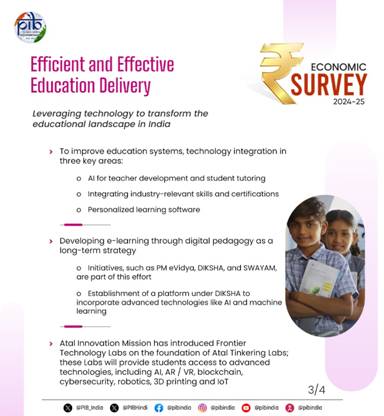
The incorporation of technology presents cost-effective solutions, making quality education more accessible and inclusive for a broader population. To improve education systems, technology integration may be focused on three key areas: using AI for teacher development and student tutoring, integrating industry-relevant skills and certifications, and creating personalized learning software, said the Survey.
Investments in skills, research, innovation ecosystems, government-academic partnerships, and faculty development are pivotal for efficiently delivering education services and improving learning outcomes, states Economic Survey 2024-25.
Children with Special Needs (CwSN): Developing a culture of inclusivity
Under Samagra Shiksha, dedicated funds have been allocated to support CwSN through aids and appliances, assistive devices, allowances, Braille materials, and therapeutic interventions including infrastructure strengthening. Infrastructure improvements include ramps in 11.35 lakh schools, handrails in 7.7 lakh, and accessible toilets in 5.1 lakh schools.
HIGHER EDUCATION
The Survey mentions that India's higher education system ranks among the largest globally, with 4.33 crore students enrolled in 2021-22, a 26.5 % increase from 3.42 crore in 2014-15. The GER for the 18–23 age group also increased from 23.7 % to 28.4 % during this same period (2014-15 to 2021-22). To achieve the government’s goal of increasing GER to 50 per cent by 2035 in higher education, there is a need to double the educational network and infrastructure.
The Survey highlights that over the years, there has been a significant transformation in higher education ecosystem. Total Higher Education Institutions (HEIs) increased by 13.8 per cent from 51,534 in 2014- 15 to 58,643 in 2022-23, the Survey added.
|
| 2014 | 2023 |
| Indian Institutes of Technology | 16 | 23 |
| Indian Institutes of Management | 13 | 20 |
| Universities | 723 | 1213 in 2024 |
| Medical colleges | 387 in 2013-14 | 780 in 2024-25 |
By 2040, all HEIs are to become multidisciplinary institutions. The measures to achieve this aim include greater opportunities for outstanding public education; scholarships by private/philanthropic universities for disadvantaged and underprivileged students; online education and Open Distance Learning (ODL); and all infrastructure and learning materials accessible and available to learners with disabilities. The National Education Policy calls for making ‘India a global knowledge superpower, Stated the Economic Survey 2024-25.
The Survey states that the effective implementation of NEP 2020 requires collaboration across the centre, states, UTs, HEIs, and regulatory bodies.

