Just a moment...

Top
Help
×

By creating an account you can:

Logo TaxTMI
Call Us / Help / Feedback

Contact Us At :

E-mail: [email protected]

Call / WhatsApp at: +91 99117 96707

For more information, Check Contact Us

FAQs :

To know Frequently Asked Questions, Check FAQs

Most Asked Video Tutorials :

For more tutorials, Check Video Tutorials

Submit Feedback/Suggestion :

Email :
Please provide your email address so we can follow up on your feedback.
Category :
Description :
Min 15 characters0/2000
Make Most of Text Search
  1. Checkout this video tutorial: How to search effectively on TaxTMI.
  2. Put words in double quotes for exact word search, eg: "income tax"
  3. Avoid noise words such as : 'and, of, the, a'
  4. Sort by Relevance to get the most relevant document.
  5. Press Enter to add multiple terms/multiple phrases, and then click on Search to Search.
  6. Text Search
  7. The system will try to fetch results that contains ALL your words.
  8. Once you add keywords, you'll see a new 'Search In' filter that makes your results even more precise.
  9. Text Search
Add to...
You have not created any category. Kindly create one to bookmark this item!
Create New Category
Hide
Title :
Description :
❮❮ Hide
Default View
Expand ❯❯
Close ✕
🔎 News - Adv. Search
TEXT SEARCH:

Press 'Enter' to add multiple search terms. Rules for Better Search

Search In:
Main Text + AI Text
  • Main Text
  • Main Text + AI Text
  • AI Text
Category: ?
Categorized by AI
---- All Categories ----
  • ---- All Categories ----
  • Income Tax
  • GST
  • Customs, DGFT & SEZ
  • FEMA & RBI
  • Corp. Laws, SEBI & IBC
  • PMLA, Black Money & ED
  • Budget
  • News and Press Release
  • PTI News
Month:
---- All Months ----
  • ---- All Months ----
  • January
  • February
  • March
  • April
  • May
  • June
  • July
  • August
  • September
  • October
  • November
  • December
Year:
---- All Years ----
  • ---- All Years ----
  • 2026
  • 2025
  • 2024
  • 2023
  • 2022
  • 2021
  • 2020
  • 2019
  • 2018
  • 2017
  • 2016
  • 2015
  • 2014
  • 2013
  • 2012
  • 2011
Sort By: ?
In Sort By 'Default', exact matches for text search are shown at the top, followed by the remaining results in their regular order.
RelevanceDefaultDate
    India, US working towards interim trade agreement: MEA
    Govt to adopt appropriate measures to mitigate fuel price volatility: MoS Finance
    Taxation laws (Amendment) Bill to attract more foreign capital, provide policy certainty introduced in LS
    Champion Mirabai Chanu Unveils MMTC-PAMP's 'Virasat' Recycled Gold Coin to Celebrate India's 80th Year of Independence
    Indian economy to hit USD 5-trillion mark in FY29 as per IMF: FM
    SVC Co-operative Bank Concludes 120th Annual General Meeting, Reaffirms Growth, Governance and Digital Focus
    Rupee falls 3 paise to close at 95.40 against US dollar
    Government Boosts MSME Financing Through SIDBI and ECLGS 5.0
    India's Market Opportunity is Growing, and the Trade is Taking Notice
    50,000 Students to Participate in Season 2 of the Franklin Templeton National Mutual Fund Olympiad 2026
    Currently nine trade disputes pending against India under WTO rules: Govt
    MNLU Mumbai Launches MBA in Entrepreneurship & Digital Business Law
    AU Small Finance Bank Savings Accounts: Competitive Interest Rates, Zero-Balance Digital Account Opening and 24x7 Mobile Banking
    Rupee opens on flat note, rises 3 paise to 95.34 against US dollar in early trade
    Meeting of Heads of National Statistical Offices of BRICS Countries “Quality Statistics as Driver of Change”
    Modernization of National Sample Surveys through adoption of digital platforms such as Computer Assisted Personal Interview (CAPI) integrated with e- ...
    Govt hikes windfall gains tax on petrol, diesel, ATF exports
    No guidelines to regulate online astrology platforms: Consumer affairs department to CIC
    Yellow.ai, a Global Leader in Enterprise Agentic AI, to Go Public via $550 Million Merger with Bluerock Acquisition Corp.
    Shri Piyush Goyal Invites Indian and Uzbek Businesses to Co-invest and Co-manufacture; Calls for Doubling Bilateral Trade at India-Uzbekistan Business...
❯❯
MaximizeMaximizeMaximize
0 / 200
Expand Note
Add to Folder

No Folders have been created

    +

    Are you sure you want to delete "My most important" ?

    NOTE:

    News
    Showing Results for :
    Reset Filters
    Results Found:
    Show All SummariesHide All Summaries
    August 4, 2026
    Show AI Summary
    Interim bilateral trade agreement negotiations continue as both sides work to finalise unresolved issues in the proposed arrangement.
    Interim bilateral trade agreement negotiations between India and the United States are continuing. Both sides have undertaken substantial work, while certain issues remain to be finalised before completion of the proposed interim trade arrangement. A United States Trade Representative delegation visited India to advance discussions. The text records the status of negotiations and identifies no concluded agreement or operative customs measure.
    August 4, 2026
    Show AI Summary
    Fuel-price volatility mitigation will combine fiscal measures, consumer protection, energy security and fiscal sustainability during external energy shocks.
    Fuel-price volatility is to be mitigated through fiscal and administrative measures that protect consumers while maintaining fiscal sustainability. The approach includes monitoring revenue and expenditure, reprioritising spending, and using fiscal measures when economic conditions require. Reduced central excise duty on petrol and diesel moderated the impact of elevated international crude prices and partly offset under-recoveries of public-sector oil marketing companies. Longer-term measures include revenue mobilisation, import diversification, Strategic Petroleum Reserves, cleaner fuels and energy efficiency.
    August 4, 2026
    Show AI Summary
    Tax policy certainty reforms propose easier fund management, data-centre access, electronics incentives and revised electronic-payment charging rules.
    The proposed Bill seeks to simplify conditions for foreign investment funds using fund managers in India without being treated as carrying on business in India, while retaining safeguards against misuse and round-tripping. It proposes removal of approval requirements for foreign cloud companies using Indian data centres and permits leased operation of Indian data centres. It also extends tax support for foreign companies participating in electronics contract manufacturing and component warehousing, preserves tax-free dividends for REIT and InvIT investors in specified circumstances, and removes the prohibition on Merchant Discount Rate charges for notified electronic payment modes.
    August 4, 2026
    Show AI Summary
    Responsible precious-metals recycling supports recycled-gold products, organised buyback channels and a more self-reliant domestic supply chain.
    Responsible precious-metals recycling is promoted through a commemorative recycled-gold coin intended to support domestic recycling, responsible sourcing and a self-reliant supply chain. The product is described as having certified purity authentication, tamper-proof packaging, a unique identification number and an assayer-certified minted card. The initiative seeks to reduce dependence on imported gold and expand organised, transparent recycling infrastructure. An organised silver buyback programme is also described as supporting secure consumer sales and a circular economy for precious metals.
    August 4, 2026
    Show AI Summary
    Broad-based growth strategy links tax reforms, trade resilience, industrial support and services development to medium-term economic expansion.
    The growth strategy combines agricultural productivity, manufacturing, MSME support, infrastructure, logistics, ease of doing business, streamlined income-tax and GST reforms, innovation, digitalisation, human-capital development, energy security, public capital expenditure, foreign direct investment liberalisation, export promotion, fiscal prudence and price stability. Trade resilience is to be strengthened through expanded trade agreements, while manufacturing, services, agriculture and strategic sectors receive targeted policy support. The material also reports secured-asset enforcement cases and recoveries by banks under the SARFAESI framework during FY25.
    August 4, 2026
    Show AI Summary
    Co-operative bank governance and financial disclosure support digital transformation, risk management, priority-sector lending and sustainable member-focused growth.
    Co-operative bank governance and financial disclosure were addressed at the annual general meeting, where the member-notice agenda was transacted and audited financial statements were presented. The bank reported growth in business, deposits and advances, together with net profit, asset quality, provisioning coverage and capital adequacy indicators. Its operational priorities include digital transformation, risk management, selective network expansion, customer service and operational discipline. Future priorities include retail and priority-sector lending, MSMEs, affordable housing and institutional deposits.
    August 4, 2026
    Show AI Summary
    Foreign-exchange market conditions weakened the rupee as oil prices, domestic equities and dollar strength shaped near-term currency expectations.
    The rupee weakened against the US dollar amid elevated crude oil prices, weaker domestic equities and a stronger dollar index, while foreign fund inflows moderated the decline. Attention shifted to the central bank's monetary policy meeting, with continuation of the existing benchmark policy rate anticipated. Earlier measures encouraging overseas dollar deposits and facilitating foreign participation in government bonds were reported to support capital inflows and India's external position.
    August 4, 2026
    Show AI Summary
    MSME credit expansion combines SIDBI lending initiatives with guaranteed additional working-capital facilities for eligible borrowers.
    MSME credit access is being expanded through SIDBI's branch network, direct lending, refinance support, co-lending arrangements, affordable credit for informal micro-entrepreneurs, and invoice-based digital credit for micro enterprises. Emergency Credit Line Guarantee Scheme 5.0 enables eligible MSMEs to obtain additional credit linked to peak fund-based working-capital outstanding, with full guarantee coverage for member lending institutions against defaults on the additional facility. The scheme also covers scheduled passenger airlines under distinct eligibility and guarantee parameters.
    August 4, 2026
    Show AI Summary
    Furniture and interiors sourcing platform connects Indian manufacturers with domestic and international trade buyers through direct procurement opportunities.
    imm india 2026 is presented as a business-to-business sourcing platform linking Indian furniture, home de cor, rug, carpet, mattress and handicraft manufacturers with domestic and international trade buyers. It is intended to provide direct manufacturer access, design-led sourcing and project-scale procurement opportunities for architects, designers, retailers, hospitality professionals and real estate developers. The programme includes a hosted buyer initiative, industry conferences, knowledge sessions and awards addressing innovation, sustainability, craftsmanship and design.
    August 4, 2026
    Show AI Summary
    Financial literacy Olympiad builds students' practical understanding of mutual funds, financial planning, market concepts and responsible investment participation.
    Financial literacy and investment awareness are promoted through a nationwide, multi-level educational competition for undergraduate and postgraduate students. Participants are assessed on mutual funds, investment fundamentals, financial planning, market concepts and long-term wealth creation, with exposure to market-linked products including ETFs, portfolio management services, alternative investment funds and specialised investment funds. The initiative combines academic institutions and financial-sector participants to improve practical investment knowledge, informed decision-making and responsible participation in investment markets.
    August 4, 2026
    Show AI Summary
    WTO dispute settlement challenges test India's safeguards, agricultural support, technology tariffs and production-linked incentives across pending proceedings.
    Nine pending WTO disputes against India concern safeguard measures, sugar support and export schemes, information and communications technology tariffs, and technology-sector incentives. India contests the claims as consistent with its WTO rights and obligations. Appeals concerning iron and steel safeguards, sugar measures, and certain information and communications technology tariff reports remain pending, including because the WTO Appellate Body is non-functional. Other proceedings concern Chinese challenges to production-linked incentives, tariffs, and solar, automotive, renewable-energy and information-technology measures; one panel proceeding is ongoing and another panel has not been constituted.
    August 4, 2026
    Show AI Summary
    Digital business law and entrepreneurship education combine management, compliance and innovation training for technology-driven enterprise careers and ventures.
    The MBA programme integrates management education, entrepreneurial capability, digital business law, and legal and policy awareness for technology-driven enterprise. It addresses compliance, digital platforms, data-driven decision-making, artificial intelligence, digital transactions, intellectual property, cross-border commerce and evolving regulatory frameworks. The programme is designed for prospective founders, start-up professionals, transforming family businesses and careers in consulting, strategy, business development, policy-oriented enterprises and digital commerce, with industry-relevant entrepreneurship education and digital-first learning.
    August 4, 2026
    Show AI Summary
    Savings account access expands through video KYC, mobile banking, no-minimum-balance options, monthly interest payments and deposit insurance coverage.
    Savings accounts provide monthly interest payments, liquidity and access to funds, subject to eligibility, internal policies and applicable terms. Digital account opening through Video KYC is available for an account with no minimum balance requirement, supported by mobile banking for UPI transfers, bill payments and balance monitoring. Account variants include premium, value-oriented, agricultural, financial-inclusion, children's and basic no-frills accounts. Deposit insurance applies up to the prescribed limit per depositor per bank.
    August 4, 2026
    Show AI Summary
    Foreign-exchange market conditions supported a modest early rupee gain, while importer demand and policy data remained key factors.
    Foreign-exchange market conditions supported a marginal early appreciation of the rupee against the US dollar, led by broad US-dollar weakness, improved risk sentiment, lower oil-price levels and foreign portfolio inflows. Importer demand for dollars moderated the movement. Market direction remained linked to the forthcoming monetary-policy decision and US economic data, while reported central-bank activity was described as helping smooth currency volatility. The US dollar index, crude-oil movements, global supply expectations and domestic equity-market activity were relevant exchange-rate influences.
    August 4, 2026
    Show AI Summary
    Quality statistics drive statistical-system reform through administrative data, interoperable systems, stronger governance, and international cooperation for evidence-based policymaking.
    Quality statistics are advanced through modernised national statistical systems, administrative data, digital public infrastructure, and stronger data-governance and privacy standards. Cooperation among national statistical offices is intended to address data gaps through knowledge sharing, methodological harmonisation and statistical innovation. Discussions also emphasised digital dissemination, transformational statistical reforms, and the use of administrative data for timely, cost-effective and granular official statistics, supported by harmonised metadata, interoperable systems and institutional collaboration.
    August 4, 2026
    Show AI Summary
    Digital statistical modernisation strengthens survey quality, macroeconomic indicators, international standards alignment and infrastructure performance monitoring through standardised data systems.
    National statistical modernisation uses digital survey platforms with validation checks, AI-enabled support and multilingual interfaces, alongside short-duration surveys and administrative data to improve sampling and timely official statistics. Reforms include base revisions for Gross Domestic Product, Consumer Price Index and Index of Industrial Production; adoption of metadata, quality-assessment and classification standards; and alignment with international statistical principles and methodologies. Sustainable development indicators and infrastructure monitoring are supported through a national indicator framework, PAIMANA and a standardised performance dashboard.
    August 3, 2026
    Show AI Summary
    Windfall gains tax on petroleum exports increases to discourage exports and preserve domestic fuel availability during regional supply disruptions.
    Special additional excise duty on exports of petrol, diesel and aviation turbine fuel has been increased for the relevant fortnightly period, while existing duty rates for petrol and diesel cleared for domestic consumption remain unchanged. The windfall gains tax is intended to preserve domestic availability of petroleum products during the West Asia crisis and prevent exporters from benefiting unduly from price differences linked to elevated global crude oil prices.
    August 3, 2026
    Show AI Summary
    Online Astrology Platform Regulation: consumer department reported no guidelines, while information requests required revised factual disclosures.
    Online astrology platforms were reported as lacking specific regulatory guidelines within the consumer affairs department. The RTI application sought information on alleged unfair trade practices, investigations, complaints, licences, approvals, and applicable rules. The National Consumer Helpline stated that it had not investigated because it functions as a grievance-resolution platform. A revised factual response was required on investigations and complaint data, while queries concerning regulation, licences, approvals, and related investigations were to be transferred to the public authorities likely to hold that information.
    August 3, 2026
    Show AI Summary
    Business combination disclosure outlines shareholder approval, registration requirements, financing conditions, and forward-looking risks for the proposed public listing.
    The proposed business combination would take Yellow.ai public through a definitive agreement with Bluerock Acquisition Corp., subject to customary closing conditions and shareholder approval. Bluerock intends to file a Form S-4 registration statement containing a proxy statement/prospectus for proxy solicitation and securities issuance in connection with the transaction. The communication is not an offer or solicitation and states that no securities offering may occur without compliance with applicable registration, qualification or exemption requirements. Transaction projections and anticipated benefits are forward-looking statements subject to material risks and uncertainties.
    August 3, 2026
    Show AI Summary
    Bilateral investment and trade facilitation drive proposed co-investment, digital cooperation and advanced manufacturing partnerships between Indian and Uzbek businesses.
    India-Uzbekistan cooperation is proposed through co-investment, co-manufacturing and co-innovation, supported by the Bilateral Investment Treaty to promote investor confidence and reciprocal investment. Priority sectors include mining, textiles, healthcare, agriculture, food processing, digital technologies and advanced manufacturing. Trade facilitation measures include reducing trade barriers, mutual recognition of standards, approvals, testing and certification, customs digitalisation and improved trade routes. Regulators and standard-setting bodies are expected to cooperate under a structured, time-bound economic partnership.

    News

    Back

    All News

    Showing Results for :
    Reset Filters
      No Records Found

      News

      Back

      All News

      whatsappJoin Channel
      Showing Results for : Reset Filters
      News and Press Release

      Household Consumption Expenditure Survey: 2023-24

      December 28, 2024

      Contents
      Summary
      Note

      Note

      -

      Bookmark

      Print

      Print

      Sustained momentum in rural consumption continues as urban-rural gap

      narrows down further in 2023-24 from the level of 2022-23

      Introduction

      The Ministry of Statistics and Programme Implementation (MoSPI) decided to conduct two consecutive surveys on household consumption expenditure during 2022-23 and 2023-24, once situation normalized after the Covid-19 pandemic. The first survey was conducted during the period August 2022 to July 2023 and the summary results of the survey in the form of a factsheet was released in February 2024.  Subsequently, the detailed report and the unit level data of the survey was released in June 2024.

      The fieldwork of the second survey on the subject has been undertaken during August 2023 to July 2024 throughout the entire country.  The summary results of the Household Consumption Expenditure Survey: 2023-24 (HCES:2023-24) has been prepared at state and broad item groups level and is being released in the form of a factsheet. The factsheet of HCES:2023-24 is available in the website of the Ministry (https://www.mospi.gov.in).

      HCES is designed to collect information on consumption and expenditure of the households on goods and services. The survey provides data required to assess trends in economic well-being and to determine and update the basket of consumer goods and services and weights used for the calculation of the Consumer Price Index. Data collected in HCES is also used to measure poverty, inequality, and social exclusion. The Monthly Per Capita Consumption Expenditure (MPCE) compiled from HCES is the primary indicator used for most analytical purposes.

      The estimates of MPCE of 2023-24 are based on the data collected from 2,61,953 Households (1,54,357 in rural areas and 1,07,596 in urban areas) in the central sample spread over all States and Union Territories in the country. As in HCES:2022-23, in HCES:2023-24 also two sets of estimates of MPCE have been generated: (i) without considering imputed values of items received free of cost by the households through various social welfare programmes and (ii) considering imputed values of items received free of cost by the households through various social welfare programmes. The first set of estimates are presented in Section A while the second ones are presented in Section B[i].

      Important Findings of HCES: 2023-24

      • The average MPCE in rural and urban India in 2023-24 has been estimated to be Rs. 4,122 and Rs. 6,996, respectively without taking into account of the values of items received free of cost by the households through various social welfare programmes.
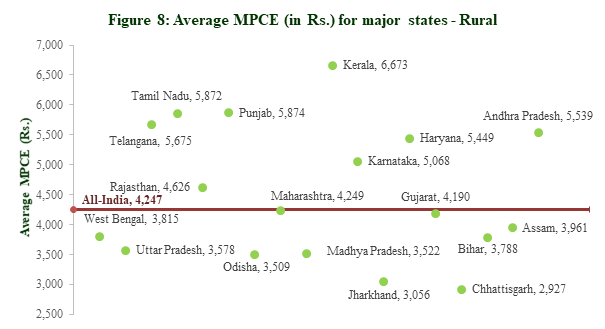
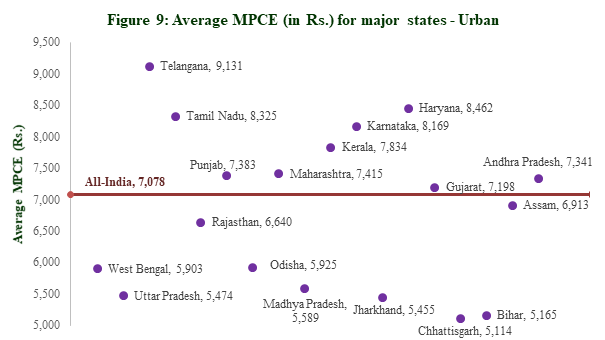
      • Considering the imputed values of items received free of cost through various social welfare programmes, these estimates become Rs. 4,247 and Rs. 7,078 respectively, for rural and urban areas.
      • In nominal prices, the average MPCE (without imputation) in 2023-24 increases by about 9% in rural areas and 8% in urban areas from the level of 2022-23.
      • The urban-rural gap in MPCE has declined to 71% in 2022-23 from 84% in 2011-12. It has further come down to 70% in 2023-24 that confirms sustained momentum of consumption growth in rural areas.
      • When ranked by MPCE, the increase in the average MPCE in 2023-24 from the level of 2022-23 has been the maximum for the bottom 5 to 10 % of India’s population, for both rural and urban areas.
      • Consistent with the trend observed in HCES:2022-23, non-food items remain the major contributor to the household’s average monthly expenditure in 2023-24 with about 53% and 60% share in MPCE in rural and urban areas respectively.
      • Beverages, refreshments and processed food continues to have the major expenditure share in 2023-24 in the food items basket of the rural and urban households.
      • Conveyance, clothing, bedding & footwear, miscellaneous goods & entertainment and durable goods have major expenditure share in non-food expenditure of the households in both rural and urban areas.
      • Rent consisting of house rent, garage rent and hotel accommodation charges with about 7% share is another major constituent of the urban households’ non-food expenditure. 
      • Consumption inequality, both in rural and urban areas has declined from the level of 2022-23. The Gini coefficient has declined to 0.237 in 2023-24 from 0.266 in 2022-23 for rural areas and to 0.284 in 2023-24 from 0.314 in 2022-23 for urban areas.

      A  Estimates of MPCE (without considering imputed values of items received free of cost through various social welfare programmes in HCES:2023-24)

      The values of average MPCE for HCES:2023-24, HCES:2022-23 (for both without considering the imputed values of the items received free of cost through social transfer) and NSS 68th (2011-12) rounds at all-India level at current prices and at 2011-12 prices are given in Table 1 below:

      Table 1: Average MPCE (Rs.) at current Prices and 2011-12 prices

      Survey

      Period

      at current Prices

      at 2011-12 Prices

      Rural

      Urban

      Rural

      Urban

      HCES: 2023-24

      Aug 2023- Jul 2024

      4,122

      6,996

      2,079

      3,632

      HCES: 2022-23

      Aug 2022- Jul 2023

      3,773

      6,459

      2,008

      3,510

      68th round (2011-12)

      Jul 2011-Jun 2012

      1,430

      2,630

      1,430

      2,630

      Variation in MPCE across fractiles classes

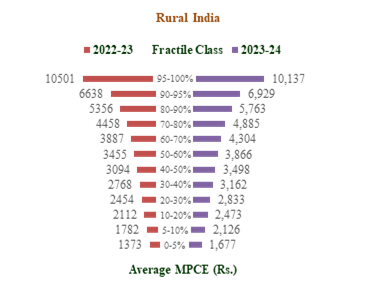
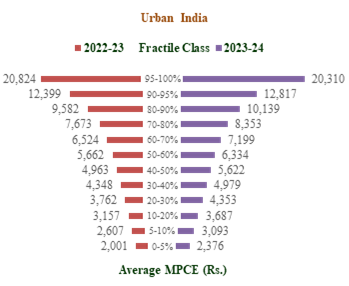
      Besides, the all-India average MPCE, average MPCE over fractile classes of MPCE compiled from the data collected in HCES: 2023-24 at current prices are shown below in Figure 1. For any fraction (0<f<1), the corresponding fractile of the distribution of MPCE (Y) is the level of MPCE, say, Yf such that the proportion of population whose household MPCE lies below Yf is f.

      The bottom 5% of India’s rural population, ranked by MPCE, has an average MPCE of Rs. 1,677 while it is Rs. 2,376 for the same category of population in the urban areas.

      The top 5% of India’s rural and urban population, ranked by MPCE, has an average MPCE of Rs. 10,137 and Rs. 20,310, respectively.

      Average MPCE in 2023-24 has increased the most (22%) from the level of 2022-23 for the bottom 5% of India’s rural population when ranked by MPCE and for the corresponding segment of urban population the growth has been about 19% during the same period.

      Figure 1: Average MPCE value for different fractile classes of MPCE

       Variation in MPCE among the States and Union Territories

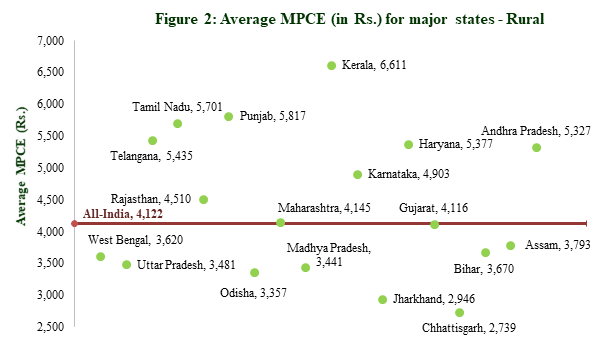
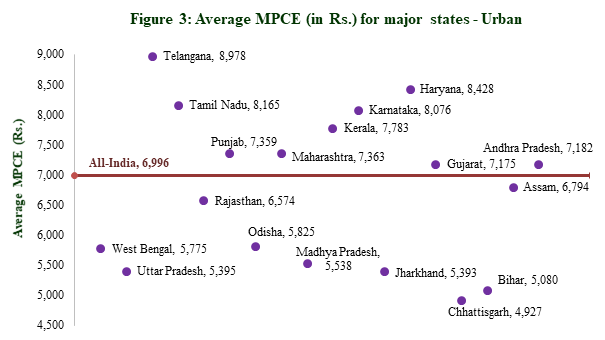
      Among the States, MPCE is the highest in Sikkim (Rural – Rs. 9,377 and Urban – Rs. 13,927) and it is the lowest in Chhattisgarh (Rural – Rs. 2,739 and Urban – Rs. 4,927).

      Among the UTs, MPCE is the highest in Chandigarh (Rural – Rs. 8,857 and Urban – Rs. 13,425), whereas it is the lowest in Dadra and Nagar Haveli and Daman and Diu (Rs. 4,311) and Jammu and Kashmir (Rs. 6,327) in rural and urban areas, respectively.

      The rural-urban difference in average MPCE among the states is the highest in Meghalaya (104%) followed by Jharkhand (83%) and Chhattisgarh (80%).

      Average MPCE in 9 out of 18 major states is higher than the all-India average MPCE in both rural and urban areas.

      The relative position of major states in terms of MPCE with regard to all-India MPCE is shown in Figures 2 & 3.
       

      Consumption Behavior of the Indian Households

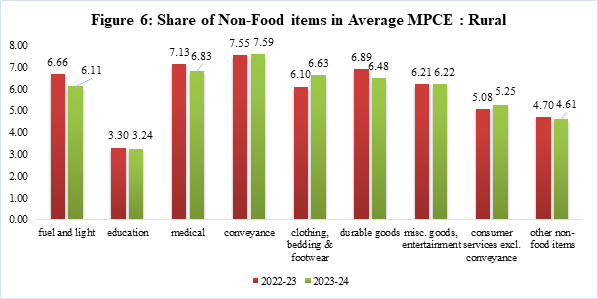
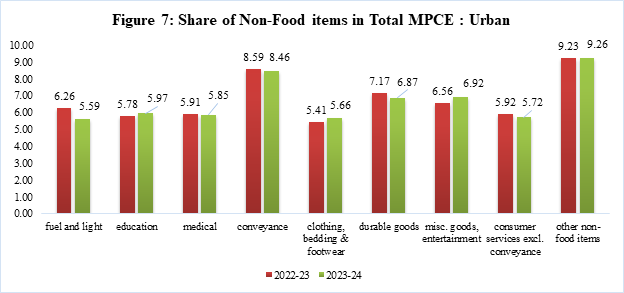
      Across all the States and UTs, the households are observed to spend more on non-food items with share of non-food items in average MPCE being 53% and 60% in rural and urban areas, respectively. The major contributors in the non-food expenditure of the households in 2023-24 have been: (i) Conveyance, (ii) clothing, bedding & footwear, (iii) miscellaneous goods & entertainment and (iv) durable goods durable goods. Rent with a share of around 7% is another major constituent of households’ non-food expenditure in urban India.

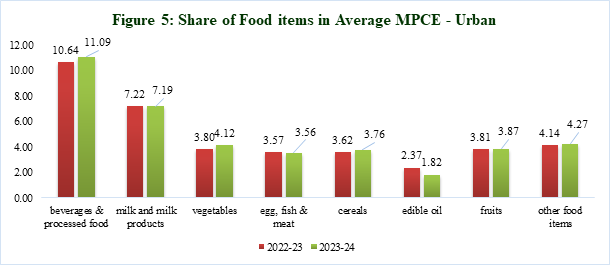
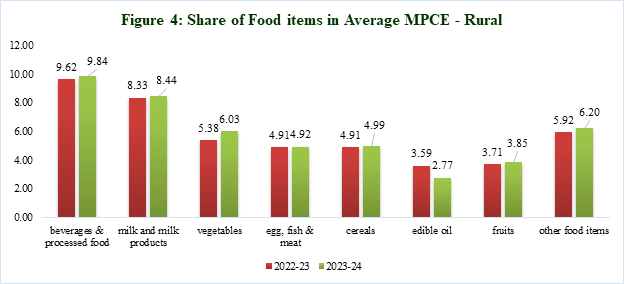
      As in 2022-23, beverages and processed food continues to be the major contributor in total consumption expenditure of food items in 2023-24, followed by milk & milk products and vegetables. A comparison of contribution of different item categories in the total consumption expenditure of the households in rural and urban areas for 2022-23 and 2023-24 is shown in Figures 4, 5, 6 and 7.     


      1. Estimates of MPCE (considering imputed values of items received free of cost through various social welfare programmes in HCES: 2023-24@)

      The values of average MPCE for HCES:2023-24, HCES:2022-23 (for both considering imputed values of items received free of cost through social transfer) and NSS 68th (2011-12) rounds at all-India level at current prices and at 2011-12 prices are given in Table 2 below:

      Table 2: Average MPCE with imputation (Rs.) at current Prices and 2011-12 prices

      Survey

      Period

      at current Prices

      at 2011-12 Prices

      Rural

      Urban

      Rural

      Urban

      HCES: 2023-24

      Aug 2023- Jul 2024

      4,247

      7,078

      2,142

      3,674

      HCES: 2022-23

      Aug 2022- Jul 2023

      3,860

      6,521

      2,054

      3,544

      68th round (2011-12)

      Jul 2011-Jun 2012

      1,430

      2,630

      1,430

      2,630

      Variation in MPCE among the States and Union Territories

      Among the States, MPCE (considering imputed values of items received free of cost through various social welfare programmes) is the highest in Sikkim (Rural – Rs. 9,474 and Urban – Rs. 13,965) and it is the lowest in Chhattisgarh (Rural – Rs. 2,927 and Urban – Rs. 5,114).

      Among the UTs, MPCE is the highest in Chandigarh (Rural – Rs. 8,857 and Urban – Rs. 13,425), whereas it is the lowest in Dadra and Nagar Haveli and Daman and Diu (Rs. 4,450) and Jammu and Kashmir (Rs. 6,375) in rural and urban areas, respectively.

      The relative position of major states in terms of MPCE with regard to all-India MPCE is shown in Figures 8 & 9.
      [i] @ In HCES:2023-24, the usual practice of imputation of the value figures for consumption out of (i) home-grown/home-produced stock and (ii) gifts, loans, free collection and goods received in exchange of goods and services etc. has been continued; and accordingly, estimates of MPCE have been generated. These are presented in section A.

      A provision for collection of information on the quantity of consumption for a number of items, received and consumed by the households free of cost through various social welfare programmes has been made in HCES:2022-23 and continued in HCES:2023-24. Consequently, the value figures for (i) food items: Rice, Wheat/Atta, Jowar, Bajra, Maize, Ragi, Barley, Small Millets, Pulses, Gram, Salt, Sugar, Edible Oil and (ii) non-food items: Laptop/PC, Tablet, Mobile Handset, Bicycle, Motor Cycle/Scooty, Clothing (school uniform), Footwear (school shoe etc.) received free of cost by the households through these programmes, have been imputed using an appropriate method. Accordingly, another set of estimates of MPCE considering imputed values of these items and of consumption out of home produce, free collection, gifts, loans etc. has also been compiled for HCES: 2023-24. These estimates are presented in Section B.

      Pradhan Mantri Jan Aarogya Yojna (PM-JAY) or any other similar state specific schemes provide cashless access to health care services to the beneficiaries at the point of service delivery, i.e., the hospital and the beneficiary does not have any information on the cost of the services availed. For such schemes, entire premium is borne by the Government and the beneficiary makes no contribution. Since HCES is not a record-based survey, often it is not possible to ascertain the exact ailment or disease for which the benefit has been availed. Hence, in view of the complexity and appropriateness involved in imputation of the expenditure for such services, no attempt has been made to impute the expenditure of health services availed by the households free of cost.

      For similar reasons, the expenditure for free education services (i.e., reimbursement/waiver of school or college fees) has also not been imputed.

      Topics

      ActsIncome Tax