
Just a moment...

Top
Help
×

By creating an account you can:

Logo TaxTMI
Call Us / Help / Feedback

Contact Us At :

E-mail: [email protected]

Call / WhatsApp at: +91 99117 96707

For more information, Check Contact Us

FAQs :

To know Frequently Asked Questions, Check FAQs

Most Asked Video Tutorials :

For more tutorials, Check Video Tutorials

Submit Feedback/Suggestion :

Email :
Please provide your email address so we can follow up on your feedback.
Category :
Description :
Min 15 characters0/2000
Make Most of Text Search
  1. Checkout this video tutorial: How to search effectively on TaxTMI.
  2. Put words in double quotes for exact word search, eg: "income tax"
  3. Avoid noise words such as : 'and, of, the, a'
  4. Sort by Relevance to get the most relevant document.
  5. Press Enter to add multiple terms/multiple phrases, and then click on Search to Search.
  6. Text Search
  7. The system will try to fetch results that contains ALL your words.
  8. Once you add keywords, you'll see a new 'Search In' filter that makes your results even more precise.
  9. Text Search
Add to...
You have not created any category. Kindly create one to bookmark this item!
Create New Category
Hide
Title :
Description :
❮❮ Hide
Default View
Expand ❯❯
Close ✕
🔎 News - Adv. Search
TEXT SEARCH:

Press 'Enter' to add multiple search terms. Rules for Better Search

Search In:
Main Text + AI Text
  • Main Text
  • Main Text + AI Text
  • AI Text
Category: ?
Categorized by AI
---- All Categories ----
  • ---- All Categories ----
  • Income Tax
  • GST
  • Customs, DGFT & SEZ
  • FEMA & RBI
  • Corp. Laws, SEBI & IBC
  • PMLA, Black Money & ED
  • Budget
  • News and Press Release
  • PTI News
Month:
---- All Months ----
  • ---- All Months ----
  • January
  • February
  • March
  • April
  • May
  • June
  • July
  • August
  • September
  • October
  • November
  • December
Year:
---- All Years ----
  • ---- All Years ----
  • 2026
  • 2025
  • 2024
  • 2023
  • 2022
  • 2021
  • 2020
  • 2019
  • 2018
  • 2017
  • 2016
  • 2015
  • 2014
  • 2013
  • 2012
  • 2011
Sort By: ?
In Sort By 'Default', exact matches for text search are shown at the top, followed by the remaining results in their regular order.
RelevanceDefaultDate
    After nine years at helm, N Chandra to exit Tata Sons amid expansion, governance standoff
    RBI invites comments on the Draft “Reserve Bank of India (Interest Rates on Loans and Advances) Directions, 2026”
    Sensex falls 188 pts amid elevated crude oil prices; Tata Group stocks decline after N Chandra's exit
    SJM urges govt to stand firm against US tariff pressure, calls for boycott of American products
    Union Minister of Commerce and Industry Shri Piyush Goyal Calls for Fair Trading Practices and Taking ‘Make in India’ from Local to Global
    Union Minister for Finance & Corporate Affairs Smt. Nirmala Sitharaman delivers keynote address at Seminar on “Role of the New Development Bank in M...
    Delhi HC halts processing of IT-returns of Supreme Court, high court judges
    Over 36,000 firms shut operations in Maharashtra in 5 yrs; Oppn claims graft, govt interference
    Powering India's Energy Freedom
    Fourth Session of the India-Namibia Joint Trade Committee held in New Delhi
    Winning in the AI Era: The New Playbook for Indian Banks - Inaugural Address by Shri Sanjay Malhotra, Governor, Reserve Bank of India at the FIBAC 202...
    Assam Cabinet okays funds for land acquisition for Guwahati satellite city
    ED arrests Chhattisgarh Congress leader in liquor 'scam' case; sent to 7 days' custody
    Sales Tax Assistant Commissioner arrested for demanding bribe of Rs 8 lakh
    Net direct tax kitty grows 23 pc to Rs 8.11 lakh cr on slower refunds, higher non-corp taxes
    Delhi court sets aside summon order in cheque bounce case
    BRICS grouping discussing linking CBDCs, fast payment systems: RBI Guv Malhotra
    PM GatiShakti National Master Plan Enables Integrated and Coordinated Infrastructure Planning
    GeM Strengthens Participation of MSMEs, Startups, Women Entrepreneurs and SHGs
    Net direct tax collection grows 23 pc to Rs 8.11 lakh cr so far this fiscal
❯❯
MaximizeMaximizeMaximize
0 / 200
Expand Note
Add to Folder

No Folders have been created

    +

    Are you sure you want to delete "My most important" ?

    NOTE:

    News
    Showing Results for :
    Reset Filters
    Results Found:
    Show All SummariesHide All Summaries
    August 12, 2026
    Show AI Summary
    Holding-company governance succession follows leadership departure, requiring transition planning amid unresolved strategy, capital allocation, board representation and listing questions.
    Tata Sons' leadership succession and governance framework have become central following the chairman's decision not to seek reappointment when his term ends in February 2027. The board has been asked to decide on a successor promptly. Unresolved matters include the strategic roadmap, losses and capital requirements in newer businesses, board representation, capital allocation, an exit route for the Shapoorji Pallonji Group, and the possible listing of Tata Sons. Future leadership must manage these issues while improving returns from investment-intensive businesses and maintaining established operations.
    August 12, 2026
    Show AI Summary
    Interest-rate regulation for loans and advances proposes harmonised fixed and floating loan-pricing principles across regulated entities.
    Interest-rate regulation for loans and advances is proposed to be harmonised across all regulated entities through a principles-based framework for fixed-rate and floating-rate loans. The framework would be calibrated to each entity's nature, complexity and scale, while supporting monetary policy transmission, credit-risk-based pricing, and fair, non-discriminatory borrower treatment. It addresses divergent commercial-bank practices in determining the marginal cost of funds-based lending rate and its components, alongside limited regulatory coverage of fixed-rate loans. Separate final directions are intended for each category of regulated entity after consideration of feedback.
    August 12, 2026
    Show AI Summary
    Elevated crude oil prices and Tata leadership transition drove broad equity market selling amid inflation concerns.
    Indian equity markets declined amid elevated crude oil prices, inflation concerns and broad risk-off selling. Tata Group shares, particularly TCS, came under pressure after N. Chandrasekaran announced that he would not seek reappointment as Tata Sons Chairman when his current term ends. Crude oil prices approaching the USD 90-per-barrel level affected investor confidence because of potential inflationary effects, while uncertainty over United States-Iran negotiations and Strait of Hormuz shipping disruptions added to global energy market concerns.
    August 12, 2026
    Show AI Summary
    Trade sovereignty and energy security underpin calls to resist tariff pressure and protect sensitive sectors in bilateral negotiations.
    Trade sovereignty and energy security are advanced as grounds for resisting tariff pressure linked to Indian purchases of Russian crude. Bilateral trade negotiations should proceed through equality, reciprocity and mutual respect without compromising agriculture, dairy, energy security or strategic autonomy. Concerns are also raised over removal of e-commerce inventory restrictions for foreign direct investment and over proposed Merchant Discount Rate charges on UPI transactions. Withdrawal of the inventory measure and opposition to payment-provider charges are urged, alongside possible restrictions on United States technology and social-media companies and consumer boycotts of American goods and services.
    August 12, 2026
    Show AI Summary
    Fair trading practices and circular production are promoted to strengthen Make in India and expand global market participation.
    Trade and industrial policy messaging encourages businesses to digitise operations, adopt good manufacturing practices, follow fair trading practices, and promote recycling, reuse and a circular economy. Nine free trade agreements are identified as creating preferential market-access opportunities for Indian industry and businesses. MSMEs, entrepreneurs, farmers, fishermen, workers and the services sector are encouraged to expand Indian products and services globally, improve competitiveness through scale, and strengthen the quality, design and brand value associated with Make in India.
    August 12, 2026
    Show AI Summary
    Private capital mobilisation requires credible long-term frameworks, risk-sharing mechanisms, and multilateral partnerships to strengthen infrastructure investment.
    Private capital mobilisation in infrastructure and development finance depends on credible long-term frameworks, investor confidence, project bankability, and balanced risk allocation. Public capital is intended to catalyse rather than replace private investment. Key financing mechanisms include Viability Gap Funding, the Hybrid Annuity Model, credit enhancement, and Infrastructure Investment Trusts. Long-term investment visibility and coordinated connectivity are supported through the National Infrastructure Pipeline and PM Gati Shakti framework, alongside investment measures for freight, rail, waterways, and coastal cargo.
    August 12, 2026
    Show AI Summary
    Judicial allowance exemptions under the new tax regime remain disputed, with return processing and resulting demands kept in abeyance.
    Tax treatment of specified judicial allowances under the new income-tax regime is disputed. Statutory service-condition provisions are asserted to exclude allowances, including official residence, conveyance, sumptuary allowance and leave travel concession, from income computation and to override the Income-tax Act. Pending consideration, affected judges may show these amounts as receipts not in the nature of income, and their returns are not to be processed further. Any resulting demand remains in abeyance, while refundable amounts are withheld subject to the pending proceedings.
    August 12, 2026
    Show AI Summary
    Corporate closure data highlights worker-claim treatment through insolvency adjudication and liquidation priority, while affected-worker information remains unmaintained.
    Corporate closure data recorded 36,211 private companies in Maharashtra as liquidated, dissolved or struck off during the preceding five financial years. Central information is not maintained on workers affected by closures or special rehabilitation packages. In corporate insolvency resolution, employee and worker claims are adjudicated under orders of the adjudicating authority. In winding-up or liquidation, the liquidator deals with pending wages and other admissible statutory dues, subject to available funds and the statutory order of priority.
    August 12, 2026
    Show AI Summary
    Compressed biogas development converts organic waste into cleaner fuel, rural income and reduced dependence on imported fossil fuels.
    CBG development is presented as a route for converting agricultural and organic waste into biomethane, bio-fertiliser and briquettes while reducing fossil-fuel imports, crop-residue burning and waste-management burdens. NexGen Energia's asset-light land-partner model uses landowner-provided sites while the company designs, installs and operates plants, including gas upgrading and offtake logistics. Anaerobic digestion and alternative gas-purification technologies support use of agricultural residue, food waste, manure and distillery effluent. Expansion is linked to the GOBARdhan National Circular Bioenergy Scheme, despite capital, feedstock-aggregation and commissioning constraints.
    August 12, 2026
    Show AI Summary
    Bilateral trade cooperation advances through investment focal points, services and health working groups, and planned preferential trade agreement negotiations.
    India-Namibia economic cooperation is being progressed through agreed follow-up mechanisms focused on value addition, investment facilitation and sectoral collaboration. Investment focal points have been designated, and a Services Working Group is to prepare a work plan for the Joint Trade Committee. Priority areas include health and pharmaceuticals, critical-mineral processing, gems and jewellery, digital payments, FinTech, railways, renewable energy and green hydrogen. Terms of Reference for the India-SACU preferential trade agreement were finalised, with negotiations to begin after signature and conclude within one year.
    August 12, 2026
    Show AI Summary
    AI governance in banking requires explainability, board accountability, rigorous testing, vendor controls and meaningful human oversight for customer-facing decisions.
    AI adoption in banking should be governed through a principles-based and proportionate framework that aligns innovation with financial stability, customer protection and accountability. Banks should maintain inventories of AI systems, adopt board-approved governance policies, ensure explainability for material lending and fraud decisions, conduct periodic red-teaming and stress testing, and preserve meaningful human oversight. Key risks include opacity, bias, vendor concentration, third-party dependence, data misuse, cyber vulnerability and loss of institutional accountability. Vendor arrangements require audit and explanation rights and credible exit plans.
    August 11, 2026
    Show AI Summary
    Land acquisition funding and regulatory approvals advance satellite-city development, tax relief, identity enrolment, employment verification, and jail reform.
    Assam Cabinet approvals include first-phase funding for land acquisition and development of the Aerotropolis Satellite City Project and a lease deed for a hotel supporting the Jagiroad semiconductor ecosystem. Measures also provide Aadhaar enrolment relaxation for Moran and Matak communities, zero agricultural tax up to the prescribed net-income threshold, OBC Non-Creamy Layer certificates, and trainee and graduate-assistance funding. Government jobs will be provisionally held pending police verification, with automatic confirmation where no report is submitted within six months. Jail rules will be amended to promote non-discrimination, sanitation, security and fair work allocation.
    August 11, 2026
    Show AI Summary
    Money-laundering investigation into alleged liquor-sale proceeds led to arrest and custodial questioning amid contested political allegations.
    Money-laundering investigation concerning an alleged liquor scam led to the Enforcement Directorate's arrest of Ramgopal Agrawal and seven days' custodial remand under the Prevention of Money Laundering Act. The agency alleged his connection with proceeds of crime, non-attendance despite multiple summonses, and evasiveness during questioning. Allegations concern purported control of the state excise department, illegal liquor sales, and sharing of commissions. The Congress has denied the allegations and described the investigation as politically motivated.
    August 11, 2026
    Show AI Summary
    GST inquiry closure bribery allegations prompted anti-corruption proceedings against a Sales Tax officer under corruption law.
    Alleged bribery in GST inquiry closure led to the arrest of a Sales Tax Assistant Commissioner after a scrap trader complained of a demand for illegal gratification to close an inquiry initiated through a GST show-cause notice. Anti-corruption officials reportedly verified the allegation through intermediaries, during which the officer allegedly agreed to accept payment for closing the matter. A criminal case was registered under the Prevention of Corruption Act, with further investigation ongoing.
    August 11, 2026
    Show AI Summary
    Direct tax collection growth reflected stronger non-corporate taxes and securities transaction tax receipts alongside slower refund issuances.
    Net direct tax collections increased by 23 per cent to over Rs 8.11 lakh crore through August 10, driven by higher non-corporate tax collections and slower refund growth. Gross direct tax collections grew by 19.75 per cent to about Rs 9.55 lakh crore. Net corporate tax collections rose about 20 per cent, net non-corporate tax collections rose 23 per cent, and Securities Transaction Tax collections increased 51 per cent. Refund issuances grew by 3.8 per cent year-on-year.
    August 11, 2026
    Show AI Summary
    Vicarious liability in cheque dishonour cases cannot attach to trust associates without statutory status or transaction-specific involvement.
    Vicarious criminal liability for cheque dishonour under section 141 of the Negotiable Instruments Act does not extend to a trust, because a trust is not a juristic person. A person cannot be summoned merely for alleged active involvement in a trust where the person was neither drawer nor signatory of the cheques, trustee, office-bearer, authorised account operator, guarantor, or executor of transaction documents.
    August 11, 2026
    Show AI Summary
    Cross-border payment integration through CBDCs and fast payment systems remains under BRICS discussion to reduce transfer costs.
    Cross-border payment integration is under discussion through potential linkages between central bank digital currencies and fast payment systems, including UPI-type platforms. These approaches seek faster and less costly trade and remittance transfers, particularly retail payments, but remain at a discussion stage. Rupee internationalisation is also being pursued through central-bank memorandums of understanding for bilateral trade settlement in local currencies, with existing arrangements covering Indonesia, Maldives, Mauritius and the UAE.
    August 11, 2026
    Show AI Summary
    Integrated infrastructure planning under PM GatiShakti coordinates project evaluation, multimodal connectivity, geospatial data use, and decentralized implementation.
    PM GatiShakti National Master Plan provides an integrated, data-driven infrastructure planning framework using geospatial data, satellite imagery and API integration. Project approval, implementation and funding remain with the respective Central Ministries, Departments and States or Union Territories under their own plans and budgetary provisions; the framework sets no separate budgetary allocation or quantified targets. The Network Planning Group evaluates critical Central Government projects at the planning stage for multimodality, synchronisation, last-mile connectivity, comprehensive local development and coordinated decision-making.
    August 11, 2026
    Show AI Summary
    MSME procurement through GeM has expanded alongside analytics-driven controls against suspicious bidding, collusion, and vendor misconduct.
    GeM uses AI/ML analytics to detect order splitting, suspicious bidding, abnormal pricing, repeated participation and potential buyer-seller collusion. Flagged cases are placed before buyer organisations for review and action, while suspected cartels are assessed through digital-footprint, pricing and bid-timing indicators. Its Incident Management framework addresses false documents, fraud, collusive behaviour and other misconduct through administrative measures, including suspension. Anti-competitive conduct and cartel formation are Severe/Grave deviations, with proven cases attracting suspension for up to 365 days.
    August 11, 2026
    Show AI Summary
    Direct tax collections show stronger corporate, non-corporate and securities transaction tax receipts, alongside increased refunds during the fiscal period.
    Net direct tax collections grew by 23.09 per cent to over Rs 8.11 lakh crore up to August 10 of the current fiscal year, while gross direct tax collections increased by 19.75 per cent to about Rs 9.55 lakh crore. Corporate tax, non-corporate tax including personal income tax, and Securities Transaction Tax receipts recorded growth. Refunds issued between April 1 and August 10 also rose over the corresponding earlier period. Direct tax collections are budgeted at Rs 26.97 lakh crore for the fiscal year.

    News

    Back

    All News

    Showing Results for :
    Reset Filters
      No Records Found

      News

      Back

      All News

      whatsappJoin Channel
      Showing Results for : Reset Filters

      Recommendations of the 55th Meeting of the GST Council

      December 21, 2024

      Contents
      Notifications
      Circulars
      Forms
      Acts
      Rules & Regulations
      Plus +
      Summary
      Note

      Note

      -

      Bookmark

      Print

      Print

      GST Council recommends reduction in GST rate on Fortified Rice Kernel (FRK), classifiable under 1904, to 5%

      GST council also recommends to fully exempt GST on gene therapy

      GST Council recommends exemption of GST on contributions by general insurance companies from third-party motor vehicle premiums for Motor Vehicle Accident Fund

      GST Council recommends no GST on transaction of vouchers as they are neither supply of goods nor supply of services. The provisions related to vouchers is also being simplified.

      GST Council clarifies that no GST is payable on ‘penal charges’ levied and collected by banks and NBFCs from borrowers for non-compliance with loan terms

      GST Council recommends reduction of payment of pre-deposit for filing an appeal before the Appellate Authority in respect of an order passed which involves only penalty amount

      Jaisalmer, Rajasthan, 21 st December 2024

      The 55th GST Council met under the Chairpersonship of Union Minister for Finance & Corporate Affairs Smt. Nirmala Sitharaman in Jaisalmer, Rajasthan, today.
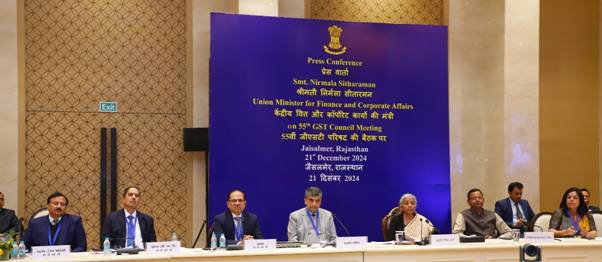
      The meeting was also attended by Union Minister of State for Finance Shri Pankaj Chaudhary, Chief Ministers of Goa, Haryana, Jammu and Kashmir, Meghalaya and Odisha; Deputy Chief Ministers of Arunachal Pradesh, Bihar, Madhya Pradesh, and Telangana; besides Finance Ministers of States & UTs (with legislature) and senior officers of the Ministry of Finance & States/ UTs.
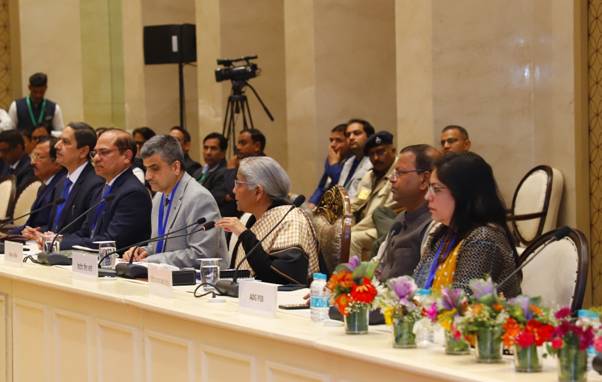
      The GST Council inter-alia made the following recommendations relating to changes in GST tax rates, provide relief to individuals,measures for facilitation of trade and measures for streamlining compliances in GST.

      A. Changes in GST rates of goods

      GOODS

      1. To reduce the GST rate on Fortified Rice Kernel (FRK), classifiable under 1904, to 5%.
      2. To exempt GST on gene therapy.
      3. To extend IGST exemption to systems, sub-systems, equipment, parts, sub-parts, tools, test equipment, software meant assembly/manufacture of LRSAM system under Notification 19/2019-Customs.
      4. To reduce the rate of Compensation Cess to 0.1% on supplies to merchant exporters at par with GST rate on such supplies.
      5. To exempt from IGST imports of all equipment and consumable samples by Inspection Team of the International Atomic Energy Agency (IAEA) subject to specified conditions.
      6. To extend the concessional 5% GST rate on food inputs of food preparations under HSN 19 or 21 that are supplied for food preparations intended for free distribution to economically weaker sections under a government program subject to the existing conditions.

      SERVICES

      1. To bring supply of the sponsorship services provided by the body corporates under Forward Charge Mechanism.
      2. To exempt GST on the contributions made by general insurance companies from the third-party motor vehicle premiums collected by them to the Motor Vehicle Accident Fund, constituted under section 164B of the Motor Vehicles Act, 1988. This fund is constituted for providing compensation/ cashless treatment to the victims of road accidents including hit and run cases.
      3. To omit the definition of declared tariff and suitably amend the definition of specified premises (from the services rate and exemption notifications) to link it with actual value of supply of any unit of accommodation provided by the hotel and to make the rate of GST applicable on restaurant services in such hotels, for a given financial year, dependent upon the ‘value of supply’ of units of accommodation made in the preceding financial year, i.e. 18% with ITC if the ‘value of supply’ exceeded Rs. 7,500 for any unit of accommodation in the preceding financial year, and 5% without ITC otherwise. Further, to give an option to pay tax on restaurant service in hotels at the rate of 18% with ITC, if the hotel so chooses, by giving a declaration to that effect on or before the beginning of the financial year or on obtaining registration. The above changes to be made effective from 01.04.2025 to avoid any transition difficulties.
      4. To exclude taxpayers registered under composition levy scheme from the entry at Sr. No. 5AB introduced vide Notification No. 09/2024-CTR dated 08.10.2024 vide which renting of any commercial/ immovable property (other than residential dwelling) by unregistered person to registered person was brought under reverse charge mechanism. Further, to regularize the period from the date when the notification No. 09/2024-CTR dated 08.10.2024, became effective i.e. from 10.10.2024 till the date of issuance of the proposed notification on “as is where is” basis.

      Other changes relating to goods and services

      1. To increase the GST rate from 12% to 18 % on sale of all old and used vehicles, including EVs other than those specified at 18% -Sale of old and used petrol vehicles of engine capacity of 1200 cc or more & of length of 4000 mm or more; diesel vehicles of engine capacity of 1500 cc or more & of length of 4000 mm and SUVs.[Note: GST is applicable only on the Value that represents Margin of the Supplier, that is, the difference between the Purchase price and Selling price (depreciated value if depreciation is claimed) and not on the value of the vehicle. Also, it is not applicable in case of unregistered persons.]
      2. To clarify that Autoclaved Aerated Concrete (ACC) blocks containing more than 50% fly ash content will fall under HS 6815 and attract 12% GST.
      3. To clarify that pepper whether fresh green or dried pepper and raisins when supplied by an agriculturist is not liable to GST.
      4. To amend the definition of ‘pre-packaged and labelled’ to cover all commodities that are intended for retail sale and containing not more than 25 kg or 25 litre, which are ‘pre-packed’ as defined under the Legal Metrology Act, or a label affixed thereto is required to bear the declarations under the provisions of the Act and rules.
      5. To clarify that ready to eat popcorn which is mixed with salt and spices are classifiable under HS 2106 90 99 and attracts 5% GST if supplied as other than pre-packaged and labelled and 12% GST if supplied as pre-packaged and labelled. However, when popcorn is mixed with sugar thereby changing its character to sugar confectionary (eg caramel popcorn), it would be classifiable under HS 1704 90 90 and attract 18% GST. It has been decided to regularise the issues for the past on “as is where is” basis.(Note: There is no new imposition of any tax in this regard and is merely a clarification as certain field units were demanding different tax rates on the same. Therefore, it is a clarification being recommended by the GST Council to settle the disputes arising out of interpretation.)
      6. To clarify that the Explanation in Sl. No. 52B in notification No. 1/2017- Compensation Cess (Rate) dated 28.6.2017 regarding ground clearance is applicable with effect from 26.07.2023.
      7. To clarify that RBI regulated Payment Aggregators are eligible for the exemption under entry at Sl. No. 34 of notification No. 12/2017-CT(R) dated 28.06.2017 since they fall within the ambit of ‘acquiring bank’ as defined in the said entry.  To also clarify that this exemption does not cover payment gateway (PG) and other fintech services which do not involve settlement of funds.
      8. To clarify that no GST is payable on the ‘penal charges’ levied and collected by banks and NBFCs from borrowers for non-compliance with loan terms.

      B.  MEASURES FOR FACILITATION OF TRADE

      1.   Amendment in Schedule III of CGST Act, 2017

      • To insertclause (aa) in paragraph 8 of Schedule III of the CGST Act, 2017 w.e.f.01.07.2017, to explicitly provide that supply of goods warehoused in a Special Economic Zone (SEZ) or Free Trade Warehousing Zone (FTWZ) to any person before clearance of such goods for exports or to the Domestic Tariff Area, shall be treated neither as supply of goods nor as supply of services.
      • This brings transactions relating to supply of goods warehoused in SEZ/FTWZ at par with the existing provision in GST for transactions in Customs bonded warehouse.

      2.  Issues pertaining to taxability of Vouchers

      In a significant move to address long-standing concerns regarding the taxability of vouchers under GST, the GST Council made the following recommendations:

      1. To omit sections 12(4) and 13(4) from CGST Act, 2017 and rule 32(6) from CGST Rules, 2017 to resolve ambiguities in the treatment of vouchers.
      2. To issue clarification on the following issues:

      (a) Transactions in vouchers shall be treated neither as a supply of goods nor as a supply of services.

      (b) Distribution of vouchers on principal-to-principal basis shall not be subject to GST. However, where vouchers are distributed on principal-to-agent basis, the commission/fee or any other amount charged by the agent for such distribution is taxable under GST.

      (c) Additional services such as advertisement, co-branding, marketing and promotion, customization and technology support, customer support etc. related to vouchers would be leviable to GST on the amount paid for these services.

      (d) Unredeemed vouchers (breakage) would not be considered as supply under GST and no GST is payable on income booked in the accounts in respect of breakage.

      3. Issuance of clarifications through the circulars to remove ambiguity and legal disputes in certain issues.

      • To issue circulars to provide clarity in the following issues due to varied interpretations by the field formations:

      (i) Clarification regarding requirement of reversal of Input Tax Credit by electronic commerce operators in respect of supplies made under section 9(5) of CGST Act, 2017The GST Council recommended that no proportional reversal of ITC under section 17 (1) or section 17 (2) of CGST Act, 2017 is required to be made by the ECO in respect of supplies for which they are required to pay tax under section 9(5) of CGST Act, 2017.

      (ii) Clarification on availability of Input Tax Credit as per section 16(2)(b) of CGST Act, 2017 in respect of goods which have been delivered by the supplier at his (supplier’s) place of business : The GST Council recommended to clarify that in an Ex-Works contract, where goods are delivered by the supplier to the recipient or a transporter at the supplier's place of business, and the property in goods transfers to the recipient at that point, the goods are considered to be "received" by the recipient under section 16(2)(b) of CGST Act, 2017 and the recipient may claim Input Tax Credit (ITC) on such goods, subject to the conditions outlined in Sections 16 and 17 of the CGST Act, 2017.

      (iii) Clarification regarding applicability of late fee for delay in furnishing of FORM GSTR-9C and providing waiver of late fee on delayed furnishing of FORM GSTR-9C for the period from 2017-18 to 2022-23:

      (a) The GST Council recommended to clarify through a circular that the late fee under Section 47(2) of the CGST Act, 2017 is leviable for the delay in filing the complete annual return under Section 44 of the CGST Act, 2017, which includes both FORM GSTR-9 (Annual Return) and FORM GSTR-9C (Reconciliation Statement), where applicable.

      (b) For the annual returns pertaining to the period 2017-18 to 2022-23, the GST Council also recommended to issue notification under section 128 of CGST Act, 2017 for waiver of the amount of late fee for delayed filing of FORM GSTR-9C, which is in excess of the amount of late fee payable till the date of filing of FORM GSTR-9 for the said financial years, provided the said FORM GSTR-9C is filed on or before 31st March 2025.

      C.  MEASURES FOR STREAMLINING COMPLIANCES IN GST

      1.   Insertion of new provision for Track and Trace Mechanism

      • To insert an enabling provision in CGST Act, 2017 through Section 148A so as to empower the Government to enforce the Track and Trace Mechanism for specifiedevasion prone commodities.
      • The system shall be based on a Unique Identification Marking which shall be affixed on the said goods or the packages thereof. This will provide a legal framework for developing such a system and will help in implementation of mechanism for tracing specified commodities throughout the supply chain.

      2Clarification regarding recording of correct details of name of the State of the un-registered recipient as well as correct declaration of place of supply in respect of supply of 'Online Services’

      • To clarify that in respect of supply of ‘Online Services’ such as supply of online money gaming, OIDAR services, etc. to unregistered recipients, the supplier is required to mandatorily record the name of the State of the unregistered recipient on the tax invoice and such name of State of recipient shall bedeemed to be the address on record of the recipient for the purpose of section 12(2)(b) of IGST Act, 2017 read with proviso to rule 46(f) of CGST Rules, 2017

      D.  OTHER MEASURES PERTAINING TO LAW & PROCEDURE

      1.   Amendment in section 17(5)(d) of CGST Act, 2017

      2.   Amendment in section 107 and section 112 of CGST Act, 2017 to provide for payment of pre-deposit for filing an appeal in respect of an order passed which involves only penalty amount.

      • To amend the proviso to section 107(6) of CGST Act, 2017 providing for payment of pre-deposit at 10% instead of 25 %for filing appeals before Appellate Authority in cases involving only demand of penalty without involving the demand of tax.
      • To insert a new proviso to section 112(8) of CGST Act, 2017 providing for payment of pre-deposit at 10% for filing appeals before Appellate Tribunal in cases involving only demand of penalty without involving the demand of tax.

      3. Amendment in section 2(69) of CGST Act, 2017 to insert an Explanation regarding definitions of Local Fund and Municipal Fund: To amend clause (c) of section 2(69) of CGST Act, 2017 and to insert an Explanation under the same to provide for definitions of the terms ‘Local Fund’ and ‘Municipal Fund’ used in the said clause.            

      4. Amendment in provisions pertaining to Input Services Distributor (ISD) mechanism under CGST Act, 2017 and CGST Rules, 2017

      5.   Provision for grant of Temporary Identification Number by Tax Officers to persons, not liable to be registered otherwise

      6.  Amendment in the field ‘category of registered person’ for taxpayers who opted for composition levy through FORM CMP-02

      7. Amendment in CGST Act, 2017 and CGST Rules, 2017 in respect of functionality of Invoice Management System (IMS)

      • The GST Council recommended inter-alia-

      (i) To amend section 38 of CGST Act, 2017 and rule 60 of CGST Rules, 2017 to provide a legal framework in respect of generation of FORM GSTR-2B based on the action taken by the taxpayers on the Invoice Management System (IMS).

      (ii) To amend section 34(2) of CGST Act, 2017, to specifically provide for requirement of reversal of input tax credit as is attributable to a credit note, by the recipient, to enable the reduction of output tax liability of the supplier.

      (iii) To insert a new rule 67B in CGST Rules, 2017, to prescribe the manner in which the output tax liability of the supplier shall be adjusted against the credit note issued by him.

      (iv) To amend section 39 (1) of CGST Act, 2017 and rule 61 of CGST Rules, 2017 to provide that FORM GSTR-3B of a tax period shall be allowed to be filed only after FORM GSTR-2B of the said tax period is made available on the portal.

      E. OTHER MEASURES:

      • The GST Council approved the recommendation of the committee of officers suggesting measures for the various issues raised by the States in respect of issues pertaining to IGST settlement and asked the committee to conclude the desired changes by March, 2025.
      • The GST Council took note of the procedural rules proposed for the internal functioning of the GSTAT, which would be notified after examination by the Law Committee. This would help in operationalization of the GSTAT.
      • The Council also decided to extend the time frame for the Group of Ministers on the restructuring of the GST Compensation till 30th June, 2025.
      • On the request of State of Andhra Pradesh the Council recommended that a Group of Ministers be constituted to examine the legal and structural issues, and recommend a uniform policy on imposition of levy in case of a natural disaster/calamity in the State.

      The issue of whether charges collected by municipalities for granting FSI including additional FSI, chargeable to GST on reverse charge basis was brought up in the Council. The matter was deferred for further examination on the behest of the Central Government on the ground that this amount relates to Municipalities or local authority.

      Note: The recommendations of the GST Council have been presented in this release containing major item of decisions in simple language for information of the stakeholders. The same would be given effect through the relevant circulars/ notifications/ law amendments which alone shall have the force of law.

      -----

      Archive: GST Council Meetings 


      Topics

      ActsIncome Tax
