 TaxTMI
 Login
 TaxTMI
Login
Loading...
Press 'Enter' to add multiple search terms. Rules for Better Search

Press 'Enter' after typing page number.
Press 'Enter' after typing page number.


No Folders have been created
Are you sure you want to delete "My most important" ?
NOTE:
Press 'Enter' after typing page number.
Press 'Enter' after typing page number.

All News
Press 'Enter' after typing page number.
All News

Note

Bookmark

Share


Prime Minister Shri Narendra Modi gave a special address at the KEC2024 to the participants, evoking enthusiasm in its ongoing effort to make India a developed economy by 2047
Prime Minister emphasised India's emergence as a preferred global investment destination due to substantial reforms over the last decade
Union Finance Minister gave an overview of India’s high economic growth, fiscal management and investment on infrastructure, manufacturing, and technology while reiterating the government’s commitment to inclusive growth and reforms
Dr. Jaishankar stressed on the emergence of AI and its far-reaching impact on economic and social activities
Prof. Jagdish Bhagwati lauded the Prime Minister for his leadership, emphasising his timely intervention with a shift from inward-looking policies to a more open, productive economy
KEC2024 showcased India’s new role in setting the global agenda, particularly in areas like green energy, technology, and trade reform, and highlighted India’s aspirations for inclusive growth and its evolving role as a strategic leader of the Global South
Over 150 prominent economists, policymakers, and academic pioneers from India and around the globe participated in the KEC2024
The third edition of the KautilyaEconomic Conclave 2024 (KEC2024)held between October 4-6, 2024, in New Delhi, was successfully concluded yesterday. The Prime Minister, Shri Narendra Modi, addressed the KEC2024 with a special address to the participants, evoking enthusiasm in its ongoing effort to make India a developed economy by 2047.The Prime Minister’s vision for a Viksit Bharat is predicated on continued economic growth, structural reforms and harnessing the cutting edge of technology.
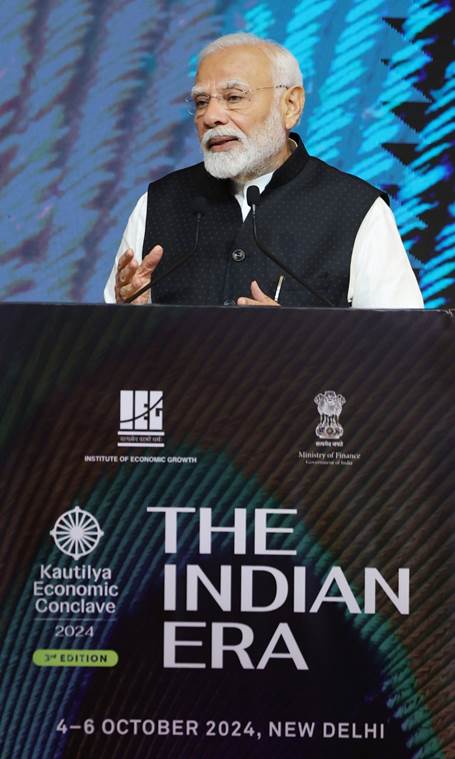
Over 150 prominent economists, policymakers, and academic pioneers from India and around the globe participated in the KEC2024, organised by the Institute of Economic Growth (IEG) in partnership with the Department of Economic Affairs (DEA), Ministry of Finance (MoF). It featured 11 plenary sessions, 12 interactive sessions and bilateral discussions on contemporary economic and social challenges facing both India and the world.
In his address, the Prime Minister emphasised India's emergence as a preferred global investment destination due to substantial reforms over the last decade, including advancements in banking, taxation, and infrastructure, and also discussed India's commitment to green energy, highlighting initiatives like the green hydrogen mission and the Global Biofuel Alliance, which were critical outcomes of India’s G20 Presidency.
Earlier, the KEC 2024 kicked off with an inaugural address by Union Minister for Finance and Corporate AffairsSmt. Nirmala Sitharaman, who emphasised India's robust macroeconomic fundamentals and its abilities to address multiple uncertainties.
Smt. Sitharaman also gave an overview of India’s high economic growth, fiscal management and investment on infrastructure, manufacturing, and technology while reiterating the government’s commitment to inclusive growth and reforms.
The KEC2024 concluded with the Union Minister for External Affairs Dr. S. Jaishankar in conversation with Mr. N.K. Singh, President of the Institute of Economic Growth, where they discussed India’s strategic role in the Global South.
Dr. Jaishankar highlighted how India is seen as a “trusted and articulate member” and spoke on the increasing importance of alternative global frameworks such as the India-Middle East-Europe Economic Corridor (IMEC) and the International Solar Alliance (ISA), which are shaping global collaboration beyond traditional structures like the UN. Dr. Jaishankar also stressed on the emergence of AI and it’s far reaching impact on economic and social activities.
A key highlight was the participation of Prof.Jagdish Bhagwati, one of India’s most respected economists, who praised India’s transformation from “taking advice” from global institutions like the World Bank to now “giving advice” to them. He lauded the Prime Minister for his leadership, emphasising that his timely intervention shifted from inward-looking policies to a more open, productive economy given the complexities, strategies have been nibble to grasp new opportunities while addressing ongoing challenges.
Throughout the KEC2024, experts delved into several critical topics like the challenges affecting factors of productivity such as skilling to enhance employment, and growth enhancing strategies; the urgent need to address climate change and strategies for a green transition; best international and domestic practices in industrial policy; the challenges and consequences of geo-economic fragmentation; reforming the international financial architecture; and artificial intelligence and its potential effects on jobs and the economy, to mention a few.
The KEC2024 featured a wide array of distinguished participants, both from India and abroad. Key international participants included, among others, Bhutan’s Finance Minister Mr. Lyonpo LekeyDorji; Ms. Amelie de Montchalin, Frech Permanent Representative of OECD & former French Minister; Mr. Albert Park, Chief Economist and Director General, Asian Development Bank; Mr. Masood Ahmed, President Emeritus of the Centre for Global Development; Mr. Justin Yifu Lin, Dean of the Institute of New Structural Economics at Peking University; Mr. Erik Berglof, Chief Economist at the Asian Infrastructure Investment Bank; Lord Nicholas Stern, IG Patel Professor of Economics and Government, London School of Economics; andmr. John Lipsky, Senior Fellow at the Foreign Policy Institute, Johns Hopkins University. Among the Indian participants, notable figures included Mr. Arvind Panagariya, Chairman of the 16th Finance Commission; Mr. Suman Bery, Vice Chairman of NITI Aayog; Dr.V. Anantha Nageswaran, Chief Economic Advisor, and Secretaries from the Ministry of Finance and Ministry of External Affairs.
These discussions spanning over three days – centred around the theme of “the Indian Era”. There were sessions on topics such as “Relationship between climate and development goals”; “Geo-economic fragmentation and the implications for growth”; “Financing the green transition”; “The rise of Asia and its implications for development economics”, etc.
The deliberations at the conclave showcased India’s shift from following global directives to setting the global agenda, particularly in areas like green energy, technology, and trade reform, and highlighted India’s aspirations for inclusive growth and its evolving role as a strategic leader of the Global South, while reinforcing its ambition to become a developed economy by 2047.

