
Just a moment...

Top
Help
×

By creating an account you can:

Logo TaxTMI
>
Call Us / Help / Feedback

Contact Us At :

E-mail: [email protected]

Call / WhatsApp at: +91 99117 96707

For more information, Check Contact Us

FAQs :

To know Frequently Asked Questions, Check FAQs

Most Asked Video Tutorials :

For more tutorials, Check Video Tutorials

Submit Feedback/Suggestion :

Email :
Please provide your email address so we can follow up on your feedback.
Category :
Description :
Min 15 characters0/2000
Add to...
You have not created any category. Kindly create one to bookmark this item!
Create New Category
Hide
Title :
Description :
❮❮ Hide
Default View
Expand ❯❯
Close ✕
🔎 News - Adv. Search
TEXT SEARCH:

Press 'Enter' to add multiple search terms. Rules for Better Search

Search In:
Main Text + AI Text
  • Main Text
  • Main Text + AI Text
  • AI Text
Category: ?
Categorized by AI
---- All Categories ----
  • ---- All Categories ----
  • Income Tax
  • GST
  • Customs, DGFT & SEZ
  • FEMA & RBI
  • Corp. Laws, SEBI & IBC
  • PMLA, Black Money & ED
  • Budget
  • News and Press Release
  • PTI News
Month:
---- All Months ----
  • ---- All Months ----
  • January
  • February
  • March
  • April
  • May
  • June
  • July
  • August
  • September
  • October
  • November
  • December
Year:
---- All Years ----
  • ---- All Years ----
  • 2026
  • 2025
  • 2024
  • 2023
  • 2022
  • 2021
  • 2020
  • 2019
  • 2018
  • 2017
  • 2016
  • 2015
  • 2014
  • 2013
  • 2012
  • 2011
Sort By: ?
In Sort By 'Default', exact matches for text search are shown at the top, followed by the remaining results in their regular order.
RelevanceDefaultDate
    India-China trade through Shipli La resumes after six years
    Odisha's export can reach USD 50 billion by FY 2029-30: Study
    Andhra records 21 per cent growth in net GST collections till July
    J&K crime branch chargesheets accused in separate bank, insurance fraud cases
    MCD-facilitated PM Vishwakarma Scheme enrols over 41,000 artisans in Delhi
    Gross GST mop-up grows 15.4 pc to over Rs 2.11 lakh cr in July on higher imports, sales
    Gross and Net GST revenue collections for the month of July, 2026
    India and Rwanda Hold First Joint Trade Committee Meeting to Deepen Bilateral Trade and Investment Cooperation
    West Bengal GST collection rises 2 pc in July to Rs 5,564 crore
    Gross GST collection kitty swells 15.4 pc to over Rs 2.11 lakh cr in July
    RBI says USD 40.82 bn mobilised under forex swap facility till Jul 31
    Sebi bars ZEEL for 2 months, Subhash Chandra, Punit Goenka for 1 year in Hyderabad land pledge case
    Department of Commerce Holds Workshop on Trade and Sustainable Development Policy Landscape
    GeM Launches 10-Day Celebrations Ahead of 10th Foundation Day, Unveils Commemorative Logo
    All Indian exports of dual-use items comply with international obligations: MEA
    PM Modi to inaugurate Bhogapuram Airport in Andhra on Aug 1
    HIGHLIGHTS
    Closely monitoring: India on US bill seeking up to 100 % tariffs on purchasers of Russian oil
    Delhi HC seeks ED stand on Nayan Raheja's plea against money laundering case
    Rupee appreciates 7 paise to close at 95.43 against US dollar
❯❯
MaximizeMaximizeMaximize
0 / 200
Expand Note
Add to Folder

No Folders have been created

    +

    Are you sure you want to delete "My most important" ?

    NOTE:

    News
    Showing Results for :
    Reset Filters
    Results Found:
    Show All SummariesHide All Summaries
    August 1, 2026
    Show AI Summary
    Cross-border barter trade resumes through Shipki La, subject to permitted goods, time limits, and import-export compliance requirements.
    Cross-border barter trade through Shipki La between India and Tibet resumed after a six-year interruption. Traders may exchange specified goods under a barter arrangement and must return within 72 hours. Traders are required to comply strictly with import-export regulations prescribed by the Union Ministry of Commerce, emphasising transparency and regulatory compliance. Expansion of permitted goods may be pursued through prescribed governmental and external-affairs channels.
    August 1, 2026
    Show AI Summary
    Export growth projections outline pathways for Odisha to expand merchandise trade through export diversification, MSME support and financing initiatives.
    Export growth projections for Odisha set out base, optimistic and ambitious scenarios through FY 2029-30, based respectively on historical growth, envisaged national export growth, and a larger share of national exports. Odisha's export basket remains concentrated in metals and minerals, led by aluminium products, with China as the principal export destination. Odisha Vision 2047 identifies exports, including MSME contributions, as an economic transformation driver, while export-financing and risk-mitigation initiatives aim to address financing gaps for exporters and MSMEs.
    August 1, 2026
    Show AI Summary
    GST compliance enforcement through AI analytics supported sustained net GST collection growth despite rate rationalisation reforms and reduced compliance costs.
    GST revenue mobilisation in Andhra Pradesh showed year-on-year growth in net GST and total commercial tax collections through July 2026, despite rate-rationalisation reforms. Revenue growth was attributed to AI-based scrutiny and analytics, machine-learning risk scoring, AI-driven IGST reversals, UPI-based enforcement analytics, data sharing, predictive analytics, registration verification, and Aadhaar-integrated expansion of the professional-tax base. These measures were stated to strengthen compliance, curb wrongful input tax credit claims, broaden taxpayer coverage, and improve revenue mobilisation.
    August 1, 2026
    Show AI Summary
    Economic-offences fraud chargesheets address alleged fictitious loans, forged insurance surrender papers, and diversion of bank and policy funds.
    Economic-offences chargesheets were filed in separate alleged bank and insurance fraud matters. The bank investigation alleged fictitious loan sanctions and overdrafts beyond delegated authority, involving cheating, forgery, use of forged documents and criminal conspiracy. The insurance investigation alleged that duplicate policy records and forged surrender documents were used to open a fraudulent account in a policyholder's name and divert policy proceeds. Records, witness statements, documentary evidence and forensic examination were cited in support of the allegations.
    August 1, 2026
    Show AI Summary
    PM Vishwakarma Scheme implementation expands artisan enrolment, skills, credit, e-commerce access and export facilitation while addressing documentation barriers.
    PM Vishwakarma Scheme implementation in Delhi facilitated artisan enrolment, application processing, skill training, toolkit distribution, loan access, e-commerce onboarding and export-related support. Awareness workshops and tele-calling campaigns were used to promote participation and follow up on benefits. Key implementation challenges concerned outreach to informal clusters, digital literacy, delays in Aadhaar and IEC documentation, and additional support for Divyang artisans. Planned action includes expanding workshops, scaling e-commerce onboarding, strengthening export facilitation and coordination with implementing agencies.
    August 1, 2026
    Show AI Summary
    Goods and Services Tax collections rise on domestic consumption and imports, while elevated import revenue prompts assessment of underlying drivers.
    Goods and Services Tax collections for July increased over the corresponding prior-year period, supported by domestic sales and imports. Gross receipts included Central GST, State GST and Integrated GST, with net GST revenue calculated after adjusting refunds. For the April-July period, gross and net collections also increased. Commentary linked domestic GST growth to consumption, formalisation and industrial activity, while identifying elevated import GST collections as an area requiring assessment of import composition, currency effects and volumes.
    August 1, 2026
    Show AI Summary
    GST revenue collections show provisional gross, refund and net revenue trends, with State-wise settlement and domestic collection data.
    GST revenue collections for July 2026 are reported provisionally through gross domestic and import revenue, domestic and export-related refunds, and net GST revenue after refunds. The data also sets out SGST collections and the SGST share of IGST settled to States and Union Territories, both monthly and cumulatively. State-wise domestic GST growth excludes GST on imported goods, while jurisdiction-wise data allocates collections between central and State formations and identifies CGST, SGST and IGST components.
    August 1, 2026
    Show AI Summary
    Bilateral trade cooperation expands through a Joint Trade Committee covering investment, critical minerals, healthcare, digital technologies and market access.
    Bilateral trade and investment cooperation between India and Rwanda is to be advanced through a structured Joint Trade Committee mechanism for reviewing commerce, diversifying trade, promoting investment, facilitating business engagement and addressing market-access and logistical issues. Priority cooperation includes critical minerals, pharmaceuticals and healthcare, agriculture and agro-processing, standards harmonisation, digital public infrastructure, fintech, cybersecurity, green mobility and renewable energy. Investment focal points will support engagement, while capacity-building assistance and close monitoring of the Agreed Minutes are intended to support time-bound implementation.
    August 1, 2026
    Show AI Summary
    GST collection growth in West Bengal continued year-on-year in July but remained below the national growth trend.
    West Bengal's July GST collection increased year-on-year and over the preceding month, marking a second consecutive month of annual growth. Official data also indicated that the State's annual growth rate was below the national trend, while gross domestic GST revenue excluding imports and overall gross GST collections including import-related taxes rose nationally during July.
    August 1, 2026
    Show AI Summary
    GST collection growth reflects higher revenue mobilisation from domestic transactions and imports, with refunds adjusted in net revenue.
    Goods and Services Tax collections increased in July, driven by higher revenue from domestic transactions and imports. The gross collection comprised Central GST, State GST and Integrated GST components. Refunds also increased during the month, and net GST revenue was determined after adjustment of refund outflows from gross tax receipts.
    August 1, 2026
    Show AI Summary
    Concessional foreign-exchange swaps encourage bank deposits and foreign borrowings to strengthen balance-of-payments resilience and foreign-exchange liquidity.
    The Reserve Bank of India introduced a concessional foreign-exchange swap facility to encourage foreign-currency inflows, strengthen the balance of payments and support foreign-exchange liquidity. The facility applies to fresh Foreign Currency Non-Resident (Bank) deposits, Overseas Foreign Currency Borrowings and External Commercial Borrowings. Foreign Currency Non-Resident (Bank) deposits constitute the principal source of inflows mobilised under the arrangement. The facility is available for specified time-bound periods, with a later availability period for Overseas Foreign Currency Borrowings and External Commercial Borrowings.
    August 1, 2026
    Show AI Summary
    Unauthorised pledge of listed-company land triggered securities-market bars for disclosure failures and misuse of management authority.
    Unauthorised pledge of ZEEL's Hyderabad land as security for loans obtained by promoter-linked entities was treated as a related-party transaction lacking prior audit committee approval. ZEEL failed to disclose the land's deployment in its financial statements. Its Chairman Emeritus was stated to have transferred title deeds by falsely representing management approval and to have concealed the transaction's nature. Securities-market prohibitions and monetary penalties were imposed with immediate effect.
    August 1, 2026
    Show AI Summary
    Trade and sustainable development policy integrates carbon regulation, sustainability standards and domestic frameworks to strengthen trade competitiveness and preparedness.
    Trade and Sustainable Development policy was examined in relation to international trade disciplines, sustainability regulation and India's trade strategy. Discussions considered carbon markets, carbon pricing, carbon border adjustment measures, sustainability standards and regulatory cooperation, and their implications for trade and industrial competitiveness. Domestic mechanisms, including the Carbon Credit Trading Scheme, Indian Carbon Market, Extended Producer Responsibility framework, and accreditation and conformity assessment systems, were considered for strengthening preparedness for emerging sustainability-related trade disciplines.
    August 1, 2026
    Show AI Summary
    Digital public procurement engagement begins with stakeholder events promoting transparent, efficient and inclusive marketplace governance.
    Government e-Marketplace launched ten-day celebrations preceding its tenth Foundation Day, including a commemorative logo, stakeholder events and recognition of employees, buyers and sellers. The programme begins a year-long nationwide outreach initiative bringing together buyers, sellers, policymakers, industry representatives and ecosystem partners through events, dialogues and collaborative platforms. Its stated focus is technology-enabled, transparent, efficient and inclusive public procurement.
    July 31, 2026
    Show AI Summary
    Strategic trade controls require dual-use exports to comply with national law and international obligations amid arms-transfer allegations.
    Strategic trade controls governing dual-use exports require Indian exports of dual-use items and technologies to comply with national law and India's international obligations. The stated framework applies to exports to various countries. In response to allegations concerning supplies to Israel, the position notes calls for an arms embargo covering direct or indirect transfers of arms and military material, including weapons, ammunition, parts and components, without determining the underlying allegations.
    July 31, 2026
    Show AI Summary
    Greenfield airport development under a public-private partnership advances licensed international passenger, cargo, logistics, and sustainable infrastructure.
    A greenfield international airport is being developed under a Public-Private Partnership and Design, Build, Finance, Operate and Transfer framework, with airport, aviation-hub, education and supporting infrastructure components. The airport has obtained an aerodrome licence and required safety, fire and environmental clearances. Passenger, airfield and terminal systems are designed for domestic and international operations. A cargo terminal with cold-chain facilities and integration with port, industrial-corridor and logistics networks are intended to strengthen exports and air-cargo logistics. Recycled-water use and LEED Platinum development standards form part of its environmental measures.
    July 31, 2026
    Show AI Summary
    Regulatory and legal developments cover trade measures, legislative action, offshore exploration support, court directions and platform algorithm scrutiny.
    The compilation reports proposed United States tariff measures concerning purchasers of Russian oil and gas, India-United Kingdom trade engagement, extension of farmer-support measures, and approval of offshore exploration support. It also covers passage of the Registration of Births and Deaths (Amendment) Bill, 2026, a privilege-motion notice, a criminal sentencing, and directions to appoint a nodal officer for families affected by the Russia-Ukraine war. Regulatory items include industrial credit data and examination of social-media algorithms, bias and public-order implications.
    July 31, 2026
    Show AI Summary
    Russian oil purchases may trigger proposed targeted tariffs, with periodic reassessment based on countries' purchasing behaviour.
    Proposed United States measures would authorise sanctions against Russia and persons supporting its war in Ukraine, while permitting targeted tariffs on imports from countries purchasing substantial volumes of Russian oil or gas or facilitating sanctions evasion. The framework identifies major purchasers and shadow-fleet facilitators for possible additional tariffs and provides for periodic reassessment and tariff adjustments based on purchasing behaviour. India stated that its energy-security policy rests on national priorities and diversified energy sources.
    July 31, 2026
    Show AI Summary
    Money-laundering proceedings face challenge over absent predicate offence, alleged lack of criminal intent, and treatment of related FIRs.
    Money-laundering proceedings linked to alleged diversion of homebuyer funds are challenged on the ground that no scheduled offence or criminal intent is attributable to the petitioner. The petitioner relies on his asserted exoneration in two predicate FIRs, where charge sheets did not name him, and settlement of the remaining FIR. Notice was issued for a response and status report, and the petitioner undertook to cooperate with the investigation.
    July 31, 2026
    Show AI Summary
    Rupee appreciation reflected foreign capital inflows and central bank support, tempered by crude prices and geopolitical tensions.
    Rupee appreciation against the US dollar was linked to sustained foreign capital inflows and Reserve Bank support through dollar selling. Higher crude oil prices, a stronger US dollar and geopolitical tensions in West Asia constrained further gains. A slightly positive near-term rupee bias was associated with softer dollar conditions, dovish US monetary expectations, favourable global markets and improved foreign inflows, while geopolitical risks remained relevant. Domestic equity indices rose, foreign-exchange reserves increased, and fiscal-deficit data showed the central government's position against its full-year target.

    News

    Back

    All News

    Showing Results for :
    Reset Filters
      No Records Found

      News

      Back

      All News

      whatsappJoin Channel
      Showing Results for : Reset Filters
      News and Press Release

      10 Years of Make in India

      September 26, 2024

      Contents
      Summary
      Note

      Note

      -

      Bookmark

      Print

      Print

      Transforming India into a Global Manufacturing PowerhouseIntroduction

      Launched on September 25, 2014, by Prime Minister Narendra Modi, the "Make in India" initiative is completing 10 years as a pivotal step in India's nation-building efforts. On the occasion, Prime Minister Shri Narendra Modi expressed in his blog that “Today is an occasion to salute each and every one of you who has made this initiative a roaring success. Each of you is a pioneer, visionary and innovator, whose tireless efforts have fuelled the success of ‘Make in India’ and thereby made our nation the focus of global attention as well as curiosity. It is the collective drive, relentless in nature, which has transformed a dream into a powerful movement. The impact of ‘Make in India’ shows that Bharat is unstoppable.”

      Union Minister of Commerce and Industry, Shri Piyush Goyal, celebrated the 10th anniversary of the "Make in India" initiative, noting significant progress in manufacturing, increased investments, and job creation. He pointed to improvements in ease of doing business, driven by digitization and procedural simplifications, and emphasized India's rise as the world's second-largest mobile phone manufacturer. The minister credited zero tolerance for corruption and targeted sectoral efforts for attracting both domestic and international investments. Looking ahead, he expressed confidence in further growth in the manufacturing sector and its contribution to the economy. He said "We are seeing very big investment plans on the anvil which will create millions of jobs and expand our manufacturing contribution to the economy."

      The initiative was conceived during a period when India's economic growth had sharply declined, and the country faced critical challenges in sustaining its development trajectory. Against this backdrop, "Make in India" was designed to transform India into a global hub for design and manufacturing. Its core objectives were to facilitate investment, encourage innovation, and develop world-class infrastructure. As one of the pioneering 'Vocal for Local' initiatives, it sought not only to boost India's manufacturing capabilities but also to showcase its industrial potential on a global stage.

      The initiative’s focus on developing a robust manufacturing sector promises to elevate India's economic trajectory and generate employment opportunities for its vast young workforce. Now, with the "Make in India 2.0" phase encompassing 27 sectors, the program continues to drive forward with significant achievements and renewed vigour, reinforcing India's position as a major player in the global manufacturing landscape.
      Sectors Under ‘Make in India’ Initiative 

      Manufacturing Sectors

      Service Sectors

      Aerospace and Defence

      Information Technology & Information Technology enabled Services (IT &ITeS)

      Automotive and Auto Components

      Tourism and Hospitality Services

      Pharmaceuticals and Medical Devices

      Medical Value Travel

      Bio-Technology

      Transport and Logistics Services

      Capital Goods

      Accounting and Finance Services

      Textile and Apparels

      Audio Visual Services

      Chemicals and Petro chemicals

      Legal Services

      Electronics System Design and Manufacturing (ESDM)

      Communication Services

      Leather & Footwear

      Construction and Related Engineering Services

      Food Processing

      Environmental Services

      Gems and Jewellery

      Financial Services

      Shipping

      Education Services

      Railways


      Construction


      New and Renewable Energy


      Pillars of ‘Make in India’

      1. New Processes: The "Make in India" initiative identified 'ease of doing business' as a crucial factor for promoting entrepreneurship. Several measures were implemented to enhance the business environment, making it more conducive for startups and established enterprises alike.


      1. New Infrastructure: The government focused on developing industrial corridors and smart cities, integrating state-of-the-art technology and high-speed communication to create world-class infrastructure. Innovation and research were supported through streamlined registration systems and improved intellectual property rights (IPR) infrastructure. Efforts were made to identify industry skill requirements and develop the workforce accordingly.


      1. New Sectors: Foreign Direct Investment (FDI) was significantly opened up in various sectors including Defence Production, Insurance, Medical Devices, Construction, and Railway infrastructure. This expansion also included easing FDI regulations in Insurance and Medical Devices, encouraging international investment and growth.


      1. New Mindset: The government embraced a role as a facilitator rather than a regulator, partnering with industry to drive the country’s economic development. This shift aimed to foster a collaborative environment that supported industrial growth and innovation.


      Major Initiatives Taken to Enable Make in India

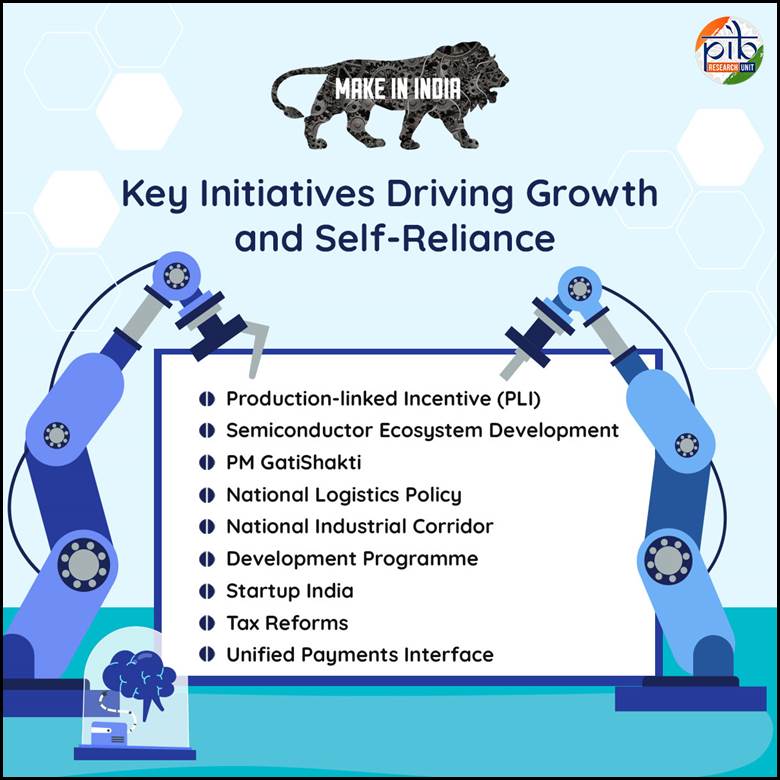
      "Make in India" initiative has been a cornerstone in transforming India into a global manufacturing hub. With a strong focus on enhancing industrial capabilities, fostering innovation, and creating world-class infrastructure, the initiative aims to position India as a key player in the global economy. Supported by major programs like Production Linked Incentive (PLI) Schemes, PM GatiShakti, the National Logistics Policy, and comprehensive tax reforms like the Goods and Services Tax (GST), "Make in India" continues to drive economic growth, job creation, and global competitiveness.
      Production linked Incentive (PLI) Schemes

      Aligned with India’s vision of becoming 'Atmanirbhar' (self-reliant), the Production Linked Incentive (PLI) Schemes were introduced to enhance the country’s manufacturing capabilities and boost exports. With an impressive outlay of ₹1.97 lakh crore (over US$26 billion), these schemes cover 14 key sectors aimed at fostering investment in cutting-edge technology and promoting global competitiveness.

      The 14 sectors covered under the PLI Scheme include:

      1. Mobile Manufacturing and Specified Electronic Components
      2. Critical Key Starting Materials/Drug Intermediaries & Active Pharmaceutical Ingredients
      3. Manufacturing of Medical Devices
      4. Automobiles and Auto Components
      5. Pharmaceuticals Drugs
      6. Specialty Steel
      7. Telecom & Networking Products
      8. Electronic/Technology Products
      9. White Goods (Air Conditioners and LEDs)
      10. Food Products
      11. Textile Products: MMF segment and technical textiles
      12. High Efficiency Solar PV Modules
      13. Advanced Chemistry Cell (ACC) Battery
      14. Drones and Drone Components\

      The primary goals of the PLI Schemes are to attract substantial investments, incorporate advanced technology, and ensure operational efficiency. By fostering economies of scale and enhancing global competitiveness, these schemes are expected to significantly boost production, stimulate manufacturing activities, and contribute to economic growth over the coming years.

      As of July 30, 2024, 755 applications have been approved across these sectors, leading to an investment realization of ₹1.23 lakh crore by March 2024. This investment has generated employment for approximately 8 lakh individuals, marking a significant stride towards achieving the objectives of the PLI Scheme.

      PM GatiShakti

      Launched on October 13, 2021, PM GatiShakti is a strategic initiative aimed at achieving Aatmanirbhar Bharat and a US $5 trillion economy by 2025 through the creation of multimodal and last-mile connectivity infrastructure. The program addresses the need for efficient transportation by promoting holistic planning and coordination among 36 Ministries/Departments, integrating progress, and synchronizing project implementation. By enhancing logistics efficiency and bridging critical infrastructure gaps, PM GatiShakti fosters a ‘whole of the government’ approach to transform India’s infrastructure landscape.

      PM GatiShakti is a transformative approach for economic growth and sustainable development. The approach is driven by 7 engines, namely:

      1. Railways
      2. Roads
      3. Ports
      4. Waterways
      5. Airports
      6. Mass Transport
      7. Logistics Infrastructure

      All 7 engines will pull forward the economy in unison. These engines are supported by the complementary roles of Energy Transmission, IT Communication, Bulk Water & Sewerage, and Social Infrastructure. The approach is powered by Clean Energy and Sabka Prayas – the efforts of the Central Government, the state governments, and the private sector together – leading to huge job and entrepreneurial opportunities for all, especially the youth.

      Semiconductor Ecosystem Development

      Recognizing the urgent need for a robust and comprehensive policy framework, the Union Cabinet approved the Semicon India programme in 2021, with a substantial financial outlay of INR 76,000 crore. This initiative is designed to foster the development of a sustainable semiconductor and display ecosystem in the country. The Semicon India Programme aims to provide a significant impetus to semiconductor and display manufacturing by facilitating capital support and promoting technological collaborations. Notably, India has crafted policies that support every segment of the semiconductor ecosystem, extending beyond just fabrication plants (fabs) to include packaging, display technologies, outsourced semiconductor assembly and testing (OSAT), sensors, and more.

      The Semicon India Programme encompasses four key schemes:

      1. Modified Scheme for Setting Up Semiconductor Fabs in India
      2. Modified Scheme for Setting Up Display Fabs in India
      3. Modified Scheme for Setting Up Compound Semiconductors, Silicon Photonics, Sensors Fabs, and Discrete Semiconductors, along with Semiconductor Assembly, Testing, Marking, and Packaging (ATMP) / OSAT Facilities in India
      4. Design Linked Incentive (DLI) Scheme

      India's semiconductor ecosystem has gained significant momentum, with several landmark projects receiving approval. Notably, the first major project with Micron was sanctioned for nearly Rs 22,000 crores. Additionally, Tata's joint venture with Taiwan’s Powerchip in Dholera stands out as a promising development. Currently, there are five such proposals, with a total combined investment nearing Rs 1.52 lakh crores, signalling a strong commitment to advancing India's position in the global semiconductor landscape.

      National Logistics Policy

      Launched on September 17, 2022, the National Logistics Policy (NLP) was introduced to complement the PM GatiShakti National Master Plan by focusing on enhancing the soft infrastructure of India’s logistics sector. The NLP aims to drive economic growth and competitiveness through an integrated, efficient, and sustainable logistics network by leveraging advanced technology, improved processes, and skilled manpower. Its targets include reducing logistics costs, improving India's Logistics Performance Index ranking to among the top 25 countries by 2030, and developing a data-driven decision support system. To meet these objectives, the Comprehensive Logistics Action Plan (CLAP) was rolled out, addressing key areas such as digital logistics systems, standardization, human resource development, state engagement, and logistics parks.

      Industrialization and Urbanization

      The National Industrial Corridor Development Programme is India's most ambitious infrastructure initiative, aiming to create "Smart Cities" and advanced industrial hubs. This program focuses on developing integrated industrial corridors with robust multi-modal connectivity, promoting growth in manufacturing and systematic urbanization. Recent cabinet approval of 12 new project proposals, involving an estimated ₹28,602 crore investment, marks a significant step in this transformative effort, positioning India as a leading global destination for manufacturing and investment.

      Startup India

      Launched on January 16, 2016, the Startup India Initiative has rolled out several programs aimed at supporting entrepreneurs, building a robust startup ecosystem, and transforming India into a country of job creators instead of job seekers. As of September 25, 2024, India boasts the third-largest startup ecosystem in the world, with 148,931 DPIIT Recognized Startups, which have created over 15.5 lakh direct jobs. This remarkable growth underscores the initiative's success in fostering innovation, enhancing employment opportunities, and driving economic development across the nation.

      Tax Reforms

      The implementation of the Goods and Services Tax (GST) on July 1, 2017, marked a significant step in India's tax reforms, especially in the context of the Make in India initiative. GST unified the country’s 36 states and union territories into a single common market, simplifying the tax structure and reducing the cascading effect of multiple taxes. This has lowered production costs, making local manufacturing more competitive. The GST rate on over 200 products was reduced from 28% to 18%, enhancing overall efficiency and productivity. The formation of the Goods & Services Tax Council has further ensured the smooth implementation of GST, boosting foreign direct investment by fostering a stable and business-friendly tax environment.

      Unified Payments Interface

      India's Unified Payments Interface (UPI) has emerged as a frontrunner in the global digital payments landscape, showcasing its remarkable capability to surpass the world's leading digital payments platforms. With an impressive 46% of the global real-time payment transactions occurring in India, UPI has firmly established itself as a significant player in this sector.

      In a striking demonstration of its growth, UPI processed nearly ₹81 lakh crore in transactions between April and July 2024 alone. This achievement not only highlights the robustness of UPI but also reflects the increasing trust and reliance on digital payment solutions among Indian consumers. The platform's user-friendly interface, combined with widespread acceptance across various sectors, has made it a cornerstone of India's digital economy, setting a benchmark for other countries to follow.

      Record FDI to Boost ‘Make in India’

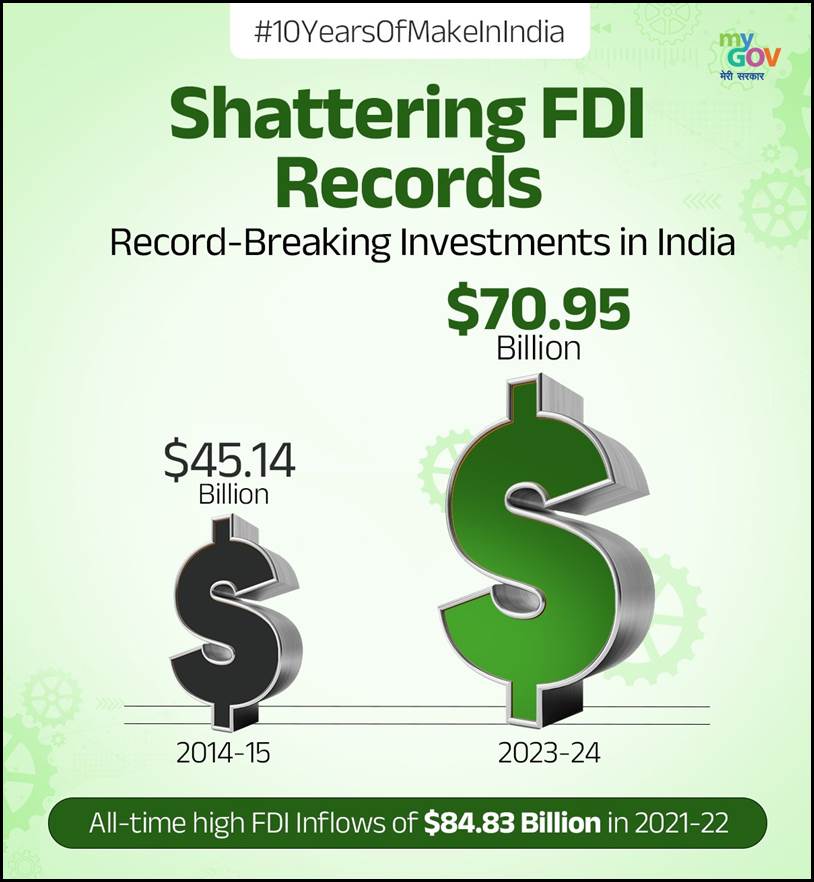
      The success of the Make in India initiative has been significantly bolstered by record-breaking Foreign Direct Investment (FDI) inflows, driven by the simplification of FDI rules and improvements in ease of doing business. India now ranks among the top 100 nations in the Ease of Doing Business (EoDB) index. FDI inflows have steadily risen, starting from $45.14 billion in 2014-15 to a record $84.83 billion in 2021-22. Between April 2014 and March 2024, India attracted $667.41 billion in FDI, representing nearly 67% of the total FDI received over the last 24 years. In FY 2023-24, total FDI inflows amounted to $70.95 billion, with equity inflows reaching $44.42 billion, underscoring India's growing appeal as a global investment destination.
      Image

      Ease of Doing Business

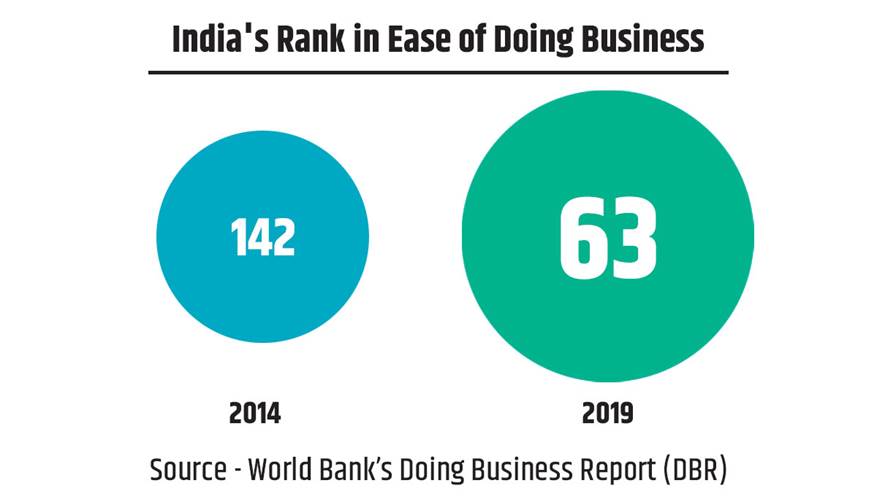
      India made remarkable progress in improving its business environment, climbing from 142nd in 2014 to 63rd in the World Bank’s Doing Business Report (DBR) 2020, published in October 2019 before its discontinuation. This 79-rank jump over five years reflects the government’s sustained efforts to simplify regulations, reduce bureaucratic hurdles, and create a more business-friendly environment, significantly boosting investor confidence and supporting the objectives of the Make in India initiative.
       Major Achievements under Make in India 

      1. Powered by indigenously produced vaccines, India not only achieved COVID-19 vaccination coverage in record time but also became a major exporter of much-needed life-saving vaccines to many developing and underdeveloped countries across the world. India supplies nearly 60% of the world's vaccines, meaning every second vaccine globally is proudly made in India.


      1. Vande Bharat Trains, India’s first indigenous semi-high-speed trains, are a shining example of the success of the 'Make in India' initiative. Featuring state-of-the-art coaches, these trains offer passengers a modern and enhanced travel experience. As of now, 102 Vande Bharat train services (51 trains) are operational across Indian Railways, connecting states with a Broad-Gauge electrified network and showcasing India's growing capability in advanced rail technology.


      1. India is achieving remarkable milestones in defence production, exemplified by the launch of INS Vikrant, the country's first domestically made aircraft carrier. This initiative is part of India's broader goal to reduce imports and become self-reliant (Atmanirbhar) in the defence sector. In 2023-24, defence production has soared to ₹1.27 lakh crore, with exports reaching over 90 countries, showcasing India's growing strength and capability in this critical area.


      1. India’s electronics sector has experienced rapid growth, reaching USD 155 billion in FY23. Production nearly doubled from USD 48 billion in FY17 to USD 101 billion in FY23, driven primarily by mobile phones, which now constitute 43% of total electronics production. India is the second-largest mobile manufacturer in the world and has significantly reduced its reliance on smartphone imports, now manufacturing 99% domestically.


      1. India recorded merchandise exports worth $437.06 billion in FY 2023-24, reflecting the country's growing role in global trade.


      1. Indian bicycles have gained international acclaim, with exports to the UK, Germany, and the Netherlands soaring. This surge highlights the global recognition of Indian engineering and design.


      1. 'Made in Bihar' boots are now part of the Russian Army’s equipment, marking a significant milestone for Indian products in the global defence market and showcasing the country’s high manufacturing standards.


      1. Kashmir willow bats have become a global favourite. Their popularity underscores India’s exceptional craftsmanship and influence in international cricket.


      1. Amul has expanded its presence by launching its dairy products in the US. This international venture reflects the global appeal of Indian Flavours and Amul’s role in promoting Indian dairy on the world stage.


      1. The textile industry has created a staggering 14.5 crore jobs across the country, significantly contributing to India's employment landscape.


      1. India produces an impressive 400 million toys annually, with 10 new toys being created every second.

      Conclusion

      In conclusion, as the "Make in India" initiative celebrates its 10th anniversary, it stands as a testament to India’s determination to reshape its manufacturing landscape and enhance its global standing. With strategic reforms, investment-friendly policies, and a strong focus on infrastructure development, the initiative has significantly enhanced India's industrial capabilities. The success of indigenous projects like the Vande Bharat trains and INS Vikrant, alongside record-breaking FDI inflows, reflects India's growing self-reliance and global competitiveness.

      The launch of the Semiconductor Ecosystem Development program and the remarkable growth of the Unified Payments Interface (UPI) further underscore India's commitment to innovation and technological advancement. As India moves forward with initiatives like the Production Linked Incentive (PLI) Scheme and PM GatiShakti, it is well on its way to achieving sustained economic growth, creating employment opportunities, and strengthening its position on the global stage. The future of India's manufacturing and industrial sectors looks promising, driven by innovation, infrastructure, and a renewed commitment to economic excellence.

      References:

      Topics

      ActsIncome Tax
