
Just a moment...

Top
Help
×

By creating an account you can:

Logo TaxTMI
>
Call Us / Help / Feedback

Contact Us At :

E-mail: [email protected]

Call / WhatsApp at: +91 99117 96707

For more information, Check Contact Us

FAQs :

To know Frequently Asked Questions, Check FAQs

Most Asked Video Tutorials :

For more tutorials, Check Video Tutorials

Submit Feedback/Suggestion :

Email :
Please provide your email address so we can follow up on your feedback.
Category :
Description :
Min 15 characters0/2000
Add to...
You have not created any category. Kindly create one to bookmark this item!
Create New Category
Hide
Title :
Description :
❮❮ Hide
Default View
Expand ❯❯
Close ✕
🔎 News - Adv. Search
TEXT SEARCH:

Press 'Enter' to add multiple search terms. Rules for Better Search

Search In:
Main Text + AI Text
  • Main Text
  • Main Text + AI Text
  • AI Text
Category: ?
Categorized by AI
---- All Categories ----
  • ---- All Categories ----
  • Income Tax
  • GST
  • Customs, DGFT & SEZ
  • FEMA & RBI
  • Corp. Laws, SEBI & IBC
  • PMLA, Black Money & ED
  • Budget
  • News and Press Release
  • PTI News
Month:
---- All Months ----
  • ---- All Months ----
  • January
  • February
  • March
  • April
  • May
  • June
  • July
  • August
  • September
  • October
  • November
  • December
Year:
---- All Years ----
  • ---- All Years ----
  • 2026
  • 2025
  • 2024
  • 2023
  • 2022
  • 2021
  • 2020
  • 2019
  • 2018
  • 2017
  • 2016
  • 2015
  • 2014
  • 2013
  • 2012
  • 2011
Sort By: ?
In Sort By 'Default', exact matches for text search are shown at the top, followed by the remaining results in their regular order.
RelevanceDefaultDate
    India successfully concludes the Tenth BRICS Industry Ministers' Meeting in Jaipur under its BRICS Chairship 2026
    APEDA Organises BIOFACH INDIA 2026 to Promote India's Certified Organic Products and Expand Global Market Access
    RBI bars banks from disabling mobile devices of defaulting borrowers
    Par panel for early conclusion of India-US trade pact, tariff exemptions on key goods
    No commitments relating to ethanol import from US for fuel blending under FTA talks: Govt
    No concession or commitment on import of Ethanol for fuel blending from the United States
    Office of the Controller General of Patents, Designs and Trade Marks Announces Tentative Schedule for Patent and Trade Marks Agent Examinations 2027 a...
    RBI invites comments on the draft “Reserve Bank of India (Non-Banking Financial Companies – Credit Facilities) Amendment Directions, 2026”
    West Bengal seeks 100pc foodgrain, 40pc sugar jute packaging quota at SAC meeting
    RBI clasifies Tata Sons, 16 others as large NBFCs
    Sensex climbs 374 points on buying in Reliance, ICICI Bank; Nifty ends flat
    Insurance Division, DFS Secures 3rd Rank in Group A Category of Grievance Redressal Assessment & Index (GRAI) for June 2026
    VKDL Group’s NPA Bazaar Strengthens India’s Distressed Asset Resolution Ecosystem Under the Leadership of V K Dubey
    Lok Sabha passes bill to authorise govt to permit banks to levy charges on UPI transactions
    Monetary Policy Statement, 2026-27 Resolution of the Monetary Policy Committee August 3 to 5, 2026
    Stock markets edged higher in early trade amid lower crude oil prices, buying in Reliance Industries
    Monthly review of accounts of Government of India upto June 2026 (FY 2026-27)
    DRI busts illegal drug manufacturing unit in Satara district in Maharashtra; two arrested
    CCI approves proposed combination inter alia involving share acquisition(s) and merger of certain entities e.g. AAPC India, Triguna, Caddie, SMPL, Tec...
    Rupee gains 20 paise to close at 95.08 against US dollar post-RBI policy decision
❯❯
MaximizeMaximizeMaximize
0 / 200
Expand Note
Add to Folder

No Folders have been created

    +

    Are you sure you want to delete "My most important" ?

    NOTE:

    News
    Showing Results for :
    Reset Filters
    Results Found:
    Show All SummariesHide All Summaries
    August 7, 2026
    Show AI Summary
    BRICS industrial cooperation advances MSME, photovoltaic, startup and logistics frameworks alongside resilient trade and digital services collaboration.
    BRICS industrial cooperation under PartNIR was strengthened through a Joint Declaration and institutional measures addressing MSMEs, photovoltaics, startup-led innovation, and resilient transport and logistics. The measures include an SME cooperation framework, Terms of Reference and an Action Plan for photovoltaic industry cooperation, and a startup innovation action plan. Trade discussions focused on the multilateral trading system, MSME participation in international trade, resilient global value chains, and cross-border digitally delivered services within a rules-based trading framework.
    August 7, 2026
    Show AI Summary
    Certified organic export promotion: BIOFACH INDIA facilitates buyer-seller engagement, certification awareness, traceability discussions and international market access.
    BIOFACH INDIA 2026 promotes certified organic exports by providing a platform for Indian organic enterprises to showcase diverse certified products and engage with overseas buyers through structured Buyer-Seller Meets. Technical sessions address organic certification, traceability, sustainability, quality standards, international regulatory requirements and export-market expectations. The initiative supports quality assurance, international market access, export linkages and sustainable agricultural practices across the organic value chain.
    August 6, 2026
    Show AI Summary
    Device-based loan recovery restrictions protect essential mobile functions while permitting gradual locking only for lender-financed devices.
    Technology-based recovery mechanisms cannot restrict or disable a borrower's mobile device unless the bank financed acquisition of that device. Where permitted, banks must adopt a gradual approach and preserve essential functions, including incoming calls, SMS access, and emergency SOS features. Regulated entities and service providers must obtain manufacturer or operating-system certification for device-locking technology. Disclosure of borrower or guarantor information to recovery personnel must be limited to what is necessary for loan-recovery duties.
    August 6, 2026
    Show AI Summary
    Bilateral trade agreement negotiations should secure tariff certainty, protect key exports, strengthen supply chains, and support vulnerable small industries.
    An early Bilateral Trade Agreement is proposed to protect Indian interests, secure tariff exemptions for key exports, reduce barriers affecting industrial products, and create predictable trade conditions. Recommended measures include financial and export-credit support for small industries, real-time monitoring of customs requirements, documentation assistance, and timely policy support against tariff and non-tariff barriers. Export strategy should develop knowledge services and critical supply-chain integration, while a National Fund should assist suppliers with redesign, tooling, certification and entry into new global supply chains.
    August 6, 2026
    Show AI Summary
    Ethanol imports for fuel blending remain excluded from trade commitments, with domestic producers continuing to supply the blending programme.
    Ethanol imports for fuel blending remain outside concessions or commitments in India-US trade discussions. Under the Ethanol Blended with Petrol Programme, ethanol procurement is governed solely by domestic policy requirements and is sourced entirely from domestic producers. Claims of existing or intended large-scale ethanol imports from the United States for fuel blending, or of a policy change permitting them, are stated to be baseless.
    August 6, 2026
    Show AI Summary
    Domestic ethanol sourcing for fuel blending continues unchanged, with no import commitments or concessions involving United States ethanol.
    Ethanol used for fuel blending under the Ethanol Blended with Petrol Programme is sourced entirely from domestic producers, with no imports from the United States for that purpose. No concessions or commitments on importing United States ethanol for fuel blending have been made in trade discussions. Fuel blending and ethanol procurement continue to be governed solely by domestic policy requirements, and claims of a policy change allowing large-scale imports are incorrect.
    August 6, 2026
    Show AI Summary
    Patent and trade marks agent qualification examinations require written-paper minimums, aggregate passing scores, and viva voce assessment for registration.
    Patent and trade marks agent examinations comprise an objective Paper I, a descriptive Paper II and a viva voce assessing suitability to practise before the Intellectual Property Office. Candidates must secure the stipulated minimum marks in each written paper and the required aggregate score to pass. Registration in the relevant Register of Patent Agents or Register of Trade Marks Agents is available only to candidates who satisfy all prescribed eligibility conditions and qualify the examination.
    August 6, 2026
    Show AI Summary
    Draft NBFC credit-facilities amendments open for stakeholder consultation through designated online and email feedback channels.
    Draft amendments to the Non-Banking Financial Companies credit-facilities framework have been released for public consultation. Regulated entities and other interested stakeholders may submit comments or feedback through the 'Connect 2 Regulate' platform or by email using the specified subject line.
    August 6, 2026
    Show AI Summary
    Mandatory jute packaging reservations were urged to protect cultivators, mill workers, crop absorption, and environmentally sustainable packaging.
    Mandatory jute packaging reservations were sought to be retained at full coverage for foodgrains and increased for sugar packaging for the forthcoming Jute Year. The submission before the Standing Advisory Committee emphasised absorption of bumper jute output, remunerative prices for cultivators, uninterrupted mill operations, and protection of farm and worker livelihoods. It also stressed that biodegradable jute bags offer an environmentally friendly alternative to HDPE and polypropylene woven sacks, and that dilution of compulsory packaging could undermine plastic-pollution reduction efforts.
    August 6, 2026
    Show AI Summary
    NBFC Upper Layer classification imposes enhanced regulation and listing obligations, while de-registration applications remain under examination.
    NBFC Upper Layer classification subjects identified large non-banking financial companies to enhanced regulatory requirements for at least five years and requires stock-exchange listing within three years of identification. The framework divides NBFCs into Base, Middle, Upper and Top Layers. Seventeen large NBFCs were included in the Upper Layer list, while Tata Sons' classification remains subject to the pending examination of its de-registration application.
    August 6, 2026
    Show AI Summary
    Closing auction price discovery may affect benchmark levels differently based on constituent liquidity and concentrated institutional order flow.
    The Closing Auction Session in the equity cash segment uses an auction-based method to determine closing prices of eligible shares with futures and options contracts, aiming to strengthen transparent and robust price discovery. Its effect on benchmark closing levels may differ according to constituent liquidity and institutional order flow. The Reserve Bank of India retained the policy repo rate and neutral stance, indicating that future policy decisions will be data-dependent and influenced by assessment of energy-cost effects on inflation.
    August 6, 2026
    Show AI Summary
    Public grievance redressal strengthens through monitoring, senior review, workshops, stakeholder coordination, and customer-centric service delivery improvements.
    Public grievance redressal is assessed through the Grievance Redressal Assessment and Index, which analyses grievance categories and disposal. The Department of Financial Services' Insurance and Banking Divisions received third and sixth ranks respectively in the June 2026 assessment. Its framework includes disposal of grievances, random reviews by senior officials, and workshops on effective grievance redressal, supporting best practices, stakeholder coordination, technology use, customer-centric service, and accountable public service delivery.
    August 6, 2026
    Show AI Summary
    Distressed asset resolution integrates restructuring, insolvency advisory, funding facilitation and digital marketplaces for transparent financial recovery transactions.
    The platform provides integrated advisory, management and transaction-facilitation services for Non-Performing Assets, stressed assets and distressed assets. Its services include NPA resolution, debt restructuring, One-Time Settlements, funding assistance, insolvency and bankruptcy advisory, asset reconstruction, financial restructuring and capital raising. Digital and offline marketplaces facilitate transactions involving distressed assets, receivables and related movable or immovable properties, supported by collaborations with banks, Non-Banking Financial Companies, Asset Reconstruction Companies, corporates and investors.
    August 6, 2026
    Show AI Summary
    Merchant discount rate framework may permit charges on notified UPI and digital payments through a government notification mechanism.
    The proposed amendment to Section 10A of the Payment and Settlement Systems Act, 2007 replaces the existing income-tax-linked reference with a Central Government notification-based mechanism for electronic payment modes. It removes the current statutory restriction preventing banks and payment service providers from charging Merchant Discount Rate on notified modes, enabling the Government to permit charges for UPI and other digital payments. The policy rationale is to support funding for payment infrastructure and a sustainable revenue model for service providers.
    August 6, 2026
    Show AI Summary
    Neutral monetary policy stance continues as resilient growth and food-fuel inflation risks require close macroeconomic monitoring.
    The Monetary Policy Committee retained the policy repo rate and continued the neutral monetary policy stance, citing the need to assess evolving growth-inflation conditions. Domestic activity was assessed as resilient, supported by consumption, investment, credit, manufacturing, services and exports, although global uncertainty, energy prices, supply-chain pressures, geopolitical developments and monsoon conditions remain risks. CPI inflation increased mainly because of food and fuel pressures, while underlying inflation remained moderate. The Committee considered that price pressures were not yet generalised and reaffirmed its commitment to align inflation with the target.
    August 6, 2026
    Show AI Summary
    Closing auction price discovery and a neutral monetary policy stance shaped equity market conditions amid lower crude prices.
    The Closing Auction Session in the equity cash segment introduced an auction-based mechanism for determining closing prices of eligible shares with futures and options contracts, intended to make price discovery more transparent and robust. The Reserve Bank of India retained its neutral stance and left the benchmark policy rate unchanged, pending greater clarity on the inflationary effects of higher energy costs. Future policy decisions were stated to be data dependent.
    August 6, 2026
    Show AI Summary
    Monthly public accounts review records receipts, expenditure, tax devolution, interest payments, subsidies, and capital spending through June.
    Consolidated monthly accounts up to June 2026 report total receipts of Rs.10,49,243 crore, comprising net tax revenue, non-tax revenue and non-debt capital receipts. Tax devolution transfers to State Governments total Rs.2,63,336 crore. Total expenditure is Rs.13,57,076 crore, including revenue expenditure of Rs.10,16,818 crore and capital expenditure of Rs.3,40,258 crore. Revenue expenditure includes interest payments and major subsidies.
    August 6, 2026
    Show AI Summary
    Illicit psychotropic drug manufacture triggered seizure, apprehensions, and investigation into planned trafficking under narcotics control law.
    Illicit manufacture and trafficking of Alprazolam and Diazepam, psychotropic substances regulated under the Narcotic Drugs and Psychotropic Substances Act, 1985, were detected at a clandestine facility. Searches recovered finished and intermediary substances, together with raw materials and reaction mixtures used in manufacture, and the goods were seized under the Act. The manufacturer and an intended buyer were apprehended, with material indicating a proposed transaction for further illicit trafficking. Preliminary investigation indicated prior involvement in illegal drug production and trafficking.
    August 6, 2026
    Show AI Summary
    Competition approval for hotel-sector consolidation covers share acquisitions and merger of Accor-branded hotel entities into InterGlobe Hotels.
    Competition approval was granted for related share acquisitions and the merger of AAPC India, Caddie, Triguna, Srilanand Mansions, Techpark and Accent into InterGlobe Hotels. The combination involves entities jointly controlled by the Bhatia Family Group and the Accor Group, including hotel-owning and developing entities, hotel management and franchising operations, leasing activities, and captive consultancy and support services relating to Accor-branded hotels in India.
    August 5, 2026
    Show AI Summary
    Rupee appreciation followed unchanged monetary policy, lower crude prices, weaker dollar and expectations of orderly exchange-rate management.
    The rupee strengthened after the central bank maintained its policy rate and neutral monetary-policy stance. Lower crude oil prices, a weaker US dollar and declining US Treasury yields supported investor sentiment. Earlier measures to attract capital inflows remained part of the framework supporting the rupee, while the central bank stressed its endeavour to preserve an orderly currency trajectory. Future movement was linked to geopolitical de-escalation, global risk sentiment and US economic data.

    News

    Back

    All News

    Showing Results for :
    Reset Filters
      No Records Found

      News

      Back

      All News

      whatsappJoin Channel
      Showing Results for : Reset Filters
      News and Press Release

      10 Years of Make in India

      September 26, 2024

      Contents
      Summary
      Note

      Note

      -

      Bookmark

      Print

      Print

      Transforming India into a Global Manufacturing PowerhouseIntroduction

      Launched on September 25, 2014, by Prime Minister Narendra Modi, the "Make in India" initiative is completing 10 years as a pivotal step in India's nation-building efforts. On the occasion, Prime Minister Shri Narendra Modi expressed in his blog that “Today is an occasion to salute each and every one of you who has made this initiative a roaring success. Each of you is a pioneer, visionary and innovator, whose tireless efforts have fuelled the success of ‘Make in India’ and thereby made our nation the focus of global attention as well as curiosity. It is the collective drive, relentless in nature, which has transformed a dream into a powerful movement. The impact of ‘Make in India’ shows that Bharat is unstoppable.”

      Union Minister of Commerce and Industry, Shri Piyush Goyal, celebrated the 10th anniversary of the "Make in India" initiative, noting significant progress in manufacturing, increased investments, and job creation. He pointed to improvements in ease of doing business, driven by digitization and procedural simplifications, and emphasized India's rise as the world's second-largest mobile phone manufacturer. The minister credited zero tolerance for corruption and targeted sectoral efforts for attracting both domestic and international investments. Looking ahead, he expressed confidence in further growth in the manufacturing sector and its contribution to the economy. He said "We are seeing very big investment plans on the anvil which will create millions of jobs and expand our manufacturing contribution to the economy."

      The initiative was conceived during a period when India's economic growth had sharply declined, and the country faced critical challenges in sustaining its development trajectory. Against this backdrop, "Make in India" was designed to transform India into a global hub for design and manufacturing. Its core objectives were to facilitate investment, encourage innovation, and develop world-class infrastructure. As one of the pioneering 'Vocal for Local' initiatives, it sought not only to boost India's manufacturing capabilities but also to showcase its industrial potential on a global stage.

      The initiative’s focus on developing a robust manufacturing sector promises to elevate India's economic trajectory and generate employment opportunities for its vast young workforce. Now, with the "Make in India 2.0" phase encompassing 27 sectors, the program continues to drive forward with significant achievements and renewed vigour, reinforcing India's position as a major player in the global manufacturing landscape.
      Sectors Under ‘Make in India’ Initiative 

      Manufacturing Sectors

      Service Sectors

      Aerospace and Defence

      Information Technology & Information Technology enabled Services (IT &ITeS)

      Automotive and Auto Components

      Tourism and Hospitality Services

      Pharmaceuticals and Medical Devices

      Medical Value Travel

      Bio-Technology

      Transport and Logistics Services

      Capital Goods

      Accounting and Finance Services

      Textile and Apparels

      Audio Visual Services

      Chemicals and Petro chemicals

      Legal Services

      Electronics System Design and Manufacturing (ESDM)

      Communication Services

      Leather & Footwear

      Construction and Related Engineering Services

      Food Processing

      Environmental Services

      Gems and Jewellery

      Financial Services

      Shipping

      Education Services

      Railways


      Construction


      New and Renewable Energy


      Pillars of ‘Make in India’

      1. New Processes: The "Make in India" initiative identified 'ease of doing business' as a crucial factor for promoting entrepreneurship. Several measures were implemented to enhance the business environment, making it more conducive for startups and established enterprises alike.


      1. New Infrastructure: The government focused on developing industrial corridors and smart cities, integrating state-of-the-art technology and high-speed communication to create world-class infrastructure. Innovation and research were supported through streamlined registration systems and improved intellectual property rights (IPR) infrastructure. Efforts were made to identify industry skill requirements and develop the workforce accordingly.


      1. New Sectors: Foreign Direct Investment (FDI) was significantly opened up in various sectors including Defence Production, Insurance, Medical Devices, Construction, and Railway infrastructure. This expansion also included easing FDI regulations in Insurance and Medical Devices, encouraging international investment and growth.


      1. New Mindset: The government embraced a role as a facilitator rather than a regulator, partnering with industry to drive the country’s economic development. This shift aimed to foster a collaborative environment that supported industrial growth and innovation.


      Major Initiatives Taken to Enable Make in India

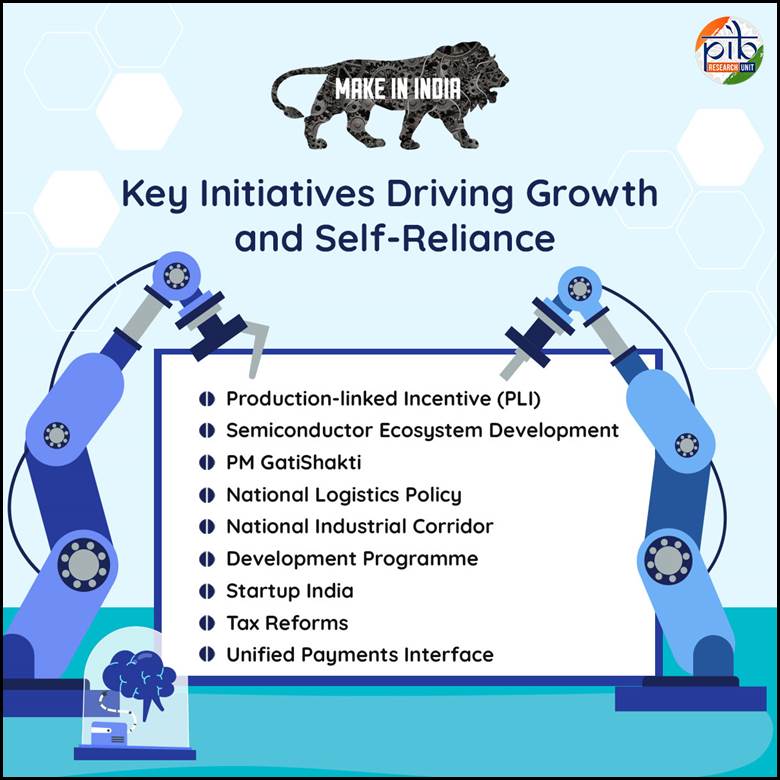
      "Make in India" initiative has been a cornerstone in transforming India into a global manufacturing hub. With a strong focus on enhancing industrial capabilities, fostering innovation, and creating world-class infrastructure, the initiative aims to position India as a key player in the global economy. Supported by major programs like Production Linked Incentive (PLI) Schemes, PM GatiShakti, the National Logistics Policy, and comprehensive tax reforms like the Goods and Services Tax (GST), "Make in India" continues to drive economic growth, job creation, and global competitiveness.
      Production linked Incentive (PLI) Schemes

      Aligned with India’s vision of becoming 'Atmanirbhar' (self-reliant), the Production Linked Incentive (PLI) Schemes were introduced to enhance the country’s manufacturing capabilities and boost exports. With an impressive outlay of ₹1.97 lakh crore (over US$26 billion), these schemes cover 14 key sectors aimed at fostering investment in cutting-edge technology and promoting global competitiveness.

      The 14 sectors covered under the PLI Scheme include:

      1. Mobile Manufacturing and Specified Electronic Components
      2. Critical Key Starting Materials/Drug Intermediaries & Active Pharmaceutical Ingredients
      3. Manufacturing of Medical Devices
      4. Automobiles and Auto Components
      5. Pharmaceuticals Drugs
      6. Specialty Steel
      7. Telecom & Networking Products
      8. Electronic/Technology Products
      9. White Goods (Air Conditioners and LEDs)
      10. Food Products
      11. Textile Products: MMF segment and technical textiles
      12. High Efficiency Solar PV Modules
      13. Advanced Chemistry Cell (ACC) Battery
      14. Drones and Drone Components\

      The primary goals of the PLI Schemes are to attract substantial investments, incorporate advanced technology, and ensure operational efficiency. By fostering economies of scale and enhancing global competitiveness, these schemes are expected to significantly boost production, stimulate manufacturing activities, and contribute to economic growth over the coming years.

      As of July 30, 2024, 755 applications have been approved across these sectors, leading to an investment realization of ₹1.23 lakh crore by March 2024. This investment has generated employment for approximately 8 lakh individuals, marking a significant stride towards achieving the objectives of the PLI Scheme.

      PM GatiShakti

      Launched on October 13, 2021, PM GatiShakti is a strategic initiative aimed at achieving Aatmanirbhar Bharat and a US $5 trillion economy by 2025 through the creation of multimodal and last-mile connectivity infrastructure. The program addresses the need for efficient transportation by promoting holistic planning and coordination among 36 Ministries/Departments, integrating progress, and synchronizing project implementation. By enhancing logistics efficiency and bridging critical infrastructure gaps, PM GatiShakti fosters a ‘whole of the government’ approach to transform India’s infrastructure landscape.

      PM GatiShakti is a transformative approach for economic growth and sustainable development. The approach is driven by 7 engines, namely:

      1. Railways
      2. Roads
      3. Ports
      4. Waterways
      5. Airports
      6. Mass Transport
      7. Logistics Infrastructure

      All 7 engines will pull forward the economy in unison. These engines are supported by the complementary roles of Energy Transmission, IT Communication, Bulk Water & Sewerage, and Social Infrastructure. The approach is powered by Clean Energy and Sabka Prayas – the efforts of the Central Government, the state governments, and the private sector together – leading to huge job and entrepreneurial opportunities for all, especially the youth.

      Semiconductor Ecosystem Development

      Recognizing the urgent need for a robust and comprehensive policy framework, the Union Cabinet approved the Semicon India programme in 2021, with a substantial financial outlay of INR 76,000 crore. This initiative is designed to foster the development of a sustainable semiconductor and display ecosystem in the country. The Semicon India Programme aims to provide a significant impetus to semiconductor and display manufacturing by facilitating capital support and promoting technological collaborations. Notably, India has crafted policies that support every segment of the semiconductor ecosystem, extending beyond just fabrication plants (fabs) to include packaging, display technologies, outsourced semiconductor assembly and testing (OSAT), sensors, and more.

      The Semicon India Programme encompasses four key schemes:

      1. Modified Scheme for Setting Up Semiconductor Fabs in India
      2. Modified Scheme for Setting Up Display Fabs in India
      3. Modified Scheme for Setting Up Compound Semiconductors, Silicon Photonics, Sensors Fabs, and Discrete Semiconductors, along with Semiconductor Assembly, Testing, Marking, and Packaging (ATMP) / OSAT Facilities in India
      4. Design Linked Incentive (DLI) Scheme

      India's semiconductor ecosystem has gained significant momentum, with several landmark projects receiving approval. Notably, the first major project with Micron was sanctioned for nearly Rs 22,000 crores. Additionally, Tata's joint venture with Taiwan’s Powerchip in Dholera stands out as a promising development. Currently, there are five such proposals, with a total combined investment nearing Rs 1.52 lakh crores, signalling a strong commitment to advancing India's position in the global semiconductor landscape.

      National Logistics Policy

      Launched on September 17, 2022, the National Logistics Policy (NLP) was introduced to complement the PM GatiShakti National Master Plan by focusing on enhancing the soft infrastructure of India’s logistics sector. The NLP aims to drive economic growth and competitiveness through an integrated, efficient, and sustainable logistics network by leveraging advanced technology, improved processes, and skilled manpower. Its targets include reducing logistics costs, improving India's Logistics Performance Index ranking to among the top 25 countries by 2030, and developing a data-driven decision support system. To meet these objectives, the Comprehensive Logistics Action Plan (CLAP) was rolled out, addressing key areas such as digital logistics systems, standardization, human resource development, state engagement, and logistics parks.

      Industrialization and Urbanization

      The National Industrial Corridor Development Programme is India's most ambitious infrastructure initiative, aiming to create "Smart Cities" and advanced industrial hubs. This program focuses on developing integrated industrial corridors with robust multi-modal connectivity, promoting growth in manufacturing and systematic urbanization. Recent cabinet approval of 12 new project proposals, involving an estimated ₹28,602 crore investment, marks a significant step in this transformative effort, positioning India as a leading global destination for manufacturing and investment.

      Startup India

      Launched on January 16, 2016, the Startup India Initiative has rolled out several programs aimed at supporting entrepreneurs, building a robust startup ecosystem, and transforming India into a country of job creators instead of job seekers. As of September 25, 2024, India boasts the third-largest startup ecosystem in the world, with 148,931 DPIIT Recognized Startups, which have created over 15.5 lakh direct jobs. This remarkable growth underscores the initiative's success in fostering innovation, enhancing employment opportunities, and driving economic development across the nation.

      Tax Reforms

      The implementation of the Goods and Services Tax (GST) on July 1, 2017, marked a significant step in India's tax reforms, especially in the context of the Make in India initiative. GST unified the country’s 36 states and union territories into a single common market, simplifying the tax structure and reducing the cascading effect of multiple taxes. This has lowered production costs, making local manufacturing more competitive. The GST rate on over 200 products was reduced from 28% to 18%, enhancing overall efficiency and productivity. The formation of the Goods & Services Tax Council has further ensured the smooth implementation of GST, boosting foreign direct investment by fostering a stable and business-friendly tax environment.

      Unified Payments Interface

      India's Unified Payments Interface (UPI) has emerged as a frontrunner in the global digital payments landscape, showcasing its remarkable capability to surpass the world's leading digital payments platforms. With an impressive 46% of the global real-time payment transactions occurring in India, UPI has firmly established itself as a significant player in this sector.

      In a striking demonstration of its growth, UPI processed nearly ₹81 lakh crore in transactions between April and July 2024 alone. This achievement not only highlights the robustness of UPI but also reflects the increasing trust and reliance on digital payment solutions among Indian consumers. The platform's user-friendly interface, combined with widespread acceptance across various sectors, has made it a cornerstone of India's digital economy, setting a benchmark for other countries to follow.

      Record FDI to Boost ‘Make in India’

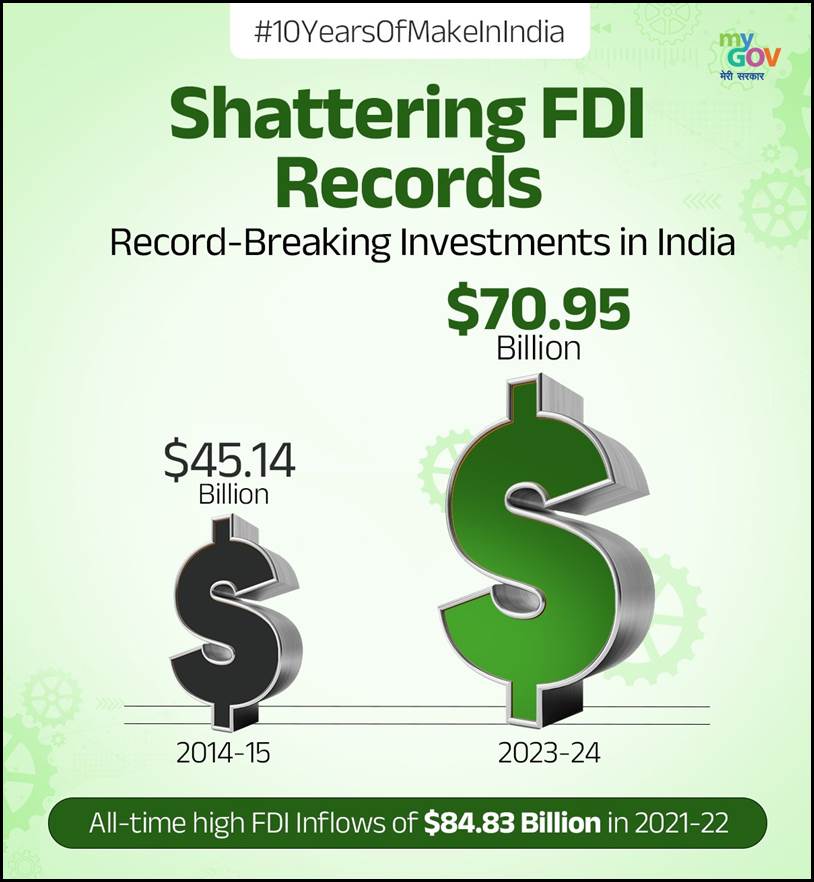
      The success of the Make in India initiative has been significantly bolstered by record-breaking Foreign Direct Investment (FDI) inflows, driven by the simplification of FDI rules and improvements in ease of doing business. India now ranks among the top 100 nations in the Ease of Doing Business (EoDB) index. FDI inflows have steadily risen, starting from $45.14 billion in 2014-15 to a record $84.83 billion in 2021-22. Between April 2014 and March 2024, India attracted $667.41 billion in FDI, representing nearly 67% of the total FDI received over the last 24 years. In FY 2023-24, total FDI inflows amounted to $70.95 billion, with equity inflows reaching $44.42 billion, underscoring India's growing appeal as a global investment destination.
      Image

      Ease of Doing Business

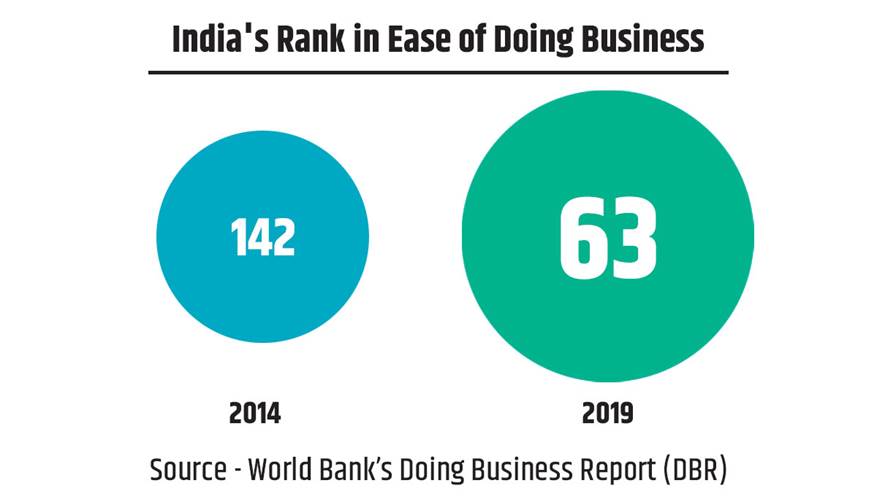
      India made remarkable progress in improving its business environment, climbing from 142nd in 2014 to 63rd in the World Bank’s Doing Business Report (DBR) 2020, published in October 2019 before its discontinuation. This 79-rank jump over five years reflects the government’s sustained efforts to simplify regulations, reduce bureaucratic hurdles, and create a more business-friendly environment, significantly boosting investor confidence and supporting the objectives of the Make in India initiative.
       Major Achievements under Make in India 

      1. Powered by indigenously produced vaccines, India not only achieved COVID-19 vaccination coverage in record time but also became a major exporter of much-needed life-saving vaccines to many developing and underdeveloped countries across the world. India supplies nearly 60% of the world's vaccines, meaning every second vaccine globally is proudly made in India.


      1. Vande Bharat Trains, India’s first indigenous semi-high-speed trains, are a shining example of the success of the 'Make in India' initiative. Featuring state-of-the-art coaches, these trains offer passengers a modern and enhanced travel experience. As of now, 102 Vande Bharat train services (51 trains) are operational across Indian Railways, connecting states with a Broad-Gauge electrified network and showcasing India's growing capability in advanced rail technology.


      1. India is achieving remarkable milestones in defence production, exemplified by the launch of INS Vikrant, the country's first domestically made aircraft carrier. This initiative is part of India's broader goal to reduce imports and become self-reliant (Atmanirbhar) in the defence sector. In 2023-24, defence production has soared to ₹1.27 lakh crore, with exports reaching over 90 countries, showcasing India's growing strength and capability in this critical area.


      1. India’s electronics sector has experienced rapid growth, reaching USD 155 billion in FY23. Production nearly doubled from USD 48 billion in FY17 to USD 101 billion in FY23, driven primarily by mobile phones, which now constitute 43% of total electronics production. India is the second-largest mobile manufacturer in the world and has significantly reduced its reliance on smartphone imports, now manufacturing 99% domestically.


      1. India recorded merchandise exports worth $437.06 billion in FY 2023-24, reflecting the country's growing role in global trade.


      1. Indian bicycles have gained international acclaim, with exports to the UK, Germany, and the Netherlands soaring. This surge highlights the global recognition of Indian engineering and design.


      1. 'Made in Bihar' boots are now part of the Russian Army’s equipment, marking a significant milestone for Indian products in the global defence market and showcasing the country’s high manufacturing standards.


      1. Kashmir willow bats have become a global favourite. Their popularity underscores India’s exceptional craftsmanship and influence in international cricket.


      1. Amul has expanded its presence by launching its dairy products in the US. This international venture reflects the global appeal of Indian Flavours and Amul’s role in promoting Indian dairy on the world stage.


      1. The textile industry has created a staggering 14.5 crore jobs across the country, significantly contributing to India's employment landscape.


      1. India produces an impressive 400 million toys annually, with 10 new toys being created every second.

      Conclusion

      In conclusion, as the "Make in India" initiative celebrates its 10th anniversary, it stands as a testament to India’s determination to reshape its manufacturing landscape and enhance its global standing. With strategic reforms, investment-friendly policies, and a strong focus on infrastructure development, the initiative has significantly enhanced India's industrial capabilities. The success of indigenous projects like the Vande Bharat trains and INS Vikrant, alongside record-breaking FDI inflows, reflects India's growing self-reliance and global competitiveness.

      The launch of the Semiconductor Ecosystem Development program and the remarkable growth of the Unified Payments Interface (UPI) further underscore India's commitment to innovation and technological advancement. As India moves forward with initiatives like the Production Linked Incentive (PLI) Scheme and PM GatiShakti, it is well on its way to achieving sustained economic growth, creating employment opportunities, and strengthening its position on the global stage. The future of India's manufacturing and industrial sectors looks promising, driven by innovation, infrastructure, and a renewed commitment to economic excellence.

      References:

      Topics

      ActsIncome Tax
