

Loading...

Top
Help
×

By creating an account you can:

Logo TaxTMI
Call Us / Help / Feedback

Contact Us At :

E-mail: [email protected]

Call / WhatsApp at: +91 99117 96707

For more information, Check Contact Us

FAQs :

To know Frequently Asked Questions, Check FAQs

Most Asked Video Tutorials :

For more tutorials, Check Video Tutorials

Submit Feedback/Suggestion :

Email :
Please provide your email address so we can follow up on your feedback.
Category :
Description :
Min 15 characters 0/2000
Make Most of Text Search
  1. Checkout this video tutorial: How to search effectively on TaxTMI.
  2. Put words in double quotes for exact word search, eg: "income tax"
  3. Avoid noise words such as : 'and, of, the, a'
  4. Sort by Relevance to get the most relevant document.
  5. Press Enter to add multiple terms/multiple phrases, and then click on Search to Search.
  6. Text Search
  7. The system will try to fetch results that contains ALL your words.
  8. Once you add keywords, you'll see a new 'Search In' filter that makes your results even more precise.
  9. Text Search
Add to...
You have not created any category. Kindly create one to bookmark this item!
Create New Category
Hide
Title :
Description :
❮❮ Hide
Default View
Expand ❯❯
Close ✕
🔎 News - Adv. Search
TEXT SEARCH:

Press 'Enter' to add multiple search terms. Rules for Better Search

Search In:
Main Text + AI Text
  • Main Text
  • Main Text + AI Text
  • AI Text
Category: ?
Categorized by AI
---- All Categories ----
  • ---- All Categories ----
  • Income Tax
  • GST
  • Customs, DGFT & SEZ
  • FEMA & RBI
  • Corp. Laws, SEBI & IBC
  • PMLA, Black Money & ED
  • Budget
  • News and Press Release
  • PTI News
Month:
---- All Months ----
  • ---- All Months ----
  • January
  • February
  • March
  • April
  • May
  • June
  • July
  • August
  • September
  • October
  • November
  • December
Year:
---- All Years ----
  • ---- All Years ----
  • 2026
  • 2025
  • 2024
  • 2023
  • 2022
  • 2021
  • 2020
  • 2019
  • 2018
  • 2017
  • 2016
  • 2015
  • 2014
  • 2013
  • 2012
  • 2011
Sort By: ?
In Sort By 'Default', exact matches for text search are shown at the top, followed by the remaining results in their regular order.
Relevance Default Date
❯❯
Maximize Maximize Maximize
0 / 200
Expand Note
Add to Folder

No Folders have been created

+

Are you sure you want to delete "My most important" ?

NOTE:

News
Showing Results for :
Reset Filters
Results Found:
Show All Summaries Hide All Summaries
September 1, 2026
Show AI Summary
Windfall gains tax on petroleum exports rises for petrol and diesel while aviation turbine fuel levy is reduced.
Special additional excise duty and road and infrastructure cess on petroleum-product exports are revised with effect from 1 September 2026. The export duty on diesel is increased, the levy on aviation turbine fuel is marginally reduced, and a duty is imposed on petrol exports. Existing duty rates for petrol and diesel cleared for domestic consumption remain unchanged. The windfall-tax framework seeks to support domestic fuel availability and deter exporters from benefiting from domestic and international price differences.
September 1, 2026
Show AI Summary
Automated Free Sale and Commerce Certificate issuance reduces manual scrutiny while preserving risk-based review for eligible exporters.
DGFT has enabled automated issuance of Free Sale and Commerce Certificates through its portal for eligible exporters of items not covered by the Drugs & Cosmetics Act, 1940. Applications satisfying prevailing framework and automated processing parameters may be issued without manual scrutiny. Applications requiring verification or not meeting those parameters may be routed for manual processing, while auto-approved applications may be flagged later for risk-based review. The mechanism seeks faster, more transparent and predictable processing while retaining necessary oversight.
September 1, 2026
Show AI Summary
Five-day banking and equitable performance incentives drive planned nationwide bank union strike amid unresolved pension demands.
United Forum of Bank Unions has proposed nationwide strike action over delayed five-day banking, the performance-linked incentive framework, and unresolved pension demands. Five-day banking was agreed under the 12th Bipartite Settlement/9th Joint Note with extended Monday-to-Friday working hours, but remains pending for implementation. Unions challenge the incentive scheme for departing from a uniform, bank-performance-linked approach and for disproportionately benefiting senior officers. The dispute is under conciliation and pending before the Delhi High Court, while pension updation, a uniform dearness allowance formula, and an old pension scheme option remain unresolved.
September 1, 2026
Show AI Summary
Equity market volatility intensified as higher crude prices, geopolitical tensions and tighter monetary expectations weakened domestic investor sentiment.
Indian equity markets closed marginally lower as higher crude oil prices, US-Iran tensions, and expectations of prolonged tight United States monetary policy weakened risk appetite. The phased Closing Auction Session contributed to a late recovery in the benchmark index. Rising crude prices and global bond yields triggered broad-based selling across several domestic sectors, while foreign institutional equity sales and weakness in overseas markets added to pressure despite stronger-than-expected domestic economic growth.
September 1, 2026
Show AI Summary
GST revenue collections show higher gross and net receipts alongside increased refunds and state-level settlement data.
GST revenue collections for August 2026 recorded total gross GST revenue of Rs. 1,99,853 crore, reflecting 14.8% growth over August 2025. Total refunds were Rs. 31,795 crore, including domestic refunds and export IGST refunds processed through ICEGATE. After adjustment of refunds, total net GST revenue was Rs. 1,68,057 crore, representing 8.3% growth. SGST collections and the SGST component of IGST settlement were separately identified for States and Union Territories, with post-settlement SGST aggregating Rs. 95,531 crore.
September 1, 2026
Show AI Summary
Trade facilitation and customs preparedness feature in AILBIEA's Silver Jubilee knowledge conference on liquid bulk commerce.
AILBIEA's Silver Jubilee programme focuses on trade facilitation, customs modernisation, GST dispute preparedness and maritime-risk issues affecting liquid bulk trade. The Knowledge Conference includes sessions on the Authorised Economic Operator advantage, next-generation customs technology, GST Appellate Tribunal-era dispute preparedness, and geopolitical risks to sea-borne trade. It also marks the launch of AGS 360, integrating port information, vessel tracking, port-call estimates and maritime intelligence.
September 1, 2026
Show AI Summary
Personal guarantor insolvency: repayment plan stayed pending majority determination, with restraint on direct or indirect asset alienation.
Personal-guarantee insolvency proceedings involve a stay on implementation of a repayment plan because the earlier members' views did not produce a clear majority capable of taking effect. The personal guarantor has been restrained from directly or indirectly alienating assets pending further hearing. The dispute follows split views on approval of the plan, claim admission and voting, followed by a third-member opinion that did not resolve the absence of a determinative majority. Creditors dispute the proposed recovery, claim treatment and declared net worth relevant to the guarantees.
September 1, 2026
Show AI Summary
Rupee exchange-rate movement reflects portfolio inflows, growth data and possible central-bank support, while crude oil prices constrain gains.
Foreign-exchange market conditions strengthened the rupee by 28 paise to 94.94 against the US dollar, supported by domestic growth, controlled fiscal slippage and portfolio inflows. Possible Reserve Bank of India intervention was also identified as supportive. Higher crude oil prices, weak domestic equities and hawkish US monetary-policy signals were identified as constraints on further appreciation. Foreign investment flows, stronger-than-expected domestic growth and the fiscal-deficit position remained material factors affecting currency conditions.
September 1, 2026
Show AI Summary
Money-laundering probe into public service recruitment irregularities examines alleged question-paper leaks, selection manipulation, and laundering through purported CSR donations.
Money-laundering investigation under the Prevention of Money Laundering Act concerns alleged irregularities in Public Service Commission recruitment examinations. Allegations include question-paper leaks, manipulation of candidate selection, and illegal gratification for securing appointments of relatives and favoured candidates. Recruitment rules were allegedly amended to facilitate selection of relatives. Alleged proceeds of crime were collected in cash and routed through layered banking transactions, including through a family-controlled samiti presented as receiving corporate social responsibility donations for a non-existent college.
September 1, 2026
Show AI Summary
Personal guarantor settlement scrutiny intensifies as asset alienation is restrained pending review of a disputed creditor repayment proposal.
A five-member special bench found that no clear majority view existed under section 419(5) of the Companies Act and stayed the third member's order that had permitted the proposed recovery. Notices were directed to all parties, and the guarantor was restrained from directly or indirectly alienating property pending further consideration. The dispute concerns approval of a personal guarantor's repayment proposal, treatment of guarantee claims, creditor voting support, assessment of the personal estate, and scrutiny of declared net worth.
September 1, 2026
Show AI Summary
Personal insolvency proceedings restrict property alienation while notices issue to parties in the debtor's case.
A five-member special National Company Law Tribunal bench hearing Subhash Chandra's personal insolvency matter issued notices to all parties and restrained him from alienating property directly or indirectly. The restraint applies during the continuing insolvency proceedings and concerns dealings with the relevant property. The procedural measure requires the interested parties to participate in the matter.
September 1, 2026
Show AI Summary
Aadhaar authentication alternatives enable eligible farmers with failed fingerprint verification to access loan-waiver benefits after identity verification.
Elderly farmers whose fingerprints cannot be captured for Aadhaar authentication may approach an Aaple Sarkar Seva Kendra with their Aadhaar card and bank passbook. Loan-account details are verified on the scheme portal before authentication is initiated. If authentication fails, the concerned tehsildar verifies identity using the Aadhaar card, bank passbook and 7/12 land record extract. Eligible farmers receive loan-waiver benefits directly in their bank accounts after authentication, identity verification and satisfaction of the scheme's eligibility criteria.
September 1, 2026
Show AI Summary
GST collection growth reflected higher domestic and import revenue, while increased refunds moderated net collections during August.
GST collections recorded year-on-year growth in August, with gross receipts reaching about Rs 2 lakh crore. Domestic transaction revenue increased to over Rs 1.37 lakh crore, while import-related revenue rose to Rs 62,604 crore. Refunds increased to Rs 31,795 crore, and net GST collections stood at Rs 1.68 lakh crore after refunds.
September 1, 2026
Show AI Summary
Personal insolvency repayment plan faces fresh hearing after a split bench prevents enforcement and restrains guarantor property transfers.
Personal insolvency proceedings were reopened before a five-member special bench after a split view on a repayment plan. As no majority view existed, including that of the third member, no final order was in force and the repayment-plan determination could not be acted upon. Notices were issued to all parties, including dissenting creditors, and the guarantor was restrained from directly or indirectly alienating property pending further consideration. Dissenting creditors also challenged the repayment-plan determination before the appellate tribunal.
September 1, 2026
Show AI Summary
Equity market sentiment weakens as higher crude prices, geopolitical tensions and tighter monetary policy expectations curb risk appetite.
Equity-market sentiment weakened as higher crude oil prices, renewed US-Iran tensions, and expectations of prolonged tight US monetary policy reduced emerging-market risk appetite. The Sensex and Nifty declined, while domestic GDP growth above projections offered partial support. Weakness in several Asian markets, a lower US market close, and net foreign institutional equity sales reinforced cautious trading conditions.
September 1, 2026
Show AI Summary
Money laundering investigation triggers searches linked to alleged Public Service Commission irregularities, including premises of a former chief minister's assistant.
A money-laundering investigation under the Prevention of Money Laundering Act has led to searches at seven locations in Chhattisgarh in connection with alleged irregularities at the Chhattisgarh Public Service Commission. The search operation includes the premises of K. K. Chandrakar, personal assistant to former Chief Minister Bhupesh Baghel. The investigation remains at the search and inquiry stage.
September 1, 2026
Show AI Summary
Income-tax return filing: non-audit business and professional taxpayers use applicable forms by prescribed due dates.
August 31, 2026 was the due date for taxpayers having business or professional income who were not subject to audit. Such non-audit taxpayers may use ITR-3, ITR-4, ITR-5 or ITR-7, as applicable. ITR-3 applies to individuals and Hindu Undivided Families with proprietary business or professional income, while ITR-4 is intended for small and medium taxpayers. ITR-5 applies to firms, limited liability partnerships and cooperative societies, and ITR-7 applies to trusts and charitable institutions.
September 1, 2026
Show AI Summary
Gold smuggling enforcement targets transit abuse, concealed carriage, and border routes through coordinated seizures and arrests nationwide.
Intelligence-led enforcement against organised gold smuggling resulted in the seizure of over 42 kg of foreign-origin gold and around 10 kg of foreign-origin silver, collectively valued at more than Rs. 65 crore, and the arrest of 25 persons. Operations targeted networks using airport transit routes, airport personnel, land-border corridors, coastal routes, and domestic road transport. Gold was concealed in wax, compound, paste, raw-chain and bar forms, including through body concealment, internally secreted capsules, clothing, and specially created cavities.
September 1, 2026
Show AI Summary
Predictive consumption-expenditure framework will use household survey data to support poverty estimation, consumption analysis, and economic planning.
MoSPI and Thapar Institute of Engineering & Technology have entered into a memorandum of understanding for a research study to develop a predictive and analytical framework for monthly consumption expenditure in India. The study will use Household Consumption Expenditure Survey data to estimate Monthly Per Capita Consumption Expenditure at national and state levels, analyse household consumption patterns, and generate evidence relevant to poverty estimation and broader economic planning.
August 31, 2026
Show AI Summary
Personal insolvency repayment plans: conflicting views on binding dissenting creditors prompted reconsideration through an expanded adjudicatory bench.
National Company Law Tribunal constituted a five-member bench after conflicting views on a personal insolvency repayment plan left no majority position for a formal order. The central issue is whether creditor approval of the plan binds dissenting creditors and extinguishes their claims against the personal guarantor. One view preserved dissenting creditors' independent recovery rights, while another applied the creditor-approved plan uniformly to all creditors. Disagreement also concerns the Adjudicating Authority's power to examine the resolution professional's report of the creditors' meeting.

News

Back

All News

Showing Results for :
Reset Filters
No Records Found

News

Showing Results for : Reset Filters
News and Press Release

India attends Ministerial Meeting of Indo-Pacific Economic Framework for Prosperity

September 24, 2024

Contents
Summary
Note

Note

-

Bookmark

Print

Print

IPEF partners welcome upcoming entry into force of the Clean Economy Agreement, Fair Economy Agreement, and IPEF Overarching Agreement under Indo-Pacific Economic Framework for Prosperity

IPEF partners commit to continued progress at virtual Ministerial Meeting


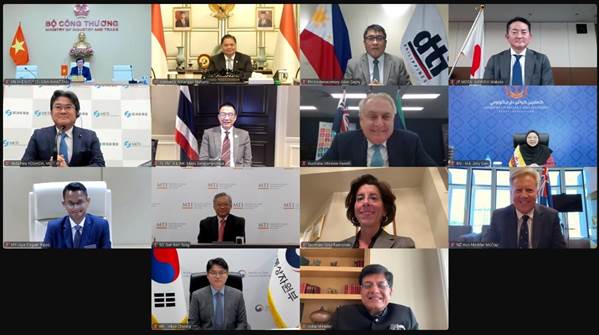
Union Commerce and Industry Minister Shri Piyush Goyal along with 13 other IPEF Ministers virtually attended the third Ministerial meeting focused on IPEF Pillar II, III, and IV.                

In particular, Minister Goyal along with other IPEF Ministers welcomed the upcoming entry into force of the Clean Economy Agreement, Fair Economy Agreement, and the Overarching Agreement on IPEF on October 11, 2024, October 12, 2024, and October 11, 2024, respectively, and emphasized the significant opportunities to further deepen economic cooperation and deliver concrete benefits under the IPEF agreements through ongoing collaboration.
Supply Chain Resilience

In the virtual meeting, IPEF Ministers reviewed and appreciated the substantive progress made to operationalize the Supply Chain Agreement, deepening cooperation to build more competitive and resilient supply chains, better prepare for, prevent, and respond to supply chain disruptions when they happen, and ensure that regional supply chains raise up workers and respect labor rights.  They outlined concrete next steps for the upcoming months, building on the progress made by the Supply Chain Agreement's three bodies: the Supply Chain Council, Crisis Response Network, and Labor Rights Advisory Board.  IPEF partners also highlighted the meaningful collaboration taking place under the Supply Chain Agreement which includes:

The IPEF Ministers noted that the three supply chain bodies – the Supply Chain Council (Council), the Crisis Response Network (Network), and the Labor Rights Advisory Board (LRAB) – met virtually in July to elect leadership in which India was elected as Vice Chair of the Council with US as Chair; Korea as Chair and Japan as Vice Chair of the Network; and the United States as Chair and Fiji as Vice Chair of the LRAB.

Minister Goyal noted that the formation of Action Plan teams in the first in person meeting of supply chain council held in Washington last week, for three critical sectors - semiconductors, critical minerals with a focus on batteries, and chemicals which are highly relevant today given their supply/production concentration and the experience learned from disruptions faced during the COVID-19 pandemic.

The world has witnessed exponential growth in demand for clean energy solutions to meet respective climate goals. The paradigm shift towards a sustainable and low-carbon future has brought to the forefront of the critical importance in securing a reliable supply of minerals which are critical for green transition.

The use of specific minerals is indispensable for the sectors including clean energy, electronics, defence, transportation, telecommunications, fertilisers, and pharmaceuticals. One of the key challenges in supply chains is risk on account of concentration of global capacities or resources, which can add to price volatility and supply uncertainty. The work under the Action Plan team needs to address this global concentration of supply chains in any form.

The growing population puts immense pressure on limited agricultural land for higher yields and in this context, the importance of resilient supply chains for Agro-chemicals has become extremely important. According to an estimate, the Global Agrochemicals Market (fertilizers, pesticides, adjuvants, and plant regulators) is projected to reach USD 282.2 billion by 2028 from USD 235.2 billion by 2023, at a CAGR of 3.7%.

Minister Goyal emphasized that healthcare including pharmaceuticals and medical devices is an extremely relevant area due to over concentration of global production of APIs and Key Starting Materials (KSMs) which can severely impair supply chain resilience and impact our capacity to address the healthcare needs of our economies. Besides, the multimodal transport systems including multimodal transport corridors, upgrades of logistics infrastructure, enhanced technological interoperability and data flows among freight and logistics enterprises, are some of the key areas which need to be focused upon.  

Minister Goyal noted that IPEF’s focus on Logistics and Movement of Good aligns perfectly with Prime Minister Shri Narendra Modi’s vision of Gati Shakti initiative, which aims to improve logistics and transportation infrastructure across India through evidence based integrated planning. Further, data and analytics on one hand will help identify new opportunities for collaboration for better resilience amongst IPEF supply chains and on other will help identify structural and systemic risks, enhancing the Council’s ability to address current challenges. He emphasized the workforce development which is a key cross cutting component of building resilient supply chains across the IPEF region should include efforts to identify skill gaps, support reskilling and upskilling, and ensure skill qualification comparability across the region to facilitate workforce mobility.

Crisis Response Network

IPEF Ministers emphasized the importance of collaboration under the Crisis Response Network to help partners timely understand risks in their supply chains. They also reflected on the emergency simulation exercise conducted during the Crisis Response Network (CRN) in person meeting to assist partners in creating tailored systems for real-time monitoring and crisis preparedness.

Clean Economy

Agreement on Clean Economy intends to accelerate efforts of IPEF partners towards energy security and transition, climate resilience and adaptation, GHG emissions mitigation; find/develop innovative ways of reducing dependence on fossil fuel energy; promote technical cooperation, workforce development, capacity building, and research collaborations; and collaborate to facilitate development, access, and deployment of clean energy and climate-friendly technologies.  The IPEF partners welcomed the progress made on the eight Cooperative Work Programs (CWPs), which serve as one of the primary mechanisms under the Clean Economy Agreement for facilitating cooperation among participating IPEF partners on priority topics. Each CWP, as developed by the proposing IPEF partner or partners, in consultation with the other IPEF partners, has different objectives and workstreams to carry forward the collaborative work.  During the virtual Ministerial, the IPEF partners commended the progress made on the Clean Economy Agreement since the successful Ministerial and inaugural Clean Economy Investor Forum in June.

The IPEF partners welcomed the continued efforts to build and sustain longer-term cooperation among various groupings of interested partners on a range of climate solutions through the CWP mechanism, in furtherance of the overarching goals of the IPEF Clean Economy Agreement, especially w.r.t hydrogen, carbon markets, and small modular reactors (SMRs) and e-waste urban mining proposed by India.

IPEF Ministers expressed great satisfaction over the very successful first IPEF investor Forum held in Singapore which provided a common platform to the investors and the project proponents together and facilitated them to gainfully engage on a wide array of investment opportunities including innovative ideas in the space of climate friendly technologies.

Fair Economy

By strengthening anti-corruption efforts and enhancing the efficiency of tax administration, the IPEF partners are demonstrating their commitment to increased transparency and predictability, and thereby will be better positioned to expand their trade, investment ties and ensure the benefits of trade are broadly shared throughout their economies.

The IPEF partners welcomed the next steps to implement the Agreement, including operationalizing the Technical Assistance and Capacity Building Coordination Group that will coordinate technical assistance and capacity building (TACB) under the Agreement’s Capacity Building Framework. Some of the TACB initiatives highlighted include:-

  • The US Department of Commerce’s Commercial Law Development Program (CLDP)’s  two-year program will offer IPEF partners TACB to help with implementation of the anti-corruption provisions of the Agreement, primarily focused on enforcement training centered on foreign bribery, corporate liability, and compliance.
  • In August 2024, the US Treasury Department’s Office of Technical Assistance (OTA)’s virtual workshop served as a forum for the IPEF partners to discuss the importance of effective tax administration to support economic and development objectives.
  • In October 2024, the US State Department, with the Malaysia Anti-Corruption Commission and the United Nations Office on Drugs and Crime, will hold an IPEF workshop focused on the implementation and enforcement of foreign bribery laws and another IPEF workshop on preventing corruption in public procurement, including tools to improve the effectiveness of oversight mechanisms, appeal systems, and potential remedies and legal options.

Minister Goyal underscored that peer learning, knowledge sharing and capacity building initiatives under the Fair Economy agreement will remain key to achieving its objectives. India, under the dynamic leadership of Prime Minister Narendra Modi, has established a robust anti-corruption regime and has already implemented several legislative, administrative, and regulatory measures to address both corruption and promote tax transparency. 

Minister Goyal emphasized that the full potential of IPEF can only be realised if each partner country brings their respective strengths to the table whether it is technological advancements or investment capacity or market potential or requisite resources including skilled workforce, to address various challenges of supply chain resilience or green transition.

The IPEF partners agreed that the Ministers will continue to monitor the progress made to further operationalize the Supply Chain Agreement, the Clean Economy Agreement, the Fair Economy Agreement, and the IPEF Overarching arrangement, and look forward to the first meetings of the ministerial-level IPEF Council and IPEF Joint Commission established under the IPEF Overarching  Agreement .

About IPEF

IPEF was launched on 23 May 2022 at Tokyo, Japan, comprising 14 countries – Australia, Brunei, Fiji, India, Indonesia, Japan, Republic of Korea, Malaysia, New Zealand, Philippines, Singapore, Thailand, Vietnam and USA. The IPEF seeks to strengthen economic engagement and cooperation among partner countries with the goal of advancing growth, economic stability and prosperity in the region.

The framework is structured around four pillars relating to Trade (Pillar I); Supply Chain Resilience (Pillar II); Clean Economy (Pillar III); and Fair Economy (Pillar IV). Agreement on Supply Chain Resilience (Pillars II) was signed in November 2023 and is in force since February 2024. Agreement on Clean Economy (Pillar-III), Agreement on Fair Economy (Pillar- IV) and the IPEF Overarching Agreement were signed by India early this week in Delaware, USA in the presence of the Prime Minister during his 3-day visit to the US.  India has maintained an observer status in Pillar-I.

These agreements were negotiated in consultation with line Ministries/Departments including the Ministry of External Affairs and other relevant stakeholders.

Topics

Acts Income Tax
