 TaxTMI
 Login
 TaxTMI
Login
Loading...
Press 'Enter' to add multiple search terms. Rules for Better Search

Press 'Enter' after typing page number.
Press 'Enter' after typing page number.


No Folders have been created
Are you sure you want to delete "My most important" ?
NOTE:
Press 'Enter' after typing page number.
Press 'Enter' after typing page number.

All News
Press 'Enter' after typing page number.
All News

Note

Bookmark

Share


The Union Budget 2024-25, presented by Union Finance Minister, Smt. Nirmala Sitharaman, sets a visionary path for India's economic development. The budget focuses on the theme of "Next Generation Reforms," aiming to bolster economic growth, improve productivity, and enhance the efficiency of markets and sectors. The budget outlines key reforms across various sectors, emphasizing collaboration between the Centre and states to promote competitive federalism and sustained economic progress.
Economic Policy Framework and Key Reforms
The government will establish a comprehensive Economic Policy Framework to guide the nation's development, focusing on increasing productivity and market efficiency. The framework will address all factors of production, including land, labour, capital, and entrepreneurship, with technology playing a critical role in improving total factor productivity and reducing inequality.
Land-Related Reforms
The planned land-related reforms and actions in both rural and urban areas will focus on two key aspects:
(1) improving land administration, planning, and management, and
(2) updating urban planning, land usage, and building bylaws.
These initiatives will be incentivized through appropriate fiscal support, with a goal for completion within the next three years.
Rural Reforms: Introduction of the Unique Land Parcel Identification Number (ULPIN) or Bhu-Aadhaar, digitization of cadastral maps, survey of map sub-divisions, establishment of a land registry, and linking to the farmers' registry.
Urban Reforms: Digitization of urban land records with GIS mapping, the establishment of an IT-based system for property record administration, and enhancement of urban local bodies' financial positions.
Labour-Related Reforms
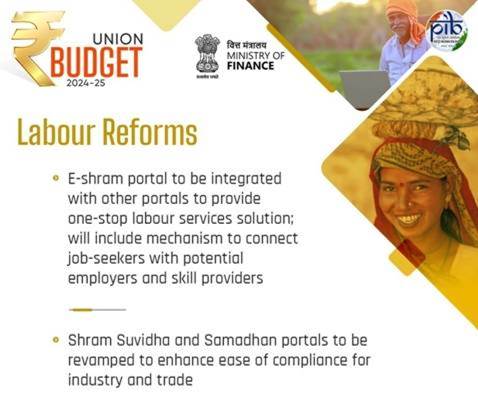
Integration of the e-Shram portal with other platforms for a comprehensive service offering to labour,
including employment and skilling services. Revamping of the Shram Suvidha and Samadhan portals to ease compliance for industries.
Financial Sector Vision and Strategy
The government plans to release a strategy document outlining the future vision for the financial sector, addressing its size, capacity, and skills.
Taxonomy for Climate Finance: Development of a taxonomy for climate finance to facilitate capital availability for climate adaptation and mitigation, supporting India's green transition and climate commitments.
Variable Capital Company Structure: Legislative approval will be sought for a Variable Capital Company structure, providing a flexible financing mode for leasing aircraft and ships and supporting private equity pooled funds.
Foreign Direct Investment and Overseas Investment: Simplification of rules and regulations for Foreign Direct Investment (FDI) and Overseas Investments to facilitate foreign investments, prioritize key sectors, and promote the use of the Indian Rupee for overseas investments.
NPS Vatsalya
Introduction of the NPS-Vatsalya plan, allowing parents and guardians to contribute to minors' accounts, which can be converted into regular NPS accounts upon reaching the age of majority.
Use of Technology and Digitalization
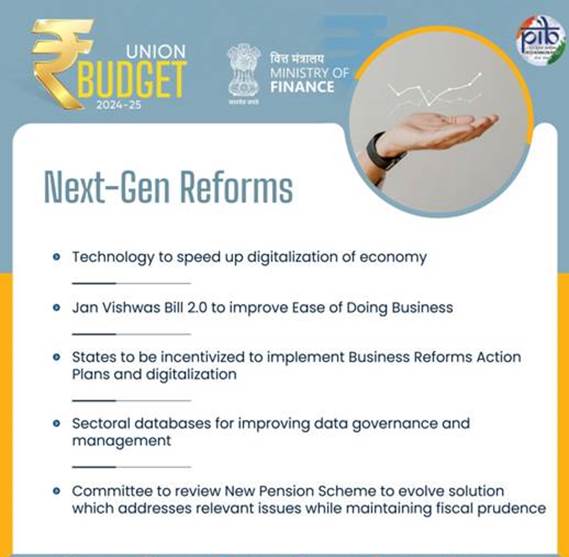
Over the past decade, the government has effectively leveraged technology to enhance productivity and reduce inequality within the economy. Public investment in digital infrastructure, combined with private sector innovations, has significantly improved citizens' access to market resources, education, healthcare, and various services, especially benefiting those from underprivileged backgrounds. The government plans to further accelerate the adoption of technology, driving the digitalization of the economy.
Ease of Doing Business
Ongoing work on the Jan Vishwas Bill 2.0 and incentives for states to implement Business Reforms Action Plans and digitalization measures.
Data and Statistics
To enhance data governance and improve the processes of data collection, processing, and management, the government will utilize various sectoral databases, including those developed under the Digital India mission. This effort will be supported by the active use of advanced technological tools, aiming to streamline and optimize the handling of data and statistics across different sectors.
New Pension Scheme (NPS)
The Union Finance Minister said that the Committee to review the NPS has made considerable progress in its work and a solution will be evolved that addresses the relevant issues while maintaining fiscal prudence to protect the common citizens.
Budget Estimates 2024-25
For the year 2024-25, the total receipts other than borrowings and the total expenditure are estimated at ₹32.07 lakh crore and ₹48.21 lakh crore respectively. The net tax receipts are estimated at ₹25.83 lakh crore and the fiscal deficit is estimated at 4.9 per cent of GDP.
The gross and net market borrowings through dated securities during 2024-25 are estimated at ₹14.01 lakh crore and ₹11.63 lakh crore respectively. It has been emphasized that the fiscal consolidation path announced in 2021 has served the economy very well, and the government will aim to reach a deficit below 4.5 per cent next year.
Additionally, the budget prioritizes fiscal responsibility, ensuring that these reforms are implemented within a sustainable financial structure.
Conclusion
The Union Budget 2024-25 outlines a comprehensive plan for economic growth and development, emphasizing next-generation reforms. By focusing on improving productivity, enhancing market efficiency, and leveraging technology, the government aims to create a robust and inclusive economic framework. The proposed reforms across land, labour, finance, and technology sectors are designed to foster sustainable growth and ensure a prosperous future for all citizens.

