Loading...

Top
Help
×

By creating an account you can:

Logo TaxTMI
Call Us / Help / Feedback

Contact Us At :

E-mail: [email protected]

Call / WhatsApp at: +91 99117 96707

For more information, Check Contact Us

FAQs :

To know Frequently Asked Questions, Check FAQs

Most Asked Video Tutorials :

For more tutorials, Check Video Tutorials

Submit Feedback/Suggestion :

Email :
Please provide your email address so we can follow up on your feedback.
Category :
Description :
Min 15 characters 0/2000
Make Most of Text Search
  1. Checkout this video tutorial: How to search effectively on TaxTMI.
  2. Put words in double quotes for exact word search, eg: "income tax"
  3. Avoid noise words such as : 'and, of, the, a'
  4. Sort by Relevance to get the most relevant document.
  5. Press Enter to add multiple terms/multiple phrases, and then click on Search to Search.
  6. Text Search
  7. The system will try to fetch results that contains ALL your words.
  8. Once you add keywords, you'll see a new 'Search In' filter that makes your results even more precise.
  9. Text Search
Add to...
You have not created any category. Kindly create one to bookmark this item!
Create New Category
Hide
Title :
Description :
❮❮ Hide
Default View
Expand ❯❯
Close ✕
🔎 News - Adv. Search
TEXT SEARCH:

Press 'Enter' to add multiple search terms. Rules for Better Search

Search In:
Main Text + AI Text
  • Main Text
  • Main Text + AI Text
  • AI Text
Category: ?
Categorized by AI
---- All Categories ----
  • ---- All Categories ----
  • Income Tax
  • GST
  • Customs, DGFT & SEZ
  • FEMA & RBI
  • Corp. Laws, SEBI & IBC
  • PMLA, Black Money & ED
  • Budget
  • News and Press Release
  • PTI News
Month:
---- All Months ----
  • ---- All Months ----
  • January
  • February
  • March
  • April
  • May
  • June
  • July
  • August
  • September
  • October
  • November
  • December
Year:
---- All Years ----
  • ---- All Years ----
  • 2026
  • 2025
  • 2024
  • 2023
  • 2022
  • 2021
  • 2020
  • 2019
  • 2018
  • 2017
  • 2016
  • 2015
  • 2014
  • 2013
  • 2012
  • 2011
Sort By: ?
In Sort By 'Default', exact matches for text search are shown at the top, followed by the remaining results in their regular order.
Relevance Default Date
    Delhi workers welfare board blacklists firm for over 20,000 'unauthorised' Aadhaar transactions
    Rupee rises 22 paise to close at 94.51 against US dollar
    Electrifying India's vehicles can cut its import bill by USD 125 billion by 2050: Study
    Loans to go beyond SHGs, women to get access to credit to expand livelihoods: Union minister Chouhan
    MIDC's role not just selling plots, but creation of conducive environment for development: CEO
    Decentro Wins Three Industry Honours for Fintech Infrastructure Innovation and Leadership in 2026
    Marching ahead with Responsibility and Growth - Keynote Address[Contributions by RBI colleague Shri Mohammed Majidullah, General Manager] delivered by...
    CCI directs Trustees’ Association of India, IDBI Trusteeship Services Ltd, Axis Trustee Services and SBI CAP Trustee Company to cease and desist fro...
    The Digital Textile Printer Revolution: How Konica Minolta NASSENGER is Preparing India for the Next Global Textile Opportunity
    Union minister Goyal hails 7.8 pc GDP growth; lauds Modi, takes dig at Oppn
    SC disposes of SEBI's pleas against NSE after Rs 1500-crore settlement
    India-US trade pact to be finalised once US offers preferential rate: Goyal
    Business Nextgen Finance Raises Rs 215 Crore in Equity to Accelerate MSME Lending
    Drugs: ED raids in 4 states; over 2 dozen offenders, foreign links under scanner
    Razorpay Launches a Conversational AI Account Manager 'RAY' on WhatsApp For Businesses, in Partnership with IndusInd Bank
    AssetPlus Launches Portfolio Management Services to Help MFD Partners Grow and Retain High-Net-Worth Clients
    APEDA Facilitates Flag-Off of 18 MT of NPOP-Certified Ethnic Rice from Tripura for Export to Austria and the Netherlands
    VR LIVIN’s ‘THE FIRST’ Records Sale of 20 Villas Within Two Days of Launch
    IAAPI Calls for GST Rationalisation to Support Growth and Consumer Demand in India’s Amusement Industry
    ED raids multiple locations in Keralam in hybrid ganja smuggling money laundering case
❯❯
Maximize Maximize Maximize
0 / 200
Expand Note
Add to Folder

No Folders have been created

+

Are you sure you want to delete "My most important" ?

NOTE:

News
Showing Results for :
Reset Filters
Results Found:
Show All Summaries Hide All Summaries
September 3, 2026
Show AI Summary
Unauthorised Aadhaar credential use triggers blacklisting and procurement debarment following alleged post-termination enrolment and update transactions.
Alleged unauthorised use of Aadhaar Registrar/EA Code credentials after termination of an operational engagement led the Delhi Construction and Other Workers Welfare Board to blacklist MDS Solution Pvt Ltd. UIDAI communication indicated that Aadhaar-related activity allegedly continued after cancellation through the Board's credentials. The Board lodged a police complaint, barred the firm from its tenders, procurement processes, empanelment and contract awards, and recommended consideration of action under applicable rules and policies.
September 3, 2026
Show AI Summary
FCNR(B) deposits strengthen foreign-exchange liquidity and support rupee appreciation alongside foreign portfolio inflows into government securities.
Foreign-currency inflows through FCNR(B) deposits, overseas foreign-currency borrowings and external commercial borrowings strengthened foreign-exchange liquidity and supported appreciation of the rupee against the US dollar. Foreign portfolio investment in government securities was linked to the abolition of withholding tax and long-term capital gains tax on such investment. Currency-market conditions were also influenced by foreign institutional equity purchases, global risk appetite, crude-oil prices and geopolitical tensions.
September 3, 2026
Show AI Summary
Electric vehicle adoption can reduce transport import dependence while domestic battery manufacturing increases projected long-term savings.
Electric-vehicle adoption across road-transport segments is projected to reduce dependence on imported petrol and diesel, notwithstanding continuing battery imports. Accelerated electrification could reduce vehicle-related import expenditure substantially by 2050 because reduced oil imports are expected to exceed battery-import costs. Domestic cell-manufacturing capacity may further increase savings by combining rapid vehicle electrification with battery localisation.
September 3, 2026
Show AI Summary
Women's livelihood credit access will extend beyond self-help groups through standardised loan formalities and coordinated banking support.
Women's access to credit for livelihood expansion is to extend beyond Self-Help Groups to individual women members. Loan accessibility concerns include distance from bank branches, repeated visits to complete formalities, and inconsistent banking procedures. Regular State Rural Livelihood Mission meetings, bank participation, training, helplines, process improvements and coordination with bankers are intended to reduce barriers. Loan formalities are to be standardised across banks through a uniform process involving RBI and NABARD.
September 3, 2026
Show AI Summary
Industrial development facilitation prioritises infrastructure, services, policy utilisation, and dry-port trade connectivity for businesses and agro-based farmers.
Industrial development facilitation extends beyond allocation of industrial plots to infrastructure development, services, and a favourable business environment. Industry-support policies seek to encourage participation by entrepreneurs, promote growth across sectors, and improve investment conditions without distinction between small and large enterprises. Dry-port infrastructure strengthens national and international trade connectivity, supporting import and export expansion for industrial and agro-based businesses.
September 3, 2026
Show AI Summary
Regulated fintech infrastructure recognition highlights integrated payment, identity and collections capabilities across embedded financial product delivery.
Decentro operates an integrated fintech infrastructure platform combining payment acceptance, identity verification, banking and AI-led collections through a unified integration layer. It holds Payment Aggregator authorisations for online and physical payments, a Payment Service Provider licence through its GIFT City entity, and certification for offline identity-verification workflows. These capabilities support embedded financial products, payment acceptance, lending collections and related financial workflows for enterprise users.
September 3, 2026
Show AI Summary
Responsible NBFC and HFC growth requires technology-enabled inclusion, proportionate regulation, sound governance, liquidity discipline, customer protection and cyber resilience.
NBFCs and HFCs can complement bank-led credit delivery through last-mile reach, sector-specific expertise, digital infrastructure, consent-based data sharing and cash-flow-based underwriting. Sustainable growth requires strong liquidity risk management, governance, compliance culture, diversified funding, stress testing, early-warning systems, dynamic provisioning and sound underwriting standards. Proportionate scale-based regulation, digital lending standards and a substance-over-form approach seek to support innovation while preserving financial stability. Customer protection, responsible lending, grievance redressal, fair recovery conduct, cyber resilience and protection of customer data remain essential.
September 3, 2026
Show AI Summary
Debenture trusteeship fee fixing constitutes cartelisation by constraining independent pricing and restricting service availability in the market.
Collective minimum-fee fixing for debenture trusteeship services prevented trustees from making independent commercial pricing decisions and constituted cartelisation. Prescription of a benchmark fee limited and controlled the supply or market for such services by directing association members and non-members not to serve debenture issuers below that fee. The conduct contravened Section 3(3)(a) and Section 3(3)(b) read with Section 3(1) of the Competition Act, 2002.
September 3, 2026
Show AI Summary
Digital textile printing enables flexible industrial production, shorter lead times, reduced screen dependency and sustainability-focused manufacturing for export markets.
Digital textile printing is presented as an industrial alternative to conventional screen printing, allowing direct production from digital design files with faster design changes, shorter lead times and flexibility across varying order quantities. Single-pass systems support high-volume production through fixed printing units and continuous fabric movement, while multipass platforms provide flexible production across natural, synthetic and specialised textiles. Digital production is associated with printing closer to demand, eliminating physical screens, reducing unnecessary production, and addressing wastewater reduction, chemical compliance, traceability and responsible manufacturing expectations.
September 3, 2026
Show AI Summary
Economic growth and infrastructure investment were presented as supporting exports, skilled employment, connectivity, and long-term development.
Economic growth, export expansion and infrastructure investment are presented as interconnected drivers of India's development, global standing and employment opportunities. Infrastructure expenditure, railway expansion and improved transport connectivity are identified as measures intended to facilitate movement, simplify transportation, support trade and exports, and strengthen industrial and commercial activity. These measures are associated with the objective of a developed India by 2047 and enhanced employment, business and growth opportunities.
September 3, 2026
Show AI Summary
Co-location and dark fibre settlement addressed allegations of preferential market-data access and speed advantages in trading.
SEBI's co-location and dark fibre matters involving NSE concerned allegations that certain stockbrokers obtained unfair preferential speed advantages to access market data and execute trades ahead of other investors. NSE pursued settlement applications covering both matters, and revised settlement terms increased the cumulative amount. Payments made by NSE together completed the agreed settlement amount.
September 3, 2026
Show AI Summary
Preferential tariff treatment remains the condition for finalising the bilateral trade agreement and improving Indian export competitiveness.
Finalisation of the India-US Bilateral Trade Agreement is contingent on the United States extending preferential tariff treatment to India relative to competing supplier countries. Further negotiations are required following changes in the United States tariff environment. A comparative tariff advantage is intended to improve the price competitiveness of Indian goods in the United States market, particularly against competitors benefiting from lower duties under least-developed-country preferences or trade agreements.
September 3, 2026
Show AI Summary
MSME secured lending equity capital, subject to regulatory approval, supports expansion without management-control change in operations.
Business Nextgen Finance Private Limited, a non-deposit taking non-banking financial company registered with the Reserve Bank of India, has raised Rs 215 crore in equity capital to expand secured credit for micro, small and medium enterprises. The transaction received prior Reserve Bank of India approval. The capital base will support secured lending scale-up, geographic expansion, technology investment and wider access to formal credit in underserved markets. The investment does not involve a change in management or day-to-day control.
September 3, 2026
Show AI Summary
Money-laundering probes into narcotics trafficking rely on predicate police and narcotics cases and examine cross-border linkages.
Money-laundering investigation under the Prevention of Money Laundering Act involves coordinated searches in connection with multiple narcotics-trafficking matters. The investigation is founded on police and Narcotics Control Bureau FIRs and linked chargesheets concerning separate drug-trafficking allegations, including alleged trafficking in methamphetamine, marijuana and MDMA with suspected cross-border linkages.
September 3, 2026
Show AI Summary
Conversational AI account management enables businesses to access payment information, settlement support, refunds, and payment links through WhatsApp.
RAY is a conversational AI account manager on WhatsApp that enables businesses to access payment information, support, and operational actions through messages or voice notes. It can provide payment summaries, analyse payment activity, monitor settlement status, generate payment links, and issue refunds. The AI assistant is designed to proactively identify payment-health issues, flag settlement events, recommend actions, and use merchant-specific context to support payment management without dashboard navigation.
September 3, 2026
Show AI Summary
Portfolio management services distribution enables certified mutual fund distributors to digitally onboard and report for eligible high-net-worth clients through AssetPlus.
AssetPlus has launched Portfolio Management Services for certified Mutual Fund Distributor partners to digitally onboard, track, manage and report PMS investments for eligible high-net-worth clients. PMS distribution requires NISM Series-XXI-A certification and operates within the APRN distributor-registration framework. PMS comprises individually managed portfolios run by SEBI-registered Portfolio Managers and held in clients' demat accounts. The minimum investment is Rs. 50 lakh, and offerings are governed by the SEBI (Portfolio Managers) Regulations, 2020. The platform provides daily reconciliation of holdings, performance and valuations.
September 3, 2026
Show AI Summary
NPOP-certified ethnic rice exports strengthen organic producer access to international markets through certification, traceability, and organised export production.
NPOP-certified ethnic rice exports from Tripura to Austria and the Netherlands connect local farmers and Farmer Producer Companies with international markets through organised, export-oriented production. The initiative emphasises certification, traceability, food safety and quality as requirements for access to markets for certified organic products. Buyer-seller linkages support export opportunities, while coordinated organic value-chain engagement strengthens certification and quality systems and supports producers in meeting international standards.
September 3, 2026
Show AI Summary
Gated residential community launch combines smart-home villas, extensive lifestyle amenities and planned expansion into future residential developments.
VR LIVIN Ventures LLP launched 'THE FIRST', an 83-villa gated residential community in Madhavaram, North Chennai, which recorded sales of 20 villas during its first two launch days. The development includes smart-home villas and more than 50 lifestyle amenities, with access to nearby metro connectivity and social infrastructure. It forms part of the company's intended expansion of residential projects in Chennai and other South Indian locations.
September 3, 2026
Show AI Summary
GST rationalisation for amusement park admissions could lower ticket prices, stimulate consumer demand, and support investment without input tax credit.
GST rationalisation for amusement park, water park and indoor entertainment admission tickets is sought through a flat 5% GST rate without Input Tax Credit. The proposed rate is intended to reduce ticket prices, improve affordability and increase customer demand in a capital-intensive tourism and entertainment sector. Many smaller and mid-sized operators report limited ability to offset GST liability through ITC. Lower taxation is projected to support facility expansion, revenue growth, new investment, employment and reinvestment in recreational services.
September 3, 2026
Show AI Summary
Money laundering linked to hybrid ganja smuggling involves alleged illicit cross-border transfers and foreign-exchange violations.
Enforcement Directorate searches form part of a money-laundering investigation into alleged hybrid ganja smuggling from Thailand. A case under the Prevention of Money Laundering Act concerns suspected laundering of drug-trafficking proceeds and transfer of funds to Thailand through illegal channels. The inquiry also examines possible foreign-exchange violations and an alleged arrangement involving carriers, visas and funds for transporting narcotic substances.

News

Back

All News

Showing Results for :
Reset Filters
No Records Found

News

Showing Results for : Reset Filters

Ministry of Finance Year Ender 2023: Department of Economic Affairs

December 27, 2023

Contents
Summary
Note

Note

-

Bookmark

Print

Print

The Year 2023 marks the beginning of ‘Amrit Kaal’ - the 25-year period beginning from the 75th anniversary of its independence on 15th August 2022, leading up to the centenary of its Independence, towards a futuristic, prosperous, inclusive and developed society, distinguished by a human-centric approach at its core.

India continues to be one of the fastest-growing economies of the world. The country's second quarter growth, 7.6 per cent, has been then highest in the world and India's GDP growth for the April-June quarter was 7.8 per cent.

Putting into effect the roadmap for making India a $5 trillion economy, the Government continues to focus on growth at the macro level and complementing it with all-inclusive welfare at the micro level, promoting digital economy and fintech, technology-enabled development, energy transition and climate action and relying on a virtuous cycle of investment and growth.

The Government has also focused on a capex-led growth strategy to support economic growth and attract investment from the private sector, increasing its capital investment outlay substantially during the last three years. Central Government’s capital expenditure has increased from 2.15 per cent of GDP in 2020-21 to 2.7 per cent of GDP in 2022-23.

To fuel such achievements, the Government has worked tirelessly for shouldering a number of bold and important socio-economic reforms. The Government has undertaken its reform drive with the spirit of inclusiveness of the marginalised and hitherto socio-economically neglected classes in the overall development process.

The success of Government’s policies is further reaffirmed and underscored when the International Organisations like the World Bank and IMF recognise India as the fastest growing Emerging Market Economy (EME) in the world and applaud the resilient and stable growth India continues to witness.

The Year 2023 is also significant as India hosted the G20 Presidency from December 1, 2022 to November 30, 2023. The 43 Heads of Delegations - the largest ever in G20 - participated in the final New Delhi Summit in September 2023.

The G20 Finance Track under India's leadership addressed critical global issues, including the strengthening of Multilateral Development Banks (MDBs) through the G20 Independent Expert Group's comprehensive report. The DEA played a pivotal role in fostering cooperation on crypto-assets, with the International Monetary Fund (IMF) and the Financial Stability Board (FSB) developing a Synthesis Paper adopted as the G20 Roadmap on Crypto Assets in October 2023.

During the G20 Indian Presidency, India steered the G20 agenda and hosted the Summit. The G20 consists of two parallel tracks: the Finance Track and the Sherpa Track. Finance Ministers and Central Bank Governors lead the Finance Track, while Sherpas lead the Sherpa Track. The high point of the Leaders’ Summit was that a global consensus was arrived at in the form of New Delhi Leaders’ Declaration (NDLD).

The department facilitated debt restructuring efforts through the Common Framework and launched the Global Sovereign Debt Roundtable, reinforcing its commitment to supporting vulnerable economies. Initiatives like the G20 Sustainable Finance Technical Assistance Action Plan (TAAP) underscored efforts to enhance capacity-building in sustainable finance, particularly for Emerging Markets and Developing Economies.

Infrastructure development also received a boost through initiatives like the Harmonised Master List (HML) of Infrastructure Sub-sectors, the National Infrastructure Pipeline (NIP), and the G20 Infrastructure Working Group's consensus on key deliverables. The DEA's strategic measures for promoting Public-Private Partnerships (PPPs) include the VGF Scheme's expansion and the revamping of the Infrastructure Investment Project Development Fund (IIPDF).

The DEA also played a role in financial sector reforms, including the launch of the NSE IFSC-SGX Connect and the transition to a T+1 settlement cycle, positioning India as a pioneer in global securities markets.

In summary, the Department of Economic Affairs in 2023 has demonstrated a proactive and inclusive approach, contributing significantly to sustainable finance, climate action, infrastructure development, and financial sector reforms on both national and international fronts.

Following are some of the major achievements of the Department of Economic Affairs, Ministry of Finance, in 2023:

Sovereign Green Bonds:

In the Union Budget 2022-23, the Government announced that, as a part of the government’s overall market borrowings in 2022-23, sovereign Green Bonds will be issued to mobilize resources for green infrastructure. The proceeds will be deployed in sector projects which help in reducing the carbon intensity of the economy.
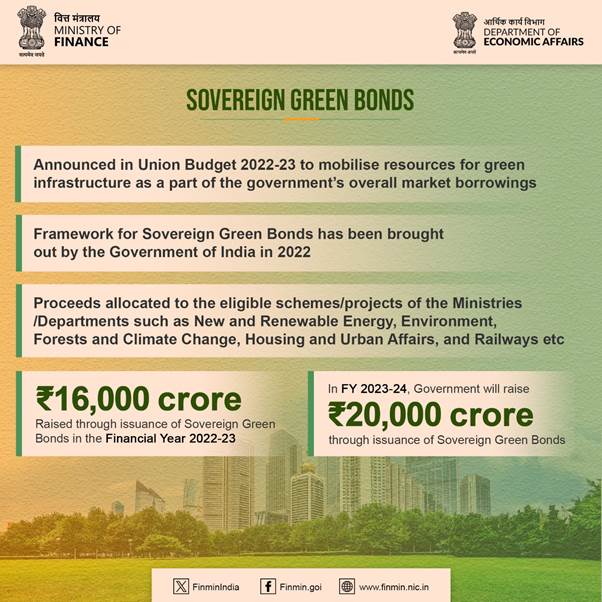
 

In pursuance of the above budget announcement, framework for Sovereign Green Bonds has been brought out by the Government of India to mobilise resources for green infrastructure projects which help in reducing the carbon intensity of the economy.

The Government has raised ₹16,000 crore, through issuance of Sovereign Green Bonds in 2023 till date and these proceeds were allocated to the eligible schemes/projects of the Ministries/Departments such as New and Renewable Energy, Environment, Forests and Climate Change, Housing and Urban Affairs, Railways etc. In the FY 2023-24, Government has decided to raise ₹ 20,000 crore through issuance of Sovereign Green Bonds.

Mahila Samman Savings Certificate (MSSC):

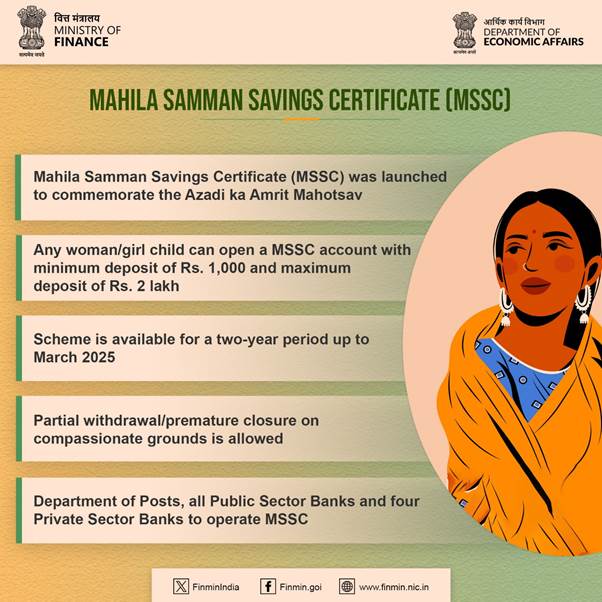
The introduction of the Mahila Samman Savings Certificate (MSSC) reflects the government's dedication to women's financial inclusion. With total number of accounts opened are at 14,83,980 with deposit of Rs. 8,630 crore as on July 2023, this initiative empowers women economically, offering an attractive 7.5% interest rate compounded quarterly.

Mahila Samman Savings Certificate (MSSC) was launched by the Government of India to commemorate the Azadi ka Amrit Mahotsav. MSSC account may be opened by women of any age group including the girl child with a minimum deposit of ₹1000/- and maximum deposit of ₹2 Lakhs for a period of two years. This scheme is available for a two-year period up to March 2025. The facility of partial withdrawal and premature closure on compassionate grounds are also available under this Scheme. Government of India has authorized Department of Posts, all Public Sector Banks and four Private Sector Banks to operate MSSC.
he maximum deposit for the senior citizen saving scheme has been enhanced from Rs 15 lakhs to Rs 30 lakhs.

The maximum deposit limit for the Post office monthly Income savings scheme is enhanced from Rs.4.5 lakh to Rs.9 lakh for a single account and from Rs.9 lakh to Rs.15 lakh for a joint account.

Sukanya Samriddhi Yojana (SSY)

The Sukanya Samriddhi Yojana (SSY) is a savings scheme initiated by the Department of Economic Affairs, Ministry of Finance, specifically designed for the benefit of the girl child. The scheme was launched as part of the ‘Beti Bachao, Beti Padhao’ campaign to promote the welfare of the girl child and encourage parents to save for their education and marriage expenses. So far, 3.2 crore accounts are active under the Scheme.

National Investment and Infrastructure Fund in 202:

  •   NIIF launched its first bilateral fund, India-Japan Fund with Japan Bank for International Cooperation (JBIC); working with U.S. International Development Finance Corporation (DFC) towards setting up of a multi-billion dollar green-transition fund

G20 Finance Track under India’s G20 Presidency, 2023:
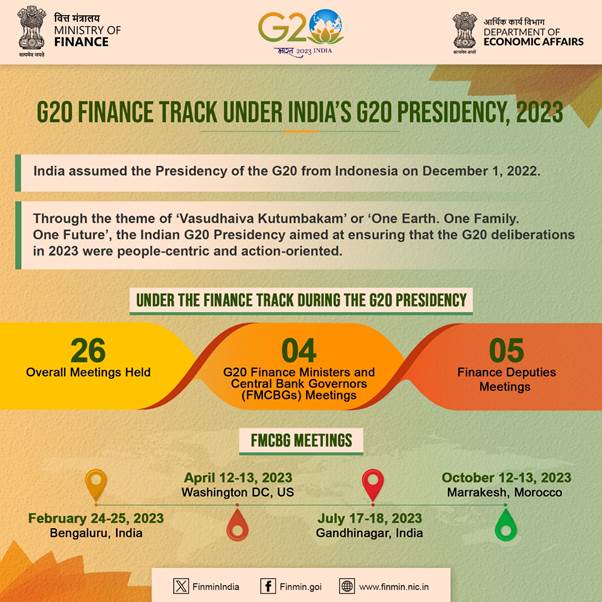
  • India assumed the Presidency of the G20 from Indonesia on December 1, 2022.
  • Through the theme of “Vasudhaiva Kutumbakam” or “One Earth. One Family. One Future”, the Indian G20 Presidency aimed at ensuring that the G20 deliberations in 2023 were people-centric and action-oriented.
  • Under the G20 Finance Track, a total of 35 meetings, including 4 meetings of G20 Finance Ministers and Central Bank Governors (FMCBG) and 5 meetings of Deputies, were held during the Presidency year. The FMCBG meetings were held on February 24-25, 2023, in Bengaluru, India; April 12-13, 2023, in Washington DC, US; July 17-18 in Gandhinagar, India; and October 12-13, in Marrakesh, Morocco.
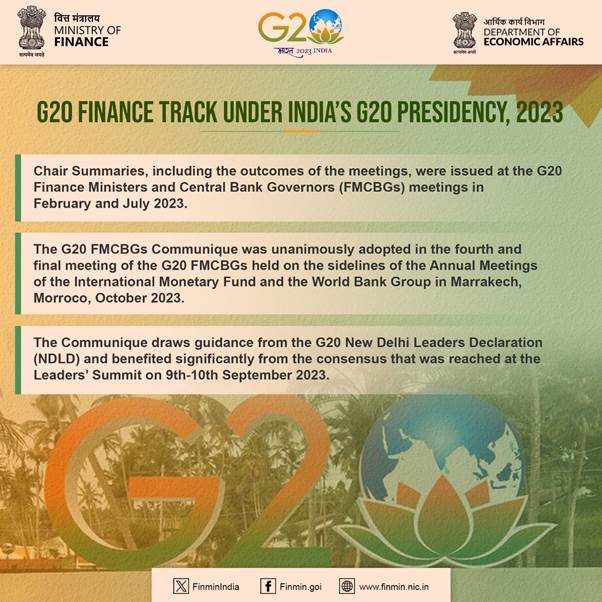
  • At the FMCBG meetings in February and July 2023, Chair Summaries including the outcomes of the meetings, were issued. In the fourth and final meeting of the G20 Finance Ministers and Central Bank Governors held on the sidelines of the Annual Meetings of the International Monetary Fund and the World Bank Group in Marrakesh in October 2023, the G20 FMCBGs unanimously adopted the G20 Finance Ministers and Central Bank Governors Communique. The Communique draws guidance from the G20 New Delhi Leaders Declaration (NDLD) and benefited significantly from the consensus that was reached at the Leaders’ Summit.

KEY OUTCOMES OF THE G20 FINANCE TRACK IN 2023: 

  • Some of the key outcomes of the Finance Track are highlighted below.

Report of the G20 Independent Expert Group on Strengthening Multilateral Development Banks (MDBs)
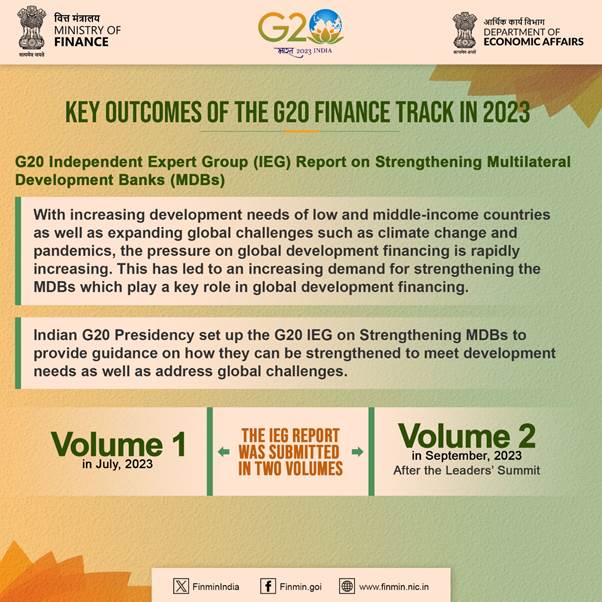
  • With increasing development needs of low and middle-income countries as well as expanding global challenges such as climate change and pandemics, the pressure on global development financing is rapidly increasing. This has led to an increasing demand for strengthening the MDBs which play a key role in global development financing.
  • The G20 Independent Expert Group (IEG) on Strengthening MDBs was set up by the Indian Presidency to provide guidance on how MDBs can be strengthened to meet the development needs as well as address global challenges. The Report was submitted in two volumes: Volume 1 in July 2023 and Volume 2 in September 2023 (after the Leaders’ Summit).
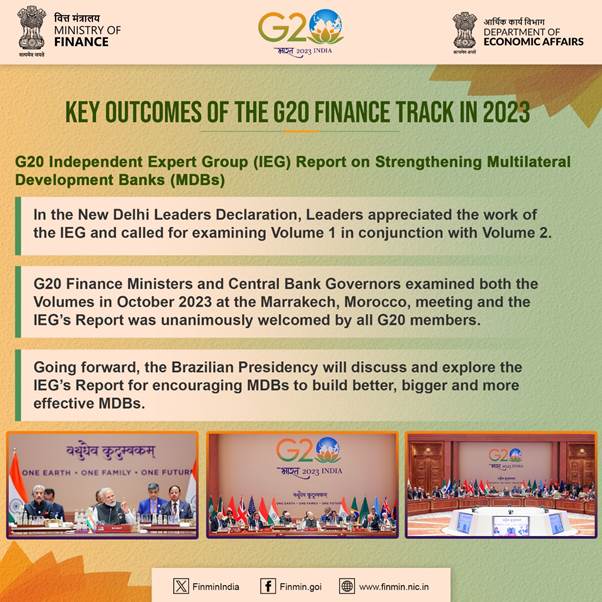
  • In the New Delhi Leaders Declaration, the Leaders appreciated the work of the IEG and called for examining Volume 1 in conjunction with Volume 2.  This was done by G20 Finance Ministers and Central Bank Governors in October 2023 and the IEG’s Report has been unanimously welcomed by all G20 members.
  • Volume 1 of the Report calls on MDBs to (i) address global challenges along with their core mandates of eliminating poverty and fostering shared prosperity; (ii) triple their sustainable lending level by 2030; and (iii) enhance their financial strength. Volume 2 of the Report provides recommendations to make MDBs better, bigger and bolder by, inter alia, suitably modifying their operating models, developing a whole-of-institution approach for mobilising more private capital and scaling up financing at an affordable cost.
  • Going forward, the recommendations of this report will be discussed in detail by the G20 under the upcoming Brazilian Presidency to explore which among these recommendations can the MDBs be encouraged to pursue to enable them to build better, bigger and more effective MDBs.


IMF-FSB Synthesis Paper on crypto-assets:
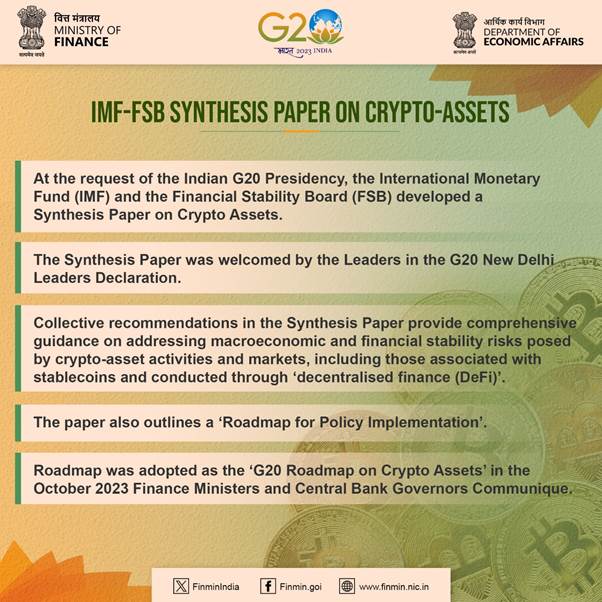
  • Crypto-assets have been in existence for more than a decade and have displayed significant volatility. Alongside their volatility, crypto-asset activities have also grown in complexity. So far, direct connections between crypto-assets and systemically important financial institutions, core financial markets, and market infrastructures have been limited. Nevertheless, they have the potential to emerge as a source of systemic risk in specific jurisdictions if they gain traction for payments or retail investments. The IMF has outlined key elements of an appropriate policy response including macroeconomic, legal and financial integrity considerations and implications for monetary and fiscal policies. In parallel, the Financial Stability Board (FSB) and standard-setting bodies (SSBs) have published regulatory and supervisory recommendations and standards to address financial stability, financial integrity, market integrity, investor protection, prudential and other risks derived from crypto-assets.
  • At the request of the Indian G20 Presidency, the IMF and the FSB have developed a Synthesis Paper which was welcomed by the Leaders in the G20 New Delhi Leaders Declaration. The collective recommendations provide comprehensive guidance to help authorities address the macroeconomic and financial stability risks posed by crypto-asset activities and markets, including those associated with stablecoins and those conducted through so-called decentralised finance (DeFi).
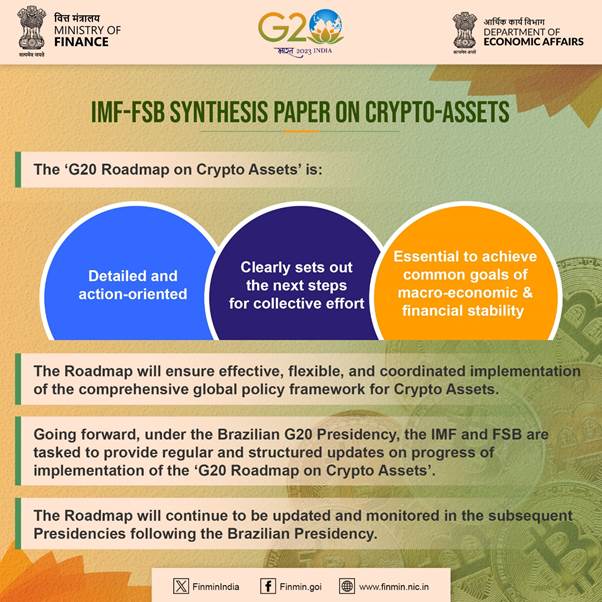
  • The paper also outlines a roadmap for policy implementation which has now been adopted as the G20 Roadmap on Crypto Assets in the October 2023 Finance Ministers and Central Bank Governors Communique. This detailed and action-oriented roadmap sets out clearly the next steps and is essential to achieve the common goals of macro-economic and financial stability and to ensure effective, flexible, and coordinated implementation of the comprehensive global policy framework for crypto assets.
  • Going forward, under the Brazilian Presidency, the IMF and FSB have been tasked to provide regular and structured updates on the progress of implementation of the G20 Roadmap on Crypto Assets. This will also continue in the subsequent Presidencies following the Brazilian Presidency.


G20 Principles for Financing Cities of Tomorrow:

  • India’s G20 Presidency has focussed on the theme of urban infrastructure to develop Cities of Tomorrow which can be visualised as action-oriented spaces which focus on bringing a positive and lasting impact on the lives of their citizens and maximising the creative potential of their resources.
  • The G20 Principles for Financing Cities of Tomorrow, endorsed during the New Delhi Leaders Summit, aim to guide the planning and financing of sustainable urban infrastructure. These principles provide a framework that holds the potential to guide Governments, MDBs and other development financing institutions in their planning and financing of sustainable urban infrastructure. Based on the preferred direction of growth of cities depending on their different stages of evolution, the key elements of these principles can be applied focusing on circular economy, investment efficiency, increasing private investments, institutional strengthening, and augmenting capacity of city administrations.
  • The upcoming Brazilian Presidency has indicated that in 2024 they will take up the issue of inclusivity in urban infrastructure drawing from the G20 Principles and elaborate on it further by focussing on poverty and inequality reduction.

Mechanisms for timely and adequate mobilization of climate finance:
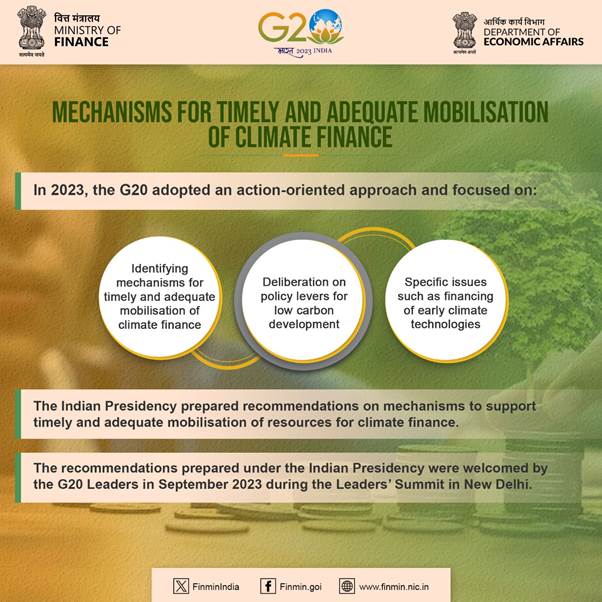
  • Finance from all sources has not yet achieved the scale to address the climate goals established by countries, especially flows directed to developing countries. The availability of adequate, credible, and predictable, new, and additional climate finance for developing countries is key to developing countries' successful implementation of climate actions under the UNFCCC and the Paris Agreement (The Standing Committee on Finance, a body under the UNFCCC, has estimated that resources in the range of US$ 5.8 trillion to US$ 11.5 trillion are required till 2030 to meet the targets set by developing countries in their Nationally Determined Contributions and other communications).
  • Till date the conversation on climate change in the G20 was focused on calling on developed countries to fulfil their climate finance commitment of USD 100 billion. In 2023, the G20 adopted an action-oriented approach and focused on identifying mechanisms for timely and adequate mobilization of climate finance, with an aim to deliberate on policy levers for low carbon development; and specific issues such as financing of early climate technologies.
  • The recommendations on the mechanisms to support timely and adequate mobilisation of resources for climate finance prepared under the Indian Presidency were welcomed by the G20 Leaders in September 2023 during the Leaders’ Summit in New Delhi. Focus has also been placed on public finance, as an important enabler of climate actions such as leveraging much-needed private finance through blended financial instruments, mechanisms, and risk-sharing facilities, to address both adaptation and mitigation efforts in a balanced manner for reaching the ambitious Nationally Determined Contributions (NDCs), carbon neutrality and net-zero considering different national circumstances. This outcome also focused on financial solutions, policies, and incentives to encourage greater private flows for the rapid development, demonstration, and deployment of green and low carbon technologies.
  • Going forward, the upcoming Brazilian Presidency of G20 has indicated that the work undertaken on climate finance in 2023 will feed into the work of the G20 Task Force on Global Mobilization against Climate Change which Brazil plans to set up in 2024.


G20 Policy Recommendations for advancing financial inclusion and productivity gains through DPI and New Financial Inclusion Action Plan 2024-26:
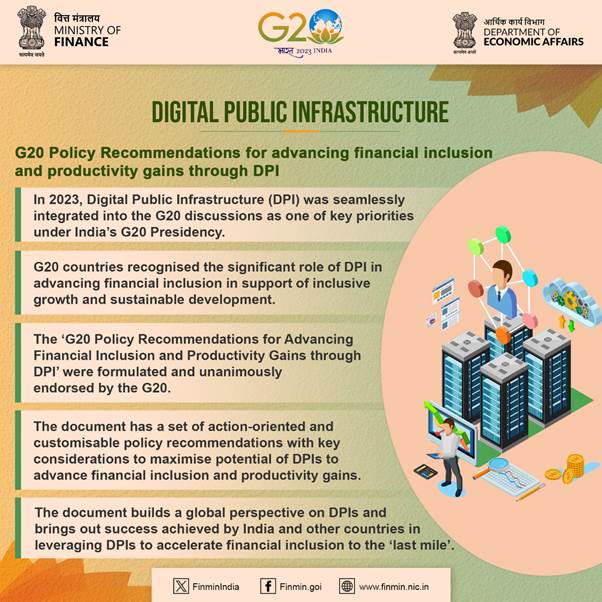
  • This year, Digital Public Infrastructure (DPI) has been seamlessly integrated into the G20 discussions as one of key priorities under India’s G20 Presidency. Members recognised the significant role of DPI in helping to advance financial inclusion in support of inclusive growth and sustainable development.
  • In this context, the G20 Policy Recommendations for advancing financial inclusion and productivity gains through DPI were formulated and unanimously endorsed by the G20. The document provides a set of action-oriented and customisable policy recommendations accompanied by a series of key considerations to help authorities maximize the potential of DPIs to advance financial inclusion and productivity gains. It also brings out the success achieved by India and other countries in leveraging DPIs to accelerate financial inclusion to the last mile and builds a global perspective on DPIs.
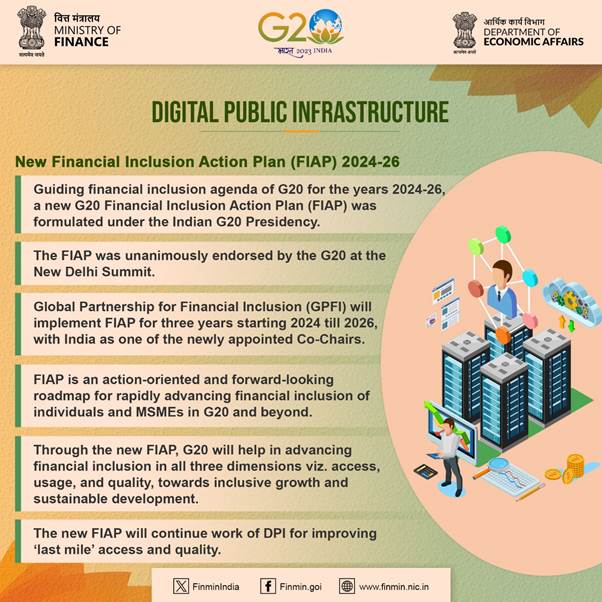
  • To guide the financial inclusion agenda under the G20 for the years 2024-26, a new G20 Financial Inclusion Action Plan (FIAP) was also formulated and unanimously endorsed by the G20 at the New Delhi Summit. The plan will be implemented by the Global Partnership for Financial Inclusion (GPFI),  for three years starting 2024, with India as one of the newly appointed Co-Chairs. The new FIAP provides an action-oriented and forward-looking roadmap for rapidly advancing financial inclusion of individuals and MSMEs in G20 and beyond by focusing on action areas which, inter alia, focus on promoting technological, innovations and digital infrastructure including DPI thereby helping countries move closer to universal financial inclusion.
  • Going forward, the G20 will continue its work for advancing financial inclusions in all three dimensions viz. access, usage, and quality, for individuals and MSMEs through innovative methods including DPI in support of inclusive growth and sustainable development. The financial inclusion work of the G20 till 2026 will be determined by the FIAP. The new FIAP will continue work of DPI for improving “last mile” access and quality inclusion for individuals and MSMEs.


Managing global debt vulnerabilities:

  • The escalation of debt issues in vulnerable economies poses significant economic risks, potentially hindering their progress towards sustainable development.
  • Under India’s G20 Presidency, the G20 members re-emphasised the importance of addressing debt vulnerabilities in low and middle-income countries. Progress has been achieved in debt treatment of both Common Framework (Zambia, Ethiopia, Ghana) and beyond Common Framework countries (Sri Lanka). The G20 has reaffirmed its commitment to uphold all the provisions outlined in the Common Framework for Debt Treatments and step up its implementation in a predictable, timely, orderly, and coordinated manner.


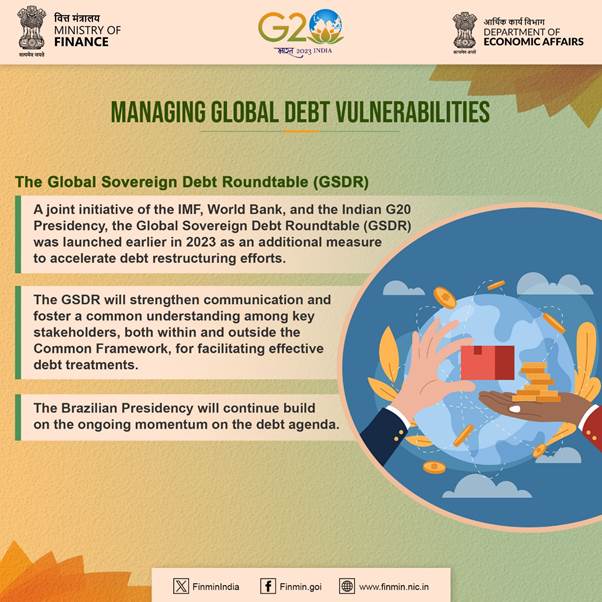
  • Additionally, to accelerate debt restructuring efforts, the Global Sovereign Debt Roundtable (GSDR), a joint initiative of the IMF, World Bank, and the Indian G20 Presidency was launched earlier this year to strengthen communication and foster a common understanding among key stakeholders, both within and outside the Common Framework, for facilitating effective debt treatments.
  • Going forward, the Brazilian Presidency is expected to continue with the ongoing momentum on the debt agenda.


G20 Sustainable Finance Technical Assistance Action Plan (TAAP):
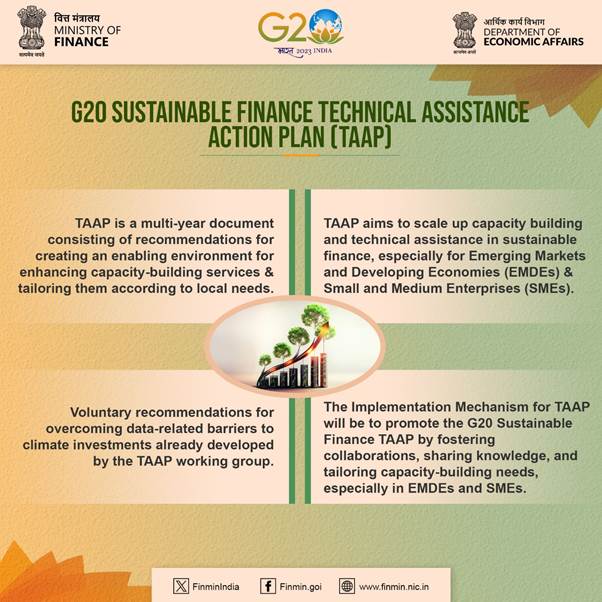
  • TAAP is a multi-year document consisting of recommendations for creating an enabling environment for enhancing capacity-building services and tailoring them according to local needs. TAAP aims to scale up capacity building and technical assistance in sustainable finance, especially for Emerging Markets and Developing Economies (EMDEs) and Small and Medium Enterprises (SMEs). The working group also developed voluntary recommendations for overcoming data-related barriers to climate investments.
  • The Implementation Mechanism for TAAP will promote the effective implementation of the G20 Sustainable Finance TAAP by fostering collaborations, sharing knowledge, and tailoring capacity-building needs, especially in EMDEs and SMEs.


INITIATIVES TO BOOST INFRASTRUCTURE INVESTMENT

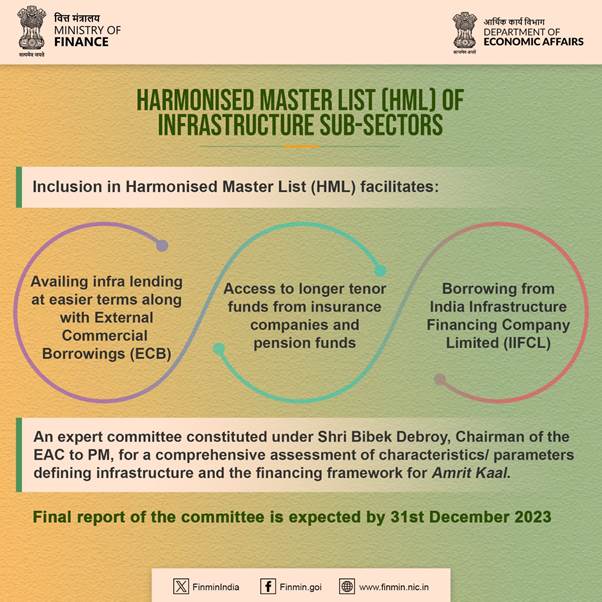
(a) Harmonised Master List (HML) of Infrastructure Sub-sectors: As of now, HML list includes 37 Infrastructure sub sectors under 5 categories i.e., 1. Transport and Logistics, 2. Energy, 3. Water and Sanitation, 4. Communication and 5. Social and Commercial Infrastructure. The inclusion of any sector in the HML enables it to avail infrastructure lending at easier terms and External Commercial Borrowings (ECB), access to longer tenor funds from insurance companies and pension funds and be eligible to borrow from

India Infrastructure Financing Company Limited (IIFCL) etc.

In accordance with para 49 of the Union Budget for FY 23-24, an expert committee has been constituted under the chairmanship of Shri Bibek Debroy, Chairman of the EAC to PM with the objective to undertake a comprehensive assessment of the characteristics/ parameters defining infrastructure and the financing framework for Amrit Kaal.

The Expert Committee had a series of stakeholder’s consultations and is finalising the recommendations and the final report of the committee is expected by 31st December 2023
 

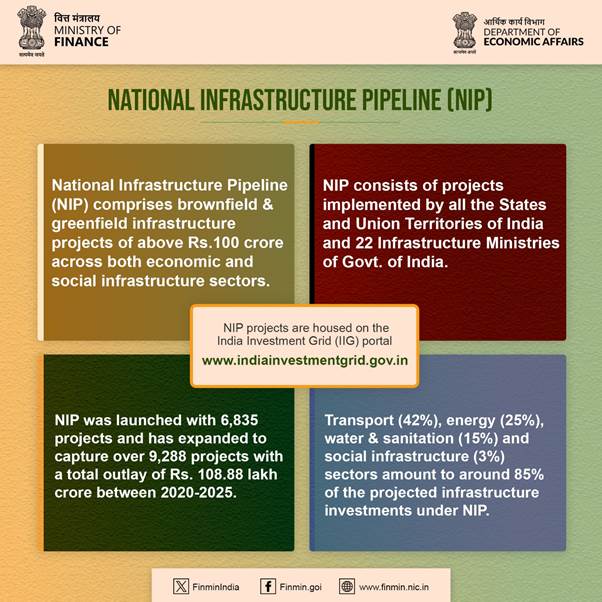
(b) National Infrastructure Pipeline (NIP): Infrastructure is one of the key enablers for economic growth. The National Infrastructure Pipeline (NIP) comprises brownfield and greenfield infrastructure projects of above INR 100 Crores across both economic and social infrastructure sectors. The pipeline consists of projects implemented by all the States and Union Territories of India and 22 Infrastructure Ministries of Govt. of India.

NIP was launched with 6,835 projects and has expanded to capture over 9,288 projects with a total project outlay of Rs 108.88 lakh cr between 2020-2025. Transport (42%), energy (25%), water & sanitation (15%) and social infrastructure (3%) sectors amount to around 85% of the projected infrastructure investments under NIP. NIP projects are housed on the India Investment Grid (IIG) portal (https://indiainvestmentgrid.gov.in/).
 

c. G20 Infrastructure Working Group: Infrastructure Working Group under the Indian G20 Presidency was able to bring a consensus amongst the members on four major deliverables namely i) the G20 Principles on Financing Cities of Tomorrow, ii) the G20/OECD Report on financing cities of tomorrow, iii) the G20/ADB Framework on Capacity Building of Urban Administrations, and iv) G20/WB Report on Enablers of Inclusive Cities.

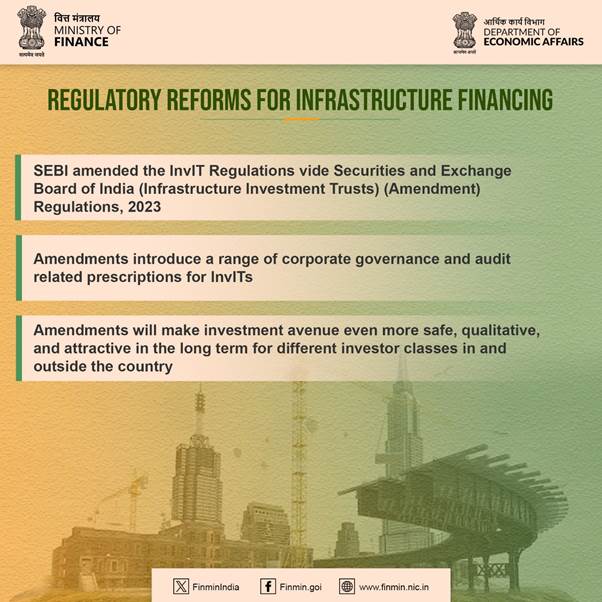
d. Regulatory reforms for infrastructure financing: SEBI amended the InvIT Regulations further in 2023 to introduce a range of corporate governance and audit related prescriptions for InvITs. This will make this investment avenue even more safe, qualitative, and attractive in the long term for different investor classes in and outside the country.
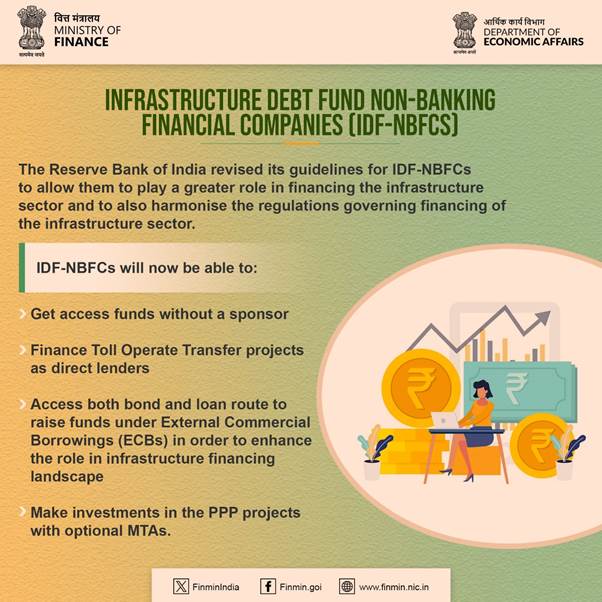
e. RBI has recently introduced updated guidelines for Infrastructure Debt FundNon-Banking Financial Companies (IDF-NBFCs)  to enable them to access funds without a sponsor, finance Toll Operate Transfer projects as direct lenders and access external commercial borrowings in order to enhance the role of IDF-NBFCs in financing the infrastructure sector and to align the regulations governing infrastructure sector financing by Non-  Banking Financial Companies (NBFCs).
 

Initiatives for Promoting PPPs:

a. VGF Scheme: Under the existing VGF Scheme, it had been observed that majority of the projects taking benefit of the scheme were from economic sectors like roads etc. In order to promote PPPs in social sector like health, education etc., the ambit of the existing VGF Scheme was expanded and the scheme was revamped in 2020 to include higher VGF support of upto 80% of CAPEX and upto 50% of OPEX for PPPs depending on project sector and contours. During 2023, EC has accorded ‘In-principle’ approval for VoC Port Project in Tuticorin, GoTN with TPC of ₹7,055 Cr and GoI VGF share of ₹1,450 Cr. Further, during 2023, Rs.410 Cr. have been disbursed under the VGF Scheme.

b. Revamping of IIPDF: The existing IIPDF was structured as a revolving fund with disbursement in the form of a refundable loan. Due to these stringent provisions, there was not even a single proposal being received under IIPDF in the past 3-4 years. In order to improve the uptake of the IIPDF, the existing fund was revamped and launched as a Central Sector Scheme on 03.11.2022 to provide support to PPP project authorities for undertaking PPP Project Preparation. During 2023, 16 projects from 11 States with TA cost of Rs.33.40 Cr. have been approved for funding under IIPDF Scheme and many more in the pipeline stage.

c. Empanelment of TAs: A long standing demand from the Central and State PSAs had been for providing a list of pre-qualified Transaction Adviser and streamlining the process of onboarding of Transaction Advisers for undertaking quality PPP project structuring. Accordingly, 12 TAs have been empanelled by DEA through an RFQ process and panel has been notified on 01.07.2022. further a Manual for the utilisation of the panel has also been issued. The TA panel has seen good uptake among states and has been utilised for over 40 PPP transactions till date.

d. Policy measures and Documents for supporting and mainstreaming PPP ecosystem such as – Reference Guide for Setting up State PPP units, Reference Guide for PPP project Appraisal and Reference Guide for Project Implementation Mode Selection-Waterfall Framework etc. were prepared and developed.

e.  IT Innovations - Revamping of the PPPININDIA website and Best Practices online portals for PPPAC, VGF, IIPDF was undertaken to streamline the application process.

f.  PPP Appraisal - As the Central Nodal authority for appraisal of PPPs, the PPPAC housed in the DEA appraised VOC Port PPP Projects with TPC of ₹7,056.00 Cr and Monetization of Telecom Tower Assets of BSNL under on Operate Maintain Transfer (OMT) Concession with TPC of Rs.4,200 Cr.

Knowledge Dissemination and promoting Cooperative Federalism:

During the period, a total of 3 Workshops were organised - Two State Outreach workshops, One workshop on ‘PPP Structuring Toolkit’. The workshops elicited good response and the impact was that the awareness of GoI schemes for promoting PPPs were disseminated and witnessed further traction.

Financial Sector Reforms
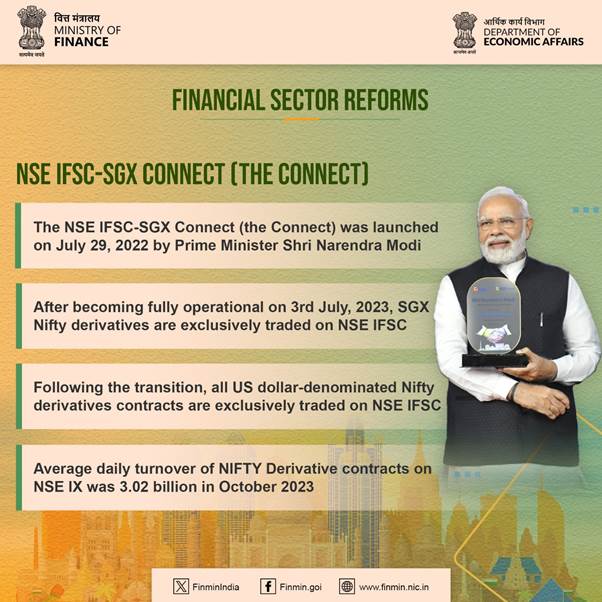
  • To onshore the offshore, the NSE IFSC-SGX Connect (the Connect) was launched on July 29, 2022 by the Prime Minister which became fully operational on 3rd July, 2023 and now SGX Nifty derivatives are exclusively traded on NSE IFSC. Following the transition, all US dollar-denominated Nifty derivatives contracts are being exclusively traded on NSE IFSC. The average daily turnover of NIFTY Derivative contracts on NSE IX (Oct 2023) was 3.02 Bn.

  • In line with the Union Budget (2022-23) announcement, enabling regulations for setting up of branches/campuses of foreign institutes have been notified. Deakin University and Wollongong University from Australia became the first two foreign universities to be granted in-principle approval to establish their branch campus at GIFT City. Both Universities are expected to commence courses in 2024.

  • Setting up Gold Spot Exchanges: SEBI issued the framework for Gold Spot Exchange on 10 January 2022 and other necessary Regulations. Bombay Stock Exchange has already launched the Electronic Gold Receipt trading in its platform in October, 2022. EGRs will cater to all kinds of market participants i.e., retail, commercial, institutional etc.

T+1 Settlement:

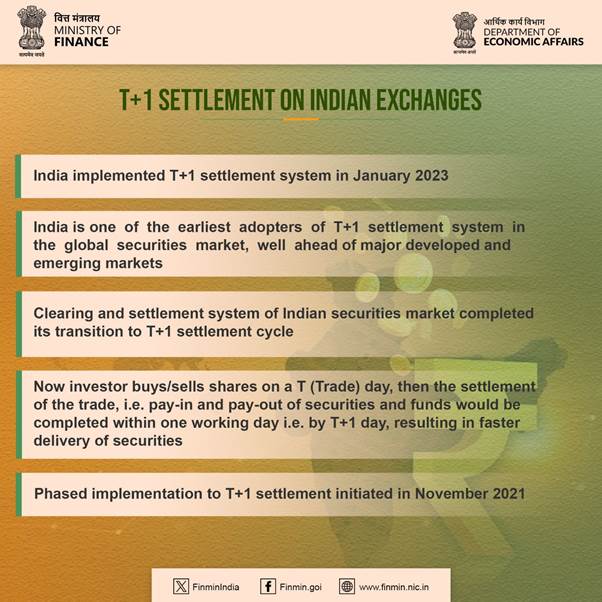
In January 2023, India,  one  of  the  earliest  adopters  of  T+1  settlement  system  in  the  global  securities  market,  well  ahead of major developed and emerging markets. The clearing and settlement system of Indian securities market completed its transition to T+1 settlement cycle based on a phased implementation which was initiated in November 2021.

So far, under the T+2 settlement cycle, trades on the Indian stock exchanges were settled within two working days. For instance, if an investor buys/sells shares on a T (Trade) day, then the settlement of the trade, i.e. pay-in and pay-out of securities and funds would be completed within two working days i.e. by T+2 day. Under the T+1 settlement cycle, the settlement of such trade will take place within one working day i.e. by T+1 day, resulting in faster delivery of securities.

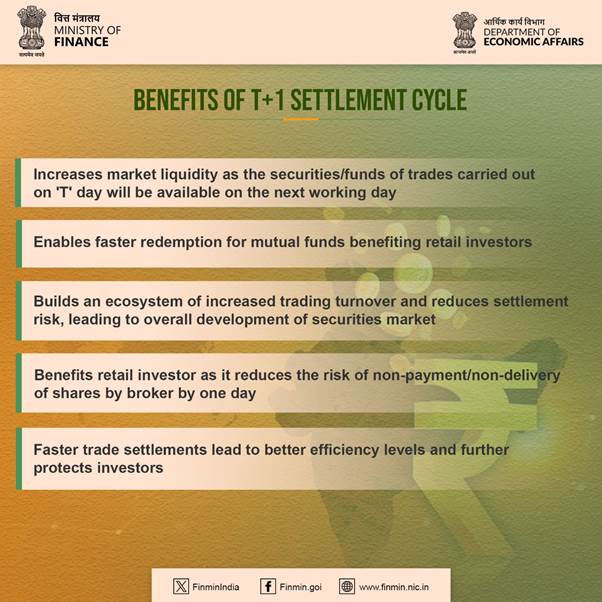
The switch to T+1 settlement cycle shall benefit investors by increasing market liquidity as the securities/funds of trades carried out on T day will be available on the next working day itself. An early settlement of funds/securities under a T+1 settlement cycle would also enable faster redemption for mutual funds, thereby benefiting the retail investors. In addition, T+1 settlement cycle include usher in a ecosystem of increased trading turnover and reduced settlement risk thereby leading to overall development of the securities market.

 India has become one of the very few large economies that switched from T+2 to T+1 settlement. The shorter settlement cycle (T+1) is in the interest of retail investor as it reduces the risk of non-payment or non-delivery of shares by the broker by one day, which is an improvement over the present system.  Further, faster trade settlements lead to better efficiency levels and further protect investors.
 

Topics

Acts Income Tax