Loading...

⚠ ✕
❮ Top
☎ Help
☰
×

By creating an account you can:

Logo TaxTMI
Call Us / Help / Feedback✕

Contact Us At :

✉ E-mail: [email protected]

✆ Call / WhatsApp at: +91 99117 96707

For more information, Check Contact Us

FAQs :

To know Frequently Asked Questions, Check FAQs

Most Asked Video Tutorials :

For more tutorials, Check Video Tutorials

Submit Feedback/Suggestion :

Email :
Please provide your email address so we can follow up on your feedback.
Category :
Description :
Min 15 characters 0/2000
Make Most of Text Search ✕
  1. Checkout this video tutorial: How to search effectively on TaxTMI.
  2. Put words in double quotes for exact word search, eg: "income tax"
  3. Avoid noise words such as : 'and, of, the, a'
  4. Sort by Relevance to get the most relevant document.
  5. Press Enter to add multiple terms/multiple phrases, and then click on Search to Search.
  6. Text Search
  7. The system will try to fetch results that contains ALL your words.
  8. Once you add keywords, you'll see a new 'Search In' filter that makes your results even more precise.
  9. Text Search
╳
Add to...
You have not created any category. Kindly create one to bookmark this item!
✕
Create New Category
Hide
Title :
Description :
❮❮ Hide
❮ Default View
Expand ❯❯
Close ✕
🔎 Filters / Advanced Search ❯
TEXT

Press 'Enter' to add multiple search terms. Rules for Better Search

Search In
Main Text + AI Text ❯
  • Main Text
  • Main Text + AI Text
  • AI Text
Category: ?
Categorized by AI
---- All Categories ---- ❯
  • ---- All Categories ----
  • Income Tax
  • GST
  • Customs, DGFT & SEZ
  • FEMA & RBI
  • Corp. Laws, SEBI & IBC
  • PMLA, Black Money & ED
  • Budget
  • News and Press Release
  • PTI News
Month:
---- All Months ---- ❯
  • ---- All Months ----
  • January
  • February
  • March
  • April
  • May
  • June
  • July
  • August
  • September
  • October
  • November
  • December
Year:
---- All Years ---- ❯
  • ---- All Years ----
  • 2026
  • 2025
  • 2024
  • 2023
  • 2022
  • 2021
  • 2020
  • 2019
  • 2018
  • 2017
  • 2016
  • 2015
  • 2014
  • 2013
  • 2012
  • 2011
Sort By: ?
In Sort By 'Default', exact matches for text search are shown at the top, followed by the remaining results in their regular order.
Relevance Default Date
☰   Show Results ❯
    DRI seizes over seven kg amphetamine and three kg cocaine as it intensifies crackdown on drug trafficking in country; three arrested
    DRI seizes 13 kg foreign-origin gold worth around Rs. 19.41 crore and dismantles a gold smuggling syndicate in Gujarat; three arrested
    Department of Commerce Organises “Leveraging FTAs” Outreach Programme in Jaipur to Strengthen Export Opportunities
    Central Bureau of Narcotics (CBN) organises five drug awareness programmes for MP youth Mission Yuva Raksha
    DRI seizes massive 137 kg consignment of crystal meth; busts coastal drug trafficking network; 4 arrested in Tamil Nadu
    Optimization of Statutory Branch Auditors (SBAs) Costs and Acceleration of Centralized Audit Frameworks
    Clarification on Legislative Developments concerning Government’s shareholding in IDBI
    Introduction of e-Invoicing Facility for Recipient Generated Self Invoices under Reverse Charge Mechanism for Domestic Supplies from Unregistered Pers...
    DFS Organises Workshop on Reservation Policy for Public Sector Banks, Public Sector Insurance Companies and Public Financial Institutions
    APEDA Facilitates Export of 1.755 MT of Organic Palmyra Jaggery Powder from Tamil Nadu to Bulgaria
    Union Commerce and Industry Minister Shri Piyush Goyal Launches National Strategic Trade Command Centre at Vanijya Bhawan
    Union Minister for Finance & Corporate Affairs Smt. Nirmala Sitharaman participates in the 114th meeting of the Development Committee Plenary of the W...
    Customs officers detect 148.67 kg hydroponic weed from Bangkok at air cargo complex at IGI Airport
    DRI seizes around 6.2 kg foreign-origin gold; busts sophisticated gold smuggling modus operandi through unaccompanied baggage; three arrested
    Central Bureau of Narcotics (CBN) U.P. Unit holds public hearing to address grievances of opium cultivators
    Directorate of Revenue Intelligence (DRI) and Central Bureau of Narcotics (CBN) destroy 2.87 Hectares (7.08 Acres) of illicit cannabis (ganja) cultiva...
    The cumulative exports (merchandise & services) during April-September 2026-27 are estimated at US$ 476.20 Billion, as compared to US$ 418.31 Billion ...
    Union Minister of Commerce and Industry Shri Piyush Goyal Calls on Youth to Drive India’s AI Journey
    CCI approves acquisition of majority stake in Tribhovandas Bhimji Zaveri Limited by GRT Jewellers (India) Private Limited
    CCI approves the acquisition of certain shareholding in Kids Clinic India by NuageLux BidCo S.à r.l
❮
❯
❯❯
Maximize Maximize Maximize
0 / 200
Expand Note
Add to Folder

No Folders have been created

+

Are you sure you want to delete "My most important" ?

NOTE:

News
Showing Results for :
Reset Filters
Results Found:
Show All Summaries Hide All Summaries
October 19, 2026
Show AI Summary
Narcotics trafficking enforcement led to airport and road interceptions, baggage concealment detection, seizures, and arrests under the NDPS framework.
Narcotics trafficking enforcement under the Narcotic Drugs and Psychotropic Substances Act, 1985, involved intelligence-led interceptions at Bengaluru and Delhi airports and near Nagpur. Passenger baggage and a backpack were examined, leading to the seizure of amphetamine and cocaine and the arrest of three passengers. The recoveries included amphetamine concealed in baggage, a ladies' suit and a backpack lining, and cocaine contained in transparent packets within baggage.
October 19, 2026
Show AI Summary
Gold smuggling syndicate enforcement traces concealed imports through airport handlers, illicit melting, and jewellery-market disposal under customs law.
Directorate of Revenue Intelligence enforcement action identified an organised gold-smuggling syndicate importing foreign-origin gold through Ahmedabad and Surat airports, followed by handover to handlers, intermediary routing, illegal melting, and cash-based supply through an Ahmedabad jewellery outlet. Further searches recovered undocumented foreign-origin gold bars and records concerning smuggled gold linked to a Dubai-based financier. The investigation identified interconnected roles across the movement, processing, and disposal of smuggled gold; three persons were arrested under the Customs Act, 1962.
October 19, 2026
Show AI Summary
Free trade agreement utilisation requires origin compliance, product standards, and documentation to secure preferential export market access.
Effective FTA utilisation requires businesses to identify eligible products and markets, assess tariff preferences and rules of origin, and meet applicable quality, certification, documentation and importing-country requirements. Preferential access under agreements with the UAE, Australia, EFTA countries and the United Kingdom remains subject to each agreement's provisions and implementation status. Tariff preferences may improve price competitiveness and facilitate participation in international supply chains where product- and partner-specific conditions are satisfied.
October 19, 2026
Show AI Summary
Drug prevention awareness initiatives engage students through health education, interactive activities and pledges supporting a drug-free society.
Mission Yuva Raksha advances preventive drug awareness and demand-reduction efforts among students through programmes at educational institutions in Madhya Pradesh. Sessions addressed the harmful effects of substance abuse on physical and mental health, education, family life and careers, supported by interactive learning activities. Participants were encouraged to avoid drugs, adopt healthy lifestyles, take pledges and support awareness initiatives in their schools, families and communities. Preventive education and youth engagement complement enforcement-oriented work through informed choices and community-based resistance to substance abuse.
October 19, 2026
Show AI Summary
Coastal narcotics trafficking enforcement addresses suspected maritime methamphetamine smuggling through seizure, asset recovery, and arrests under drug-control law.
Intelligence-led narcotics enforcement addressed suspected coastal storage and maritime transfer of methamphetamine to Sri Lanka. Searches recovered crystal methamphetamine concealed in foil packets within duffel bags, which was seized under the Narcotic Drugs and Psychotropic Substances Act, 1985. Searches also recovered suspected drug-sale proceeds and vehicles allegedly used in transportation. Persons allegedly involved in organising coastal export, transport, storage and logistics were arrested and remanded to judicial custody.
October 17, 2026
Show AI Summary
Centralised audit framework targets lower physical branch audit coverage while preserving regulatory oversight and maintaining remuneration.
For FY 2026-27, audit remuneration is to remain at existing levels. Member banks are advised to accelerate a centralised audit framework to improve cost efficiency while retaining comprehensive risk oversight. Physical statutory branch audit coverage should be reduced to cover 50% of total business, apart from centralised treasury audits. Audit coverage must align with SEBI listing and disclosure requirements and RBI guidelines, supported by a Board-approved policy for the centralised audit roadmap.
October 17, 2026
Show AI Summary
Promissory estoppel cannot prevent Government shareholding dilution where enacted legislation imposes no restriction on strategic disinvestment.
Government shareholding in IDBI may be reduced or divested because the IDBI (Repeal) Act, 2003 contains no restriction on dilution of the Government's stake. A proposed amendment to limit dilution was rejected and not incorporated into the enacted law. Parliamentary statements cannot override statutory text, and promissory estoppel cannot be invoked on the basis of legislative debate statements to prevent dilution of Government shareholding. Successive Union Budget speeches also reflected a policy of transformation and strategic disinvestment of IDBI Bank.
October 16, 2026
Show AI Summary
Recipient-generated e-invoicing under reverse charge enables eligible taxpayers to obtain IRNs for domestic unregistered supplies and imported services.
Eligible active registered recipients meeting the applicable aggregate annual turnover threshold may report recipient-generated self-invoices for specified reverse-charge domestic supplies from unregistered persons and imports of services. RCMDOM and RCMIMP must be selected as the relevant e-invoice supply types when reporting through an authorised Invoice Registration Portal. Submission and validation of prescribed invoice particulars would generate an Invoice Reference Number, subject to applicable GST provisions, notifications and e-invoice specifications.
October 16, 2026
Show AI Summary
Reservation Policy Implementation in public financial institutions was examined through capacity building, practical deliberations, and measures for consistent application.
Implementation of the Government of India's Reservation Policy across public sector banks, public sector insurance companies, sectoral regulators and public financial institutions was addressed through capacity building to support uniform and effective application. Deliberations considered practical implementation issues, operational challenges and actionable measures for consistent policy application, alongside related welfare measures and interactive discussion of implementation questions.
October 16, 2026
Show AI Summary
Organic agricultural export certification supports overseas market access for Palmyra Jaggery Powder through export-oriented producer linkages.
APEDA facilitated the maiden sea export of NPOP- and EU-certified organic Palmyra Jaggery Powder from Tamil Nadu to Bulgaria. The initiative seeks to diversify India's organic export basket, create market linkages for traditional Palmyra-based products, and improve producer access through export-oriented value chains. It covers organic cultivation and reports improved price realisation for participating farmers and the manufacturer compared with the domestic market. APEDA supports certified organic and value-added agricultural exports through market development, quality compliance, and overseas buyer linkages.
October 16, 2026
Show AI Summary
Data-driven trade governance enables integrated monitoring, application analysis and evidence-based policy inputs through the National Strategic Trade Command Centre.
The National Strategic Trade Command Centre provides an integrated analytics and visualisation platform consolidating trade data to monitor trade indicators, scheme performance, application pendency, processing timelines, regional trends and compliance-related parameters. It enables analysis across national trade performance, Regional Authorities, schemes, products, destination markets and individual applications, subject to role-based access permissions. Initial dashboards cover key trade-facilitation and regulatory processes, including SCOMET, export promotion schemes, certificates of origin, importer-exporter registration and restricted imports and exports.
October 16, 2026
Show AI Summary
Private capital mobilisation should use competitive financing, guarantees and risk mitigation to expand productive employment and productivity.
Private capital mobilisation is treated as essential to employment generation and productivity growth. Private enterprises, MSMEs and startups should remain central to job creation, with financing assessed by employment and productivity outcomes rather than volume. Guarantees, risk-mitigation instruments, local-currency financing and lower transaction costs are identified as means to expand affordable and predictable access to capital. Methodologies underlying governance indicators should be transparent, objective, evidence-based and responsive to diverse development experiences.
October 16, 2026
Show AI Summary
Narcotics smuggling through misdeclared air cargo triggered seizure, arrest, and ongoing investigation into concealed hydroponic weed imports.
A Bangkok-origin air-cargo consignment declared as PU Tubes was examined on suspicion of mis-declaration. Plastic spools were found to contain concealed cavities holding polythene-wrapped packets of compacted green substance, preliminarily identified as suspected ganja/marijuana and described as hydroponic weed. The concealed substance, packaging and concealment material were seized under the NDPS Act, 1985. One person was arrested, and follow-up searches produced leads for continuing investigation.
October 16, 2026
Show AI Summary
Unaccompanied baggage gold smuggling: concealed hardware and insider coordination triggered interception, seizure, and arrests under customs law.
Foreign-origin gold smuggling through the unaccompanied baggage channel involved concealment of gold within hardware items and coordinated retrieval through warehouse personnel and intermediaries. Intelligence-led interception resulted in recovery and seizure of foreign-origin gold concealed in a floor spring, metal locks, a grease gun and a door closer. The arrangement used a trolley secured by a pre-decided number-lock combination, with a warehouse staff member, mediator and receiver allegedly involved in delivery of the concealed gold.
October 16, 2026
Show AI Summary
Opium cultivation licensing grievance redressal advances through public hearings, administrative remedies, policy recording, and a planned cultivator helpline.
Opium cultivation licensing grievances were addressed through a public hearing where cultivators raised irrigation, climatic, single-plot licensing, and village-wise allocation concerns. Participants were informed of available legal provisions and administrative remedies. Requests for more licences and larger cultivation plots were considered, with policy matters recorded. A helpline is intended to assist cultivators during the 2026-27 licensing operation.
October 16, 2026
Show AI Summary
Illicit cannabis cultivation: crop destruction followed legal formalities, while investigation continues in a remote wildlife sanctuary.
Illicit cannabis cultivation was located by a joint DRI and CBN team across five stretches of remote, densely forested wildlife-sanctuary land near village Jamniapani, Shirpur, District Dhule, Maharashtra. The cultivation covered 2.87 hectares. Following requisite legal formalities, the cannabis crop was destroyed using a rotavator in the presence of Police and Forest Department officials. Investigation remains in progress.
October 15, 2026
Show AI Summary
Merchandise and services trade estimates show export growth, import expansion, and a wider combined trade deficit over the reporting period.
Combined trade estimates for April-September 2026-27 show exports of US$ 476.20 billion and imports of US$ 551.13 billion, resulting in a trade deficit of US$ 74.93 billion. Merchandise exports rose to US$ 259.89 billion, while merchandise imports reached US$ 437.53 billion. Estimated services exports were US$ 216.31 billion and services imports were US$ 113.60 billion, producing a services trade surplus of US$ 102.71 billion. September services figures are estimates, and specified earlier-period data were revised using quarterly balance-of-payments data.
October 15, 2026
Show AI Summary
Emerging technology skills and resilient supply chains are positioned as foundations for investment competitiveness and inclusive economic growth.
Ministerial policy priorities for India's trade, investment and technology agenda emphasise artificial intelligence, cybersecurity, technology adoption, manufacturing investment and lifelong skill development. Investment competitiveness is linked to political stability, resilient supply chains, and fair and transparent trading practices. The first tranche of a bilateral trade agreement with the United States has been finalised, while final contours and legal drafting continue before operationalisation.
October 14, 2026
Show AI Summary
Majority stake acquisition in the jewellery sector receives competition clearance for GRT Jewellers' purchase of Tribhovandas Bhimji Zaveri.
Competition Commission of India approved GRT Jewellers (India) Private Limited's proposed acquisition of a majority stake in Tribhovandas Bhimji Zaveri Limited. The transaction concerns entities operating in the Indian gems and jewellery market, including a private limited acquirer and a publicly listed target engaged in manufacturing and sale of gems and jewellery.
October 14, 2026
Show AI Summary
Minority shareholding acquisition in mother and baby healthcare receives competition clearance for a private equity-backed investment.
Competition Commission of India clearance authorises NuageLux BidCo S.a r.l. to acquire approximately 23% of the fully diluted shareholding in Kids Clinic India Ltd. The transaction constitutes an acquisition of a minority equity interest in a healthcare provider operating under the Cloudnine brand. NuageLux BidCo is a Luxembourg-incorporated private limited special purpose vehicle, ultimately controlled by Permira Holdings Ltd.

News

Back

All News

Showing Results for :
Reset Filters
No Records Found

News

Back

All News

Ministry of Finance Year Ender 2023: Department of Economic Affairs

December 27, 2023

Contents
Summary
Note

Note

-

Bookmark

Print

Print

The Year 2023 marks the beginning of ‘Amrit Kaal’ - the 25-year period beginning from the 75th anniversary of its independence on 15th August 2022, leading up to the centenary of its Independence, towards a futuristic, prosperous, inclusive and developed society, distinguished by a human-centric approach at its core.

India continues to be one of the fastest-growing economies of the world. The country's second quarter growth, 7.6 per cent, has been then highest in the world and India's GDP growth for the April-June quarter was 7.8 per cent.

Putting into effect the roadmap for making India a $5 trillion economy, the Government continues to focus on growth at the macro level and complementing it with all-inclusive welfare at the micro level, promoting digital economy and fintech, technology-enabled development, energy transition and climate action and relying on a virtuous cycle of investment and growth.

The Government has also focused on a capex-led growth strategy to support economic growth and attract investment from the private sector, increasing its capital investment outlay substantially during the last three years. Central Government’s capital expenditure has increased from 2.15 per cent of GDP in 2020-21 to 2.7 per cent of GDP in 2022-23.

To fuel such achievements, the Government has worked tirelessly for shouldering a number of bold and important socio-economic reforms. The Government has undertaken its reform drive with the spirit of inclusiveness of the marginalised and hitherto socio-economically neglected classes in the overall development process.

The success of Government’s policies is further reaffirmed and underscored when the International Organisations like the World Bank and IMF recognise India as the fastest growing Emerging Market Economy (EME) in the world and applaud the resilient and stable growth India continues to witness.

The Year 2023 is also significant as India hosted the G20 Presidency from December 1, 2022 to November 30, 2023. The 43 Heads of Delegations - the largest ever in G20 - participated in the final New Delhi Summit in September 2023.

The G20 Finance Track under India's leadership addressed critical global issues, including the strengthening of Multilateral Development Banks (MDBs) through the G20 Independent Expert Group's comprehensive report. The DEA played a pivotal role in fostering cooperation on crypto-assets, with the International Monetary Fund (IMF) and the Financial Stability Board (FSB) developing a Synthesis Paper adopted as the G20 Roadmap on Crypto Assets in October 2023.

During the G20 Indian Presidency, India steered the G20 agenda and hosted the Summit. The G20 consists of two parallel tracks: the Finance Track and the Sherpa Track. Finance Ministers and Central Bank Governors lead the Finance Track, while Sherpas lead the Sherpa Track. The high point of the Leaders’ Summit was that a global consensus was arrived at in the form of New Delhi Leaders’ Declaration (NDLD).

The department facilitated debt restructuring efforts through the Common Framework and launched the Global Sovereign Debt Roundtable, reinforcing its commitment to supporting vulnerable economies. Initiatives like the G20 Sustainable Finance Technical Assistance Action Plan (TAAP) underscored efforts to enhance capacity-building in sustainable finance, particularly for Emerging Markets and Developing Economies.

Infrastructure development also received a boost through initiatives like the Harmonised Master List (HML) of Infrastructure Sub-sectors, the National Infrastructure Pipeline (NIP), and the G20 Infrastructure Working Group's consensus on key deliverables. The DEA's strategic measures for promoting Public-Private Partnerships (PPPs) include the VGF Scheme's expansion and the revamping of the Infrastructure Investment Project Development Fund (IIPDF).

The DEA also played a role in financial sector reforms, including the launch of the NSE IFSC-SGX Connect and the transition to a T+1 settlement cycle, positioning India as a pioneer in global securities markets.

In summary, the Department of Economic Affairs in 2023 has demonstrated a proactive and inclusive approach, contributing significantly to sustainable finance, climate action, infrastructure development, and financial sector reforms on both national and international fronts.

Following are some of the major achievements of the Department of Economic Affairs, Ministry of Finance, in 2023:

Sovereign Green Bonds:

In the Union Budget 2022-23, the Government announced that, as a part of the government’s overall market borrowings in 2022-23, sovereign Green Bonds will be issued to mobilize resources for green infrastructure. The proceeds will be deployed in sector projects which help in reducing the carbon intensity of the economy.
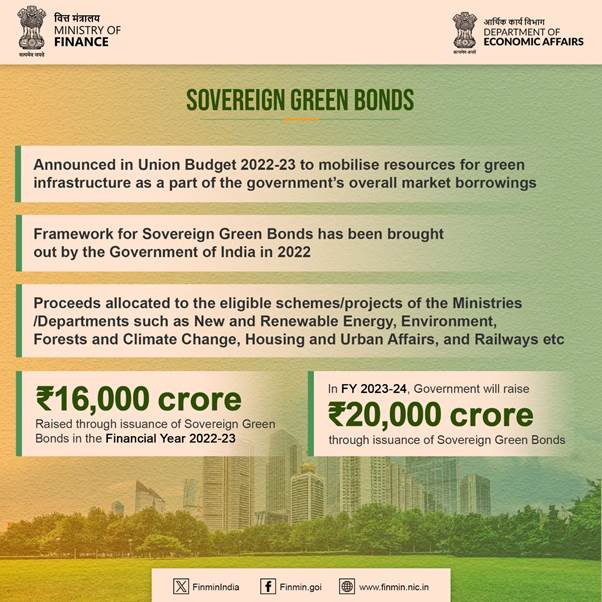
 

In pursuance of the above budget announcement, framework for Sovereign Green Bonds has been brought out by the Government of India to mobilise resources for green infrastructure projects which help in reducing the carbon intensity of the economy.

The Government has raised ₹16,000 crore, through issuance of Sovereign Green Bonds in 2023 till date and these proceeds were allocated to the eligible schemes/projects of the Ministries/Departments such as New and Renewable Energy, Environment, Forests and Climate Change, Housing and Urban Affairs, Railways etc. In the FY 2023-24, Government has decided to raise ₹ 20,000 crore through issuance of Sovereign Green Bonds.

Mahila Samman Savings Certificate (MSSC):

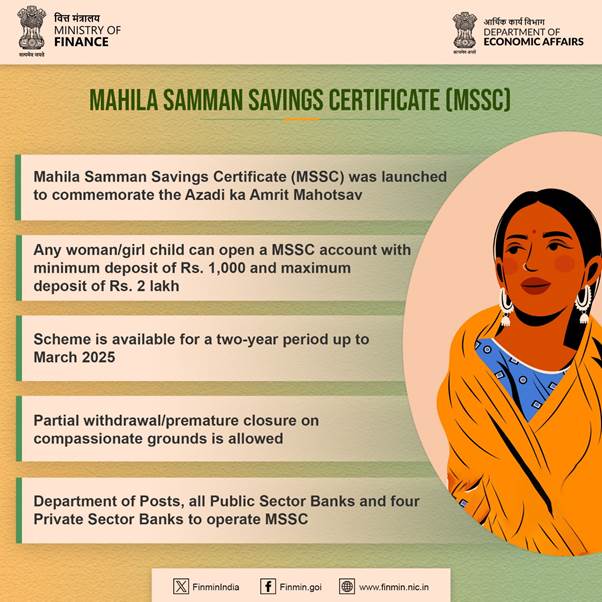
The introduction of the Mahila Samman Savings Certificate (MSSC) reflects the government's dedication to women's financial inclusion. With total number of accounts opened are at 14,83,980 with deposit of Rs. 8,630 crore as on July 2023, this initiative empowers women economically, offering an attractive 7.5% interest rate compounded quarterly.

Mahila Samman Savings Certificate (MSSC) was launched by the Government of India to commemorate the Azadi ka Amrit Mahotsav. MSSC account may be opened by women of any age group including the girl child with a minimum deposit of ₹1000/- and maximum deposit of ₹2 Lakhs for a period of two years. This scheme is available for a two-year period up to March 2025. The facility of partial withdrawal and premature closure on compassionate grounds are also available under this Scheme. Government of India has authorized Department of Posts, all Public Sector Banks and four Private Sector Banks to operate MSSC.
he maximum deposit for the senior citizen saving scheme has been enhanced from Rs 15 lakhs to Rs 30 lakhs.

The maximum deposit limit for the Post office monthly Income savings scheme is enhanced from Rs.4.5 lakh to Rs.9 lakh for a single account and from Rs.9 lakh to Rs.15 lakh for a joint account.

Sukanya Samriddhi Yojana (SSY)

The Sukanya Samriddhi Yojana (SSY) is a savings scheme initiated by the Department of Economic Affairs, Ministry of Finance, specifically designed for the benefit of the girl child. The scheme was launched as part of the ‘Beti Bachao, Beti Padhao’ campaign to promote the welfare of the girl child and encourage parents to save for their education and marriage expenses. So far, 3.2 crore accounts are active under the Scheme.

National Investment and Infrastructure Fund in 202:

  •   NIIF launched its first bilateral fund, India-Japan Fund with Japan Bank for International Cooperation (JBIC); working with U.S. International Development Finance Corporation (DFC) towards setting up of a multi-billion dollar green-transition fund

G20 Finance Track under India’s G20 Presidency, 2023:
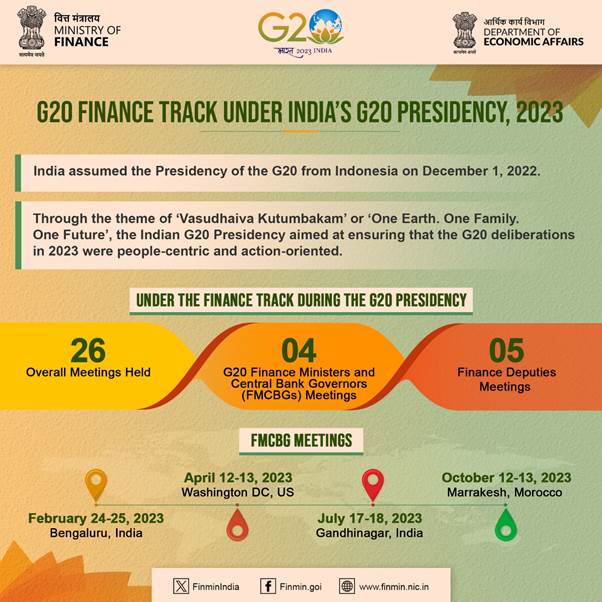
  • India assumed the Presidency of the G20 from Indonesia on December 1, 2022.
  • Through the theme of “Vasudhaiva Kutumbakam” or “One Earth. One Family. One Future”, the Indian G20 Presidency aimed at ensuring that the G20 deliberations in 2023 were people-centric and action-oriented.
  • Under the G20 Finance Track, a total of 35 meetings, including 4 meetings of G20 Finance Ministers and Central Bank Governors (FMCBG) and 5 meetings of Deputies, were held during the Presidency year. The FMCBG meetings were held on February 24-25, 2023, in Bengaluru, India; April 12-13, 2023, in Washington DC, US; July 17-18 in Gandhinagar, India; and October 12-13, in Marrakesh, Morocco.
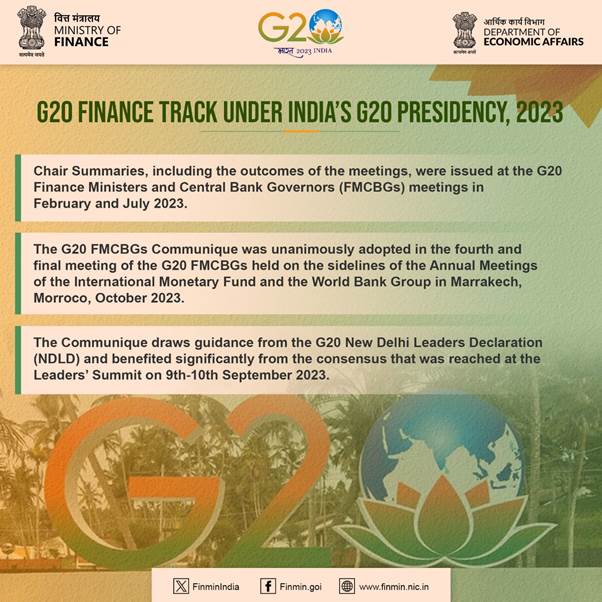
  • At the FMCBG meetings in February and July 2023, Chair Summaries including the outcomes of the meetings, were issued. In the fourth and final meeting of the G20 Finance Ministers and Central Bank Governors held on the sidelines of the Annual Meetings of the International Monetary Fund and the World Bank Group in Marrakesh in October 2023, the G20 FMCBGs unanimously adopted the G20 Finance Ministers and Central Bank Governors Communique. The Communique draws guidance from the G20 New Delhi Leaders Declaration (NDLD) and benefited significantly from the consensus that was reached at the Leaders’ Summit.

KEY OUTCOMES OF THE G20 FINANCE TRACK IN 2023: 

  • Some of the key outcomes of the Finance Track are highlighted below.

Report of the G20 Independent Expert Group on Strengthening Multilateral Development Banks (MDBs)
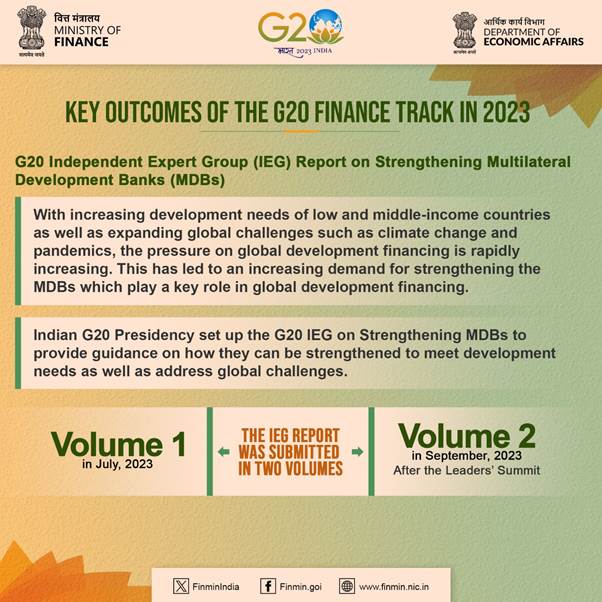
  • With increasing development needs of low and middle-income countries as well as expanding global challenges such as climate change and pandemics, the pressure on global development financing is rapidly increasing. This has led to an increasing demand for strengthening the MDBs which play a key role in global development financing.
  • The G20 Independent Expert Group (IEG) on Strengthening MDBs was set up by the Indian Presidency to provide guidance on how MDBs can be strengthened to meet the development needs as well as address global challenges. The Report was submitted in two volumes: Volume 1 in July 2023 and Volume 2 in September 2023 (after the Leaders’ Summit).
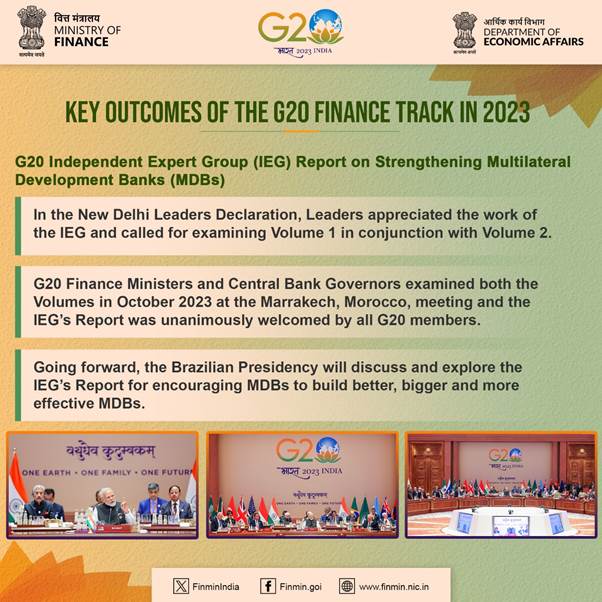
  • In the New Delhi Leaders Declaration, the Leaders appreciated the work of the IEG and called for examining Volume 1 in conjunction with Volume 2.  This was done by G20 Finance Ministers and Central Bank Governors in October 2023 and the IEG’s Report has been unanimously welcomed by all G20 members.
  • Volume 1 of the Report calls on MDBs to (i) address global challenges along with their core mandates of eliminating poverty and fostering shared prosperity; (ii) triple their sustainable lending level by 2030; and (iii) enhance their financial strength. Volume 2 of the Report provides recommendations to make MDBs better, bigger and bolder by, inter alia, suitably modifying their operating models, developing a whole-of-institution approach for mobilising more private capital and scaling up financing at an affordable cost.
  • Going forward, the recommendations of this report will be discussed in detail by the G20 under the upcoming Brazilian Presidency to explore which among these recommendations can the MDBs be encouraged to pursue to enable them to build better, bigger and more effective MDBs.


IMF-FSB Synthesis Paper on crypto-assets:
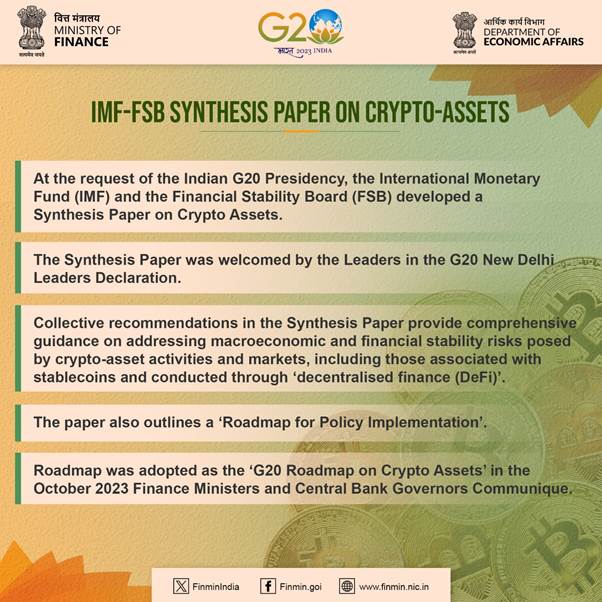
  • Crypto-assets have been in existence for more than a decade and have displayed significant volatility. Alongside their volatility, crypto-asset activities have also grown in complexity. So far, direct connections between crypto-assets and systemically important financial institutions, core financial markets, and market infrastructures have been limited. Nevertheless, they have the potential to emerge as a source of systemic risk in specific jurisdictions if they gain traction for payments or retail investments. The IMF has outlined key elements of an appropriate policy response including macroeconomic, legal and financial integrity considerations and implications for monetary and fiscal policies. In parallel, the Financial Stability Board (FSB) and standard-setting bodies (SSBs) have published regulatory and supervisory recommendations and standards to address financial stability, financial integrity, market integrity, investor protection, prudential and other risks derived from crypto-assets.
  • At the request of the Indian G20 Presidency, the IMF and the FSB have developed a Synthesis Paper which was welcomed by the Leaders in the G20 New Delhi Leaders Declaration. The collective recommendations provide comprehensive guidance to help authorities address the macroeconomic and financial stability risks posed by crypto-asset activities and markets, including those associated with stablecoins and those conducted through so-called decentralised finance (DeFi).
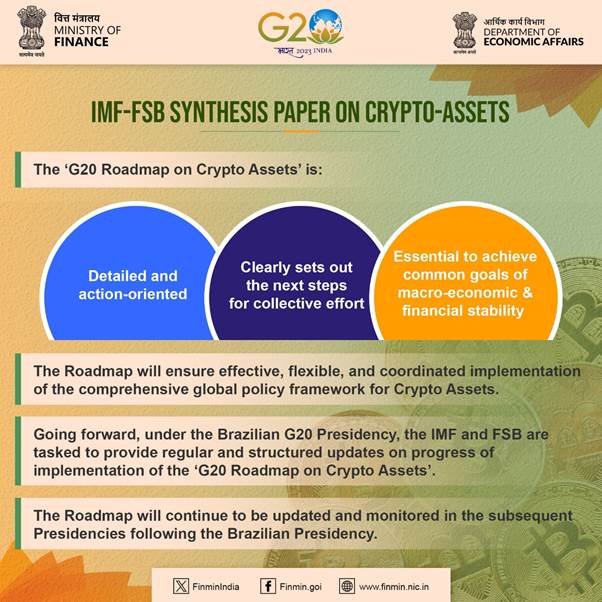
  • The paper also outlines a roadmap for policy implementation which has now been adopted as the G20 Roadmap on Crypto Assets in the October 2023 Finance Ministers and Central Bank Governors Communique. This detailed and action-oriented roadmap sets out clearly the next steps and is essential to achieve the common goals of macro-economic and financial stability and to ensure effective, flexible, and coordinated implementation of the comprehensive global policy framework for crypto assets.
  • Going forward, under the Brazilian Presidency, the IMF and FSB have been tasked to provide regular and structured updates on the progress of implementation of the G20 Roadmap on Crypto Assets. This will also continue in the subsequent Presidencies following the Brazilian Presidency.


G20 Principles for Financing Cities of Tomorrow:

  • India’s G20 Presidency has focussed on the theme of urban infrastructure to develop Cities of Tomorrow which can be visualised as action-oriented spaces which focus on bringing a positive and lasting impact on the lives of their citizens and maximising the creative potential of their resources.
  • The G20 Principles for Financing Cities of Tomorrow, endorsed during the New Delhi Leaders Summit, aim to guide the planning and financing of sustainable urban infrastructure. These principles provide a framework that holds the potential to guide Governments, MDBs and other development financing institutions in their planning and financing of sustainable urban infrastructure. Based on the preferred direction of growth of cities depending on their different stages of evolution, the key elements of these principles can be applied focusing on circular economy, investment efficiency, increasing private investments, institutional strengthening, and augmenting capacity of city administrations.
  • The upcoming Brazilian Presidency has indicated that in 2024 they will take up the issue of inclusivity in urban infrastructure drawing from the G20 Principles and elaborate on it further by focussing on poverty and inequality reduction.

Mechanisms for timely and adequate mobilization of climate finance:
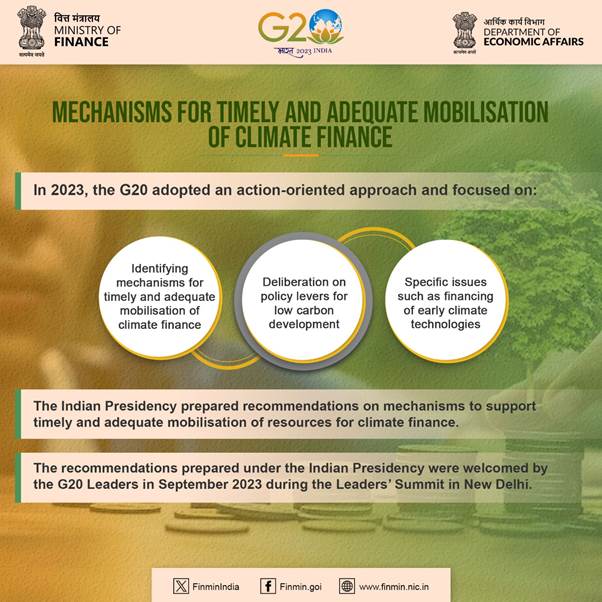
  • Finance from all sources has not yet achieved the scale to address the climate goals established by countries, especially flows directed to developing countries. The availability of adequate, credible, and predictable, new, and additional climate finance for developing countries is key to developing countries' successful implementation of climate actions under the UNFCCC and the Paris Agreement (The Standing Committee on Finance, a body under the UNFCCC, has estimated that resources in the range of US$ 5.8 trillion to US$ 11.5 trillion are required till 2030 to meet the targets set by developing countries in their Nationally Determined Contributions and other communications).
  • Till date the conversation on climate change in the G20 was focused on calling on developed countries to fulfil their climate finance commitment of USD 100 billion. In 2023, the G20 adopted an action-oriented approach and focused on identifying mechanisms for timely and adequate mobilization of climate finance, with an aim to deliberate on policy levers for low carbon development; and specific issues such as financing of early climate technologies.
  • The recommendations on the mechanisms to support timely and adequate mobilisation of resources for climate finance prepared under the Indian Presidency were welcomed by the G20 Leaders in September 2023 during the Leaders’ Summit in New Delhi. Focus has also been placed on public finance, as an important enabler of climate actions such as leveraging much-needed private finance through blended financial instruments, mechanisms, and risk-sharing facilities, to address both adaptation and mitigation efforts in a balanced manner for reaching the ambitious Nationally Determined Contributions (NDCs), carbon neutrality and net-zero considering different national circumstances. This outcome also focused on financial solutions, policies, and incentives to encourage greater private flows for the rapid development, demonstration, and deployment of green and low carbon technologies.
  • Going forward, the upcoming Brazilian Presidency of G20 has indicated that the work undertaken on climate finance in 2023 will feed into the work of the G20 Task Force on Global Mobilization against Climate Change which Brazil plans to set up in 2024.


G20 Policy Recommendations for advancing financial inclusion and productivity gains through DPI and New Financial Inclusion Action Plan 2024-26:
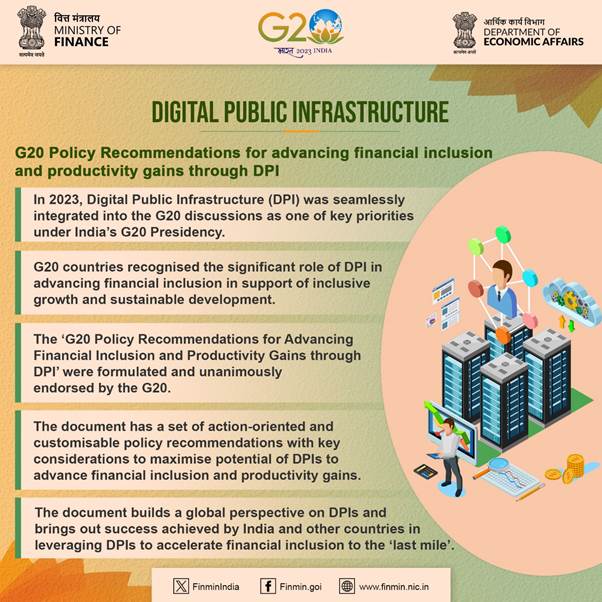
  • This year, Digital Public Infrastructure (DPI) has been seamlessly integrated into the G20 discussions as one of key priorities under India’s G20 Presidency. Members recognised the significant role of DPI in helping to advance financial inclusion in support of inclusive growth and sustainable development.
  • In this context, the G20 Policy Recommendations for advancing financial inclusion and productivity gains through DPI were formulated and unanimously endorsed by the G20. The document provides a set of action-oriented and customisable policy recommendations accompanied by a series of key considerations to help authorities maximize the potential of DPIs to advance financial inclusion and productivity gains. It also brings out the success achieved by India and other countries in leveraging DPIs to accelerate financial inclusion to the last mile and builds a global perspective on DPIs.
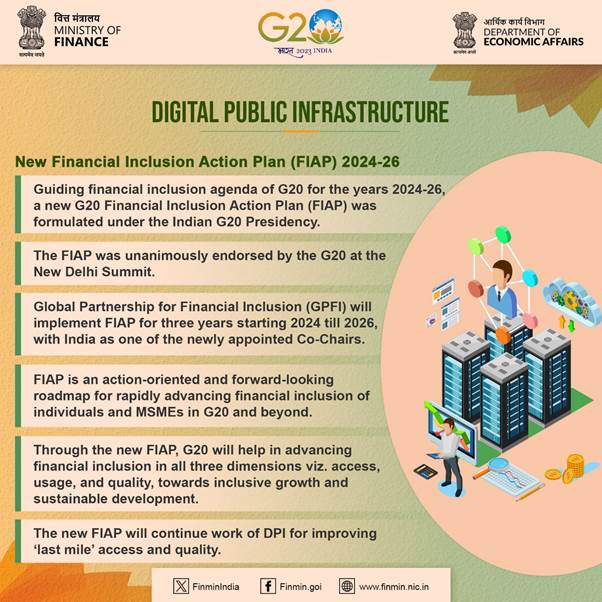
  • To guide the financial inclusion agenda under the G20 for the years 2024-26, a new G20 Financial Inclusion Action Plan (FIAP) was also formulated and unanimously endorsed by the G20 at the New Delhi Summit. The plan will be implemented by the Global Partnership for Financial Inclusion (GPFI),  for three years starting 2024, with India as one of the newly appointed Co-Chairs. The new FIAP provides an action-oriented and forward-looking roadmap for rapidly advancing financial inclusion of individuals and MSMEs in G20 and beyond by focusing on action areas which, inter alia, focus on promoting technological, innovations and digital infrastructure including DPI thereby helping countries move closer to universal financial inclusion.
  • Going forward, the G20 will continue its work for advancing financial inclusions in all three dimensions viz. access, usage, and quality, for individuals and MSMEs through innovative methods including DPI in support of inclusive growth and sustainable development. The financial inclusion work of the G20 till 2026 will be determined by the FIAP. The new FIAP will continue work of DPI for improving “last mile” access and quality inclusion for individuals and MSMEs.


Managing global debt vulnerabilities:

  • The escalation of debt issues in vulnerable economies poses significant economic risks, potentially hindering their progress towards sustainable development.
  • Under India’s G20 Presidency, the G20 members re-emphasised the importance of addressing debt vulnerabilities in low and middle-income countries. Progress has been achieved in debt treatment of both Common Framework (Zambia, Ethiopia, Ghana) and beyond Common Framework countries (Sri Lanka). The G20 has reaffirmed its commitment to uphold all the provisions outlined in the Common Framework for Debt Treatments and step up its implementation in a predictable, timely, orderly, and coordinated manner.


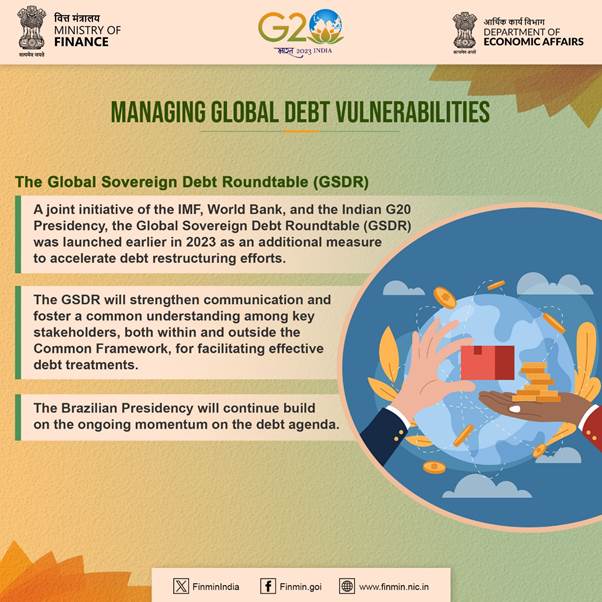
  • Additionally, to accelerate debt restructuring efforts, the Global Sovereign Debt Roundtable (GSDR), a joint initiative of the IMF, World Bank, and the Indian G20 Presidency was launched earlier this year to strengthen communication and foster a common understanding among key stakeholders, both within and outside the Common Framework, for facilitating effective debt treatments.
  • Going forward, the Brazilian Presidency is expected to continue with the ongoing momentum on the debt agenda.


G20 Sustainable Finance Technical Assistance Action Plan (TAAP):
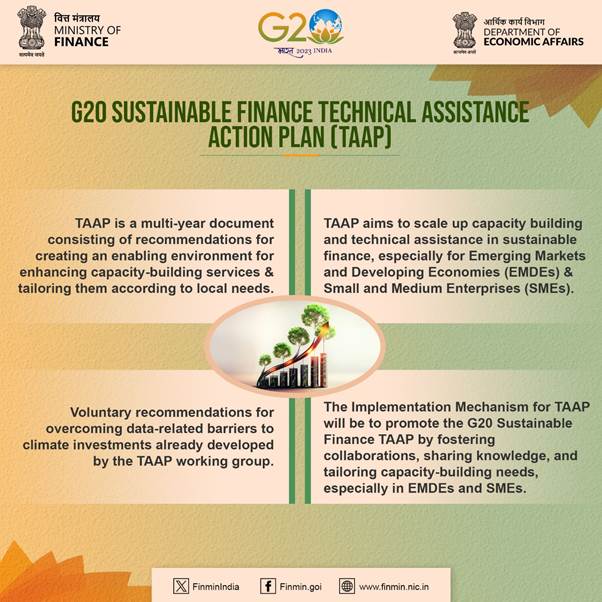
  • TAAP is a multi-year document consisting of recommendations for creating an enabling environment for enhancing capacity-building services and tailoring them according to local needs. TAAP aims to scale up capacity building and technical assistance in sustainable finance, especially for Emerging Markets and Developing Economies (EMDEs) and Small and Medium Enterprises (SMEs). The working group also developed voluntary recommendations for overcoming data-related barriers to climate investments.
  • The Implementation Mechanism for TAAP will promote the effective implementation of the G20 Sustainable Finance TAAP by fostering collaborations, sharing knowledge, and tailoring capacity-building needs, especially in EMDEs and SMEs.


INITIATIVES TO BOOST INFRASTRUCTURE INVESTMENT

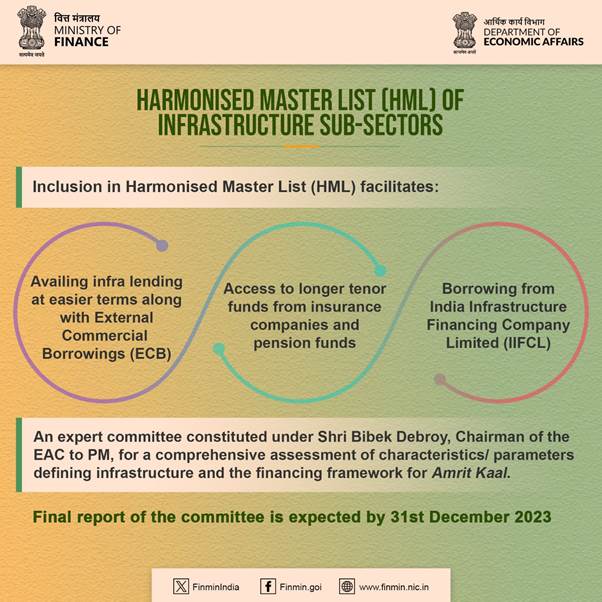
(a) Harmonised Master List (HML) of Infrastructure Sub-sectors: As of now, HML list includes 37 Infrastructure sub sectors under 5 categories i.e., 1. Transport and Logistics, 2. Energy, 3. Water and Sanitation, 4. Communication and 5. Social and Commercial Infrastructure. The inclusion of any sector in the HML enables it to avail infrastructure lending at easier terms and External Commercial Borrowings (ECB), access to longer tenor funds from insurance companies and pension funds and be eligible to borrow from

India Infrastructure Financing Company Limited (IIFCL) etc.

In accordance with para 49 of the Union Budget for FY 23-24, an expert committee has been constituted under the chairmanship of Shri Bibek Debroy, Chairman of the EAC to PM with the objective to undertake a comprehensive assessment of the characteristics/ parameters defining infrastructure and the financing framework for Amrit Kaal.

The Expert Committee had a series of stakeholder’s consultations and is finalising the recommendations and the final report of the committee is expected by 31st December 2023
 

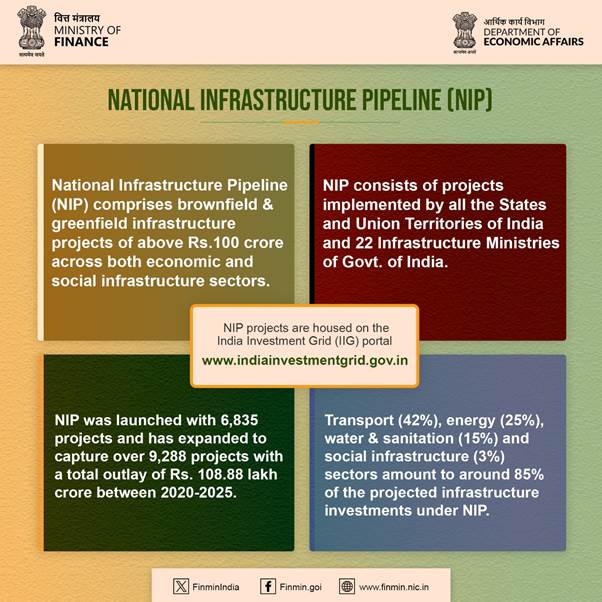
(b) National Infrastructure Pipeline (NIP): Infrastructure is one of the key enablers for economic growth. The National Infrastructure Pipeline (NIP) comprises brownfield and greenfield infrastructure projects of above INR 100 Crores across both economic and social infrastructure sectors. The pipeline consists of projects implemented by all the States and Union Territories of India and 22 Infrastructure Ministries of Govt. of India.

NIP was launched with 6,835 projects and has expanded to capture over 9,288 projects with a total project outlay of Rs 108.88 lakh cr between 2020-2025. Transport (42%), energy (25%), water & sanitation (15%) and social infrastructure (3%) sectors amount to around 85% of the projected infrastructure investments under NIP. NIP projects are housed on the India Investment Grid (IIG) portal (https://indiainvestmentgrid.gov.in/).
 

c. G20 Infrastructure Working Group: Infrastructure Working Group under the Indian G20 Presidency was able to bring a consensus amongst the members on four major deliverables namely i) the G20 Principles on Financing Cities of Tomorrow, ii) the G20/OECD Report on financing cities of tomorrow, iii) the G20/ADB Framework on Capacity Building of Urban Administrations, and iv) G20/WB Report on Enablers of Inclusive Cities.

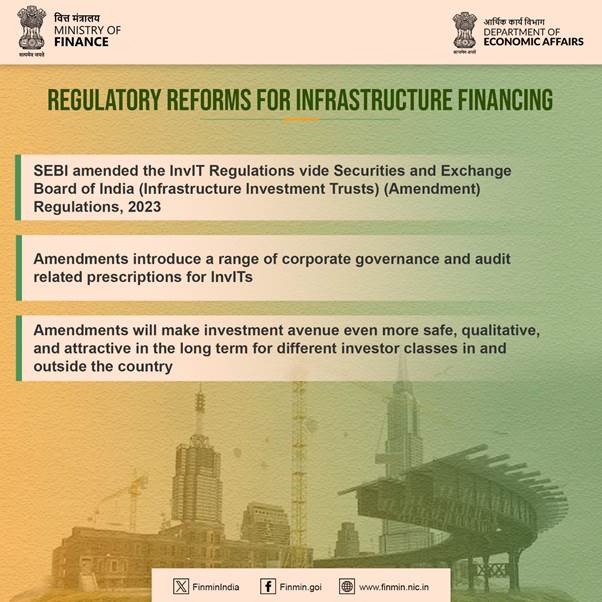
d. Regulatory reforms for infrastructure financing: SEBI amended the InvIT Regulations further in 2023 to introduce a range of corporate governance and audit related prescriptions for InvITs. This will make this investment avenue even more safe, qualitative, and attractive in the long term for different investor classes in and outside the country.
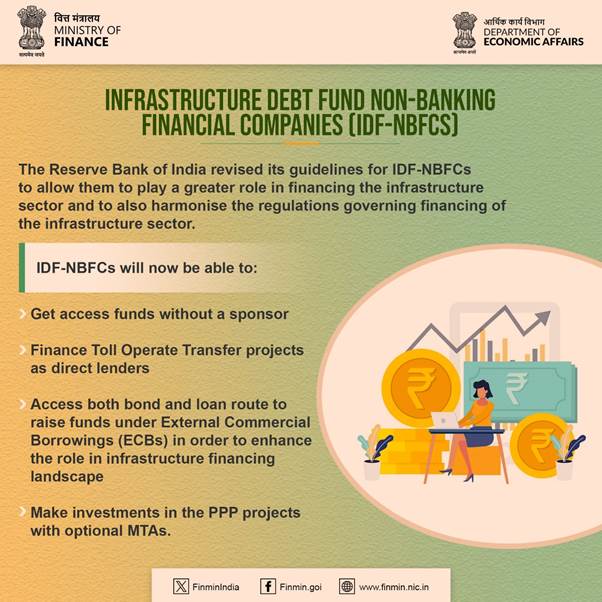
e. RBI has recently introduced updated guidelines for Infrastructure Debt FundNon-Banking Financial Companies (IDF-NBFCs)  to enable them to access funds without a sponsor, finance Toll Operate Transfer projects as direct lenders and access external commercial borrowings in order to enhance the role of IDF-NBFCs in financing the infrastructure sector and to align the regulations governing infrastructure sector financing by Non-  Banking Financial Companies (NBFCs).
 

Initiatives for Promoting PPPs:

a. VGF Scheme: Under the existing VGF Scheme, it had been observed that majority of the projects taking benefit of the scheme were from economic sectors like roads etc. In order to promote PPPs in social sector like health, education etc., the ambit of the existing VGF Scheme was expanded and the scheme was revamped in 2020 to include higher VGF support of upto 80% of CAPEX and upto 50% of OPEX for PPPs depending on project sector and contours. During 2023, EC has accorded ‘In-principle’ approval for VoC Port Project in Tuticorin, GoTN with TPC of ₹7,055 Cr and GoI VGF share of ₹1,450 Cr. Further, during 2023, Rs.410 Cr. have been disbursed under the VGF Scheme.

b. Revamping of IIPDF: The existing IIPDF was structured as a revolving fund with disbursement in the form of a refundable loan. Due to these stringent provisions, there was not even a single proposal being received under IIPDF in the past 3-4 years. In order to improve the uptake of the IIPDF, the existing fund was revamped and launched as a Central Sector Scheme on 03.11.2022 to provide support to PPP project authorities for undertaking PPP Project Preparation. During 2023, 16 projects from 11 States with TA cost of Rs.33.40 Cr. have been approved for funding under IIPDF Scheme and many more in the pipeline stage.

c. Empanelment of TAs: A long standing demand from the Central and State PSAs had been for providing a list of pre-qualified Transaction Adviser and streamlining the process of onboarding of Transaction Advisers for undertaking quality PPP project structuring. Accordingly, 12 TAs have been empanelled by DEA through an RFQ process and panel has been notified on 01.07.2022. further a Manual for the utilisation of the panel has also been issued. The TA panel has seen good uptake among states and has been utilised for over 40 PPP transactions till date.

d. Policy measures and Documents for supporting and mainstreaming PPP ecosystem such as – Reference Guide for Setting up State PPP units, Reference Guide for PPP project Appraisal and Reference Guide for Project Implementation Mode Selection-Waterfall Framework etc. were prepared and developed.

e.  IT Innovations - Revamping of the PPPININDIA website and Best Practices online portals for PPPAC, VGF, IIPDF was undertaken to streamline the application process.

f.  PPP Appraisal - As the Central Nodal authority for appraisal of PPPs, the PPPAC housed in the DEA appraised VOC Port PPP Projects with TPC of ₹7,056.00 Cr and Monetization of Telecom Tower Assets of BSNL under on Operate Maintain Transfer (OMT) Concession with TPC of Rs.4,200 Cr.

Knowledge Dissemination and promoting Cooperative Federalism:

During the period, a total of 3 Workshops were organised - Two State Outreach workshops, One workshop on ‘PPP Structuring Toolkit’. The workshops elicited good response and the impact was that the awareness of GoI schemes for promoting PPPs were disseminated and witnessed further traction.

Financial Sector Reforms
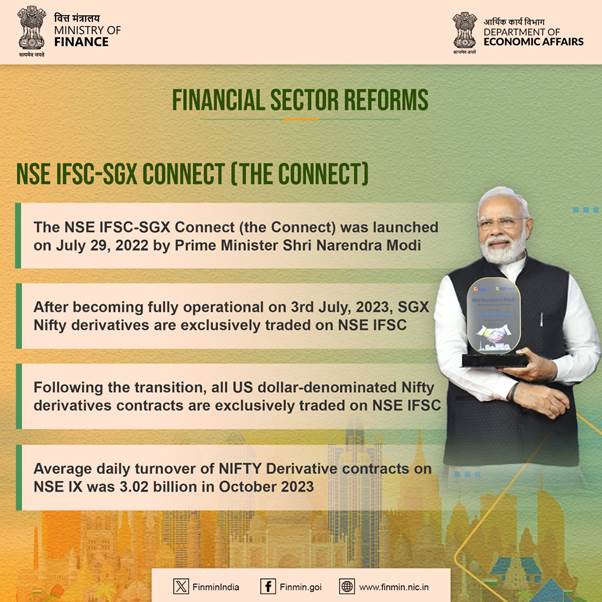
  • To onshore the offshore, the NSE IFSC-SGX Connect (the Connect) was launched on July 29, 2022 by the Prime Minister which became fully operational on 3rd July, 2023 and now SGX Nifty derivatives are exclusively traded on NSE IFSC. Following the transition, all US dollar-denominated Nifty derivatives contracts are being exclusively traded on NSE IFSC. The average daily turnover of NIFTY Derivative contracts on NSE IX (Oct 2023) was 3.02 Bn.

  • In line with the Union Budget (2022-23) announcement, enabling regulations for setting up of branches/campuses of foreign institutes have been notified. Deakin University and Wollongong University from Australia became the first two foreign universities to be granted in-principle approval to establish their branch campus at GIFT City. Both Universities are expected to commence courses in 2024.

  • Setting up Gold Spot Exchanges: SEBI issued the framework for Gold Spot Exchange on 10 January 2022 and other necessary Regulations. Bombay Stock Exchange has already launched the Electronic Gold Receipt trading in its platform in October, 2022. EGRs will cater to all kinds of market participants i.e., retail, commercial, institutional etc.

T+1 Settlement:

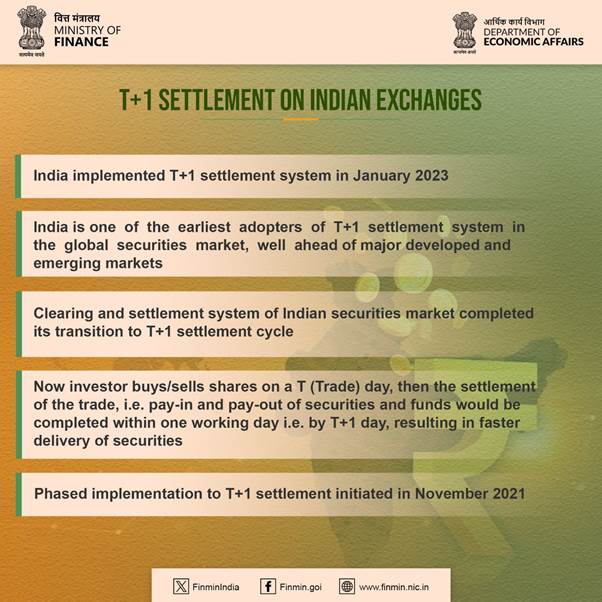
In January 2023, India,  one  of  the  earliest  adopters  of  T+1  settlement  system  in  the  global  securities  market,  well  ahead of major developed and emerging markets. The clearing and settlement system of Indian securities market completed its transition to T+1 settlement cycle based on a phased implementation which was initiated in November 2021.

So far, under the T+2 settlement cycle, trades on the Indian stock exchanges were settled within two working days. For instance, if an investor buys/sells shares on a T (Trade) day, then the settlement of the trade, i.e. pay-in and pay-out of securities and funds would be completed within two working days i.e. by T+2 day. Under the T+1 settlement cycle, the settlement of such trade will take place within one working day i.e. by T+1 day, resulting in faster delivery of securities.

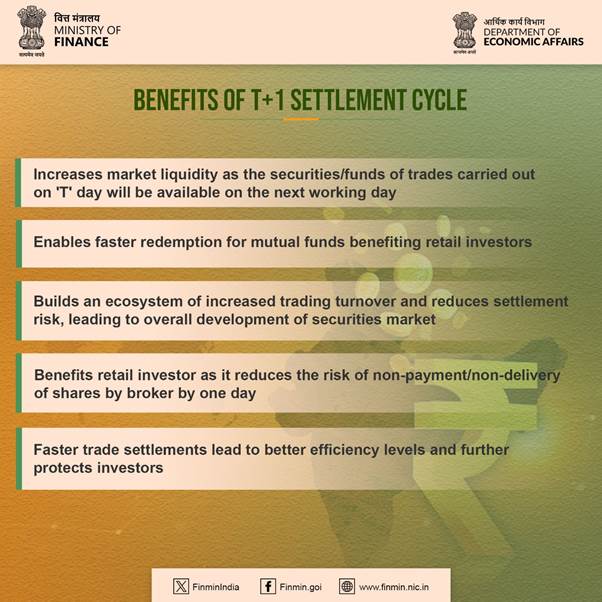
The switch to T+1 settlement cycle shall benefit investors by increasing market liquidity as the securities/funds of trades carried out on T day will be available on the next working day itself. An early settlement of funds/securities under a T+1 settlement cycle would also enable faster redemption for mutual funds, thereby benefiting the retail investors. In addition, T+1 settlement cycle include usher in a ecosystem of increased trading turnover and reduced settlement risk thereby leading to overall development of the securities market.

 India has become one of the very few large economies that switched from T+2 to T+1 settlement. The shorter settlement cycle (T+1) is in the interest of retail investor as it reduces the risk of non-payment or non-delivery of shares by the broker by one day, which is an improvement over the present system.  Further, faster trade settlements lead to better efficiency levels and further protect investors.
 

Topics

Acts Income Tax