Just a moment...

Top
Help
×

By creating an account you can:

Logo TaxTMI
>
Call Us / Help / Feedback

Contact Us At :

E-mail: [email protected]

Call / WhatsApp at: +91 99117 96707

For more information, Check Contact Us

FAQs :

To know Frequently Asked Questions, Check FAQs

Most Asked Video Tutorials :

For more tutorials, Check Video Tutorials

Submit Feedback/Suggestion :

Email :
Please provide your email address so we can follow up on your feedback.
Category :
Description :
Min 15 characters0/2000
Add to...
You have not created any category. Kindly create one to bookmark this item!
Create New Category
Hide
Title :
Description :
❮❮ Hide
Default View
Expand ❯❯
Close ✕
🔎 News - Adv. Search
TEXT SEARCH:

Press 'Enter' to add multiple search terms. Rules for Better Search

Search In:
Main Text + AI Text
  • Main Text
  • Main Text + AI Text
  • AI Text
Category: ?
Categorized by AI
---- All Categories ----
  • ---- All Categories ----
  • Income Tax
  • GST
  • Customs, DGFT & SEZ
  • FEMA & RBI
  • Corp. Laws, SEBI & IBC
  • PMLA, Black Money & ED
  • Budget
  • News and Press Release
  • PTI News
Month:
---- All Months ----
  • ---- All Months ----
  • January
  • February
  • March
  • April
  • May
  • June
  • July
  • August
  • September
  • October
  • November
  • December
Year:
---- All Years ----
  • ---- All Years ----
  • 2026
  • 2025
  • 2024
  • 2023
  • 2022
  • 2021
  • 2020
  • 2019
  • 2018
  • 2017
  • 2016
  • 2015
  • 2014
  • 2013
  • 2012
  • 2011
Sort By: ?
In Sort By 'Default', exact matches for text search are shown at the top, followed by the remaining results in their regular order.
RelevanceDefaultDate
    Govt to introduce bill in Lok Sabha to broaden NCDC's mandate for co-operative sector growth
    AAP govt indulged in large-scale financial irregularities, caused losses to exchequer: Delhi minister
    ED files chargesheets in 2 PMLA cases against Anil Ambani Group companies, ex-executives
    RJD criticises UDF govt's move not to disburse pensions through cooperative banks
    Raymond Limited reports a healthy Q1 FY27 performance
    Why Most People Choose the Wrong Savings Account And How Not to Be One of Them
    RBI has proactively helped UCBs; cooperatives should look at regulator differently: Shah
    Ministry of Agriculture, Food and Rural Affairs and aT Host '2026 K-Food Fair in New Delhi, India'
    No compromise on tackling illegal immigrants' issue: Minister Priyank Kharge
    Technology, transparency key for urban cooperative banks to stay competitive: Shah
    Paul Merchants Gets RBI Approval for Perpetual AD Category-II Licence Under Revised FEMA Framework
    IEPFA Organises Stakeholder Engagement with Nodal Officers of Companies on Integrated IEPFA Portal 2.0
    Rupee settles with 5 paise gain at 95.17 against US dollar
    India weathered Hormuz disruption without fuel shortages: Puri
    RBI invites public comments on the draft Directions on ‘Credit Valuation Adjustment (CVA) Framework’
    RBI invites comments on the draft “Reserve Bank of India (Commercial Banks – Prudential Norms on Capital Adequacy) Eleventh Amendment Directions, ...
    87 Proposals Received under BHAVYA Scheme during First Round of Phase-I
    India successfully concludes the 16th BRICS Trade Ministers' Meeting in Jaipur under its BRICS Chairship 2026
    GeM Completes a Decade of Transforming Public Procurement with Cumulative GMV Exceeding ₹20 Lakh Crore
    NEWS HIGHLIGHTS
❯❯
MaximizeMaximizeMaximize
0 / 200
Expand Note
Add to Folder

No Folders have been created

    +

    Are you sure you want to delete "My most important" ?

    NOTE:

    News
    Showing Results for :
    Reset Filters
    Results Found:
    Show All SummariesHide All Summaries
    August 9, 2026
    Show AI Summary
    Co-operative development financing would expand through direct assistance, share-capital participation and wider operational powers for sectoral support.
    National Cooperative Development Corporation (Amendment) Bill, 2026 proposes to broaden the Corporation's mandate to promote co-operative development. It would permit direct loans and grants to co-operative societies and other entities engaged in co-operative development, where funds are used for co-operative purposes. With Central Government approval, the Corporation could participate in the share capital of such entities. The proposals also expand the meaning of foodstuffs, remove geographical restrictions for industrial-goods assistance, and provide additional functional powers.
    August 9, 2026
    Show AI Summary
    GST compliance failures and electricity subsidy controls raise allegations of financial irregularities and potential losses to the public exchequer.
    Allegations based on a Comptroller and Auditor General report identified purported GST compliance failures involving outstanding tax liabilities, e-way bills generated after cancellation of GST registrations, limited bill scrutiny, non-compliance, and turnover mismatches. The allegations also concerned electricity subsidies extended to consumers with prolonged zero bills or apparent non-residence, presenting these issues as possible financial irregularities and losses to the public exchequer.
    August 9, 2026
    Show AI Summary
    Money-laundering prosecution complaints allege fund diversion through shell entities, credit-facility evergreening, layered transactions and fictitious project expenditure.
    Money-laundering prosecution complaints allege that funds from toll-road projects and credit facilities were diverted through group companies, contractors, shell entities and conduit accounts. In the toll-road matter, allegedly sham or back-dated subcontracting arrangements and subsequent documentation were used to portray transfers as genuine project expenditure. In the credit-facilities matter, fresh facilities were allegedly used to repay, rotate and evergreen earlier liabilities rather than for sanctioned end-use, with funds layered and presented as legitimate business expenditure or receipts. Attached assets are sought to be confiscated as alleged proceeds of crime.
    August 9, 2026
    Show AI Summary
    Direct Benefit Transfer pension disbursement replaces cooperative-bank doorstep delivery, while preserving home payments for beneficiaries unable to use bank accounts.
    Direct Benefit Transfer of social security and welfare pensions to Aadhaar-linked bank accounts is intended to replace cooperative-bank doorstep delivery, except for bedridden and similarly situated beneficiaries. The change addresses delays in remitting undistributed pensions, deficient record updates and reconciliation, duplicate payments, delivery incentives, and compliance with Direct Benefit Transfer norms. Criticism focuses on beneficiary access to linked commercial-bank accounts, possible minimum-balance deductions, exclusion of cooperative banks, and the effect on doorstep-delivery workers.
    August 8, 2026
    Show AI Summary
    Engineering business growth supported Raymond's first-quarter performance, with export expansion, capacity investment and net-debt-free financial flexibility.
    Raymond Limited reported unaudited first-quarter FY27 growth in total income, EBITDA and profit before tax before exceptional items, while remaining net-debt-free with a net cash surplus. Its Engineering business comprises Precision Technology & Auto Components and Aerospace & Defence. Growth in the former was attributed to export expansion, operating leverage, product mix and cost reductions. Aerospace & Defence growth was linked to production for global OEMs, portfolio expansion and increased capacity, although margins were affected by targeted research and development investment. Forward-looking statements remain subject to regulatory, political, economic and technological risks.
    August 8, 2026
    Show AI Summary
    Savings account selection requires comparison of effective interest, fees, digital service, access, and individual banking needs.
    Savings-account selection should compare effective interest returns under slab-based rates, recurring operating charges and the customer's actual banking needs. Net value depends not only on advertised rates but also on relevant minimum-balance, card, ATM, alert and transfer fees. Digital reliability, customer support, branch availability and ATM access should be assessed according to the customer's average balance, cash use, transfer frequency, travel patterns and need for in-person assistance. The suitable account is one that matches real banking behaviour.
    August 8, 2026
    Show AI Summary
    Urban cooperative bank regulation promotes licensing, governance, compliance support and cybersecurity measures to strengthen stability and depositor confidence.
    Urban cooperative banks are encouraged to recognise regulatory support through liberalised branch opening, doorstep banking, demand drafts, life certificates, dedicated regulatory coordination, enhanced gold-loan limits, one-time settlements and progress towards on-tap licensing. Sound governance is material to sectoral stability, while small-borrower lending is presented as a comparatively safe lending segment. The umbrella body can support member banks through technical expertise, compliance assistance, cybersecurity solutions and participation in a security operations centre to strengthen depositor confidence.
    August 8, 2026
    Show AI Summary
    Korean food export promotion combines buyer consultations, regulatory guidance and consumer experiences to support entry into Indian and South Asian markets.
    Korean food export promotion in India and South Asia combined business consultations with consumer-facing activities. Individual meetings connected Korean exporters with regional buyers and generated memoranda of understanding for products including frozen gimbap, ginseng wine and kombucha. Exporters received on-site guidance concerning non-tariff barriers, including food import customs clearance and certification requirements. Preparatory online sessions addressed import procedures, regulatory matters and consumer trends, while consumer events promoted Korean food through tasting, retail and experiential activities.
    August 8, 2026
    Show AI Summary
    Illegal immigration enforcement prioritises dismantling entry, documentation and employment networks while requiring citizens to report information through police channels.
    Illegal immigration enforcement involves continuous identification and verification operations, coordination with relevant officials, and confidential investigation of networks facilitating entry, identity documentation, accommodation and employment. Enquiries extend to intermediaries, contractors, Aadhaar procurement and verification practices, rather than focusing only on apprehended individuals. Citizen vigilantism, moral policing and social-media targeting of suspected migrants are discouraged because they may compromise investigations; information should instead be given through proper police channels.
    August 8, 2026
    Show AI Summary
    Technology, transparency and governance strengthen urban cooperative banks through modern customer services, depositor protection and cooperative-sector support.
    Technology adoption, transparency, sound governance and modern customer services are identified as necessary for urban cooperative banks to remain competitive. Banks are encouraged to join the sector's umbrella organisation and self-regulatory body, which provides capital, information-technology infrastructure and liquidity support. Protection of depositors' money remains a regulatory responsibility, while banks are expected to improve governance, train staff, adopt technology and enhance customer-centric services. Customer prosperity and reduced perception gaps between the central bank and urban cooperative banks are emphasised as measures to strengthen the sector.
    August 8, 2026
    Show AI Summary
    Authorised Dealer Category-II licensing expands permissible FEMA current account and foreign trade transaction services for cross-border payment customers.
    An Authorised Dealer Category-II approval under the Foreign Exchange Management (Authorised Persons) Regulations, 2026 enables Paul Merchants to undertake additional permissible non-trade current account transactions under FEMA, excluding gifts and donations, and foreign trade transactions within the applicable per-transaction limit. The approval supports foreign exchange and cross-border payment services, including overseas remittances for education, medical treatment, travel, and conference or event participation.
    August 8, 2026
    Show AI Summary
    Integrated investor claim portal modernisation advances digital KYC, streamlined verification, stakeholder-informed safeguards, and efficient investor claim settlement services.
    Integrated IEPFA Portal 2.0 is proposed to modernise investor claim processing through digital KYC, pre-filled Form IEPF-5, entitlement search, and a simplified e-Verification Report filing workflow. Stakeholder feedback included Aadhaar eKYC address validation, KYC for authorised representatives, entitlement-letter validation checks, bulk DSC and eSign functionality, integration of approved IEPF Form-4 data, lower-value share valuation using NSE and BSE data, and alerts for frequent address changes to prevent fraud.
    August 7, 2026
    Show AI Summary
    Foreign capital inflows supported the rupee despite geopolitical uncertainty, oil-price pressures, and volatile global market sentiment.
    Foreign capital inflows supported a marginal strengthening of the rupee against the US dollar despite global risk aversion arising from uncertainty surrounding negotiations affecting the Strait of Hormuz. Higher crude oil prices and weak domestic equity sentiment remained relevant pressures. Near-term currency movement was expected to depend on developments in the negotiations, weekend decisions, US employment data, the dollar index, crude oil prices, and the reported increase in foreign exchange reserves.
    August 7, 2026
    Show AI Summary
    Energy security through diversified sourcing protected fuel supplies during Hormuz disruption and supports domestic exploration and alternative fuels.
    Energy security measures based on diversified crude oil and LPG sourcing, expanded infrastructure, increased domestic LPG production and alternative fuels were presented as maintaining fuel availability during disruption of shipping through the Strait of Hormuz. Domestic resilience is also linked to support for private deep-water oil and gas exploration, opening offshore acreage, and expansion of compressed biogas and ethanol blending. Ethanol-blended petrol testing identified limited contamination instances rather than a systemic issue, while excise duty reductions were described as cushioning consumers against global fuel-price volatility.
    August 7, 2026
    Show AI Summary
    Credit valuation adjustment framework revises derivative capital requirements through flexible basic approaches, hedge recognition, and risk-sensitive counterparty treatment.
    Credit Valuation Adjustment framework revisions align CVA capital treatment with final Basel III standards. Eligible banks may use the full or reduced basic approach, while banks with an insignificant volume of non-centrally cleared derivatives may calculate their CVA capital charge at 100 per cent of the counterparty credit risk capital charge. The draft also clarifies CVA hedge recognition, introduces risk weights sensitive to sector and credit quality, and separates systematic and idiosyncratic CVA risk in the full basic approach.
    August 7, 2026
    Show AI Summary
    Leverage ratio framework amendments propose Basel-aligned capital adequacy standards, with public feedback invited on the draft directions.
    Proposed amendments to the leverage ratio framework would revise Chapter VII of the 2025 Commercial Banks Prudential Norms on Capital Adequacy Directions to implement the Basel Committee's Leverage Ratio 2017 Standard. Public comments and feedback on the draft Eleventh Amendment Directions, 2026, are invited until August 28, 2026, through the designated online platform, postal submission, or email.
    August 7, 2026
    Show AI Summary
    BHAVYA Scheme project selection uses challenge-based evaluation of infrastructure, industrial ecosystems, and policy enablers under prescribed eligibility criteria.
    BHAVYA Scheme Phase-I proposals submitted by State and Union Territory governments will be evaluated and scored under prescribed eligibility and evaluation criteria. Challenge-based project selection considers connectivity and site suitability, quality of core, value-added and social infrastructure in the detailed project report, and the industrial ecosystem and policy enablers. The Scheme guidelines provide for completion of the first-phase selection process within one year from notification.
    August 7, 2026
    Show AI Summary
    Multilateral trade cooperation preserves developing economies' policy space while advancing MSME finance, diversified value chains and digital services.
    BRICS ministers adopted measures supporting a development-centred multilateral trading system with the World Trade Organization at its core, preservation of Special and Differential Treatment, binding two-tier dispute settlement, and developing economies' policy space for food security and public stockholding. MSME measures include study of an invoice discounting mechanism and credit-assessment principles focused on cash flow rather than collateral. Value-chain measures provide for a GVC Action Plan, technical cooperation, Special Economic Zone cooperation and digitised trade documents, alongside principles for trusted cross-border digitally delivered services.
    August 7, 2026
    Show AI Summary
    Digital public procurement promotes transparent sourcing, reduced seller charges, competition monitoring and evidence-based spending oversight through an integrated marketplace.
    Government e-Marketplace digitises public procurement through a unified platform promoting transparency, efficiency, good governance and wider supplier participation. Seller-facing measures include reduced transaction charges, exemption of smaller orders, a cap on maximum transaction fees and reduced vendor assessment fees. The platform uses Artificial Intelligence and Machine Learning tools to identify suspected cartelisation, collusion and order splitting, while its digital transactional trail supports expenditure monitoring, identification of inefficiencies and evidence-based policy interventions.
    August 7, 2026
    Show AI Summary
    Criminal justice, extremist-material regulation and administrative schemes feature in reports on prosecutions, demolition practices, loan waivers and fuel policy.
    Criminal justice reports cover bail and an expedited trial in an assault prosecution, arrest for allegedly sheltering an accused, allegations of rape and murder of a minor, and claimed irregularities in a police recruitment examination. Regulatory developments include a ban on extremist literature associated with proscribed organisations and judicial disapproval of coercive demolition. Administrative coverage includes farmer loan-waiver transfers following Aadhaar authentication and debate over the E20 fuel-blending programme.

    News

    Back

    All News

    Showing Results for :
    Reset Filters
      No Records Found

      News

      Back

      All News

      whatsappJoin Channel
      Showing Results for : Reset Filters
      Customs, DGFT & SEZ

      India’s overall exports is projected to grow at 16.18 percent during April-February 2022-23 over same period last year (April-February 2021-22), with one month remaining in the current financial year.

      March 15, 2023

      Contents
      Summary
      Note

      Note

      -

      Bookmark

      Print

      Print

      India’s overall exports is projected to grow at 16.18 percent during April-February 2022-23 over same period last year (April-February 2021-22), with one month remaining in the current financial year.

      Merchandise exports registered growth of 7.55 percent during April-February 2022-23 over the same period last year (April-February 2021-22).

      Services exports remain strong and projected to grow at 30.48 percent during April-February 2022-23 over same period last year (April-February 2021-22).

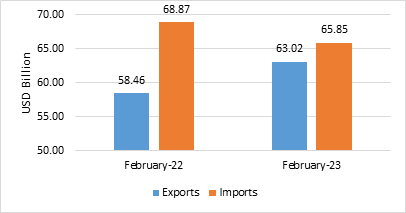
      India’s overall exports (Merchandise and Services combined) in February 2023* are estimated to be USD 63.02 Billion, exhibiting a positive growth of 7.81 per cent over the same period last year. Overall imports in February 2023* are estimated to be USD 65.85 Billion, exhibiting a negative growth of (-) 4.38 per cent over the same period last year.

      Table 1: Trade during February 2023*


      February 2023

      (USD Billion)

      February 2022

      (USD Billion)

      Merchandise

      Exports

      33.88

      37.15

      Imports

      51.31

      55.90

      Services*

      Exports

      29.15

      21.30

      Imports

      14.55

      12.97

      Overall Trade

      (Merchandise +Services) *

      Exports

      63.02

      58.46

      Imports

      65.85

      68.87

      Trade Balance

      -2.83

      -10.41

      * Note: The latest data for services sector released by RBI is for January 2023. The data for February 2023 is an estimation, which will be revised based on RBI’s subsequent release. (ii) Data for April-February 2021-22 and April-September 2022 has been revised on pro-rata basis using quarterly balance of payments data.

      Fig 1: Overall Trade during February 2023*
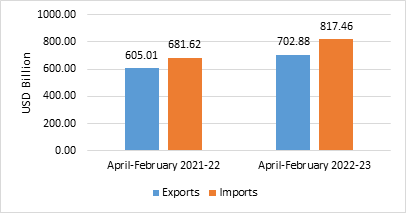
      India’s overall exports (Merchandise and Services combined) in April-February 2022-23 is estimated to exhibit a positive growth of 16.18 per cent over the same period last year (April-February 2021-22). As India’s domestic demand has remained steady amidst the global slump, overall imports in April-February 2022-23 is estimated to exhibit a growth of 19.93 per cent over the same period last year.

      Table 2: Trade during April-February 2022-23*


      April-February

       2022-23

      (USD Billion)

      April-February

       2021-22

      (USD Billion)

      Merchandise

      Exports

      405.94

      377.43

      Imports

      653.47

      549.96

      Services*

      Exports

      296.94

      227.58

      Imports

      164.00

      131.66

      Overall Trade (Merchandise+

      Services) *

      Exports

      702.88

      605.01

      Imports

      817.46

      681.62

      Trade Balance

      -114.58

      -76.62


      Fig 2: Overall Trade during April-February 2022-23*
      MERCHANDISE TRADE

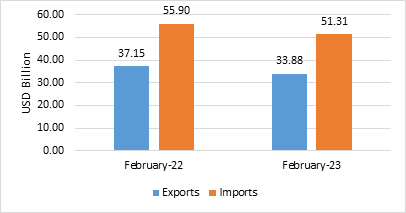
      • Merchandise exports in February 2023 were USD 33.88 Billion, as compared to USD 37.15 Billion in February 2022.
      • Merchandise imports in February 2023 were USD 51.31 Billion, as compared to USD 55.90 Billion in February 2022.

      Fig 3: Merchandise Trade during February 2023
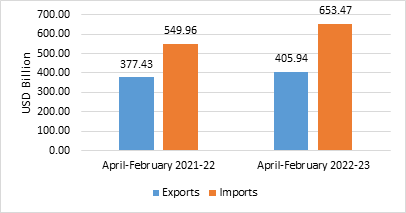
      • Merchandise exports for the period April-February 2022-23 were USD 405.94 Billion as against USD 377.43 Billion during the period April-February 2021-22.
      • Merchandise imports for the period April-February 2022-23 were USD 653.47 Billion as against USD 549.96 Billion during the period April-February 2021-22.
      • The merchandise trade deficit for April-February 2022-23 was estimated at USD 247.52 Billion as against USD 172.53 Billion in April-February 2021-22.

      Fig 4: Merchandise Trade during April-February 2022-23
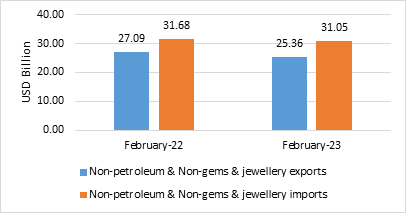
      • Non-petroleum and non-gems & jewellery exports in February 2023 were USD 25.36 Billion, compared to USD 27.09 Billion in February 2022.
      • Non-petroleum, non-gems & jewellery (gold, silver & precious metals) imports in February 2023 were USD 31.05 Billion, compared to USD 31.68 Billion in February 2022.

      Table 3: Trade excluding Petroleum and Gems & Jewellery during February 2023


      February 2023

      (USD Billion)

      February 2022

      (USD Billion)

      Non- petroleum exports

      28.96

      30.26

      Non- petroleum imports

      36.23

      40.14

      Non-petroleum & Non Gems & Jewellery exports

      25.36

      27.09

      Non-petroleum & Non Gems & Jewellery imports

      31.05

      31.68


      Note: Gems &Jewellery Imports include Gold, Silver & Pearls, precious & Semi-precious stones

      Fig 5: Trade excluding Petroleum and Gems & Jewellery during February 2023
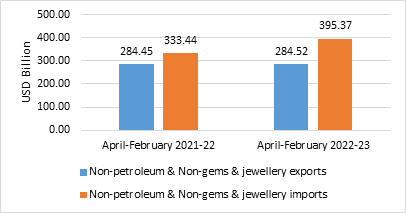
      • Non-petroleum and non-gems & jewellery exports during April-February 2022-23 was USD 284.52 Billion, as compared to USD 284.45 Billion in April-February 2021-22.
      • Non-petroleum, non-gems & jewellery (gold, silver & precious metals) imports were USD 395.37 Billion in April-February 2022-23 as compared to USD 333.44 Billion in April-February 2021-22.

      Table 4: Trade excluding Petroleum and Gems & Jewellery during April-February 2022-23

      April-February

      2022-23

      (USD Billion)

      April-February

      2021-22

      (USD Billion)

      Non- petroleum exports

      319.73

      319.77

      Non- petroleum imports

      459.99

      409.30

      Non-petroleum & Non Gems & Jewellery exports

      284.52

      284.45

      Non-petroleum & Non Gems & Jewellery imports

      395.37

      333.44

      Note: Gems &Jewellery Imports include Gold, Silver & Pearls, precious & Semi-precious stones

      Fig 6: Trade excluding Petroleum and Gems & Jewellery during April-February 2022-23
      SERVICES TRADE

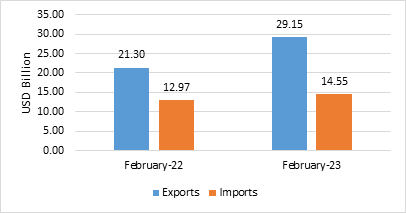
      • The estimated value of services export for February 2023* is USD 29.15 Billion, as compared to USD 21.30 Billion in February 2022.
      • The estimated value of services import for February 2023* is USD 14.55 Billion as compared to USD 12.97 Billion in February 2022

      Fig 7: Services Trade during February 2023*
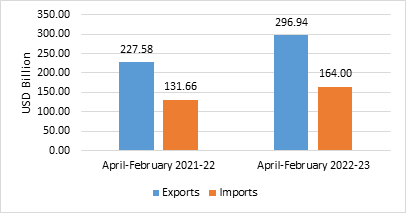
      • The estimated value of services export for April-February 2022-23* is USD 296.94 Billion as compared to USD 227.58 Billion in April-February 2021-22.
      • The estimated value of services imports for April-February 2022-23* is USD 164.00 Billion as compared to USD 131.66 Billion in April-February 2021-22.
      • The services trade surplus for April-February 2022-23*is estimated at USD 132.95 Billion as against USD 95.92 Billion in April-February 2021-22.

      Fig 8: Services Trade during April-February 2022-23*
      • In spite of strong global headwinds, with one month remaining in the current financial year, India’s overall exports is projected to grow at 16.18 percent during April-February 2022-23 over same period last year (April-February 2021-22).
      • Under merchandise exports, 14 of the 30 key sectors exhibited positive growth in February 2023 as compared to same period last year (February 2022). These include Oil Meals (220.96%), Iron Ore (51.37%), Spices (30.85%), Electronic Goods (29.85%), Fruits & Vegetables (17.42%), Gems & Jewellery (13.76%), Rice (11.75%), Ceramic Products & Glassware (11.5%), Other Cereals (10.65%), Oil Seeds (9.4%), Cereal Preparations & Miscellaneous Processed Items (5.22%), Marine Products (4.96%), Drugs & Pharmaceuticals (4.72%) and Mica, Coal & Other Ores, Minerals Including Processed Minerals (2.97%).
      • Under merchandise exports, 17 of the 30 key sectors exhibited positive growth during April-February 2022-23 as compared to the same period last financial year (April-February 2021-22). These include Electronic Goods (49.54%), Petroleum Products (49.5%), Oil Meals (44.12%), Tobacco (34.3%), Cereal Preparations & Miscellaneous Processed Items (16.12%), Rice (15.88%), Oil Seeds (13.36%), Other Cereals (12.15%), Fruits & Vegetables (11.16%), Leather & Leather Products (11.08%), Tea (10.03%), Coffee (8.17%), Ceramic Products & Glassware (7.62%), Organic & Inorganic Chemicals (3.91%), Rmg of All Textiles (3.28%), Marine Products (3.19%) and Drugs & Pharmaceuticals (3.14%).
      • Exports of Electronic goods increased by 29.85 percent during February 2023 at USD 1.93 Billion as compared to USD 1.48 Billion in February 2022. During April – February 2022-23 electronic goods exports were recorded at USD 20.70 Billion as compared to USD 13.84 Billion during the same period last year registering a growth of 49.54 percent.
      • Effect of duty withdrawal on Iron Ore is visible on India’s exports of the item which have exhibited positive growth of 51.37 percent during February 2023 over the same month in 2022.
      • Textiles, Plastic & Linoleum exports continued to decline in February 2023 because of subdued demand due to recessionary effects in major economies.
      • Under merchandise imports, 16 out of 30 key sectors exhibited negative growth in February 2023. These include Silver (-97.31%), Fertilisers, Crude & Manufactured (-59.29%), Sulphur & Unroasted Iron Pyrites (-54.27%), Gold (-44.92%), Metaliferrous Ores & Other Minerals                     (-30.16%), Cotton Raw & Waste (-26.47%), Dyeing/Tanning/Colouring Materials (-23.15%), Pearls, Precious & Semi-Precious Stones (-20.86%), Leather & Leather Products (-15.38%), Textile Yarn Fabric, Made-Up Articles (-12.29%), Electronic Goods (-11.09%), Organic & Inorganic Chemicals (-5.55%), Petroleum, Crude & Products (-4.27%), Vegetable Oil (-2.48%), Pulses (-0.13%) and Non-Ferrous Metals (-0.05%).
      • Under merchandise imports, 5 of the 30 key sectors exhibited negative growth in April-February 2022-23 as compared to the same period last financial year (April-February 2021-22). These include Gold (-29.71%), Sulphur & Unroasted Iron Pyrites (-25.83%), Pulses (-15.66%), Medicinal & Pharmaceutical Products (-10.54%) and Dyeing/Tanning/Colouring Materials              (-1.52%).
      • Gold imports, which have a bearing on the current account deficit, declined by 44.92 per cent to USD 2.63 Billion in February 2023 in comparison to USD 4.78 Billion in February 2022. Similarly, silver imports slumped by 97.31 percent from USD 0.48 Billion in February 2022 to USD 0.01 Billion in February 2023.
      • Merchandise exports growth for the period April-February 2022-23 remain impressive at 7.55 percent as against the same period last financial year (April-February 2021-22).
      • Services exports remain strong and projected to grow at 30.48 percent during April-February 2022-23 over same period last year (April-February 2021-22).

      * Link for Quick Estimates

      Topics

      ActsIncome Tax
