 TaxTMI
 Login
 TaxTMI
Login
Loading...
Press 'Enter' to add multiple search terms. Rules for Better Search

Press 'Enter' after typing page number.
Press 'Enter' after typing page number.


No Folders have been created
Are you sure you want to delete "My most important" ?
NOTE:
Press 'Enter' after typing page number.
Press 'Enter' after typing page number.

All News
Press 'Enter' after typing page number.
All News

Note

Bookmark

Share


India’s Response to Covid-19 based on Epidemiological and Economic research, Especially those Pertaining to the Spanish FLU : Economic Survey
Policy Focused on Minimizing losses in a worst case Scenario when Uncertainty is very high
Covid-19 spread restricted by 37 lakh cases and more than 1 lakh lives saved
India took 168 days to reach the Million case load and 175 days to reach the first peak
V-Shaped recovery discernible in only 7.5 per cent decline in Q2 and the recovery across all key Economic Indicators
Structural Reforms Introduced to target demand and supply side shocks in the Economy
“Saving a life that is in jeopardy is the origin of Dharma”, the Economic Survey quotes from the epic Mahabharat while explaining the India’s policy response to the pandemic wherein the trade-offs between lives and livelihood was inherent in the crisis triggered by COVID-19. The Survey, presented in Parliament today by Union Minister for Finance and Corporate Affairs, Smt. Nirmala Sitharaman, says that COVID-19 pandemic engendered a once-in-a-century global crisis in 2020 where 90 per cent of countries are expected to experience a contraction in GDP per capita and India’s efforts focused on saving lives and livelihoods by its willingness to take short-term pain for long term gain.
Research-driven policy response
The Survey mentions the huge uncertainty regarding the indicators of Case Fatality Rate (CFR) and R0 (Reproduction Number) prevailing at the onset of pandemic and showing wide variation, along with the many cases being asymptomatic. It is amidst this uncertainty that the policies must be designed with the objective of minimizing large losses by selecting the policy that would be optimal under the worst-case scenario, the survey adds.
The Survey also highlights that denser areas are more vulnerable to faster spread of the virus and this effect is stronger at the onset of the epidemic. This had an important policy implications in terms of early measures to prevent spread for a densely populated country like India with more than 130 crore people.
The response by India also drew on epidemiological and economic research, especially those pertaining to the Spanish Flu, which highlighted that an early, intense lockdown provided a win-win strategy to save lives, and preserve livelihoods via economic recovery in the medium to long-term. This strategy was also tailored to India’s unique vulnerabilities to the pandemic by quarantining people to reduce the quantity of people interacting and encouraging behavioral measures such as better sanitary practices to reduce the spread of germs
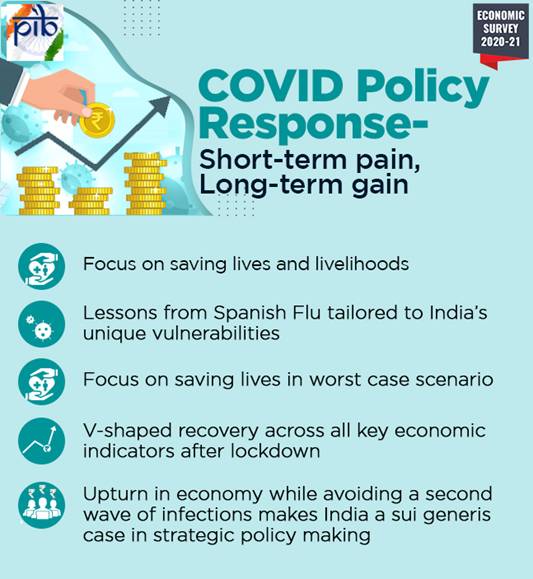
India’s response: Short-term pain, Long-term gain
The Economic Survey states the example of Spanish Flu to prove the point that the timing matters - early and extensive lockdowns leading to greater delays in reaching peak mortality, lower peak mortality rates and overall lower mortality burden. Hence the policymakers followed the approach of hedging for the worst outcome initially, and updating its response step-by-step via feedback.
The Survey also mentions that 40 day lockdown period was used for scaling up the necessary medical and para-medical infrastructure for active surveillance, expanding testing, contact tracing, isolation and management of cases and educating citizens about social distancing and masks.
Efficacy of initial lockdown
The cross-country analysis mentioned in the Survey shows that India has been able to effectively manage both the spread of COVID-19 and the fatalities with 37.1 lakh less cases than what was estimated vis-à-vis the actual cases in US being more than the estimated cases by 62.5 lakh cases. The same model estimates that more than 1 lakh lives were saved too.
An inter-State analysis also shows that Uttar Pradesh, Gujarat and Bihar have restricted the case spread the best; Kerala, Telangana and Andhra Pradesh have saved the most lives; Maharashtra has under-performed the most in restricting the spread of cases and in saving lives.
The analysis clearly shows that early and more stringent lockdowns have been effective in controlling the spread of the pandemic – both across countries and across States in India.
Flattening of curve
The Survey credits the flattening of curve and lives saved to the early lockdown imposed by the government. While most countries reached their first peak in less than 50 days, India took around 175 days. The Survey also states that India took 168 days to reach the million cases.
V-shaped recovery due to timely lockdown
While the lockdown resulted in a 23.9 per cent contraction in GDP in Q1, the recovery
has been a V-shaped one as seen in the 7.5 per cent decline in Q2 and the recovery across all key economic indicators. In line with learning from economic research, economic activity in States with higher initial stringency has also rebounded faster during the year.
Policy response for economic revival
On the economic policy front, India recognized that, unlike previous crises, the pandemic affects both demand and supply. The timing of the expenditure push, especially the capital expenditure, after the reduction in health-related curbs, manifests the strategy of stimulating ‘growth’ when it would be most effective.
The Survey states that India is the only country to have undertaken structural reforms on the supply-side at the initial stages of the pandemic. The Indian policymakers also recognized that the ‘supply’ shock induced by the pandemic would have disrupted the productive capacity of the economy which need to be strengthened to meet the pent-up demand once it resumes as any mismatch would lead to macro-economic instabilities.
During the unlock phase, demand-side measures have been announced in a calibrated manner. A public investment programme centred around the National Infrastructure Pipeline is likely to accelerate this demand push and further the recovery. Structural reforms have been initiated by the government in the fields of agriculture markets, labour laws, definition of MSMEs, mining and bringing out Production Linked incentives for 10 key sectors for enhancing the efficiency and achieving economies of scale.
The upturn in the economy while avoiding a second wave of infections makes India a sui-generis case in strategic policymaking amidst a once-in-a-century pandemic.

