
Just a moment...

Top
Help
×

By creating an account you can:

Logo TaxTMI
Call Us / Help / Feedback

Contact Us At :

E-mail: [email protected]

Call / WhatsApp at: +91 99117 96707

For more information, Check Contact Us

FAQs :

To know Frequently Asked Questions, Check FAQs

Most Asked Video Tutorials :

For more tutorials, Check Video Tutorials

Submit Feedback/Suggestion :

Email :
Please provide your email address so we can follow up on your feedback.
Category :
Description :
Min 15 characters0/2000
Make Most of Text Search
  1. Checkout this video tutorial: How to search effectively on TaxTMI.
  2. Put words in double quotes for exact word search, eg: "income tax"
  3. Avoid noise words such as : 'and, of, the, a'
  4. Sort by Relevance to get the most relevant document.
  5. Press Enter to add multiple terms/multiple phrases, and then click on Search to Search.
  6. Text Search
  7. The system will try to fetch results that contains ALL your words.
  8. Once you add keywords, you'll see a new 'Search In' filter that makes your results even more precise.
  9. Text Search
Add to...
You have not created any category. Kindly create one to bookmark this item!
Create New Category
Hide
Title :
Description :
❮❮ Hide
Default View
Expand ❯❯
Close ✕
🔎 News - Adv. Search
TEXT SEARCH:

Press 'Enter' to add multiple search terms. Rules for Better Search

Search In:
Main Text + AI Text
  • Main Text
  • Main Text + AI Text
  • AI Text
Category: ?
Categorized by AI
---- All Categories ----
  • ---- All Categories ----
  • Income Tax
  • GST
  • Customs, DGFT & SEZ
  • FEMA & RBI
  • Corp. Laws, SEBI & IBC
  • PMLA, Black Money & ED
  • Budget
  • News and Press Release
  • PTI News
Month:
---- All Months ----
  • ---- All Months ----
  • January
  • February
  • March
  • April
  • May
  • June
  • July
  • August
  • September
  • October
  • November
  • December
Year:
---- All Years ----
  • ---- All Years ----
  • 2026
  • 2025
  • 2024
  • 2023
  • 2022
  • 2021
  • 2020
  • 2019
  • 2018
  • 2017
  • 2016
  • 2015
  • 2014
  • 2013
  • 2012
  • 2011
Sort By: ?
In Sort By 'Default', exact matches for text search are shown at the top, followed by the remaining results in their regular order.
RelevanceDefaultDate
    THE FINANCE (No. 2) ACT, 2024 updated 16-08-2024
    THE FINANCE (No. 2) BILL, 2024 - AS PASSED BY LOK SABHA ON 7.8.2024
    FAQs issued by CBDT on the new capital gains tax regime proposed in the Union Budget 2024-25
    Union Budget 2024-25: Pathway to ‘Viksit Bharat’
    Union Budget 2024-25: India's Next Generation Reforms and Strategic Policies
    Union Budget 2024-25: Advancing Economic Growth through Infrastructure Initiatives
    UNION BUDGET 2024-25: BOOST TO INCLUSIVE DEVELOPMENT & SOCIAL JUSTICE
    Celebrating Income Tax Day 2024: A Journey of Transformation
    Budget 2024-25 - Customs Notifications
    HIGHLIGHTS OF THE UNION BUDGET 2024-25
    SUMMARY OF THE UNION BUDGET 2024-2025
    STATES TO BE INCENTIVIZED FOR IMPLEMENTATION OF THEIR BUSINESS REFORMS ACTION PLANS AND DIGITALIZATION: UNION BUDGET 2024-25
    FOCUS ON AGRICULTURE RESEARCH SETUP FOR RAISING PRODUCTIVITY AND DEVELOPING CLIMATE RESILIENT VARIETIES
    PROVISION OF ₹ 1.52 LAKH CRORE FOR AGRICULTURE AND ALLIED SECTOR IN UNION BUDGET 2024-25
    UNION FINANCE MINISTER SMT. NIRMALA SITHARAMAN PROPOSES EIGHT NEW MEASURES IN SUPPORT FOR PROMOTION OF MSMEs
    SCHEME FOR PROVIDING INTERNSHIP OPPORTUNITIES IN TOP COMPANIES LAUNCHED AS 5th SCHEME UNDER THE PRIME MINISTER'S PACKAGE
    NEW CENTRALLY SPONSORED SCHEME FOR SKILLING ANNOUNCED AS 4th SCHEME UNDER THE PRIME MINISTER’S PACKAGE
    GOVERNMENT TO IMPLEMENT 3 SCHEMES FOR ‘EMPLOYMENT LINKED INCENTIVE’ AS PART OF THE PRIME MINISTER’S PACKAGE
    GST A SUCCESS OF VAST PROPORTIONS, DECREASED TAX INCIDENCE ON COMMON MAN: FINANCE MINISTER
    SIMPLIFYING TAX AND IMPROVING TAX PAYER SERVICES – A CONSISTENT ENDEAVOUR OF THE GOVERNMENT: UNION FINANCE MINISTER
❯❯
MaximizeMaximizeMaximize
0 / 200
Expand Note
Add to Folder

No Folders have been created

    +

    Are you sure you want to delete "My most important" ?

    NOTE:

    News
    Showing Results for :
    Reset Filters
    Results Found:
    Show All SummariesHide All Summaries
    August 17, 2024
    Show AI Summary
    Income-tax rates, surcharge and procedural reforms updated including block assessment rules and Vivad Se Vishwas scheme.
    The Act prescribes income tax rates and graduated surcharges for assessment year 2024 25, adds a 4% Health and Education Cess, revises capital gains tax and withholding rates with date specific rates, inserts a cruise ship profit provision (section 44BBC), reduces multiple TDS/TCS rates, incorporates IFSC regulatory references, and replaces sections 148/148A with a pre notice show cause procedure. It creates a new Chapter XIV B for block assessments following search or requisition, sets computation, filing, timeline, interest and penalty rules, and establishes the Direct Tax Vivad Se Vishwas Scheme, 2024 with specified settlement percentages.
    August 8, 2024
    Show AI Summary
    Income-tax rates and surcharge changes, new search-based block assessment procedure, and targeted direct tax amendments.
    The Bill prescribes income-tax slab rates and detailed surcharge schedules for diverse taxpayer classes, imposes a 4% Health and Education Cess on tax plus surcharge, and harmonises deduction/collection/advance tax rates with these rates. It also inserts targeted withholding provisions, adjusts TDS/TCS percentages and thresholds, and sets surcharge caps for certain dividend and specified-fund incomes.
    July 25, 2024
    Show AI Summary
    Capital gains taxation simplified with uniform long term rate and new holding period rules, affecting transfers after enactment.
    The Finance (No.2) Bill, 2024 simplifies capital gains taxation by creating two holding period categories-listed securities long term after one year and other assets after two years-while immovable property and unlisted shares retain the two year rule. It removes indexation for long term gains and adopts a uniform concessional long term rate for most assets, revises rates for STT paid assets, increases the exemption threshold for certain long term gains, ensures parity between residents and non residents, and preserves existing rollover and reinvestment reliefs subject to current conditions.
    July 24, 2024
    Show AI Summary
    Skill Development policy advances employment-linked incentives and education finance reforms to boost workforce employability and industry alignment.
    The Budget prioritises coordinated skill development and employment generation through a new centrally sponsored skilling scheme with states and industry, upgrades to Industrial Training Institutes, expanded loan support with government-backed guarantees and interest subvention, and continued backing for major national programmes (PMKVY, CTS, JSS, NAPS). It pairs these supply-side measures with employment-linked incentive schemes, a large internship programme, entrepreneurship and digital skilling initiatives, sectoral upskilling for emerging industries, and targeted measures to raise women's workforce participation.
    July 24, 2024
    Show AI Summary
    Economic Policy Framework to boost productivity and market reforms, including land digitization, labour platform integration and financial sector measures.
    The Budget creates an Economic Policy Framework to enhance productivity and market efficiency across land, labour, capital and entrepreneurship, using technology and Centre-state collaboration. It mandates land digitisation measures including a Unique Land Parcel Identification Number (ULPIN) and urban GIS mapping, integration of the e Shram portal and compliance portals for labour, a financial sector strategy including a climate finance taxonomy and a legislative proposal for a Variable Capital Company, simplification of FDI rules, and introduction of NPS Vatsalya for minors' pension contributions.
    July 24, 2024
    Show AI Summary
    Infrastructure investment support emphasised to mobilise private financing and enhance state central project collaboration.
    The Union Budget 2024-25 prioritises accelerated infrastructure investment, combining sustained capital expenditure with concessional long-term interest-free loans to states, and promoting private participation via market-based financing, viability gap funding, project development support and asset monetisation through PPP frameworks and related instruments.
    July 24, 2024
    Show AI Summary
    Inclusive human resource development and social justice: budget prioritises targeted welfare, skills and regionally balanced infrastructure investments.
    The Union Budget 2024-25 prioritises Inclusive Human Resource Development and Social Justice through a saturation approach that extends education, health, skilling and livelihood measures to marginalised groups. It intensifies schemes such as PM Vishwakarma, PM SVANidhi, DAY NRLM and Stand Up India to promote certification, collateral free microcredit, digital incentives and SHG financing, while coupling these social measures with regionally targeted infrastructure projects under Purvodaya and special support commitments to Andhra Pradesh, expanded housing and rural development allocations, and increased banking access in underserved regions.
    July 23, 2024
    Show AI Summary
    Tax deductions under the revised personal income tax regime increased, with extended assessment reopening tied to escaped income thresholds.
    Budget 2024-25 increases deductions in the new personal income tax regime (including standard deduction and family pension), permits reopening of assessments beyond three years up to five years where escaped income exceeds a high threshold, and advances administrative reforms-expanded Form 26AS reporting, pre filled ITRs, the updated return facility under Section 139(8A), an e verification scheme, expansion of TDS/TCS, and a digital Dispute Resolution Committee to reduce litigation for smaller taxpayers.
    July 23, 2024
    Show AI Summary
    Customs tariff amendments extend re import/re export timeframes and revise duty and concession rules for specified goods.
    The Budget 2024-25 customs amendments revise tariff notifications to extend validity and re-import/re-export time-limits, modify Basic Customs Duty and Health Cess on specified goods, provide concessional treatment for precious metals, electronics and critical minerals, alter AIDC treatment on certain items, and introduce a New Shippers Review procedure in countervailing and injury determination rules.
    July 23, 2024
    Show AI Summary
    Employment Linked Incentive expands wage and EPFO-linked support to stimulate formal youth employment and employer hiring incentives.
    Budget 2024-25 establishes a Prime Minister's package of Employment Linked Incentive schemes providing wage and EPFO-linked support to first-time employees, manufacturing job creation incentives, and employer reimbursement to promote formal hiring; introduces a centrally sponsored skilling programme, internship placements, and expanded Mudra and MSME credit support including a collateral-free guarantee for machinery term loans; and advances tax simplification measures including merged charity exemptions, TDS rationalisation, narrowed reassessment windows with thresholds, capital gains rate revisions, expanded digitalisation of tax services, and appellate monetary limit increases to streamline litigation.
    July 23, 2024
    Show AI Summary
    Tax simplification expands relief and restructures assessments, TDS and capital gains to reduce compliance burdens and disputes.
    Comprehensive tax reform measures streamline direct and indirect tax regimes, simplifying compliance and adjusting substantive provisions: expansion of simplified personal and corporate regimes, increased standard and family pension deductions in the new personal tax regime, abolition of angel tax, limitations on reopening assessments based on an escaped income threshold, consolidation and rationalisation of TDS/TCS rules with decriminalisation of certain TDS delays, restructuring of capital gains taxation with revised holding-period classifications and increased exemption limits, targeted Customs duty recalibrations to support domestic manufacturing and policy goals, proposals for GST rationalisation and digitalisation, and dispute-resolution initiatives including expanded safe harbour rules and higher appeal thresholds.
    July 23, 2024
    Show AI Summary
    Insolvency and Bankruptcy Code reform to introduce an integrated technology platform and tribunal strengthening for faster resolutions.
    An Integrated Technology Platform will be established to improve outcomes under the Insolvency and Bankruptcy Code, ensuring consistency, transparency, timely processing and oversight; associated IBC amendments, tribunal strengthening and additional tribunals (including Companies Act-dedicated benches) are proposed to accelerate insolvency resolution, while C-PACE services will be extended for voluntary LLP closure and states will be incentivized for business reform implementation and digitalization.
    July 23, 2024
    Show AI Summary
    Agriculture research refocus to prioritise productivity and climate resilient varieties, with challenge mode funding and scaled natural farming support.
    A comprehensive review of the national agriculture research framework will prioritise productivity and climate resilient varieties, with funding allocated in challenge mode to public and private researchers under expert oversight, and the release of new high yielding climate resilient crop varieties. Concurrently, a national natural farming programme will expand farmer adoption via certification, branding, institutional and gram panchayat implementation, supported by a network of bio input resource centres, while a National Cooperation Policy aims to developmentally strengthen the cooperative sector to boost rural growth and employment.
    July 23, 2024
    Show AI Summary
    Digital public infrastructure for agriculture to register farmers, enable credit cards, and strengthen supply chains and aquaculture.
    The Budget allocates a major sum to agriculture with a focus on deploying Digital Public Infrastructure to register farmers and lands, conduct digital Kharif crop surveys in selected districts, and enable Jan Samarth linked Kisan Credit Cards; it promotes Farmer Producer Organizations, cooperatives and start ups for vegetable supply chains and large scale clusters, advances a strategy for self reliance in oilseeds, and provides financial support for a network of Nucleus Breeding Centres for shrimp with financing facilitation through NABARD.
    July 23, 2024
    Show AI Summary
    Credit Guarantee Scheme for MSMEs expands collateral-free term loan support and strengthens credit during stress periods.
    A package of measures strengthens MSME finance and market access by establishing a self-financing credit guarantee scheme for collateral-free term loans in manufacturing, a government-promoted guarantee fund to sustain credit during stress periods, and expansion of bank and SIDBI credit outreach. PSBs will develop in-house digital-footprint based credit assessment models to include enterprises without formal accounts, Mudra loan limits for repeat creditworthy entrepreneurs are increased, buyer onboarding thresholds on trade receivables platforms are reduced to improve working capital access, and infrastructure for food safety and e-commerce export hubs will be supported.
    July 23, 2024
    Show AI Summary
    Government internship scheme offers year long placements with monthly allowance and employer CSR contribution requirement for a nationwide youth cohort.
    A national internship programme will place a large youth cohort in 500 top companies over five years for twelve month industry placements. Participants will receive a monthly internship allowance and a one time assistance payment to support living costs. Host companies are expected to bear training costs and to contribute a portion of internship costs from their Corporate Social Responsibility funds, embedding private sector financing and training obligations into the scheme.
    July 23, 2024
    Show AI Summary
    Model Skill Loan revision expands government backed trainee financing to improve access to industry aligned vocational training.
    A new Centrally Sponsored Scheme announced as the fourth scheme under the Prime Minister's package will expand vocational skilling in partnership with State governments and industry, upgrade Industrial Training Institutes in a hub and spoke model oriented to measurable outcomes, and align course content to industry and emerging needs. The Model Skill Loan Scheme will be revised to enable larger trainee loans backed by a government promoted fund guarantee to widen access to skilling finance.
    July 23, 2024
    Show AI Summary
    Employment-linked incentives to boost formal hiring via EPFO enrolment, wage support for first-time hires and employer contribution subsidies.
    Implementation of three schemes creates an incentive framework tied to EPFO enrolment to promote formal employment: Scheme A provides a one-month wage via direct benefit transfer to first-time EPFO registrants within a specified salary ceiling; Scheme B subsidises EPFO contributions for both first-time employees and employers in manufacturing during the initial four years of employment on a prescribed scale; Scheme C reimburses employers a fixed monthly portion of EPFO contribution for additional employees across sectors within a salary ceiling for two years. Eligibility depends on EPFO registration and incremental job creation.
    July 23, 2024
    Show AI Summary
    GST amendments ease compliance and appeals, exclude extra neutral alcohol from central tax and relax input tax credit rules.
    Amendments simplify GST compliance and dispute resolution: Extra Neutral Alcohol is excluded from central tax with parallel IGST/UTGST changes; a new regularisation power covers non-levy or short-levy due to prevailing trade practice; input tax credit time limits are relaxed and a common deadline for demand notices and orders is set; the window to secure reduced penalties by paying tax with interest is extended. Pre-deposit requirements for appeals are lowered and Tribunal filing timelines adjusted, while the government may notify the Appellate Tribunal for anti-profiteering cases.
    July 23, 2024
    Show AI Summary
    Reassessment rules tightened, tax services digitalized and a new dispute resolution scheme announced to curb litigation.
    A statutory simplification program includes a comprehensive six month review of the Income tax Act, tightened reassessment and search time limits, and full digitalization of remaining GST, Customs and Income tax services within two years. Compliance changes merge charitable exemption regimes, rationalize and reduce multiple TDS rates, permit TCS credit against salary TDS, and decriminalize TDS delay until statement filing. The Vivad se Vishwas Scheme, 2024 is announced for pending appeals, monetary appeal thresholds are raised, and safe harbor and transfer pricing procedures will be expanded and streamlined.

    News

    Back

    All News

    Showing Results for :
    Reset Filters
      No Records Found

      News

      Back

      All News

      whatsappJoin Channel
      Showing Results for : Reset Filters

      Union Budget 2024-25: Pathway to ‘Viksit Bharat’

      July 24, 2024

      Contents
      Plus +
      Summary
      Note

      Note

      -

      Bookmark

      Print

      Print

      Prioritizing Skill Development for Employment Growth

      The Union Budget 2024-25 outlines a comprehensive strategy to achieve 'Viksit Bharat' by focusing on nine key priorities that aim to create abundant opportunities for all citizens. Together, these initiatives are designed to propel India towards a developed nation status.
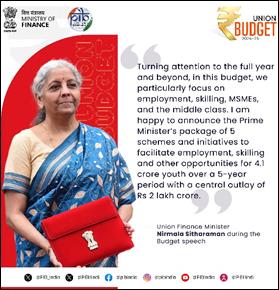
      1. Productivity and resilience in Agriculture

      Image

      1. Employment & Skilling
      1. Inclusive Human Resource Development and Social Justice
      1. Manufacturing & Services
      1. Urban Development 
      1. Energy Security
      1. Infrastructure
      1. Innovation, Research & Development and
      1. Next Generation Reforms

      The Union Budget 2024-25 prioritizing skilling and employment highlights the crucial role these aspects play in nation-building. Skilling equips the workforce with the necessary competencies to meet industry demands, fostering innovation and productivity. Employment not only ensures economic stability but also empowers individuals, enhancing their quality of life and contributing to overall societal progress.

      With one of the youngest populations, a median age of 28, India can harness its demographic dividend by nurturing a workforce that is equipped with employable skills and prepared for the needs of the industry. Sixty-five per cent of India’s fast-growing population is under 35, and many lack the skills needed by a modern economy. Estimates show that about 51.25 per cent of the youth is deemed employable. However, it must be noted that the percentage has improved from around 34 per cent to 51.3 per cent in the last decade.
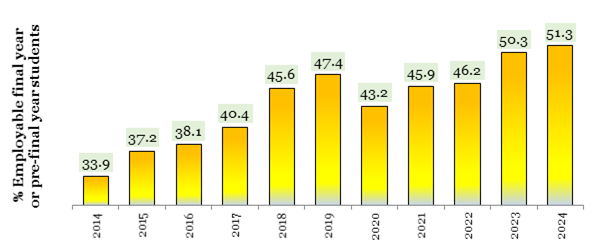
      Source: India Skills Report, Wheebox

      This sets the stage to discuss various government schemes and initiatives aimed at bolstering skill development and bridging the employability gap among India's burgeoning young population.

      Government's Focus and Commitment Towards Skill Development
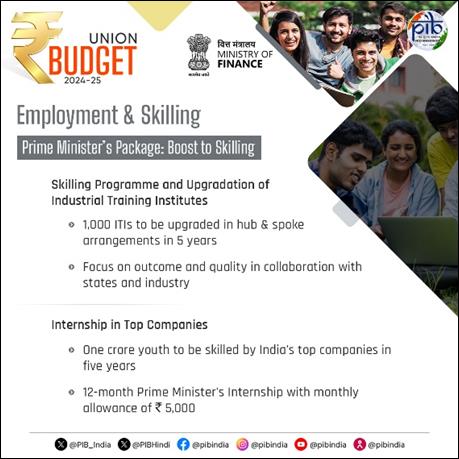
      The Government of India has demonstrated a strong commitment to skill development through various comprehensive initiatives aimed at enhancing employability and fostering entrepreneurship. Under the Union Budget 2024-25, a notable highlight is the announcement of a new centrally sponsored scheme under the Prime Minister’s package, in collaboration with state governments and industry. This scheme aims to skill 20 lakh youth over five years and upgrade 1,000 Industrial Training Institutes (ITIs).

      Additionally, the Model Skill Loan Scheme will be revised to facilitate loans up to ₹7.5 lakh with government-backed guarantees, benefiting 25,000 students annually. For those ineligible for existing schemes, financial support for loans up to ₹10 lakh for higher education in domestic institutions will be provided, with e-vouchers offering annual interest subvention of 3% for 1 lakh students each year.

      In alignment with these new measures, the government continues to support established programs. The National Policy on Skill Development & Entrepreneurship (NPSDE) continues to bridge gaps, improve industry engagement, and expand apprenticeship opportunities. Pradhan Mantri Kaushal Vikas Yojana (PMKVY) has successfully trained over 1.42 crore individuals since 2015, integrating over 1,000 educational institutions as Skill India Centres. The Craftsmen Training Scheme (CTS), with 14,955 ITIs, focuses on long-term vocational training, showing significant female participation growth. Jan Shikshan Sansthan (JSS) targets non/neo-literates, having trained 26.36 lakh individuals from FY19 to FY24, with women constituting 82% of beneficiaries.

      The National Apprenticeship Promotion Scheme (NAPS) has engaged 32.38 lakh apprentices and increased industry participation, highlighting substantial growth in female apprentices. Entrepreneurship training is bolstered by institutions like the National Institute for Entrepreneurship and Small Business Development (NIESBUD) and the Indian Institute of Entrepreneurship (IIE), which have collectively trained 4.64 lakh individuals from FY19 to FY24. The Skill India Digital Hub launched in August 2023, enhances access to skilled resources and integrates multiple government initiatives, engaging over 60 lakh learners.

      Targeted skilling efforts extend to emerging sectors such as Green Hydrogen and the PM Vishwakarma initiative, which upskill diverse populations. Skilling India at global standards is advanced through Skill India International Centers and international partnerships with countries like Australia, Germany, etc., promoting mutual recognition of qualifications and international mobility. The National Skill Development Corporation (NSDC) drives industry collaboration through innovative finance mechanisms like the Skill Impact Bond, which has trained and placed thousands of youths, including a significant proportion of women. The Directorate General of Training (DGT) partners with major corporations to provide industry-relevant skills training, preparing trainees for Industry 4.0 and beyond.

      In conclusion, while India faces significant challenges with its skill gap, the government's proactive initiatives have shown progress in bridging this divide These efforts address talent shortages and prepare India's youth for a global economy, emphasizing the need for sustained investment and collaboration.

      Efforts to Boost Employment
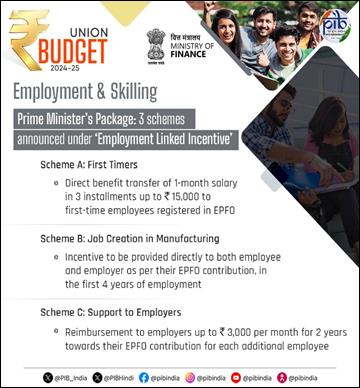
      The government has unveiled a robust package to bolster employment and skill development, targeting 4.1 crore youth over five years. This includes three Employment-Linked Incentive Schemes to enhance job creation and support employees and employers. Scheme A - First Timers offers up to ₹15,000 in three installments for first-time employees registered with EPFO, encouraging new workforce entrants. Scheme B - Job Creation in Manufacturing provides incentives for EPFO contributions for both employees and employers in the first four years of employment, fostering job creation in the manufacturing sector. Scheme C - Support to Employers reimburses up to ₹3,000 per month for two years towards EPFO contributions for each additional employee, easing the financial burden on employers and promoting workforce expansion. Further, a new scheme for internships will provide opportunities for 1 crore youth in 500 top companies, offering valuable industry exposure and experience.
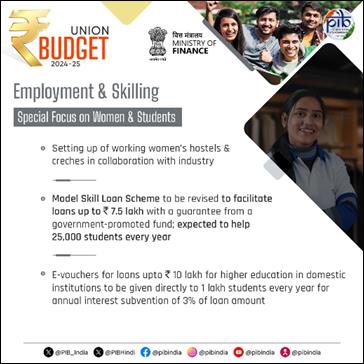
      The government is also taking significant steps to facilitate higher participation of women in the workforce. This includes establishing working women hostels and crèches in collaboration with industry partners, organizing women-specific skilling programs to enhance their employability, and promoting market access for women-led Self-Help Group (SHG) enterprises, empowering women economically and socially.

      Through these initiatives, the government is not only addressing immediate employment needs but also building a sustainable framework for long-term skill development and job creation. This comprehensive approach aims to equip India's youth with the necessary skills and opportunities to thrive in a rapidly evolving global economy, thereby maximizing the nation's demographic dividend.

      Topics

      ActsIncome Tax
