Development agreements require legal possession or effective enjoyment for capital gains transfer; permissive possession and deferred consideration de...
Prolonged sterilisation of development rights supports capital-gains treatment, while business-income disallowances cannot govern capital-gains comput...
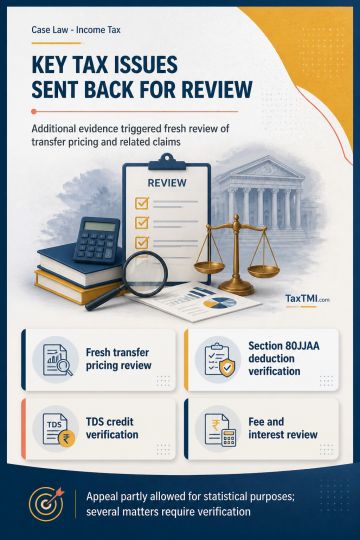
Additional evidence in transfer pricing dispute leads to fresh examination, while tax deductions, TDS credit, fee and refund interest require verifica...
Category II AIF pass-through taxation preserves non-business income character; investment receipts cannot be reclassified without applying recognised ...
The ITAT upheld deletion of transfer pricing adjustments on captive power supplied to eligible manufacturing units for section 80-IA purposes, applying the Supreme Court principle that the relevant market value is the rate charged by the State Electricity Board or distribution company to industrial consumers, not the regulated or contracted surplus-power rate. It accepted the annual landed cost paid by the manufacturing units as the proper benchmark and rejected the Revenue's challenge. The Tribunal also sustained allocation of common head office expenses on the fixed-asset ratio, holding that the Revenue had followed the same method in earlier years and no change in facts or law justified a profitability-based allocation. All four Revenue appeals were dismissed.
The ITAT upheld deletion of transfer pricing adjustments on captive power supplied to eligible manufacturing units for section 80-IA purposes, applying the Supreme Court principle that the relevant market value is the rate charged by the State Electricity Board or distribution company to industrial consumers, not the regulated or contracted surplus-power rate. It accepted the annual landed cost paid by the manufacturing units as the proper benchmark and rejected the Revenue's challenge. The Tribunal also sustained allocation of common head office expenses on the fixed-asset ratio, holding that the Revenue had followed the same method in earlier years and no change in facts or law justified a profitability-based allocation. All four Revenue appeals were dismissed.
Note: It is a system-generated summary and is for quick reference only.
 TaxTMI
 of 4805

















 Join Channel


 TaxTMI
