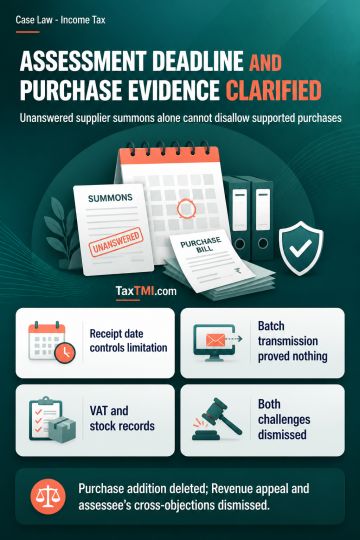
Limitation for consequential assessments runs from prescribed authority receipt, while verified purchases cannot be disallowed merely for unanswered s...
Higher depreciation for qualifying commercial vehicles, exempt-income disallowance, research deduction verification, and club-expense treatment clarif...
Charitable registration renewal cannot become an assessment of receipts, profitability or annual exemption compliance, requiring renewal and donation ...
AMP expenditure for own business is not an international transaction without an associated-enterprise arrangement, eliminating transfer pricing adjust...
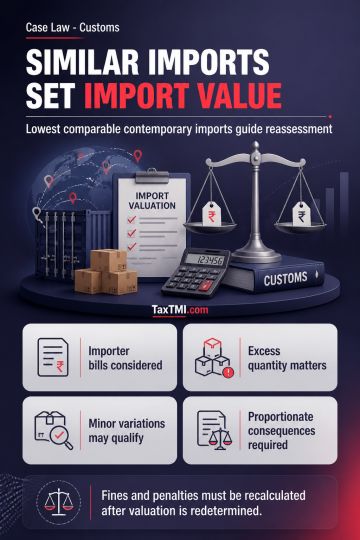
Customs valuation must use comparable contemporary imports, while confiscation fines and penalties require proportionate recalculation on reassessed v...
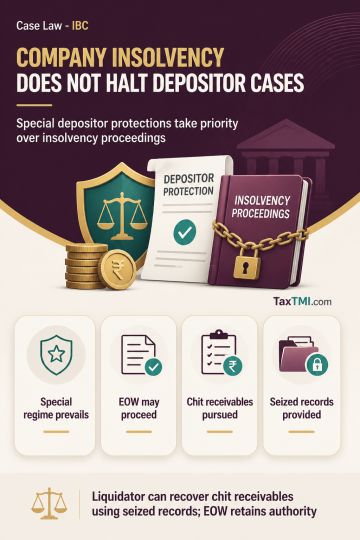
Depositor-protection proceedings prevail over corporate insolvency, while liquidators may recover chit receivables using copies of seized company reco...
The ITAT upheld deletion of transfer pricing adjustments on captive power supplied to eligible manufacturing units for section 80-IA purposes, applying the Supreme Court principle that the relevant market value is the rate charged by the State Electricity Board or distribution company to industrial consumers, not the regulated or contracted surplus-power rate. It accepted the annual landed cost paid by the manufacturing units as the proper benchmark and rejected the Revenue's challenge. The Tribunal also sustained allocation of common head office expenses on the fixed-asset ratio, holding that the Revenue had followed the same method in earlier years and no change in facts or law justified a profitability-based allocation. All four Revenue appeals were dismissed.
The ITAT upheld deletion of transfer pricing adjustments on captive power supplied to eligible manufacturing units for section 80-IA purposes, applying the Supreme Court principle that the relevant market value is the rate charged by the State Electricity Board or distribution company to industrial consumers, not the regulated or contracted surplus-power rate. It accepted the annual landed cost paid by the manufacturing units as the proper benchmark and rejected the Revenue's challenge. The Tribunal also sustained allocation of common head office expenses on the fixed-asset ratio, holding that the Revenue had followed the same method in earlier years and no change in facts or law justified a profitability-based allocation. All four Revenue appeals were dismissed.
Note: It is a system-generated summary and is for quick reference only.
 TaxTMI
  TaxTMI
 of 4811















 Join Channel