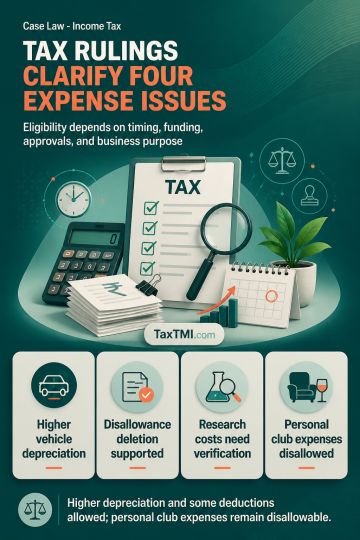
Higher depreciation for qualifying commercial vehicles, exempt-income disallowance, research deduction verification, and club-expense treatment clarif...
Charitable registration renewal cannot become an assessment of receipts, profitability or annual exemption compliance, requiring renewal and donation ...
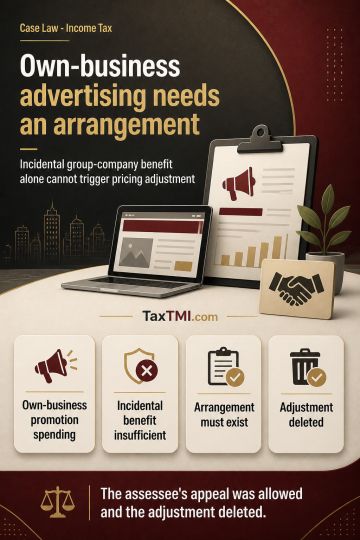
AMP expenditure for own business is not an international transaction without an associated-enterprise arrangement, eliminating transfer pricing adjust...
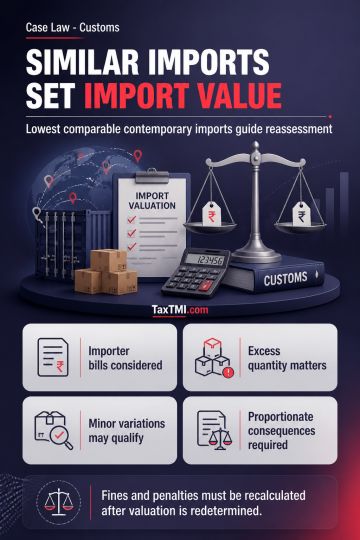
Customs valuation must use comparable contemporary imports, while confiscation fines and penalties require proportionate recalculation on reassessed v...
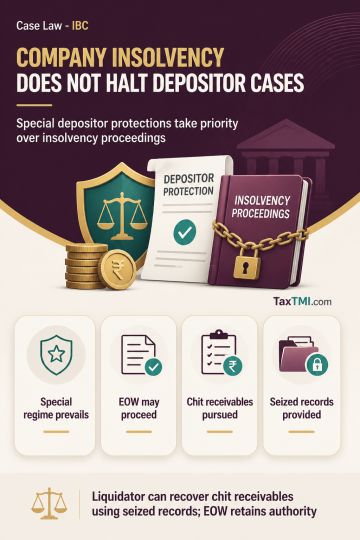
Depositor-protection proceedings prevail over corporate insolvency, while liquidators may recover chit receivables using copies of seized company reco...
Trade receivables under TNMM were treated as integral to the international transactions, so a separate notional interest adjustment was deleted where working capital adjustment had already captured the receivables impact and no distinct financing arrangement was shown. Goodwill arising on amalgamation was accepted as a depreciable acquired intangible, and depreciation was allowed. Product registration and regulatory approval were held to be revenue in nature because they facilitated existing business operations rather than creating a capital asset. For section 80-IC, the Tribunal upheld full deduction on manufacturing profits without hypothetical brand-royalty allocation, included scrap income as derived from manufacturing, and confirmed 100% deduction after substantial expansion in line with Aarham Softronics.
Trade receivables under TNMM were treated as integral to the international transactions, so a separate notional interest adjustment was deleted where working capital adjustment had already captured the receivables impact and no distinct financing arrangement was shown. Goodwill arising on amalgamation was accepted as a depreciable acquired intangible, and depreciation was allowed. Product registration and regulatory approval were held to be revenue in nature because they facilitated existing business operations rather than creating a capital asset. For section 80-IC, the Tribunal upheld full deduction on manufacturing profits without hypothetical brand-royalty allocation, included scrap income as derived from manufacturing, and confirmed 100% deduction after substantial expansion in line with Aarham Softronics.
Note: It is a system-generated summary and is for quick reference only.
 TaxTMI
  TaxTMI
 of 4811






 Join Channel


