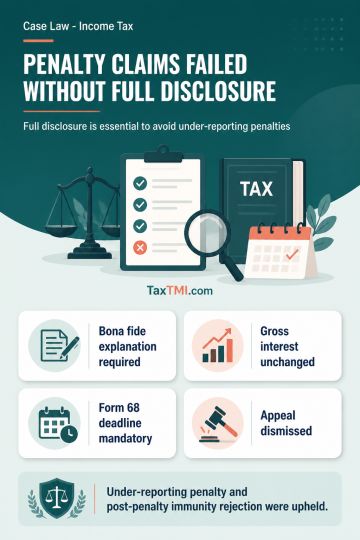
Bona fide disclosure requirements govern under-reporting penalties, and post-penalty immunity applications cannot secure available statutory protectio...
Certificate-of-origin verification procedure governs preferential customs benefits; denial without retroactive verification was set aside with consequ...
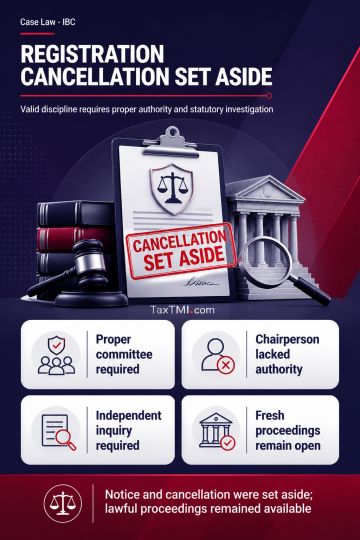
Disciplinary Committee jurisdiction and mandatory investigation requirements invalidated cancellation of an insolvency professional's registration and...
Reopening notices for years before AY 2021-22 could be issued after the 01.04.2021 amendment only if the pre-existing six-year limitation under section 149 was still alive on the date of notice. Applying the principle in UOI v. Rajiv Bansal and following Sridhar Lokesh, the Tribunal held that the first proviso bars retrospective use of the extended ten-year period; for AY 2015-16, the outer limit expired on 31.03.2022, so a notice issued on 01.04.2022 was time-barred. It further held that exclusion of time spent in section 148A proceedings could not revive a notice already barred under the first proviso. The reassessment was quashed and the additions were deleted.
Reopening notices for years before AY 2021-22 could be issued after the 01.04.2021 amendment only if the pre-existing six-year limitation under section 149 was still alive on the date of notice. Applying the principle in UOI v. Rajiv Bansal and following Sridhar Lokesh, the Tribunal held that the first proviso bars retrospective use of the extended ten-year period; for AY 2015-16, the outer limit expired on 31.03.2022, so a notice issued on 01.04.2022 was time-barred. It further held that exclusion of time spent in section 148A proceedings could not revive a notice already barred under the first proviso. The reassessment was quashed and the additions were deleted.
Note: It is a system-generated summary and is for quick reference only.
 TaxTMI
 of 4805









 Join Channel


 TaxTMI
