Captive power transfer pricing and non-resident export commission rules support deletion of adjustments and withholding disallowance in discussed proc...
Cooperative society deposits, member-interest TDS exemption and credit-facility deduction claims require verification through records and supporting e...
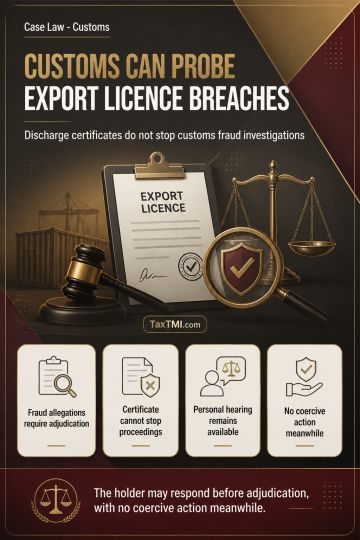
Customs jurisdiction over EPCG condition breaches survives export-obligation discharge certificates, requiring alleged fraud and misdeclaration to be ...
Page of 4811
Press 'Enter' after typing page number.
981 to 1000 of 96208 Results
❮
❯
❯❯
0 / 200
Expand Note
Add to Folder
No Folders have been created
+
Are you sure you want to delete "My most important" ?
Duty-free import benefit for a 100% EOU was denied because export of serpentine products did not satisfy the condition attached to imported marble blocks, as serpentine marble and marble were not similar goods; customs duty was therefore payable on the imports. The extended period of limitation was set aside because the department knew of the imports, exports and DTA clearances, so suppression with intent to evade duty was not proved, and a B-17 bond did not remove the normal limitation rules. Cutting marble blocks into slabs or tiles during the relevant period was held not to amount to manufacture, so the central excise demand failed. Excise duty already paid on DTA clearances was allowed to be adjusted against the surviving customs demand, and confiscation, redemption fine and penalties were set aside.
Duty-free import benefit for a 100% EOU was denied because export of serpentine products did not satisfy the condition attached to imported marble blocks, as serpentine marble and marble were not similar goods; customs duty was therefore payable on the imports. The extended period of limitation was set aside because the department knew of the imports, exports and DTA clearances, so suppression with intent to evade duty was not proved, and a B-17 bond did not remove the normal limitation rules. Cutting marble blocks into slabs or tiles during the relevant period was held not to amount to manufacture, so the central excise demand failed. Excise duty already paid on DTA clearances was allowed to be adjusted against the surviving customs demand, and confiscation, redemption fine and penalties were set aside.
Note: It is a system-generated summary and is for quick reference only.
 TaxTMI
  TaxTMI
 of 4811
















 Join Channel