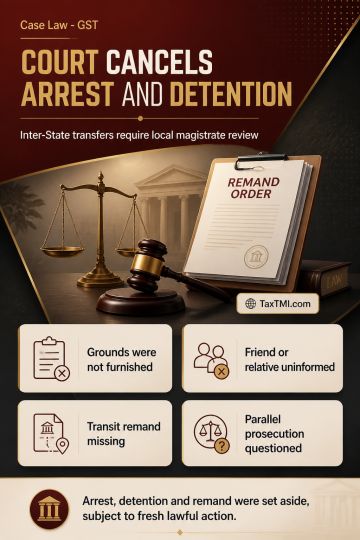
Arrest safeguards and transit remand requirements invalidated detention following inter-State transfer without communicated grounds or magistrate auth...
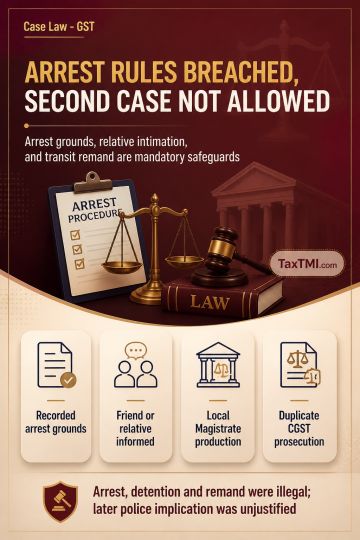
Arrest safeguards require disclosed grounds, relative intimation and transit remand, while duplicate prosecution under the CGST framework is unsustain...
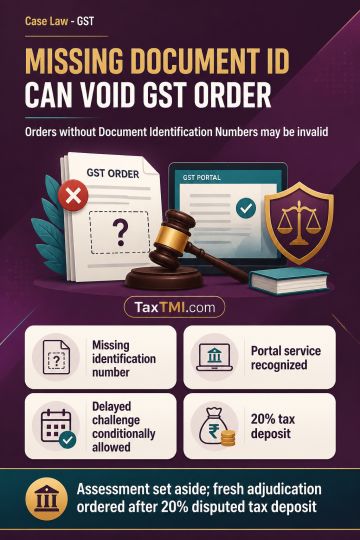
Document Identification Number defects can invalidate GST assessments, with delayed challenges entertained conditionally where patent irregularities e...
Windmill commissioning evidence supported higher depreciation where grid connection and electricity generation proved operational use before the relev...
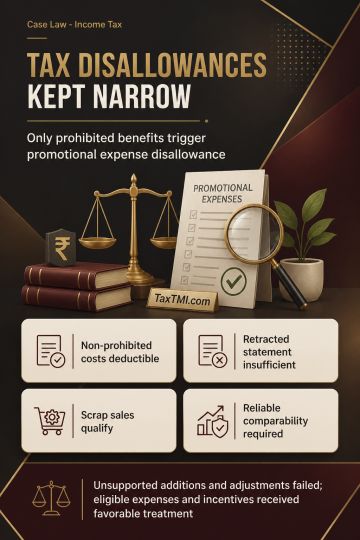
Pharmaceutical promotion and transfer-pricing comparability principles limited disallowances, while uncorroborated search allegations and unsupported ...
ITAT held that disallowance of depreciation on a disclosed block...
Depreciation and routine compliance expenses disallowance did not prove inaccurate particulars or misreporting; penalty sustained only on foreign travel.
Contents
Summary
Note
Bookmark
Share
✓ Copied successfully !
Print
Print Options
For full text, please login
Login to TaxTMI
Verification Pending
The Email Id has not been verified. Click on the link we have sent on
ITAT held that disallowance of depreciation on a disclosed block of assets did not, by itself, establish furnishing of inaccurate particulars or misreporting, because the claim was grounded in the books and the issue was one of allowability. Penalty was therefore deleted on depreciation, but sustained for foreign travelling expenses in A.Y. 2015-16 because no business activity or nexus was shown. For A.Ys. 2016-17, 2017-18 and 2018-19, penalties under section 271(1)(c) and section 270A were deleted, as routine compliance and administrative expenses, and a write-off, were not shown to be fictitious, bogus or based on suppressed facts; ad hoc or inadequate substantiation disallowed in quantum was insufficient to prove concealment.
ITAT held that disallowance of depreciation on a disclosed block of assets did not, by itself, establish furnishing of inaccurate particulars or misreporting, because the claim was grounded in the books and the issue was one of allowability. Penalty was therefore deleted on depreciation, but sustained for foreign travelling expenses in A.Y. 2015-16 because no business activity or nexus was shown. For A.Ys. 2016-17, 2017-18 and 2018-19, penalties under section 271(1)(c) and section 270A were deleted, as routine compliance and administrative expenses, and a write-off, were not shown to be fictitious, bogus or based on suppressed facts; ad hoc or inadequate substantiation disallowed in quantum was insufficient to prove concealment.
Note: It is a system-generated summary and is for quick reference only.
 TaxTMI
  TaxTMI
 of 4809












 Join Channel