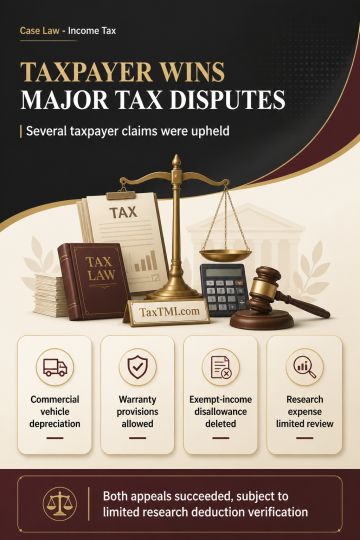
Commercial vehicle depreciation, scientifically determined warranty provisions and exempt-income disallowances were resolved in favour of the taxpayer...
Inherited property sale proceeds require capital-gains treatment where ownership is supported by evidence, not suspicion or unverified signature doubt...
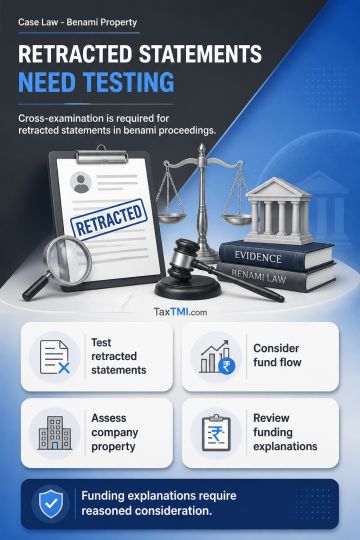
Cross-examination of retracted statements is essential where foundational evidence supports a benami allegation and documented funding explanations re...
Capital-goods exemption covers plant-modernisation accessories, while the import restriction applies only to earlier capital-goods components and spar...
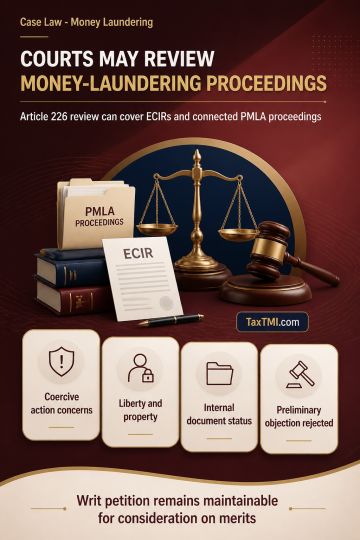
Constitutional judicial review permits challenges to ECIRs and connected money-laundering proceedings where coercive action affects fundamental intere...
ITAT held that disallowance of depreciation on a disclosed block...
Depreciation and routine compliance expenses disallowance did not prove inaccurate particulars or misreporting; penalty sustained only on foreign travel.
Contents
Summary
Note
Bookmark
Share
✓ Copied successfully !
Print
Print Options
For full text, please login
Login to TaxTMI
Verification Pending
The Email Id has not been verified. Click on the link we have sent on
ITAT held that disallowance of depreciation on a disclosed block of assets did not, by itself, establish furnishing of inaccurate particulars or misreporting, because the claim was grounded in the books and the issue was one of allowability. Penalty was therefore deleted on depreciation, but sustained for foreign travelling expenses in A.Y. 2015-16 because no business activity or nexus was shown. For A.Ys. 2016-17, 2017-18 and 2018-19, penalties under section 271(1)(c) and section 270A were deleted, as routine compliance and administrative expenses, and a write-off, were not shown to be fictitious, bogus or based on suppressed facts; ad hoc or inadequate substantiation disallowed in quantum was insufficient to prove concealment.
ITAT held that disallowance of depreciation on a disclosed block of assets did not, by itself, establish furnishing of inaccurate particulars or misreporting, because the claim was grounded in the books and the issue was one of allowability. Penalty was therefore deleted on depreciation, but sustained for foreign travelling expenses in A.Y. 2015-16 because no business activity or nexus was shown. For A.Ys. 2016-17, 2017-18 and 2018-19, penalties under section 271(1)(c) and section 270A were deleted, as routine compliance and administrative expenses, and a write-off, were not shown to be fictitious, bogus or based on suppressed facts; ad hoc or inadequate substantiation disallowed in quantum was insufficient to prove concealment.
Note: It is a system-generated summary and is for quick reference only.
 TaxTMI
  TaxTMI
 of 4813















 Join Channel


