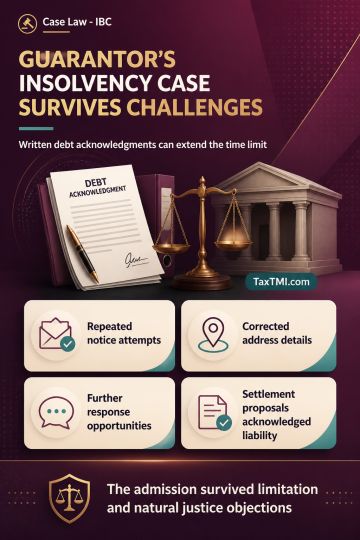
Service of notice and contractual debt acknowledgment preserved insolvency admission against a corporate guarantor despite limitation and natural just...
Original works exemption excludes standalone boulder transportation, leaving subcontracted railway-project transport services subject to service tax l...
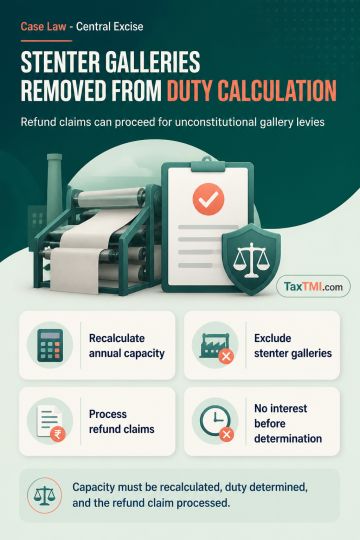
Annual production capacity determinations excluding stenter galleries support refunds for unconstitutional excise levies without an unjust-enrichment ...
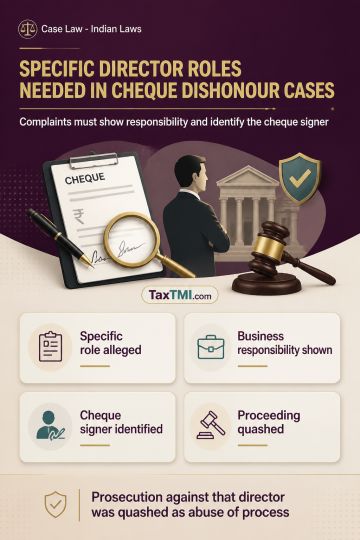
Vicarious liability for cheque dishonour requires specific allegations of responsibility and cheque signatory; generic director allegations cannot sus...
IT Resilience Index requires market infrastructure institutions to automate resilience scoring, early warnings, and continuous service-delivery monito...
A High Court held that the second proviso to Rule 30(9) of the Companies (Incorporation) Rules, 2014 imposes a strict bar on shifting a company's registered office where an appeal against the approved resolution plan is pending, and that Section 238 of the IBC does not override this restriction. The Court read the proviso as creating an independent threshold, found the Regional Director acted beyond jurisdiction in permitting the shift, and set aside the Regional Director's order as well as the Single Judge's order. It also held that the appellants could maintain the writ petition because they were heard in the proceedings, were aggrieved by the impugned order, and had no efficacious alternative remedy.
A High Court held that the second proviso to Rule 30(9) of the Companies (Incorporation) Rules, 2014 imposes a strict bar on shifting a company's registered office where an appeal against the approved resolution plan is pending, and that Section 238 of the IBC does not override this restriction. The Court read the proviso as creating an independent threshold, found the Regional Director acted beyond jurisdiction in permitting the shift, and set aside the Regional Director's order as well as the Single Judge's order. It also held that the appellants could maintain the writ petition because they were heard in the proceedings, were aggrieved by the impugned order, and had no efficacious alternative remedy.
Note: It is a system-generated summary and is for quick reference only.
 TaxTMI
  TaxTMI
 of 4817












 Join Channel