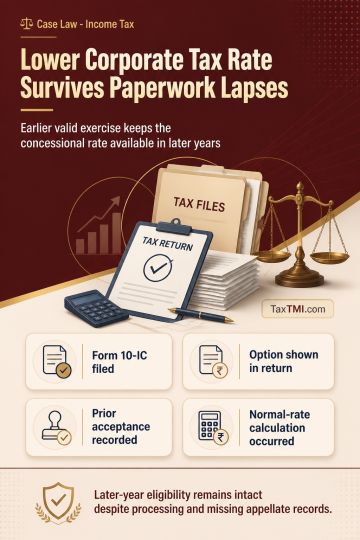
Concessional corporate tax option under section 115BAA survives procedural documentary lapses when statutory compliance and earlier exercise are estab...
Penny-stock additions require transaction-specific evidence; general investigation material alone cannot establish undisclosed income or accommodation...
Transfer pricing comparability prioritises reliable external CUPs and foreign-currency LIBOR benchmarks for exports, borrowings and delayed receivable...
Section 153C satisfaction and seized electronic records sustained unexplained-investment addition, subject to proportionate ownership-share verificati...
A habeas corpus petition challenging arrest and detention...
Habeas corpus challenge to arrest safeguards remains maintainable, but substantial compliance with reasons-to-believe requirement defeats the petition.
Contents
Summary
Note
Bookmark
Share
✓ Copied successfully !
Print
Print Options
For full text, please login
Login to TaxTMI
Verification Pending
The Email Id has not been verified. Click on the link we have sent on
A habeas corpus petition challenging arrest and detention remained maintainable despite a judicial remand order where the grievance was breach of a mandatory statutory arrest safeguard affecting personal liberty. The Court held that while a remand order is not ordinarily assailable on merits by habeas corpus, the writ can be invoked to test whether arrest complied with the statutory precondition of recording reasons to believe. On the merits, the Court found that the competent authority had recorded the reasons, authorised arrest, and supplied them in substance to the arrestee; no rule required a verbatim signed copy. The challenge to arrest and custody was therefore rejected.
A habeas corpus petition challenging arrest and detention remained maintainable despite a judicial remand order where the grievance was breach of a mandatory statutory arrest safeguard affecting personal liberty. The Court held that while a remand order is not ordinarily assailable on merits by habeas corpus, the writ can be invoked to test whether arrest complied with the statutory precondition of recording reasons to believe. On the merits, the Court found that the competent authority had recorded the reasons, authorised arrest, and supplied them in substance to the arrestee; no rule required a verbatim signed copy. The challenge to arrest and custody was therefore rejected.
Note: It is a system-generated summary and is for quick reference only.
 TaxTMI
  TaxTMI
 of 4816












 Join Channel


