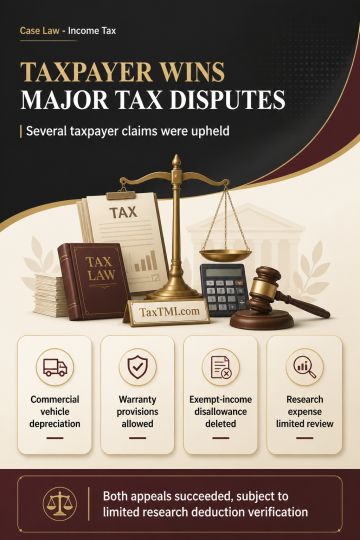
Commercial vehicle depreciation, scientifically determined warranty provisions and exempt-income disallowances were resolved in favour of the taxpayer...
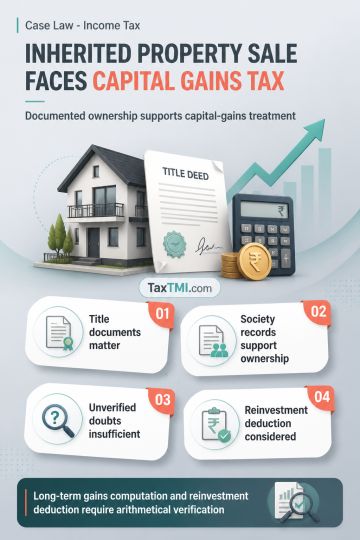
Inherited property sale proceeds require capital-gains treatment where ownership is supported by evidence, not suspicion or unverified signature doubt...
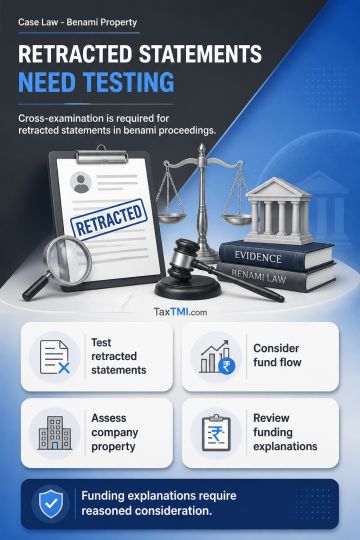
Cross-examination of retracted statements is essential where foundational evidence supports a benami allegation and documented funding explanations re...
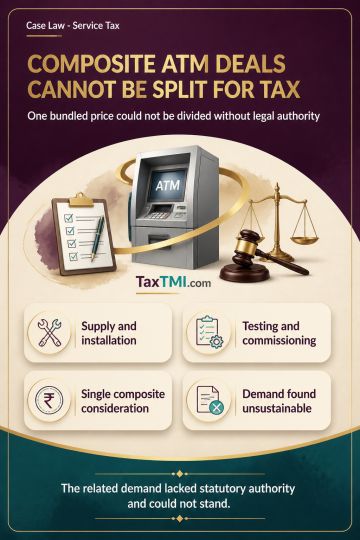
Capital-goods exemption covers plant-modernisation accessories, while the import restriction applies only to earlier capital-goods components and spar...
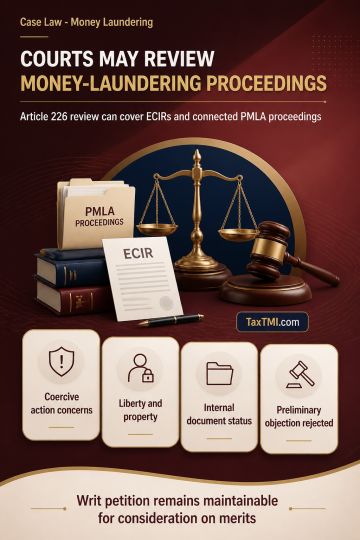
Constitutional judicial review permits challenges to ECIRs and connected money-laundering proceedings where coercive action affects fundamental intere...
The High Court held that the Bright Line Test could not be adopted for transfer pricing because it is not provided under the Income-tax Act, 1961 or the Rules and is alien to the statutory scheme; the proposed question was rejected. It also declined to entertain the royalty adjustment questions, noting that the need for any transfer pricing adjustment, the computation method, and the arm's length price had already been decided in the assessee's own cases, with no contrary Supreme Court ruling shown. The exclusion of Febulka Advertising Pvt. Ltd. as a comparable was treated as a factual finding based on its different business and incomplete public data, beyond interference under section 260A. The appeal was dismissed.
The High Court held that the Bright Line Test could not be adopted for transfer pricing because it is not provided under the Income-tax Act, 1961 or the Rules and is alien to the statutory scheme; the proposed question was rejected. It also declined to entertain the royalty adjustment questions, noting that the need for any transfer pricing adjustment, the computation method, and the arm's length price had already been decided in the assessee's own cases, with no contrary Supreme Court ruling shown. The exclusion of Febulka Advertising Pvt. Ltd. as a comparable was treated as a factual finding based on its different business and incomplete public data, beyond interference under section 260A. The appeal was dismissed.
Note: It is a system-generated summary and is for quick reference only.
 TaxTMI
  TaxTMI
 of 4813








 Join Channel


