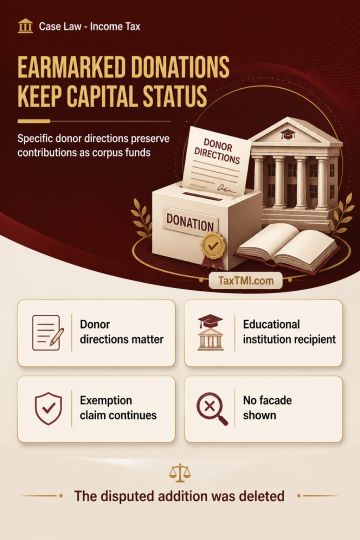
Donor-directed corpus contributions retain capital character despite exemption claims under section 10(23C)(vi), preventing their treatment as taxable...
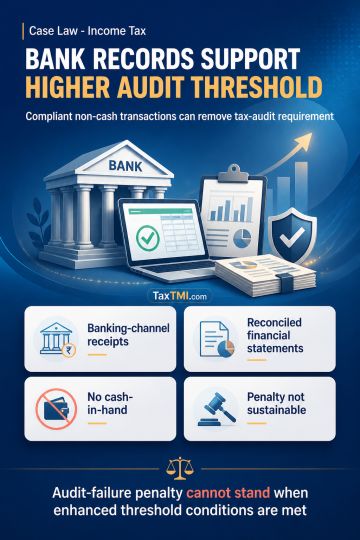
Enhanced tax-audit threshold applies where banking records establish compliant non-cash receipts and payments, eliminating penalty exposure for audit ...
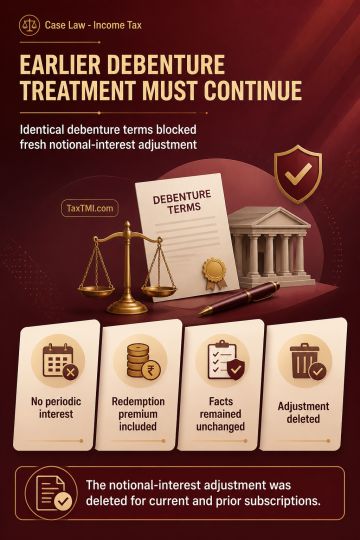
Transfer pricing consistency protects identical non-interest-bearing debenture terms from a later notional-interest adjustment without valid statutory...
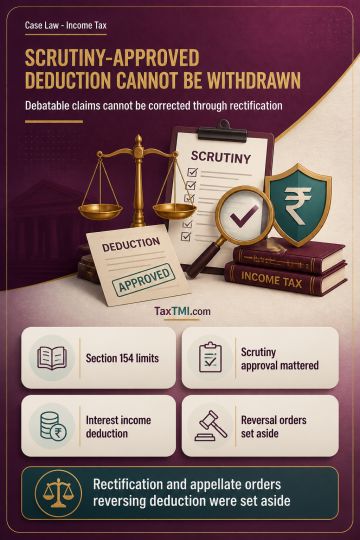
Rectification of debatable deduction claims cannot reverse scrutiny-approved co-operative society interest income deductions as apparent record errors...
Cash-method accounting bars presumptive interest taxation, while unsupported securities and share-trading additions require reliable material and veri...
The High Court held that the Bright Line Test could not be adopted for transfer pricing because it is not provided under the Income-tax Act, 1961 or the Rules and is alien to the statutory scheme; the proposed question was rejected. It also declined to entertain the royalty adjustment questions, noting that the need for any transfer pricing adjustment, the computation method, and the arm's length price had already been decided in the assessee's own cases, with no contrary Supreme Court ruling shown. The exclusion of Febulka Advertising Pvt. Ltd. as a comparable was treated as a factual finding based on its different business and incomplete public data, beyond interference under section 260A. The appeal was dismissed.
The High Court held that the Bright Line Test could not be adopted for transfer pricing because it is not provided under the Income-tax Act, 1961 or the Rules and is alien to the statutory scheme; the proposed question was rejected. It also declined to entertain the royalty adjustment questions, noting that the need for any transfer pricing adjustment, the computation method, and the arm's length price had already been decided in the assessee's own cases, with no contrary Supreme Court ruling shown. The exclusion of Febulka Advertising Pvt. Ltd. as a comparable was treated as a factual finding based on its different business and incomplete public data, beyond interference under section 260A. The appeal was dismissed.
Note: It is a system-generated summary and is for quick reference only.
 TaxTMI
  TaxTMI
 of 4817










 Join Channel