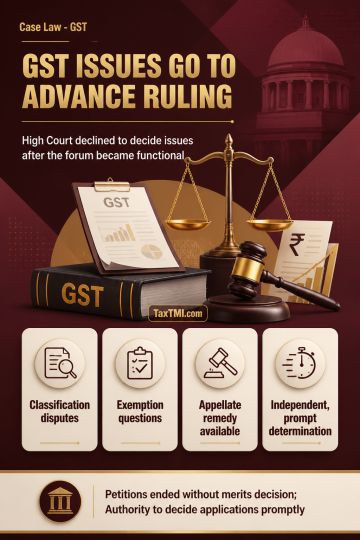
Advance-ruling mechanism governs pending GST classification, exemption and taxability disputes, limiting writ review once the specialised forum functi...
Charitable trust income application permits verified capital expenditure but rejects deferred pre-operative claims and requires reconsideration of con...
Reinsurance premium deductions require established regulatory breaches, while independently acquired software qualifies within the computer depreciati...
Under the amended reassessment regime, the High Court held that capital gains from the property transfer had to be computed with the stamp duty valuation under Sections 148, 149, 50C and 48. Because the petitioner's one-fourth share, valued on that basis, exceeded the statutory threshold of fifty lakh rupees, the extended limitation period applied and the Section 148A(d) order and consequential Section 148 notice were not without jurisdiction. The Court also held that the complaint that the written reply was not considered did not alter the result once limitation was decided against the petitioner. The writ petition was dismissed and assessment was directed to proceed, excluding the period spent before the Court for limitation purposes.
Under the amended reassessment regime, the High Court held that capital gains from the property transfer had to be computed with the stamp duty valuation under Sections 148, 149, 50C and 48. Because the petitioner's one-fourth share, valued on that basis, exceeded the statutory threshold of fifty lakh rupees, the extended limitation period applied and the Section 148A(d) order and consequential Section 148 notice were not without jurisdiction. The Court also held that the complaint that the written reply was not considered did not alter the result once limitation was decided against the petitioner. The writ petition was dismissed and assessment was directed to proceed, excluding the period spent before the Court for limitation purposes.
Note: It is a system-generated summary and is for quick reference only.
 TaxTMI
  TaxTMI
 of 4809















 Join Channel


