Commercial vehicle depreciation, scientifically determined warranty provisions and exempt-income disallowances were resolved in favour of the taxpayer...
Inherited property sale proceeds require capital-gains treatment where ownership is supported by evidence, not suspicion or unverified signature doubt...
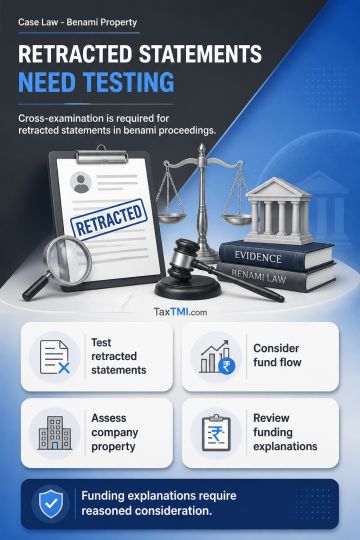
Cross-examination of retracted statements is essential where foundational evidence supports a benami allegation and documented funding explanations re...
Under the amended reassessment regime, the High Court held that capital gains from the property transfer had to be computed with the stamp duty valuation under Sections 148, 149, 50C and 48. Because the petitioner's one-fourth share, valued on that basis, exceeded the statutory threshold of fifty lakh rupees, the extended limitation period applied and the Section 148A(d) order and consequential Section 148 notice were not without jurisdiction. The Court also held that the complaint that the written reply was not considered did not alter the result once limitation was decided against the petitioner. The writ petition was dismissed and assessment was directed to proceed, excluding the period spent before the Court for limitation purposes.
Under the amended reassessment regime, the High Court held that capital gains from the property transfer had to be computed with the stamp duty valuation under Sections 148, 149, 50C and 48. Because the petitioner's one-fourth share, valued on that basis, exceeded the statutory threshold of fifty lakh rupees, the extended limitation period applied and the Section 148A(d) order and consequential Section 148 notice were not without jurisdiction. The Court also held that the complaint that the written reply was not considered did not alter the result once limitation was decided against the petitioner. The writ petition was dismissed and assessment was directed to proceed, excluding the period spent before the Court for limitation purposes.
Note: It is a system-generated summary and is for quick reference only.
 TaxTMI
  TaxTMI
 of 4811












 Join Channel